


Most guides to Google Ads for tour operators start by asking what a booking is worth. That is the wrong opening question, and it leads to budgets that are far too small.
You are not, in most cases, buying a booking that would otherwise never have happened. That traveler was going to find a kayak tour in your harbor. The large activity marketplaces have already made sure of it. What you are buying is the same booking arriving through a channel that does not take a cut.
So the number that sets your budget is not your margin on a tour. It is the commission you avoid by getting there first. Once you price the ad against that, a click that looked expensive turns out to be one of the cheapest things you buy all season.
Your real competitor is a reseller of your own product
Search for almost any tour in almost any destination and the paid results are dominated by marketplaces listing operators, not by the operators themselves.
That is a strange auction to be in. The marketplace bidding above you is selling your tour, on your dates, at your price, and taking a percentage for the introduction. They can outbid you because they are amortizing that click across every operator in the harbor while you are amortizing it across one.
You will not win that fight on budget. You do not need to. You need to win the searches where the traveler has already decided which operator they want, and to be visible on the ones where they have decided what they want to do but not who with.
There is a version of this that is genuinely additive, and it is worth separating out. If you sell a private charter, a corporate day, a multi-day itinerary or anything custom, the marketplaces mostly do not carry it. That demand is not being intermediated. It is just not being captured, and search ads are one of the few ways to reach it.

A traveler with a backpack standing alone on a garden path in front of a white marble monument.
Work out what a direct booking is actually worth
Take your marketplace commission rate, multiply it by your average booking value, and that is the extra money a direct booking puts in your account. It is also your allowable cost per acquisition, before you have touched margin.
Nobody can quote you a standard rate here, and the reason is worth knowing: the major marketplaces do not publish rate cards for operators. Terms are negotiated individually and vary by country, product type and volume. So use your actual number, not a figure from an article.
The arithmetic, using $250 as an average booking and 25 percent as a placeholder for your real rate:
| Through a marketplace | Direct | |
|---|---|---|
| Booking value | $250 | $250 |
| Commission | $62.50 | $0 |
| You receive | $187.50 | $250 |
| Difference | **$62.50** |
That $62.50 is what a direct booking is worth over the same booking sold through a marketplace. At a $2.14 cost per click, you could spend 29 clicks acquiring it and still break even against the intermediated version.
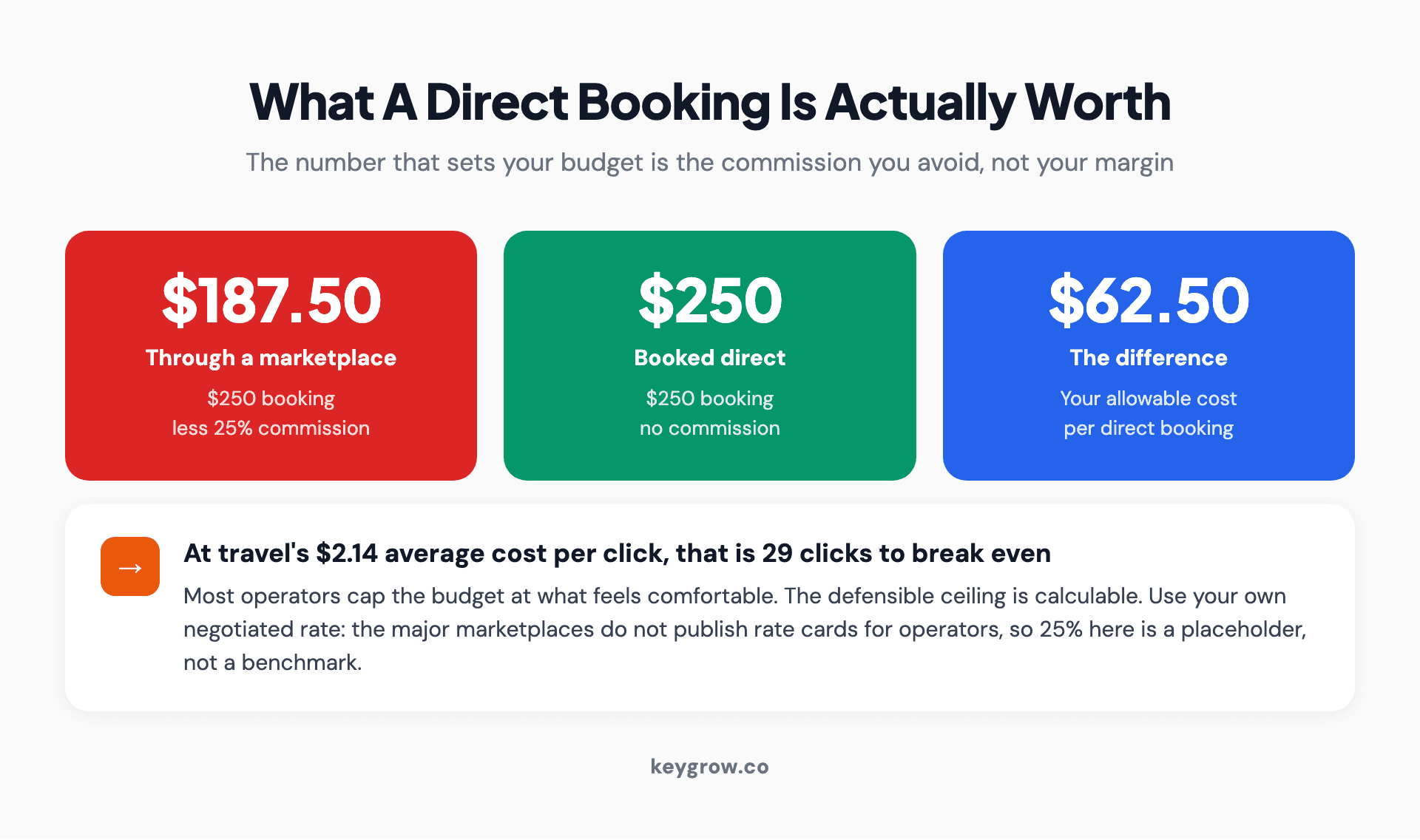
Three stat cards comparing a $250 tour booking sold through a marketplace at 25 percent commission against the same booking taken direct, leaving a $62.50 difference as the allowable cost per direct booking.
Read that again, because it is the whole argument. Most operators cap their ad budget somewhere around what feels comfortable. The defensible ceiling is considerably higher, and it is calculable rather than a matter of nerve.
Two honest caveats. First, some share of your direct bookings would have come to you anyway, so the true incremental value is lower than the full commission. Second, marketplace listings do genuine discovery work for you, particularly with travelers who have never heard of your destination. The goal is a better channel mix, not zero marketplace volume.
Travel buys the cheapest clicks in search
At $2.14, travel has the lowest average cost per click of any industry in WordStream's 2026 benchmarks, against a $5.42 all-industry average. It also has the highest click-through rate at 9.32 percent.
Then it converts at 5.83 percent, against an 8.18 percent average.
| Metric | Travel | All industries |
|---|---|---|
| Cost per click | $2.14 | $5.42 |
| Click-through rate | 9.32% | 6.64% |
| Conversion rate | 5.83% | 8.18% |
| Cost per lead | $44.70 | $66.69 |
This is the trap in the category, and it is worth naming plainly because it produces the most misleading reports in marketing. A travel account generates enormous click volume at a low price with a click-through rate that looks like a triumph. Screenshot the top of that report and it reads like a campaign working brilliantly.
Vanity-metric reporting is the industry's biggest scam, and travel is where it is easiest to get away with. Impressions and clicks do not pay for a boat. If your monthly report opens with click-through rate rather than direct bookings and revenue, ask why. The 5.83 percent conversion rate is the number that decides whether any of it mattered.
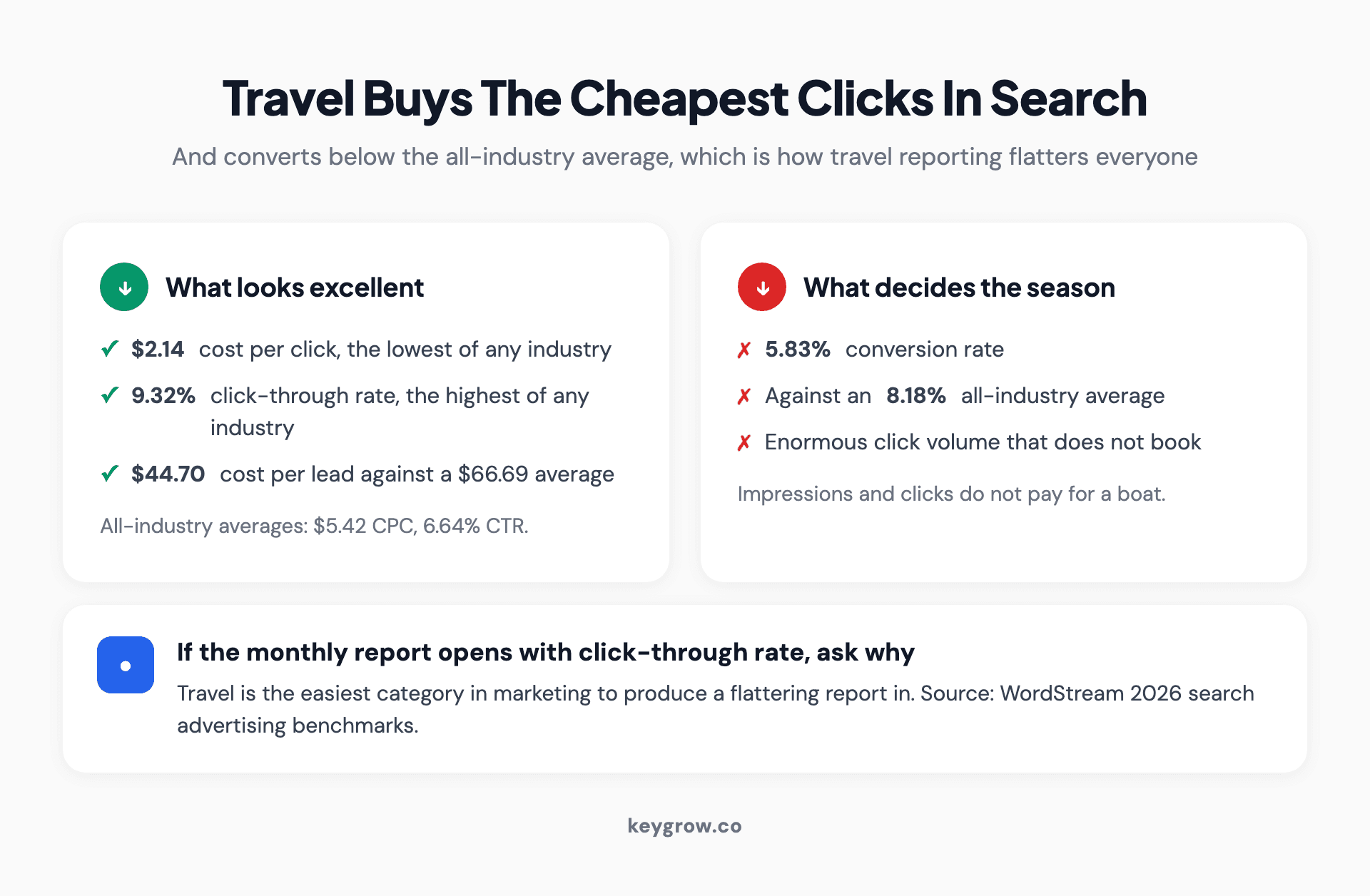
Two-column card layout contrasting travel's flattering metrics, a $2.14 cost per click and 9.32 percent click-through rate, against its 5.83 percent conversion rate versus an 8.18 percent all-industry average.
Things to do is the placement most operators have not switched on
Google has a placement built specifically for tours and attractions, and it does not run off your keyword campaigns. It runs off a product feed.
According to Google's documentation, Things to do campaigns let you bid for placements that appear when a traveler searches for experiences, activities and local attractions, and the ads show on both Search and Maps with photos, prices and a booking link.
To run them you need three things:
- A Things to do product feed carrying your product information
- Either an approved connectivity partner or your own feed, built to Google's specification
- A Google Ads account connected to that product data
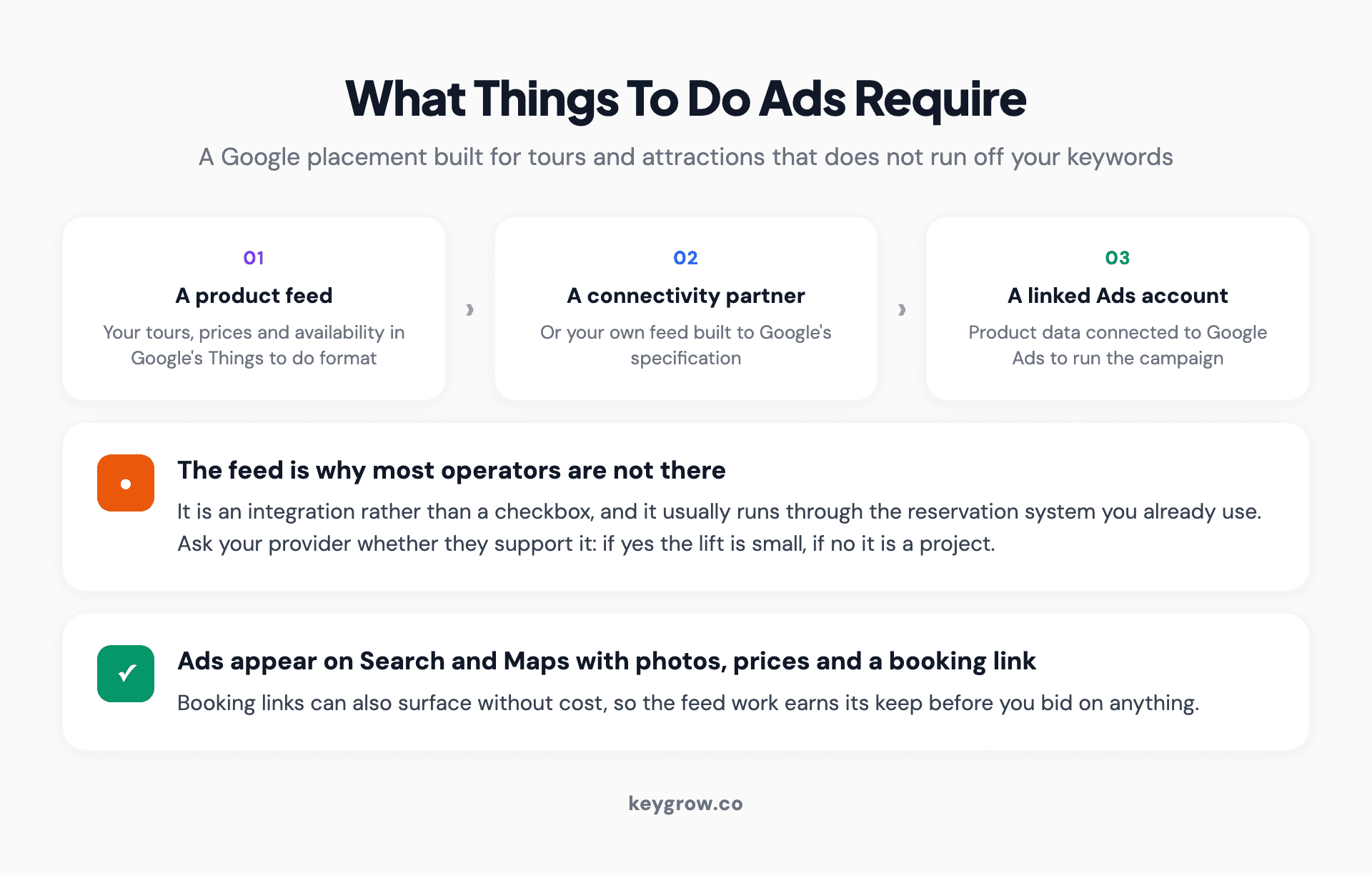
Three-step flow showing what Google Things to do ads require: a product feed, a connectivity partner or self-built feed, and a linked Google Ads account.
That feed requirement is the reason most operators are not there. It is not a checkbox inside your existing account, it is an integration, and it usually runs through whichever reservation system you already use. The practical first step is asking your reservation provider whether they support it, because if they do the lift is small and if they do not it is a project.
Worth knowing alongside the paid version: booking links can also appear without cost, which makes the feed work useful even before you bid on anything.
The gap between the click and the trip breaks most reporting
Someone clicks in February and travels in July. Almost nothing in a default Google Ads setup handles that well, and it is the single most common reason an operator concludes their ads do not work.
Three specific failures come out of it:
You judge too early. A campaign launched in January selling summer departures will look dreadful in January. The bookings for that spend land over the following weeks and months. Six weeks is the minimum before the picture means anything, and for a long-lead product it is longer.
Your attribution window is too short. If a traveler researches for three weeks before booking, a 30-day click window is tight and a shorter one is losing conversions you paid for. Widen it to match how long your customers actually take, which your reservation data can tell you.
Your conversion value is a flat number. A two-hour walking tour and a six-person private charter should not both count as "1 booking". Send the actual transaction value back to Google Ads, because otherwise the bidding will optimize toward whichever booking is easiest to get, and the easiest booking is always the smallest one.
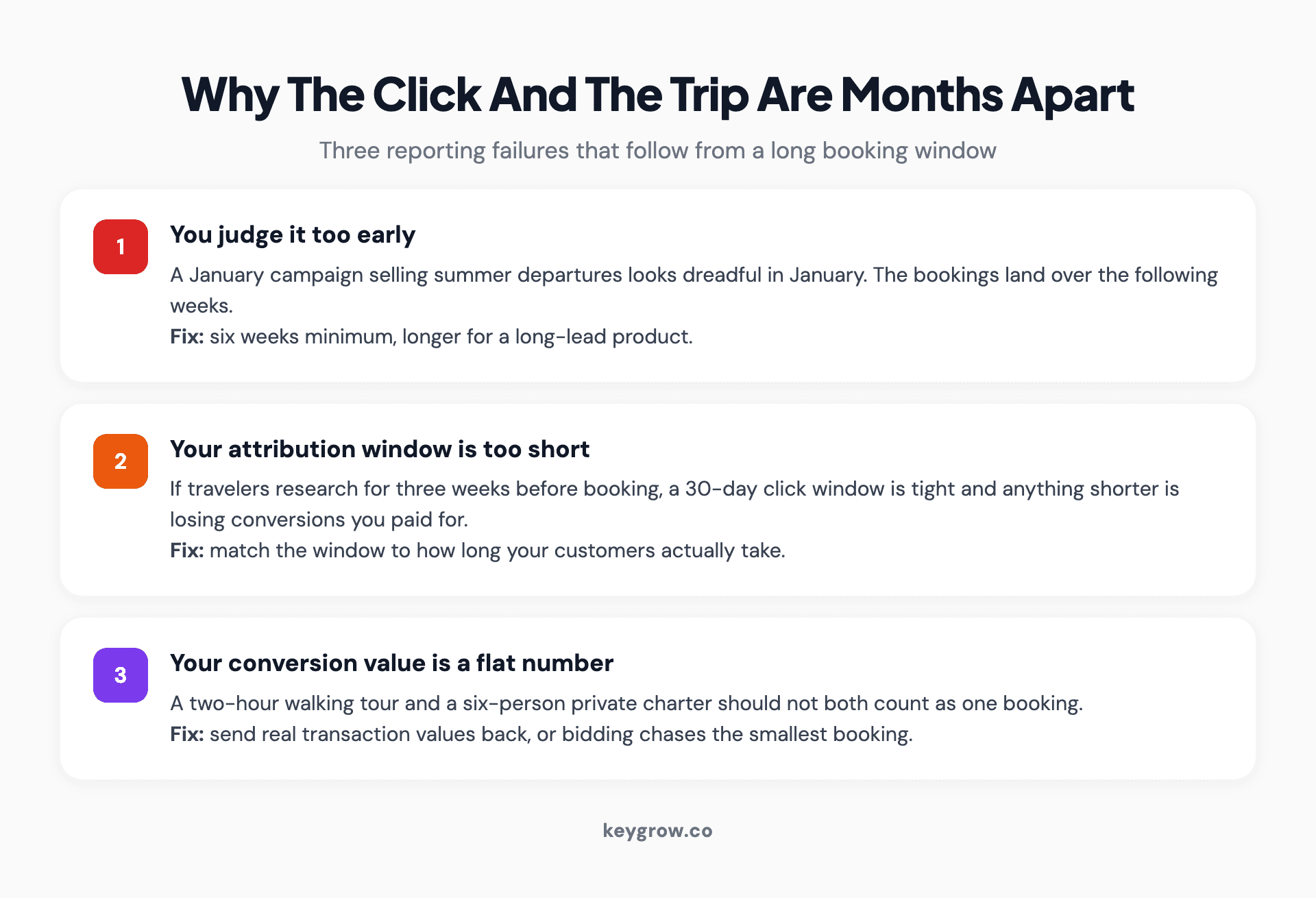
Three numbered cards explaining why a long booking window breaks tour operator reporting: judging too early, an attribution window that is too short, and a flat conversion value.
Build the account around the calendar, not the tour list
Most operators structure campaigns by product. Structure by season instead, because that is what actually changes your economics.
A tour business has three distinct commercial situations in a year, and they need different accounts, not different bids:
- Peak. You may be at or near capacity. Advertising into a sold-out week is spending money to turn away customers. Either pause, or shift spend to the products and dates that are not full.
- Shoulder. This is where the budget belongs. Demand exists, capacity exists, and the marketplaces are competing less hard than they do in peak.
- Booking season. The weeks when people plan rather than travel, which for most seasonal products sits months ahead of the season itself. Spend here is the cheapest of the year and the slowest to prove itself.
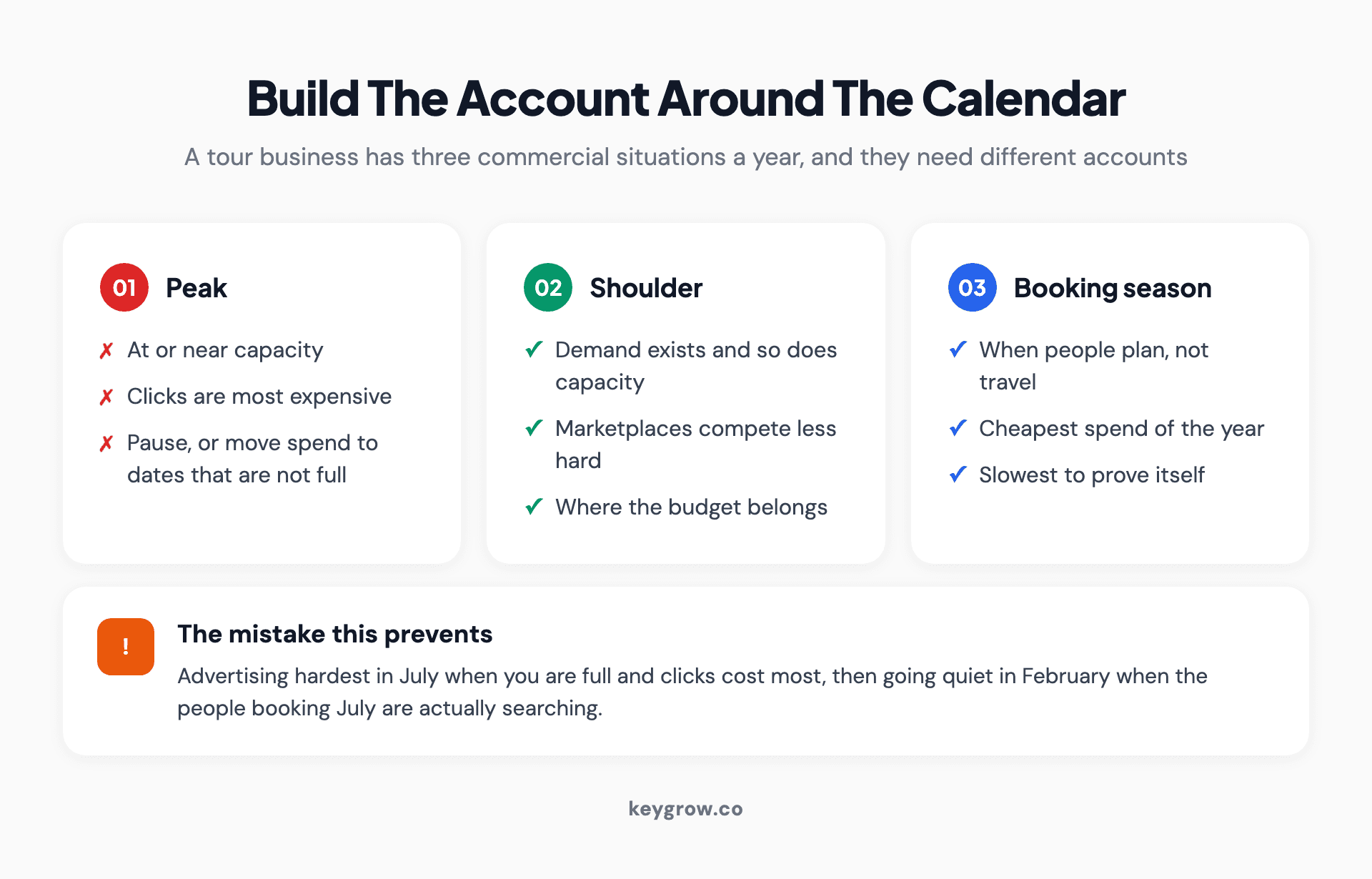
Three cards covering the commercial seasons of a tour business: peak when capacity is full, shoulder where the budget belongs, and booking season when people plan rather than travel.
The mistake this prevents is the common one: an operator who advertises hardest in July, when they are full and clicks are most expensive, and goes quiet in February, when the people booking July are actually searching.
Capacity is a genuine constraint in this business, and unlike most industries it varies week to week rather than in total. Your budget should follow your open seats, at the level of a specific date, not your enthusiasm.

A group of hikers with backpacks laughing together on a trail below jagged mountain peaks.
Which searches to buy
Buy the searches where the traveler has named a destination and an activity. Those are the ones that convert, and they are cheaper than the generic travel terms sitting above them.
Worth buying:
- Activity plus destination. "Sunset sailing charleston", "kayak tour san juan islands". This is the core of the account.
- Your own brand. Cheap, and the marketplaces selling your tours will bid on it if you do not. This is the highest-return spend in a tour account and the one operators most often skip on principle.
- Private, custom and group variants. The demand marketplaces do not serve well, and usually the highest booking value you sell.
- Nearby-attraction terms, where you are genuinely the thing people do next.
Worth blocking from the first day: *free, jobs, cheap, discount code, promo code, coupon,* anything to do with weather or maps, and every general travel term like "things to do in [city]" unless you have specifically funded the discovery experiment and are watching it. That last group is where tour budgets vanish. The traffic is enormous, the click-through rate is flattering, and almost none of it books. Our method for negative keywords applies as written, but the discipline needs to be tighter here than almost anywhere else.
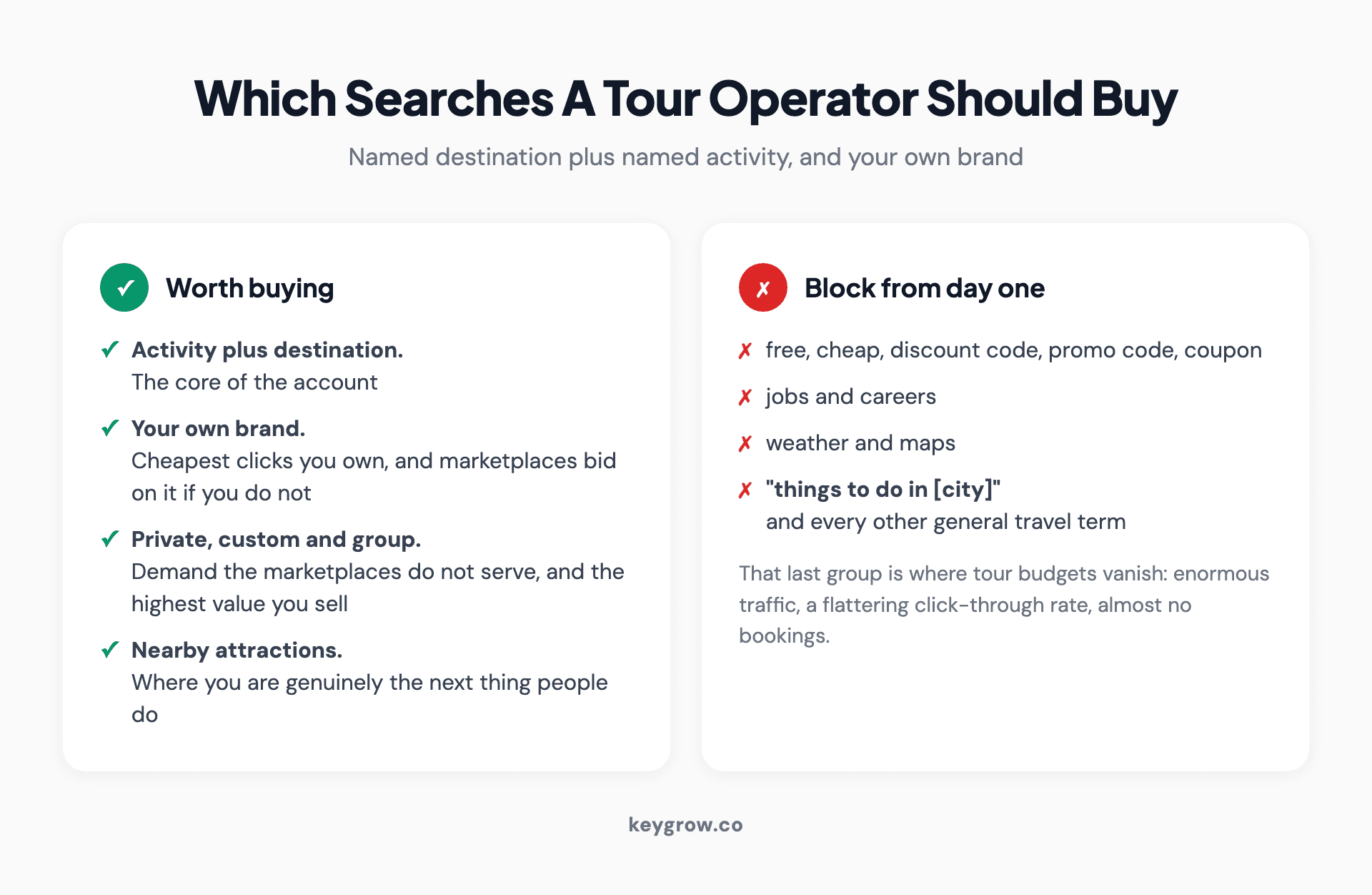
Two-column card layout of tour searches worth buying, including activity plus destination and your own brand, against the terms to block such as discount codes and general things-to-do queries.
What the booking page has to do
The traveler comparing you to a marketplace listing is comparing two things: whether they can trust you, and whether booking will be as easy. You have to win both, and the second one is where operators lose.
The marketplace listing shows availability, an instant price for their party size, hundreds of reviews and a two-tap checkout. If your page shows a phone number and an inquiry form, the comparison is over before trust enters into it.
So the page needs live availability for the dates in question, a price that resolves for their group size, reviews visible without scrolling, the cancellation policy stated plainly, and a checkout that finishes on the same page. The single strongest thing you can add is a reason to book direct that the marketplace cannot match: a better cancellation window, a small inclusion, priority on the good departure time.
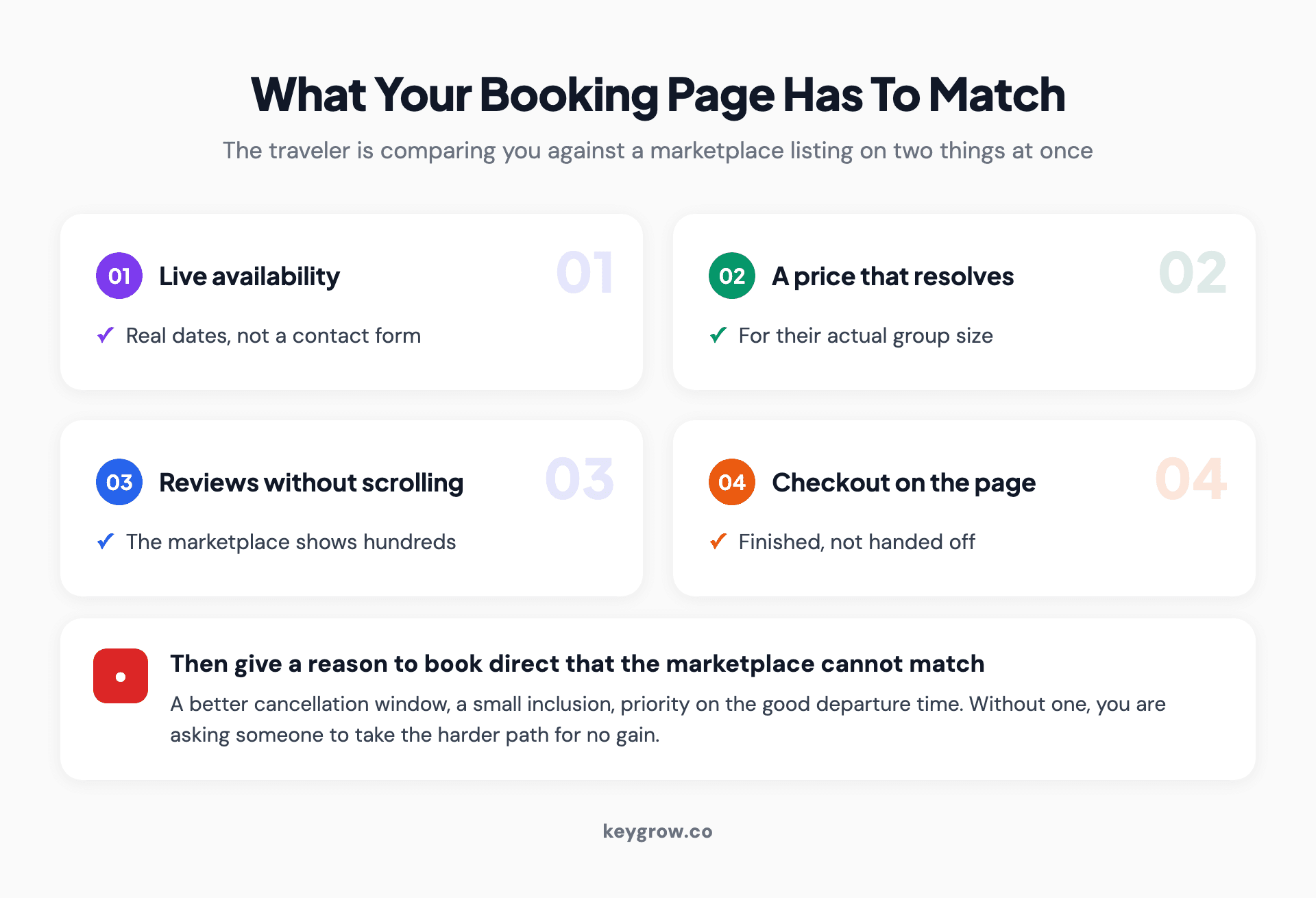
Four numbered cards showing what a tour booking page must match from a marketplace listing: live availability, a resolving price, visible reviews and checkout on the page.
We rebuilt the landing page for a services client around one clear action and the information people needed to take it, and their conversion rate rose 120 percent in five weeks on the same traffic. That is what a page fix is worth before you touch a bid. There is more on the choice between a dedicated page and your existing site in our piece on ad landing pages, and if you want the forward arithmetic on spend, the budget calculator will do it.
Three ways tour operators lose money here
Advertising the destination instead of the tour. "Things to do in [city]" is a research query with fantastic volume and almost no booking intent. It feels like the right keyword because it describes your business. It buys you readers.
Running peak-season budget into sold-out inventory. Check your open seats before you check your bids. If Saturday is full, the Saturday campaign should be off.
Not bidding on your own name. Operators refuse this on principle, calling it paying for traffic they already own. Meanwhile the marketplace selling their tour at a 25 percent commission is bidding on it happily. Brand terms are the cheapest clicks in your account and they defend the bookings with the best economics you have.
If you are weighing paid against organic for a seasonal business, the trade-off is covered in our note on SEO or Google Ads first.
FAQs
How much should a tour operator spend on Google Ads?
Start from your commission rate rather than a fixed figure. Multiply your average booking value by the marketplace commission you avoid on a direct booking, and that is your allowable cost per acquisition. At travel's $2.14 average cost per click, a modest monthly budget buys a lot of traffic, so the constraint is usually available capacity and a booking page that converts, not the budget itself.
Do Google Ads work for small tour operators?
Yes, particularly for private, custom and group bookings that the large marketplaces do not carry well. For standard scheduled tours you are competing against resellers of your own product with much bigger budgets, so the winnable searches are your brand name, specific activity and destination combinations, and the shoulder-season dates where competition thins out.
What are Google Things to do ads?
They are a Google Ads placement built for tours, activities and attractions, appearing on Search and Maps with photos, prices and a booking link. They do not run from your keyword campaigns. They require a Things to do product feed, either through an approved connectivity partner or built to Google's specification yourself, connected to a Google Ads account.
Should tour operators bid on their own brand name?
Yes. It is the cheapest traffic in the account and it protects the bookings with the best economics you have. If you do not bid on your own name, the marketplaces reselling your tours generally will, which means paying commission on a customer who was already looking for you specifically.
Why do my travel ads get lots of clicks but no bookings?
Usually because the keywords describe research rather than purchase. Travel has the highest click-through rate of any industry at 9.32 percent and converts below the all-industry average at 5.83 percent, so click volume in this category is a poor signal. Check whether your spend is concentrated on general destination queries rather than on activity plus destination searches.
When should a seasonal tour business run ads?
During the booking season and the shoulder months, not during peak. People planning a summer trip search months ahead, so spend placed then is both cheaper and better timed. Advertising into weeks you have already sold out spends money to generate inquiries you have to turn down.
How long before I know if tour ads are working?
At least six weeks, and longer if your booking window is long. Someone who clicks in February and travels in July will not appear in a January report. Widen your attribution window to match how far ahead your customers actually book, or your reporting will credit the bookings to nothing.
What to do next
Work out your commission number first. Average booking value times your marketplace rate gives you the money a direct booking saves, and that figure is your budget ceiling, not your comfort level. Most operators are underspending against it by a wide margin.
Then put the budget where the capacity is, buy the searches that name your activity and your destination, defend your own brand, and ask your reservation provider about a Things to do feed. Judge none of it before six weeks, and judge it on bookings rather than on a click-through rate that flatters everyone in this industry.
If you want that built and run rather than described, our PPC management is month to month, cancel anytime.