

To get featured snippets, put a 40 to 60 word answer directly beneath a heading that repeats the question, on a page that already ranks in Google's top ten for that query. That is the whole mechanic. Google pulls the block it thinks answers the search, and it will only pull from pages it already trusts enough to rank.
The part most guides on this topic skip is that the prize got a lot smaller while they were being written.
One thing to clear up first, because the terms get swapped constantly. A featured snippet is a block of your page text lifted to the top of the results. A rich snippet is the stars, prices, and other extras that schema markup adds to an ordinary listing. Different features, different levers, and we cover the other one in rich snippets and SEO.
First, the number that changes how much effort this deserves
Featured snippets appeared on 15.41 percent of search results in January 2025. By June 2025 they appeared on 5.53 percent. That is a 64 percent drop in five months, measured by Ahrefs across a million randomly sampled US desktop results.
Over the same five months, AI Overviews went from 3.93 percent of results to 27.43 percent.
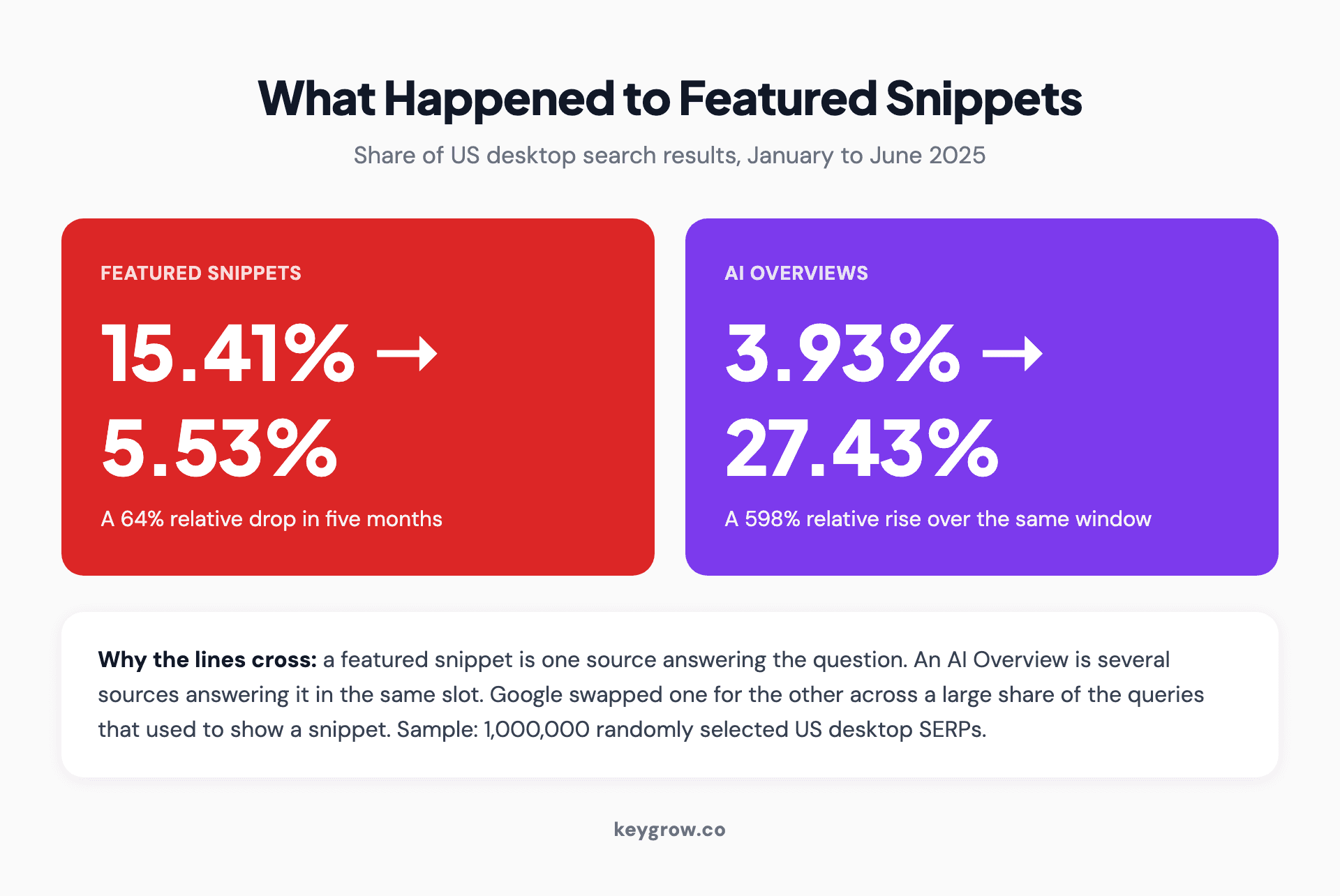
Two stat cards comparing SERP features: featured snippets fell from 15.41 percent to 5.53 percent of US desktop results between January and June 2025, while AI Overviews rose from 3.93 percent to 27.43 percent.
Those two lines cross for an obvious reason. A featured snippet is one source answering a question at the top of the page. An AI Overview is several sources answering the same question in the same slot. Google replaced one with the other on a large share of the queries where it used to show a snippet.
So the honest framing for this post: the technique still works, it is cheap, and it is worth doing on the pages where it applies. It is not a strategy. Anyone selling you a "position zero campaign" in 2026 is selling you a feature that disappeared from two thirds of the results it used to occupy.
Is it still worth trying?
Yes, for two reasons, and one of them is weaker than you have probably read.
The strong reason: the work that wins a snippet is the same work that makes a page easy to quote anywhere. A clear question, a short direct answer, a clean list or table underneath. That formatting helps human skimmers, it helps the AI Overview, and it helps assistants that read your page outside Google entirely.

A person working at a laptop reviewing search performance data.
The weaker reason is the one you see repeated a lot right now: win the snippet and you will get cited in the AI Overview instead. There is something to it, but less than the confident version suggests. Ahrefs re-ran their citation study in March 2026 across 863,000 keyword results and four million cited URLs, and found that only 38 percent of pages cited in AI Overviews rank in the top ten for that query. Eight months earlier that figure was about 76 percent.
Google is increasingly answering from pages it found through related queries rather than from the results in front of you. Winning the snippet puts you in a pool that has been shrinking as a share of what gets cited. Do the work, but do not build a plan on that particular bridge.
This is the same shift we keep writing about in how AI Overviews affect SEO. The question stopped being how do I rank and became how do I become the source. Of every page ChatGPT pulls while it builds an answer, roughly 15 percent end up cited. Being findable and being quoted stopped being the same achievement.
Find the queries where a snippet still exists
Do not optimize for a snippet that is not there. Half the pages that get written for this keyword skip this step, which is how people end up rewriting a page for a SERP feature that Google stopped showing two years ago.
Open Google Search Console, go to Search Results, and filter queries by position. You want the ones sitting between positions two and ten, because those are pages Google already considers eligible. A page at position 40 is not one paragraph away from a snippet.
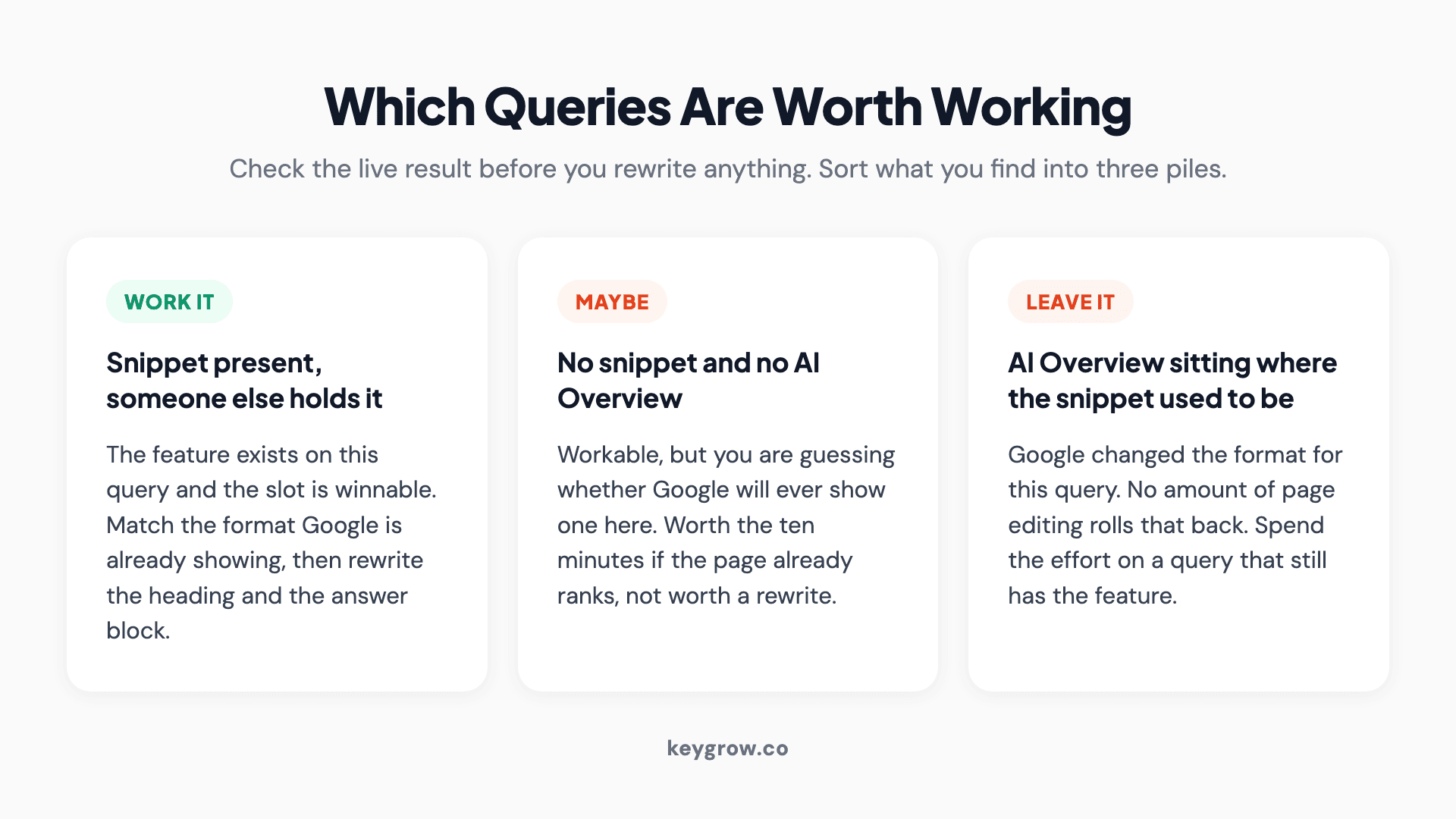
Three decision cards for sorting queries: work it when a snippet exists and a competitor holds it, maybe when there is no snippet and no AI Overview, leave it when an AI Overview has replaced the snippet.
Then take the twenty best of those and actually look at the live search result. Not a tool's cached idea of the SERP, the real one, in an incognito window. You are sorting them into three piles:
Twenty queries takes about forty minutes. It saves you from the far more common failure, which is rewriting fifteen pages for a feature that does not appear on any of their queries.
The four formats, and what each one wants from your page
Google shows four kinds, and each is triggered by a different shape of content. Matching the shape to the query is most of the job.
| Format | Query pattern | What the page needs |
|---|---|---|
| Paragraph | what is, why does, definitions | A 40 to 60 word answer directly under the heading |
| Numbered list | how to, steps, process | Real <ol> markup with short step headings |
| Bulleted list | best, types of, checklist | Real <ul> markup, parallel items, no giant blocks |
| Table | cost, comparison, specs, sizes | A genuine HTML table with a header row |
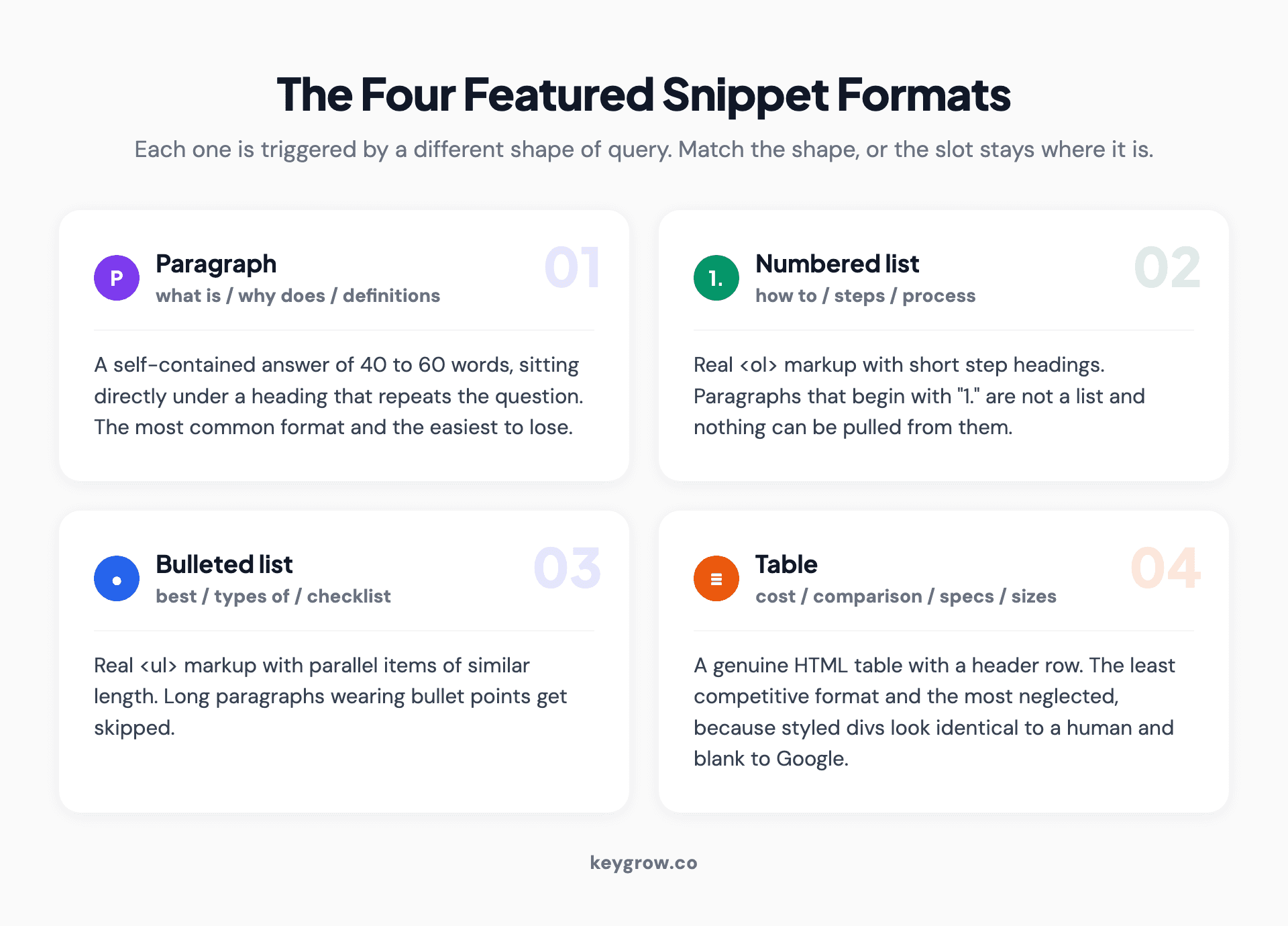
Four cards covering the featured snippet formats: paragraph for definition queries, numbered list for how-to queries, bulleted list for best-of queries, and table for cost and comparison queries, with the markup each one needs.
Paragraph snippets are the most common and the easiest to lose, because anyone can write 50 words. Table snippets are the least competitive and the most neglected. If you have pricing, dimensions, timelines, or any data that belongs in rows and columns, put it in a real table rather than a styled set of divs. Google reads the markup, not the visual result.
The formatting mistake we see most: a list that looks like a list on screen but is a sequence of paragraphs starting with dashes in the HTML. Nothing to extract there.
The answer block is the whole technique
Everything above is context. This section is the part that moves a page.
Under a heading that matches the question as people type it, write a self-contained answer of 40 to 60 words. Self-contained means it makes sense to someone who has never seen the rest of your page. No "as we discussed above", no pronouns pointing at the previous section, no setup.
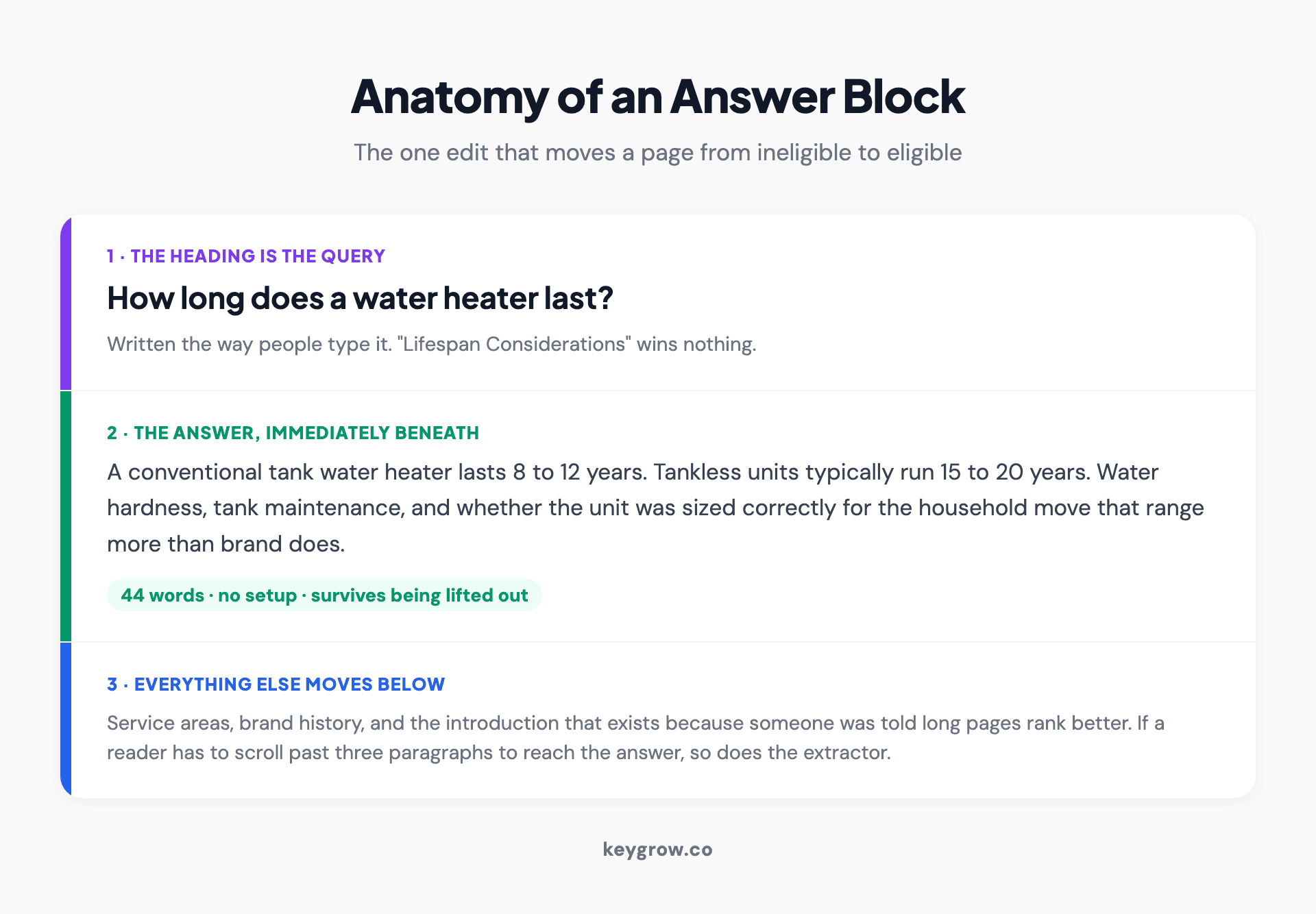
Annotated example of a featured snippet answer block: the heading written as the query, a 44 word self-contained answer directly beneath it, and the remaining page content moved below.
Then expand underneath, for as long as the topic needs.
Google does not publish a target length. Their documentation says the minimum is variable and depends on the language, the platform, and the information itself. The 40 to 60 range is what extraction consistently produces in practice, and it also happens to be the length that reads well to a person who wanted a quick answer. Our word counter is the fastest way to check a block without guessing.
The heading matters as much as the answer. "Timeline" will not win anything. "How long does a bathroom remodel take?" might. Write the heading as the query, then answer it immediately. We go further into this pattern in structuring a page for AEO, because it is the same structure that gets pages quoted by assistants.
Turning a page that already ranks into one that gets pulled
Work in this order. It goes fastest and you find out early whether the page is even a candidate.
1. Confirm the page ranks in the top ten for the target query. If it does not, stop here and fix the ranking first. Snippet optimization on a page at position 18 is decoration.
2. Confirm a snippet exists on that live SERP, and note which format Google is showing. Match that format. If Google shows a list, a beautifully written paragraph will not displace it.
3. Rewrite the heading as the question, in the words people search, not your internal terminology.
4. Write the answer block directly beneath it, 40 to 60 words, self-contained.
5. Fix the markup so lists are lists and tables are tables.
6. Remove the throat-clearing above the answer. If the reader has to scroll past three paragraphs of context, so does the extractor.
7. Request indexing in Search Console and wait. Two to six weeks is normal. Snippets also rotate, so one check on one day tells you very little.
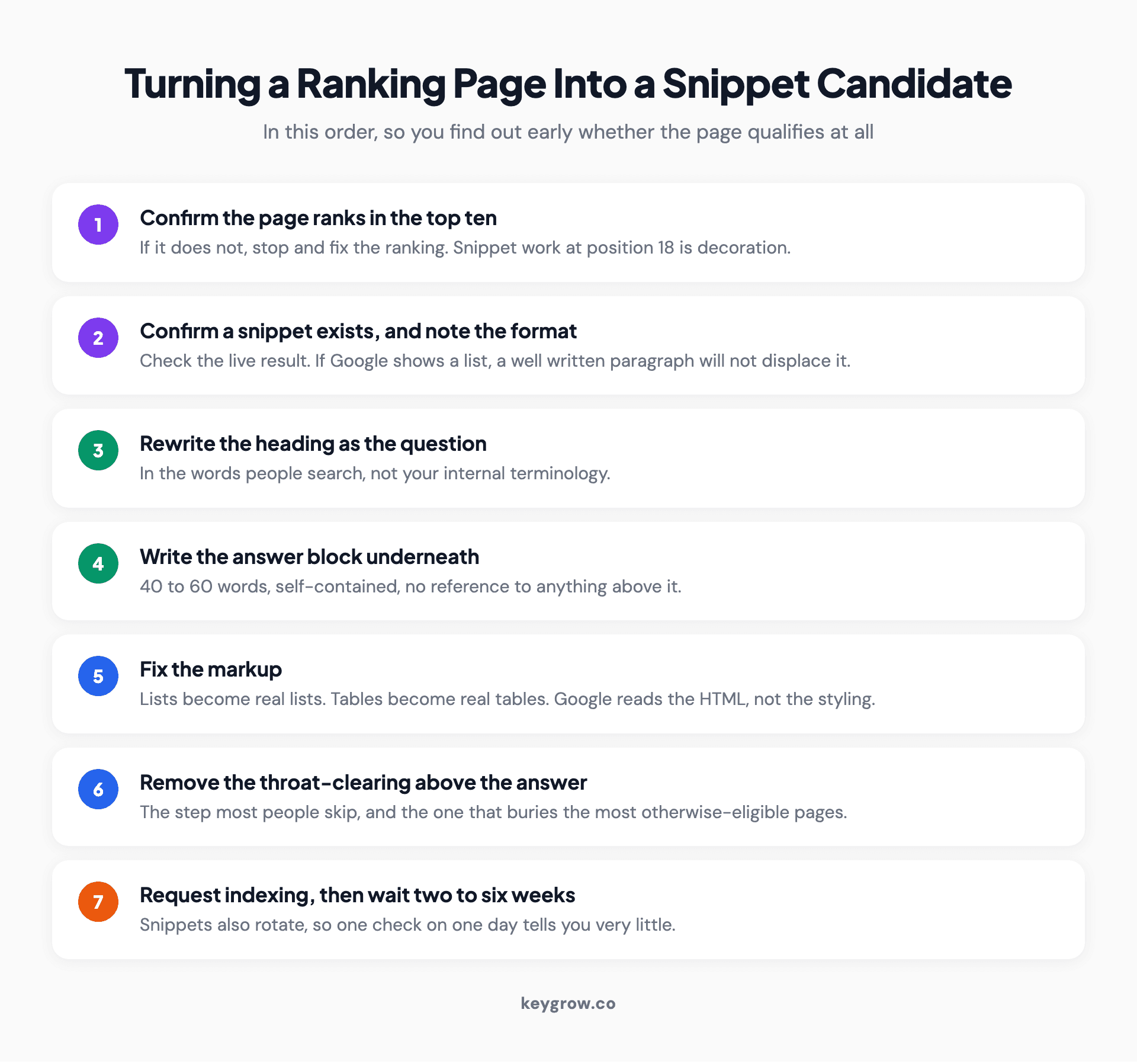
Seven numbered steps for turning a ranking page into a featured snippet candidate, from confirming a top ten ranking through requesting indexing and waiting two to six weeks.
Step six is the one people skip. A lot of pages have the right answer sitting in paragraph four, buried under an introduction that exists because someone was told long posts rank better.
A worked example
A plumbing company has a page ranking sixth for "how long does a water heater last". The page opens with two paragraphs about the company's service area, then a section headed "Lifespan Considerations" that eventually says most tanks last eight to twelve years.
Google is showing a paragraph snippet from a manufacturer's site.

Close-up of a computer screen showing search results.
The fix takes fifteen minutes. The heading becomes "How long does a water heater last?" The first line underneath becomes: "A conventional tank water heater lasts 8 to 12 years. Tankless units typically run 15 to 20 years. Water hardness, tank maintenance, and whether the unit was sized correctly for the household move that range more than brand does." That is 44 words, it answers the question with no setup, and it survives being lifted out of the page.
The service-area paragraphs move down. Nothing else about the page changes.
This is not a guaranteed win. It is a page that went from ineligible to eligible, which is the only part you control.
You can also tell Google not to show one
Almost nobody covers this, and it is a real decision for some pages.
If your page answers a question so completely in the snippet that nobody clicks, the snippet can cost you traffic rather than earn it. Recipe sites, calculators, and definition pages hit this constantly. Google documents three levers for it:
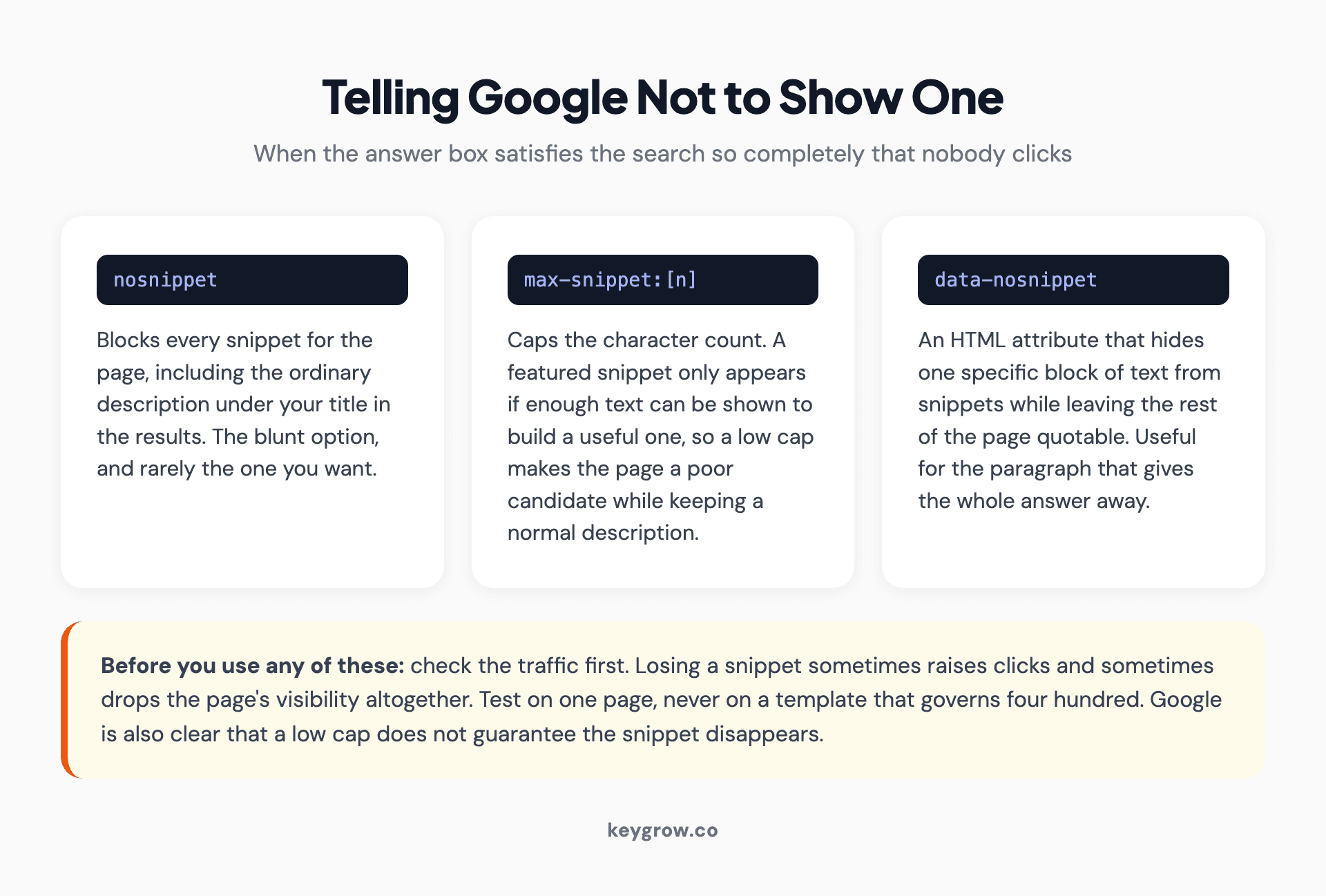
Three cards explaining how to block a featured snippet: the nosnippet rule, the max-snippet character cap, and the data-nosnippet HTML attribute, with a warning to test on one page first.
The middle one is the useful one, because it lets you keep a normal search description while making the page a poor candidate for the full answer box. Google is clear that a low setting does not guarantee the snippet disappears.
Before you reach for this: check the traffic first. Losing a snippet sometimes raises clicks and sometimes drops the page's visibility altogether. Test on one page, not on a template that governs four hundred.
Checking whether you won
Search Console will not tell you directly, which is the frustrating part. There is no "featured snippet" filter in the interface.
What you can do:
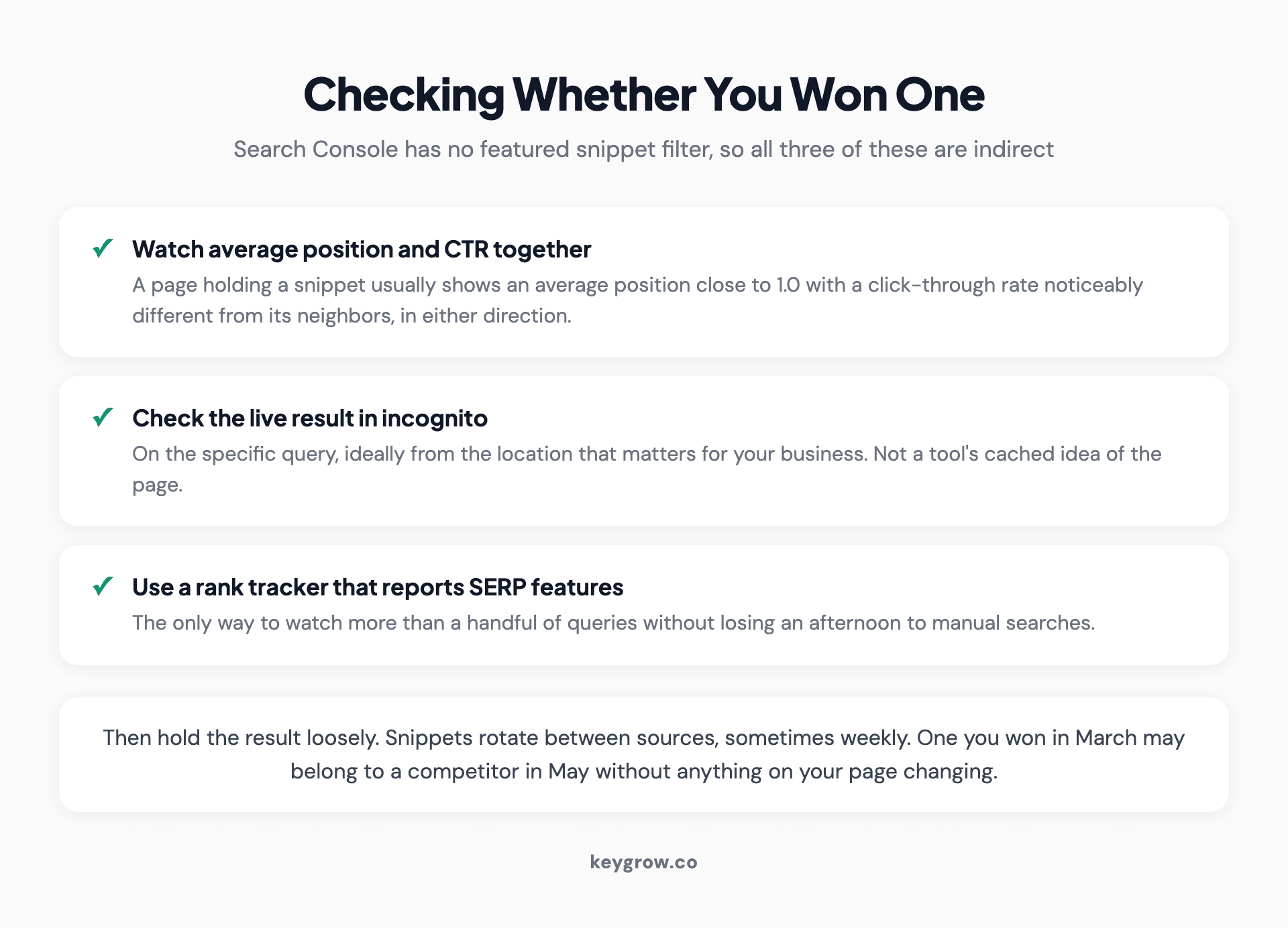
Checklist of three indirect ways to confirm a featured snippet: watching average position against click-through rate, checking the live result in incognito, and using a rank tracker that reports SERP features.
Then hold the result loosely. Snippets rotate between sources, sometimes weekly. A snippet you won in March may belong to someone else in May without anything on your page changing.
Who should not spend time on this
If you run a single-location service business, this is near the bottom of the list. The queries that bring you customers are things like "emergency plumber near me", and those results are a map pack and a set of local listings. There is no paragraph snippet to win, and there never was.
Your version of this work is the Google Business Profile, reviews, and service pages that load fast and say where you actually go. Snippet formatting is for the informational pages that sit above that in the funnel, and if you do not have those pages yet, the formatting question has not arrived.

A laptop on a desk in a small business workspace.
If you publish informational content and you already rank in the top ten for questions people actually ask, then yes, this is a genuinely cheap improvement. An afternoon of heading rewrites on twenty pages is a reasonable trade. A six-month "position zero" engagement is not, and any agency proposing one should be asked to show you the snippet rate for your query set first. If they have not checked, they are pitching a 2019 deck.
FAQs
How long does it take to get a featured snippet?
Usually two to six weeks after the page is recrawled, assuming the page already ranks in the top ten. Requesting indexing in Search Console speeds up the recrawl but not the decision. If nothing has changed after two months, the format is probably wrong for the query or a stronger page holds the slot.
Do you have to rank number one to get the featured snippet?
No. Any page in the top ten is eligible, and snippets are often pulled from results in positions two through six. Ranking first helps but does not decide it. What decides it is whether a clean, self-contained answer exists on the page in the format the query calls for.
Are AI Overviews the same as featured snippets?
No. A featured snippet quotes one page verbatim and links to it. An AI Overview generates a summary from several sources and links to all of them. They occupy the same position on the page, which is why one replaced the other on so many queries, but the mechanics and the traffic outcomes are different.
What is the ideal length for a featured snippet answer?
Between 40 and 60 words for a paragraph snippet. Google does not publish a target and says the minimum varies by language and platform, but that range is what gets extracted most reliably. Lists and tables are judged on structure rather than length.
Can you lose a featured snippet you already have?
Yes, routinely. Snippets rotate between competing pages, Google changes the format it shows for a query, or it stops showing one at all. Treat a snippet as borrowed rather than owned, and do not build a revenue forecast on one.
Does schema markup help you win featured snippets?
Not directly. Schema powers rich results like star ratings and review stars, which are a separate feature with separate rules. Google selects featured snippets from the text of the page rather than from structured data. Schema is still worth having, just not for this.
Should I target People Also Ask boxes instead?
They are worth the same treatment and they are more plentiful. The format that wins a PAA answer is identical: question as the heading, short direct answer beneath. One round of heading and answer-block edits usually makes a page eligible for both.
Sizing the effort correctly
Featured snippets are now a small formatting win rather than a channel. Spend an afternoon, not a quarter.
The sequence that actually pays: find your queries in positions two to ten, check which of them still show a snippet at all, rewrite those headings as questions, put a 40 to 60 word answer underneath, and make sure your lists and tables are real markup. Everything else in this post is context for why that short list is the short list.
If you want that done across a content library rather than one page at a time, our AEO service is built around exactly this kind of extraction work, and it is month-to-month.


