


Zero search volume keywords are search terms that a keyword tool reports as getting no monthly searches, even though real people type them. The zero describes the tool, not the demand. Most are long, specific phrases that fall under a reporting floor, get folded into a bigger phrase, or are too new to have any history.
So "no search volume" in a tool column usually means the tool had too little data to print a number. Nobody searching is a different claim. Google says 15 percent of the searches it sees every day are new, according to Google's own blog, and a database built on last year's averages has no figure for a question nobody asked last year.
What decides it is whether one of your customers has asked the question. If they have, write for it. If the only evidence is a tool's suggestion list, skip it.
Why do keyword tools show zero?
Tools show zero when a phrase sits below their reporting floor, gets merged into a close variant, is too new to have history, or is too local to measure.
No tool counts every Google search. Each one estimates, and each estimate has an edge where it gives up and prints a zero.
| Why the tool shows zero | What is happening | What to do about it |
|---|---|---|
| Below the reporting floor | Small numbers are suppressed or rounded down instead of shown as 3 or 7 | Read it as "small", not "none" |
| Merged with a close variant | Searches are credited to a sibling phrase with the same meaning | Check the parent phrase's number |
| Sampled data | Estimates built from samples thin out on long phrases | Trust your own data over the estimate |
| Too new | A product name, feature, error message or rule change has no history yet | Expect the zero to change |
| Too local | A small town's demand never clears a national threshold | Look at the live search result instead |
The merging row explains more zeros than people expect. The Keyword Planner documentation defines average monthly searches as searches for a keyword and its close variants. The searches happened. They were counted under a different phrase.
"No search volume data" is not the same as no searches
A zero means the tool lacks data. Our own keyword pulls and our own Search Console both show real searching behind phrases the tools call empty.
Before a Texas rollout we pulled volume for 764 city-qualified keyword variants. 582 came back at zero, which is 76.2 percent, and plenty of those still produced full local results in Google. The breakdown by service is in our guide to how to do local keyword research.
The second number is why this post exists. Between October 4 and November 2, 2026, that local keyword research guide collected 46 Search Console impressions on three phrases it was never written for: "how to find zero search volume keywords in saas" (19), "no search volume" (15) and "no search volume data" (12). It sat at average positions between 38 and 41 on all three. We never targeted those searches. They showed up anyway.
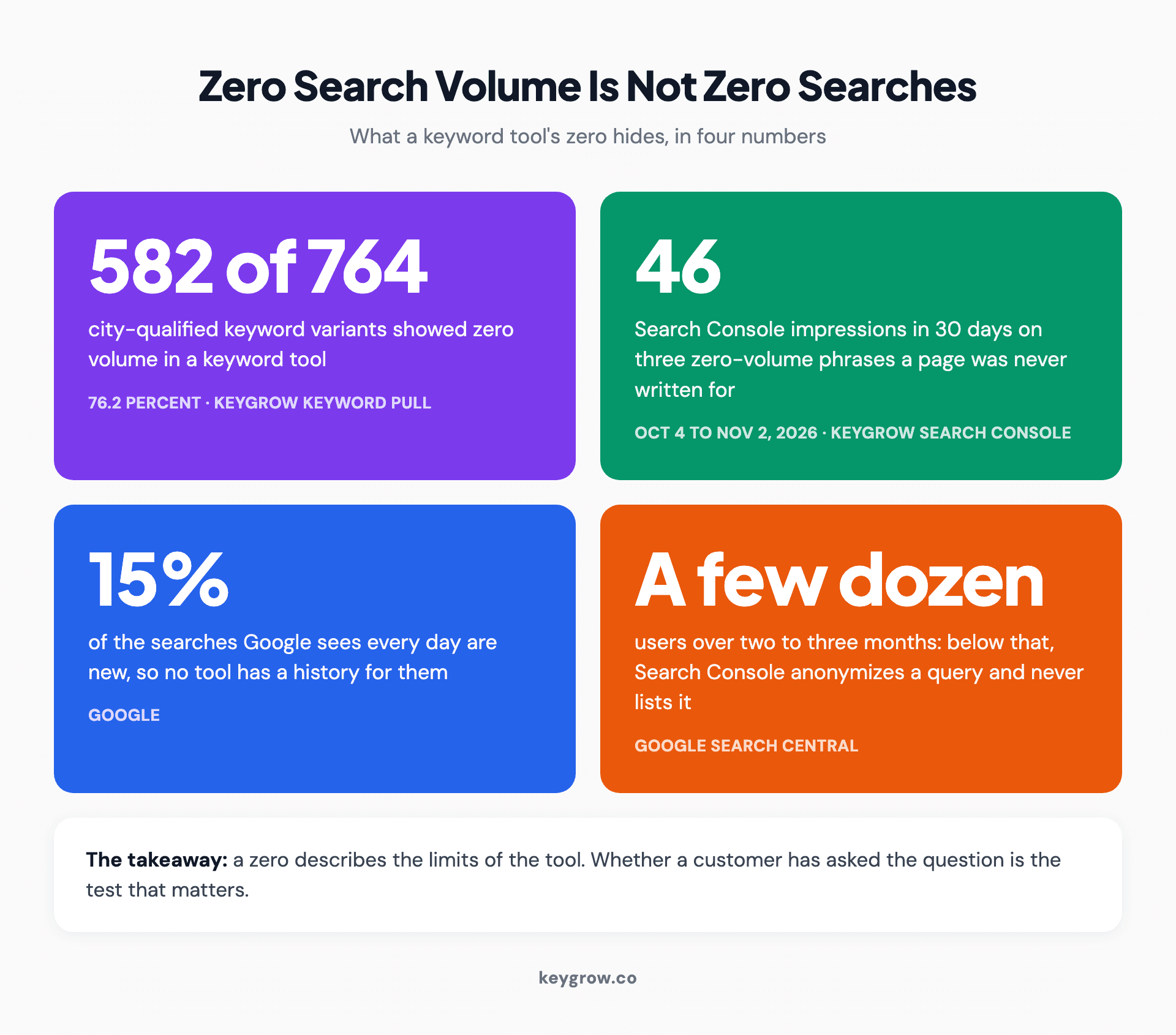
Stat strip of zero search volume evidence: 582 of 764 local keyword variants showed zero volume (76.2 percent), 46 Search Console impressions in 30 days on three untargeted zero-volume phrases, and Google's statement that 15 percent of daily searches are new.
Search Console has a blind spot of its own, too. Per Google Search Central, queries not issued by more than a few dozen users over a two to three month period are anonymized and never listed in the report.
Turn that around. Any query listed in your Search Console was searched by more than a few dozen people in that window, whatever a keyword tool says. Below that line sits a tail of rarer questions no tool will ever name.
Find them where your customers already talk
The best zero-volume keywords come from your own sources: Search Console queries, sales calls, support tickets and site search, then autocomplete and forums.
A keyword tool is the worst place to hunt for terms keyword tools cannot see. Start with your customers' actual wording, roughly in this order of trust.
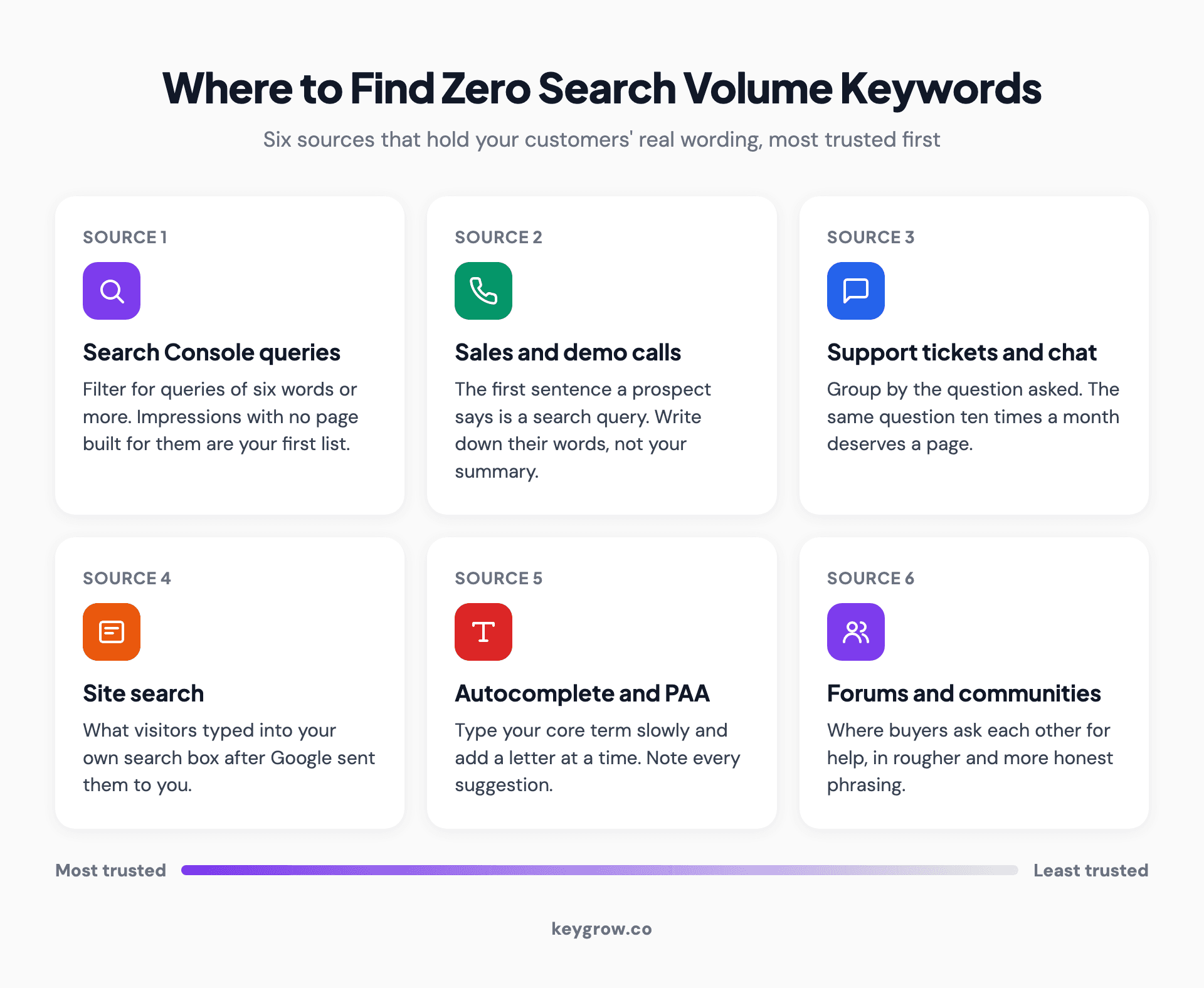
Six sources of zero search volume keywords ranked by trust: Search Console queries, sales and demo calls, support tickets and chat, site search, autocomplete and People Also Ask, and forums and communities.
- Search Console queries. In the Performance report, use the custom regex filter to pull queries of six words or more. Long phrases with impressions and no page built for them are your first list.
- Sales and demo calls. The first sentence a prospect says is a search query with a person attached. Write down their words, not your summary.
- Support tickets and live chat, grouped by the question asked rather than by product area. Ten tickets with the same question in a month deserve a page.
- Site search: what visitors typed into your own search box after Google sent them to you.
- Autocomplete and People Also Ask, typed slowly, a letter at a time after your core term.
- Forums and communities where your buyers ask each other for help, in rougher and more honest phrasing.

Customer support agents wearing headsets at their desks, the people who hear zero-volume questions first.
Keep it all in one spreadsheet: the phrase, where you heard it, how often, and which page should answer it.
The rule for when to write for a zero
Write a page when a real customer asked it and nothing you own answers it. Add a section when a page nearly does. Skip it when only a tool suggested it.
Four questions, asked in order:
- Did a real person use these words? A Search Console impression, a call, a ticket, an autocomplete suggestion. If the only source is a tool's suggestion list, park it.
- Would the person asking buy what you sell, or need it to use what you sold them? If not, skip it.
- Does a page you own already answer it, or nearly? Then add a section or an FAQ entry to that page. Two pages chasing one question split the signals between them.
- Does the answer need more than a few paragraphs, and can you say something specific? Yes earns its own page. No becomes an FAQ entry.
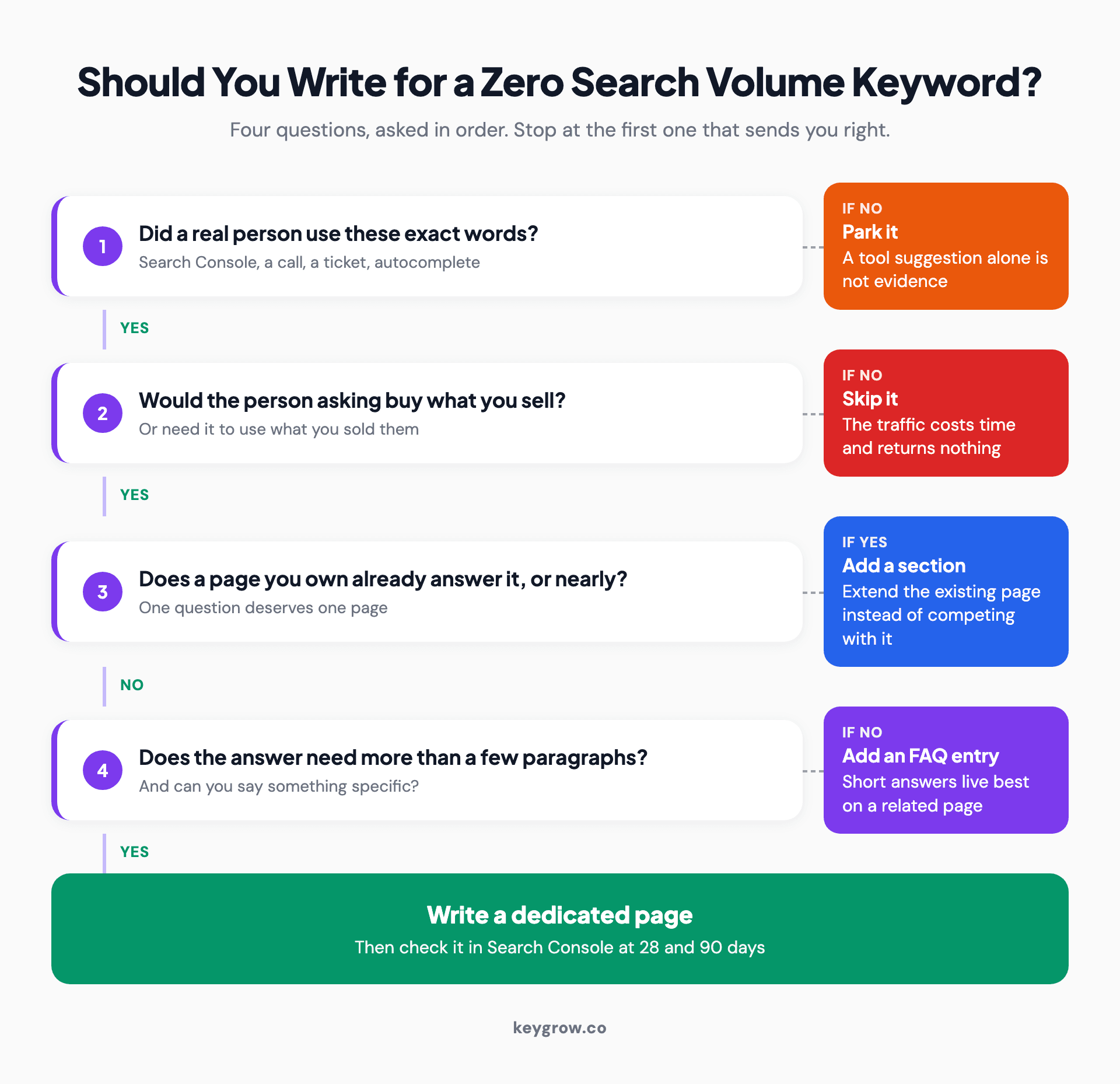
Decision flow for zero search volume keywords: if no real person used the words, park it; if the asker would not buy, skip it; if an existing page nearly answers it, add a section; if the answer is short, add an FAQ entry; otherwise write a dedicated page.
A worked example, with made-up numbers to show the mechanics: a scheduling software company gets 11 support tickets in a month asking how to block public holidays for one location only. The help center covers holidays in one line. Questions one and two pass, question three says an existing page nearly answers it, so the first move is a proper section on that help page. If the tickets keep coming, it graduates to its own article.
This post passed the same test. Search Console supplied the words, and the SaaS question had no answer anywhere on our site.
Twenty related zeros usually belong under one parent page with sections, not on twenty thin pages. An SEO topical map is the planning tool for grouping them.
Zero search volume keywords in SaaS
To find zero search volume keywords in SaaS, mine support tickets, sales call notes, onboarding questions and your own changelog. Integration, migration and error queries carry the most intent.
SaaS has more zero-volume demand than most categories. The queries that convert name your product, a feature, or a pairing of two tools, and tools rarely carry numbers for phrases that specific.
| Query shape | Example pattern | Where you hear it | Page that answers it |
|---|---|---|---|
| Integration | "[your product] [other tool] sync" | Integration requests, tickets | Integration page with setup steps |
| Error or limit | "[your product] import fails over 10,000 rows" | Support tickets, error logs | Troubleshooting article |
| Migration | "move from spreadsheets to [category] software" | Sales calls, onboarding | Migration guide |
| Segment fit | "[category] software for 5-person agencies" | Lost-deal notes, demos | Use-case page |
| Pricing logic | "[category] per seat vs usage pricing" | Sales objections | Pricing FAQ |
| New feature | the feature name plus "how to" | Your changelog | Tutorial published on release day |
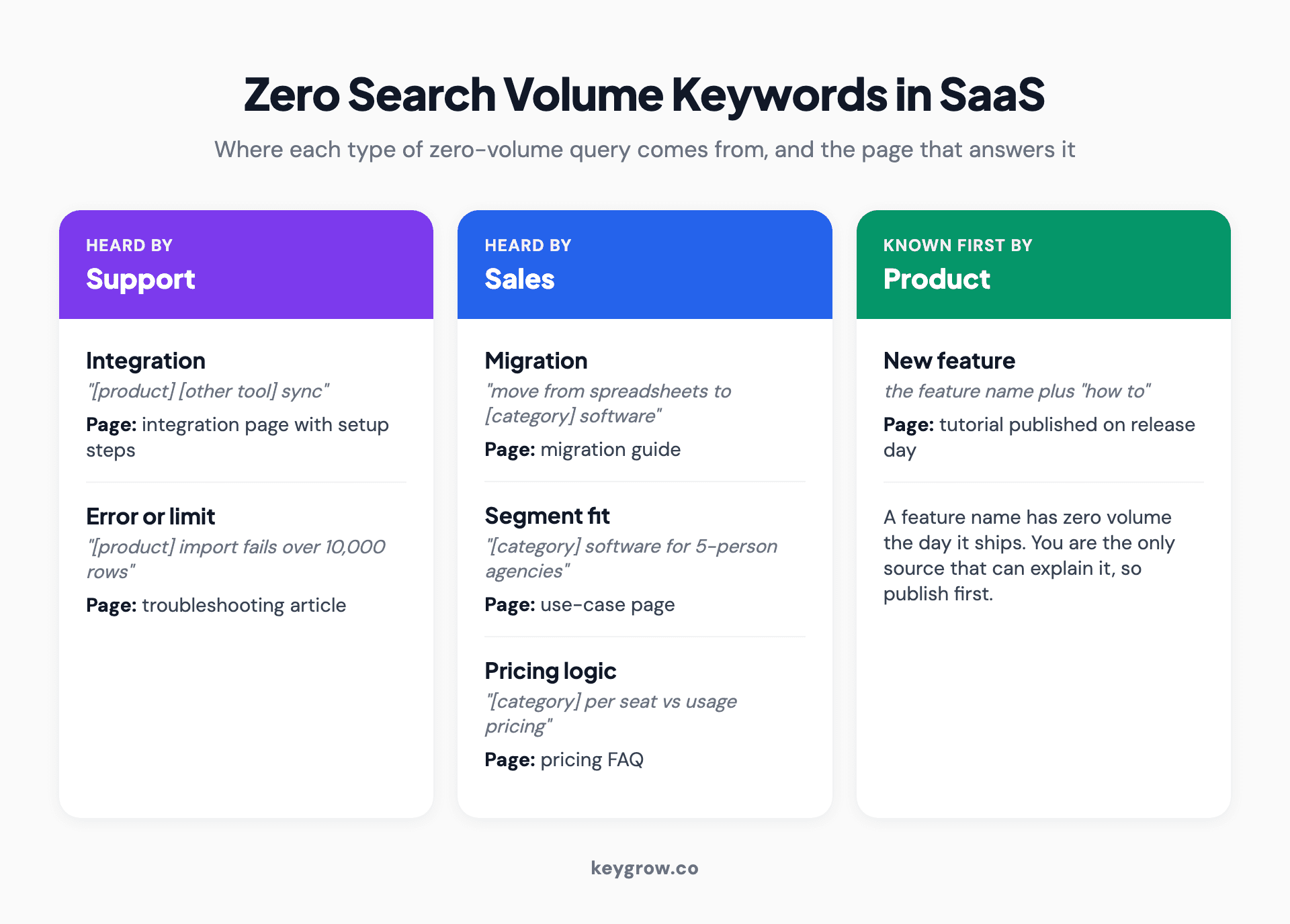
SaaS zero search volume keyword types and where each comes from: integration queries from tickets, error queries from logs, migration queries from sales calls, segment-fit queries from lost deals, pricing queries from objections, and new feature names from the changelog.
Most teams miss the last row. A feature name has zero volume on the day it ships, and you are the only source that can explain it. Publish the tutorial that day and you are first in line when people start searching.
One habit wastes most of this demand: help content kept behind a login. Search engines cannot crawl it, so your support team's daily answers never reach a search result.
Our SEO for SaaS playbook explains why bottom-of-funnel pages like these hold up better than glossary content now that AI answers summarize the top of the funnel. If you would rather have the research and the pages handled for you, our SaaS marketing services include the SEO side.
How do you know a zero-volume page worked?
Judge it in Search Console at 28 and 90 days, impressions across query variants first, then what visitors did. Sessions are the wrong scorecard.
A page built on a zero will never post big traffic, so do not grade it on traffic. Filter the Performance report to the page and read the query list: a page that answers a specific question well starts showing for several wordings of it. Then check what visitors did. A trial, a demo request, a call.
One quirk helps. Search Console leaves anonymized queries out of the table but keeps them in the chart totals unless you filter by query, as the same Search Central post explains. Filter by page, add up the query rows, and compare the sum with the chart total. The gap is clicks from searches too rare to list.
Where zero-volume targeting goes wrong
The first is building from tool suggestions alone. Without a customer behind them, many of those phrases are zero for the boring reason.
The second is one page per wording. "How to export invoices" and "export invoices to csv" are one question. Give it one page.
The third is a report padded with rankings nobody searches for. Rank a page for a phrase nobody types and the screenshot looks wonderful. Anyone promising page one in 30 days is either targeting keywords nobody searches or about to burn your domain. Our strongest organic result, a doctor's practice in Dubai, took 12 months to reach 1,519% traffic growth. A ranking report should tell you which rankings produced a call or a demo.
The last is judging the page at week three. A rare query needs time to collect enough impressions to read.
When you can do this yourself
Most businesses can. The toolset is Search Console, your inbox, and whoever answers the phone. A paid keyword tool is the one source that cannot see these terms, so it is the last thing you need here. If you are choosing one anyway, our local keyword tool comparison shows which ones report city-level numbers and which go blank.

A person writing customer questions into a notebook at a desk beside a laptop.
It stops being a side job when the list passes a few hundred phrases or nobody has time to write the pages. That is where our SEO content strategy work earns its fee, and we run it month to month.
FAQs
What are zero search volume keywords?
They are search terms that keyword tools report as having no monthly searches. Real people still type many of them. The zero usually means the phrase is too rare, too new, too local, or merged into a similar phrase for the tool to show a number.
Why does my keyword tool say no search volume?
The phrase falls below the tool's reporting floor, or the tool has credited its searches to a close variant. New and very local terms also show zero because the tool has no history or sample for them. Check Search Console and the live search result before trusting the zero.
Are zero search volume keywords worth targeting?
They are when a real customer has asked the question and no page you own answers it. They are not when the only evidence is a tool's suggestion list. Relevance to what you sell decides it, not the number.
How do I find zero search volume keywords in SaaS?
Start with support tickets, sales call notes, onboarding questions and your changelog. Then check Search Console for long queries that already bring impressions. Integration, error, migration and new feature queries are usually worth the most.
Do zero-volume keywords matter for AI search?
Yes. Questions typed into AI assistants are long and conversational, which is the same shape as most zero-volume queries. A page that answers one specific question clearly, near the top, is easier for an assistant to quote.
Write for the question your customers asked last week
Open last week's support tickets or call notes and find the question that came up three times. Search it. If nothing you own answers it properly, that is your next page, whatever the volume column says.
If you want a second opinion on your list before you write, get in touch and we will tell you which phrases are worth a page.