


Two people searched for SEO for franchises this morning and landed on the same article.
One is a marketing director at a 140-unit system, holding a budget and a complaint from the regional council that the new locations are invisible. The other owns three units, cannot edit a word of the corporate website, and wants the phone to ring in his territory specifically.
Almost every guide on this topic is written for the first person and pretends the second does not exist. Worse, both versions cover only half of what a franchisor actually has to rank for.
Because a franchise system does not run one search funnel. It runs two, and the second one sells something worth six figures a unit.
Franchise SEO is two funnels, and most advice covers one
Customer acquisition brings people to your locations. Franchise development brings people who want to own one. They are separate audiences, separate keywords, separate pages, and usually separate teams that never talk.
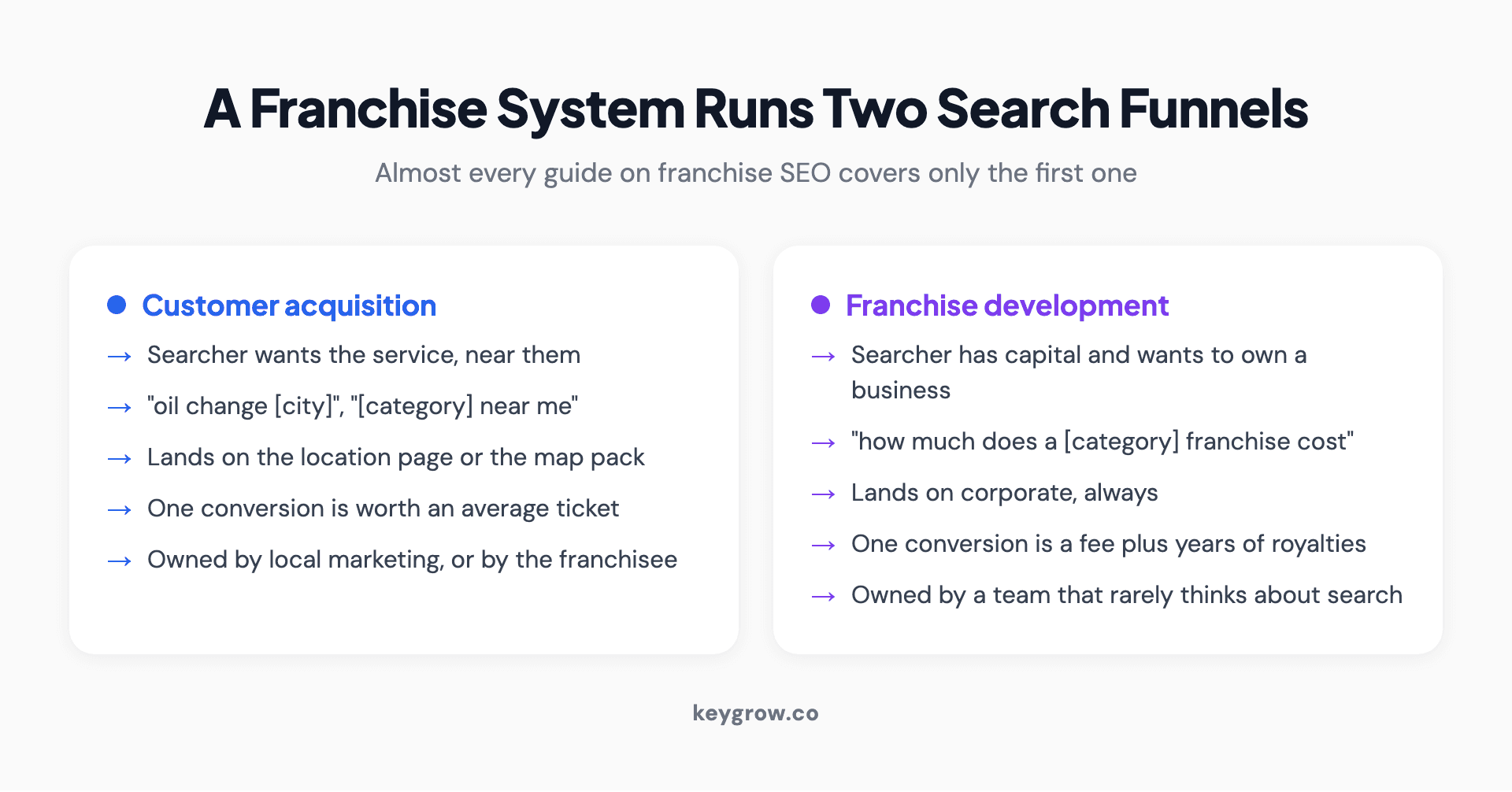
The two search funnels a franchise system runs: customer acquisition at the location level and franchise development at the corporate level, with the keywords and page types for each.

Four colleagues working through a plan together in a modern office.
Here is the split as it actually exists inside most systems:
| Customer funnel | Development funnel | |
|---|---|---|
| Who is searching | Somebody wanting the service, near them | Somebody with capital wanting a business |
| Example query | "oil change [city]" | "how much does a [category] franchise cost" |
| Where it lands | The location page or the map pack | Corporate, always |
| Value of one conversion | An average ticket | A franchise fee plus years of royalties |
| Who usually owns it | Local marketing, or the franchisee | Franchise development, who rarely think about SEO |
| How much SEO advice exists | Enormous amounts | Almost none |
Both matter. But if you are the franchisor and you have one quarter of attention to spend, the arithmetic is not close. A location page that works well might add a few thousand dollars of monthly revenue at one unit. A development page that works well signs an owner.
The development funnel is the most valuable search a franchisor can own
Prospective franchisees research for months, ask financial questions no salesperson will answer on a first call, and search the brand name against words like "cost", "profit", "reviews" and "failure rate".
This is the half of franchise SEO nobody writes about, and it is wide open. Go and search your own brand name plus "franchise cost" and see what comes back. In most categories the first page belongs to franchise brokerage sites, aggregator directories that scraped your disclosure document, and a forum thread from 2019 where three people argue about margins.
None of those are you. All of them are shaping the impression of a person about to spend a lot of money.
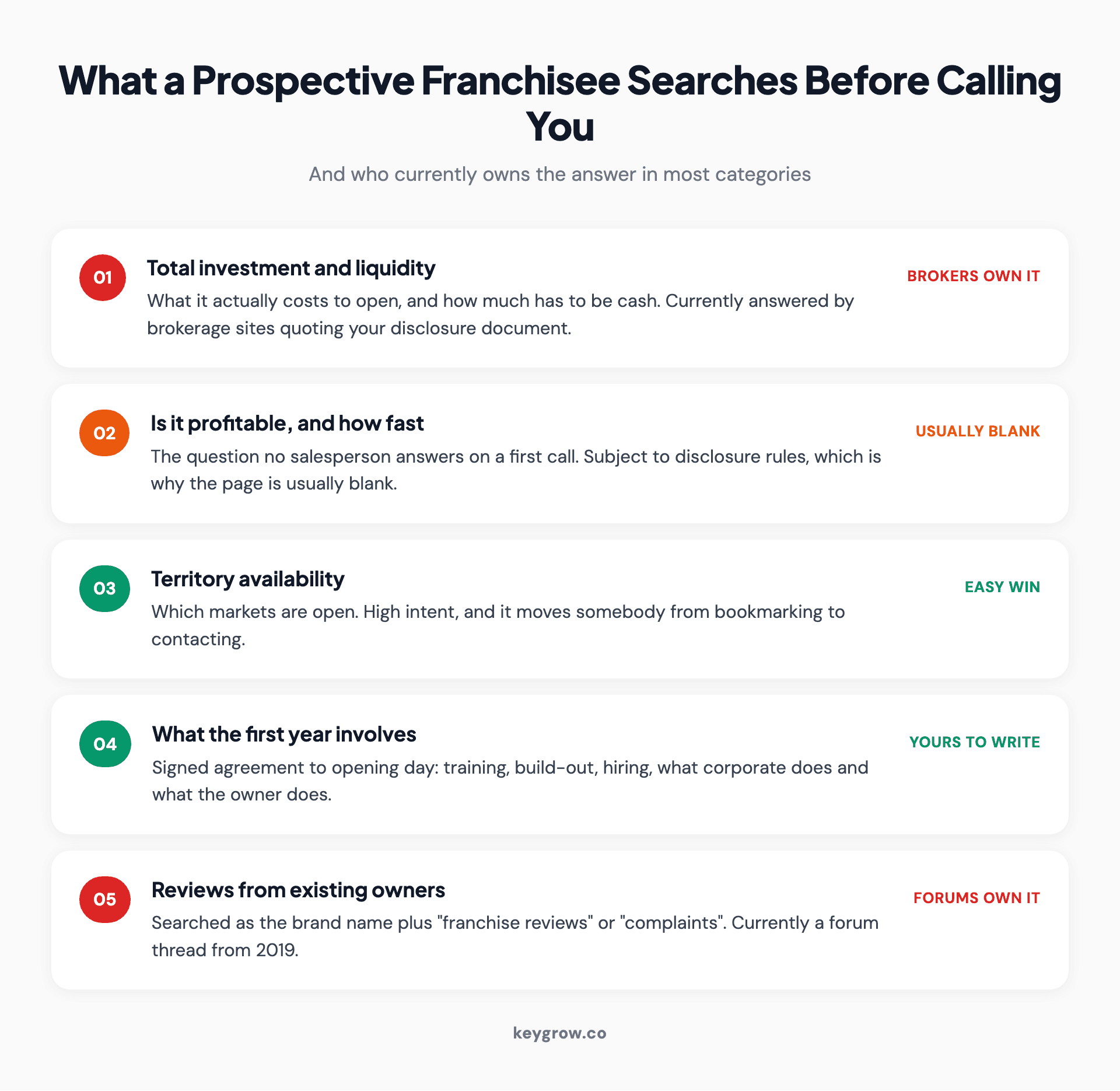
The questions prospective franchisees search before contacting a franchisor, and who currently owns each answer.
The pages worth building:
- Total investment, laid out. Not "investment varies". The range, and what sits inside it: build-out, equipment, initial fee, working capital, the amount somebody actually needs liquid.
- What the first year looks like. Timeline from signed agreement to opening, training, what corporate does and what the owner does.
- Territory and availability. A map of open markets is one of the highest-intent pages a development site can have, and it makes somebody act now rather than bookmark.
- Who this is not for. The single most credible page you can publish. Absentee owners, people below the liquidity threshold, people who wanted a passive investment. Saying it out loud filters the pipeline and reads as honesty rather than sales.
- The comparison pages. People shopping one franchise are shopping four. Write the honest comparison against the category, not against a named competitor.
One important constraint. Franchisors are restricted in the financial performance claims they can make, and those rules do not stop applying because the claim is on a blog post instead of a brochure. The FTC compliance guide is the starting point, and every earnings-adjacent sentence on your development site should be run past whoever maintains your disclosure document. This is a real reason franchisors avoid the topic. It is not a reason to leave the page blank while a brokerage site fills it with worse numbers.
Get the architecture decision right once, then stop discussing it
Subfolders on the corporate domain, for almost everyone. Subdomains are defensible at very large scale. Separate franchisee domains are the version that quietly costs the most.
This decision gets relitigated in every franchise system every few years, so here it is in one table and then we can move on.
| Model | Looks like | Works when | The cost |
|---|---|---|---|
| Subfolders | brand.com/locations/austin | Almost always. Default choice. | Corporate has to actually let franchisees contribute |
| Subdomains | austin.brand.com | Very large systems with real local teams | Authority is split; each subdomain earns its own |
| Separate domains | brandaustin.com | Rarely, mostly legacy | Every unit starts from zero, forever |
The reason subfolders win is boring and decisive: authority pools. A link earned by the corporate blog helps the Austin page. On separate domains, it helps nothing.
If you have inherited a mess of franchisee-owned domains, the migration is worth doing and it is also genuinely painful. Do it once, redirect properly, and accept a rough quarter.
Location pages fail for one reason and it is always the same one
They are one template with the city name swapped, times two hundred. That pattern has been visible to search engines for years and it does not rank.
I have watched this in our own work often enough to be blunt about it. When a batch of location pages fails, it is never the schema and it is never the title tag. It is that page 47 and page 112 say the same thing about two different towns.
The fix is not more words. It is one genuinely local fact per page that could not be true of any other location, ideally several:
- The actual address, the actual phone, the actual hours, the actual manager
- What is near it, in a way somebody local would recognize
- Which services that unit offers and which it does not, because they are rarely identical
- Photos of that building, that team, that parking situation
- Reviews pulled from that location, not the brand aggregate
- Anything genuinely different: a drive-through, weekend hours, a second bay
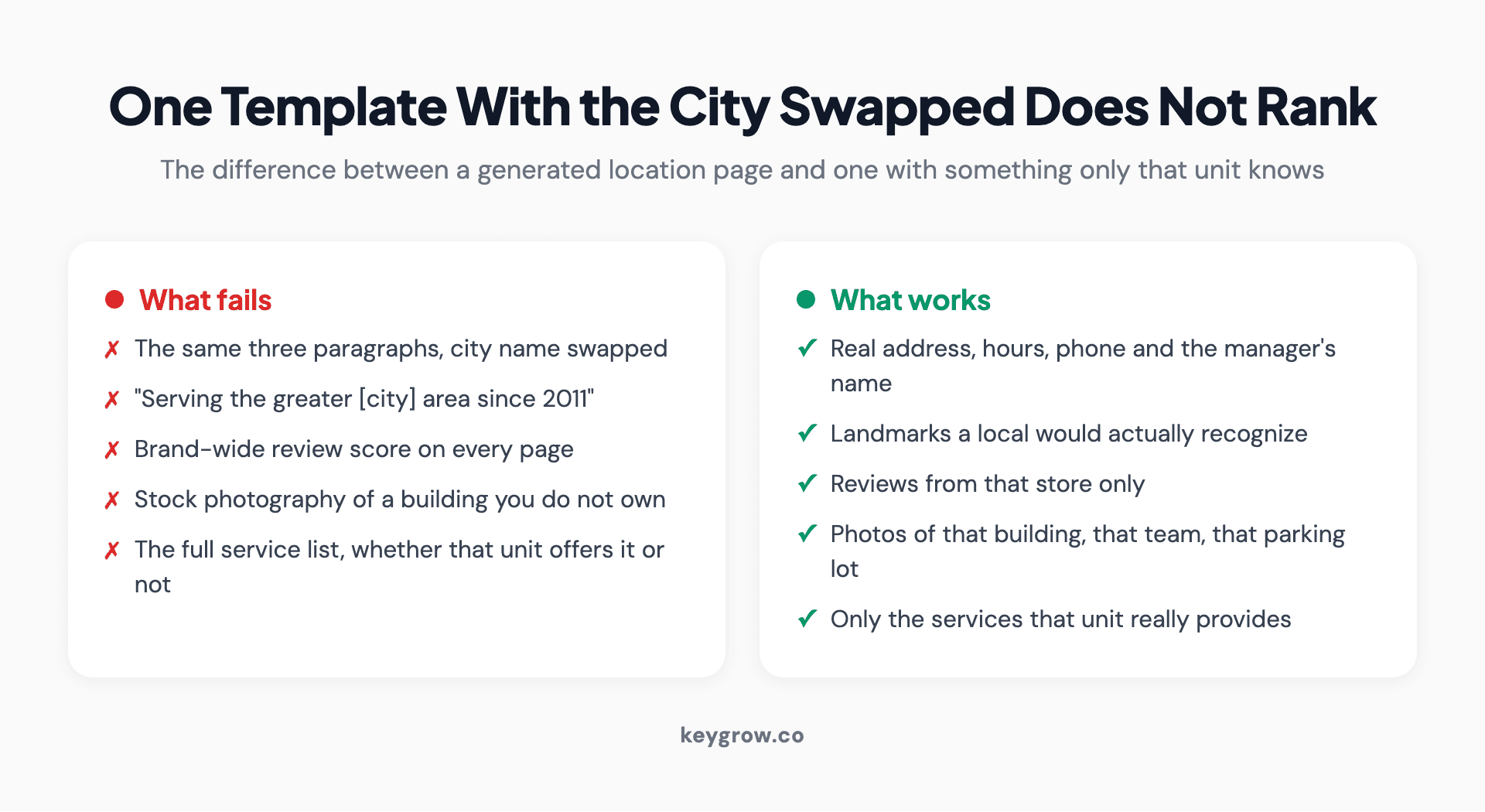
The difference between a templated location page and one with location-specific substance, shown field by field.
The operational answer at scale is not to write two hundred pages centrally. It is to build a structure where the franchisee supplies the six fields only they know, and corporate supplies everything else. A form that takes an owner fifteen minutes produces a better page than an agency writing blind, and it produces it two hundred times.
Mark the pages up properly while you are at it. Google's LocalBusiness docs cover what the markup has to contain, and at franchise scale it should be generated from the same data that fills the page rather than hand-written per location.
Where two of your own locations start eating each other
Two units six miles apart, both optimized for the same city term, will split the signal and neither will rank as well as one would have.
Internal competition is the failure mode specific to this model, and it shows up in three places.
Both pages target the metro. The Austin north unit and the Austin south unit both say "Austin", both target "service Austin", and Google has to choose. Fix: target the neighborhood, suburb or corridor each unit actually serves, and let the corporate page own the metro term.
Service area overlap in the profiles. Two profiles claiming the same delivery radius creates confusion in the map pack and, more practically, creates customer complaints about which unit takes the job. Draw the lines the way the franchise agreement draws them.
Blog content published twice. Corporate writes a good article and encourages every franchisee to post it on their location page. Now the system has 140 copies of the same article, and the version that ranks is whichever one Google picked at random. Publish once, centrally, and link to it.
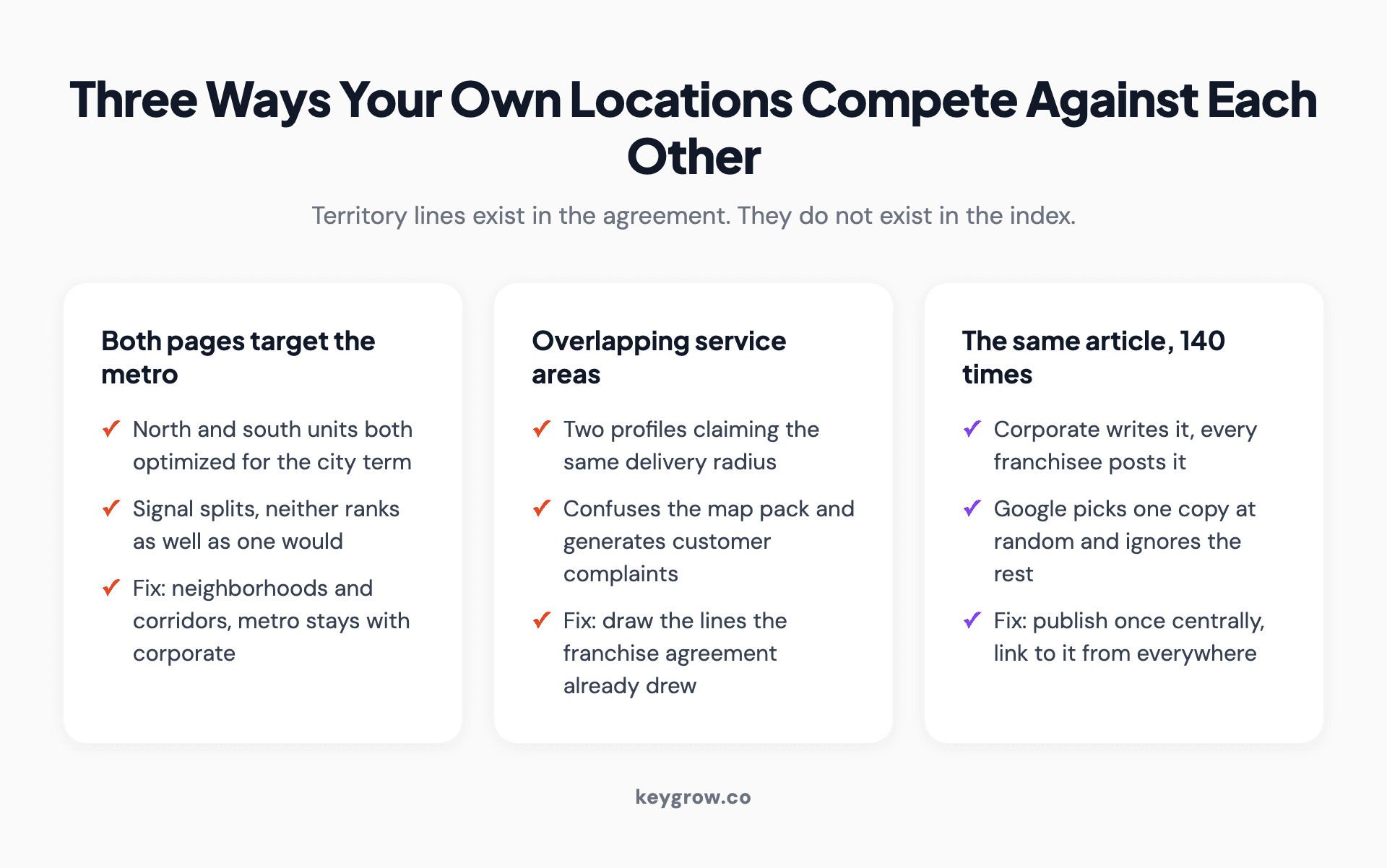
Three ways two franchise locations compete against each other in search, and the fix for each.
Territory lines exist in your franchise agreement. They do not exist in the index. You have to draw them again, in the content.
The profile is an operations problem, not a marketing one
At two locations, Google Business Profiles are marketing. At two hundred, they are inventory that decays: hours change, managers leave, units close, ownership transfers, and every one of those is a broken listing until somebody fixes it.
This is the part that separates franchise SEO from local SEO done more times. The work is not optimization, it is maintenance at a rate that never stops. In any given month across a large system somebody has changed their holiday hours, somebody has sold their unit, somebody has renovated and closed for three weeks, and somebody has had a listing suspended after a well-meaning duplicate.
What that requires:
- One source of truth for name, address, phone and hours, owned by corporate, that everybody edits in one place
- A verification pass on a schedule, not on complaint
- A defined process for ownership transfers that runs before the closing, not after
- Someone whose actual job includes the suspension queue
- Franchisee access that is genuinely useful (posts, photos, replies) but does not include the fields that break consistency
If nobody owns this, you will discover the problem the way most systems do: a franchisee calls to say their listing has shown the wrong hours for a month and they have the reviews to prove it.
Reviews are the one thing corporate cannot do for a franchisee
Rating and volume are per location, decided by what happens inside that unit, and no centralized program fixes a store that is underperforming operationally.
Corporate can build the mechanism: the request timing, the templates, the dashboard, the escalation path for a review that needs a real response. Corporate cannot generate the reviews. That comes from the unit, and it will vary wildly across your system in a way that maps almost perfectly onto operations quality.
Which makes the review dashboard the most honest operational report a franchisor has. Rating by unit, trailing ninety days, sorted ascending. The bottom of that list is not a marketing problem.
Two practical rules for a system:
- Responses should sound like the location, not like a corporate template pasted 140 times. A visible template in the review replies undoes the credibility the reviews were meant to build.
- Never let corporate respond on behalf of a unit without the unit knowing. The number of times a head office has apologized for something that did not happen is higher than you would think.
What corporate owes the franchisee, and what the franchisee owes back
Write the split down. Most franchise SEO failures are not strategy failures, they are two parties each assuming the other was handling it.
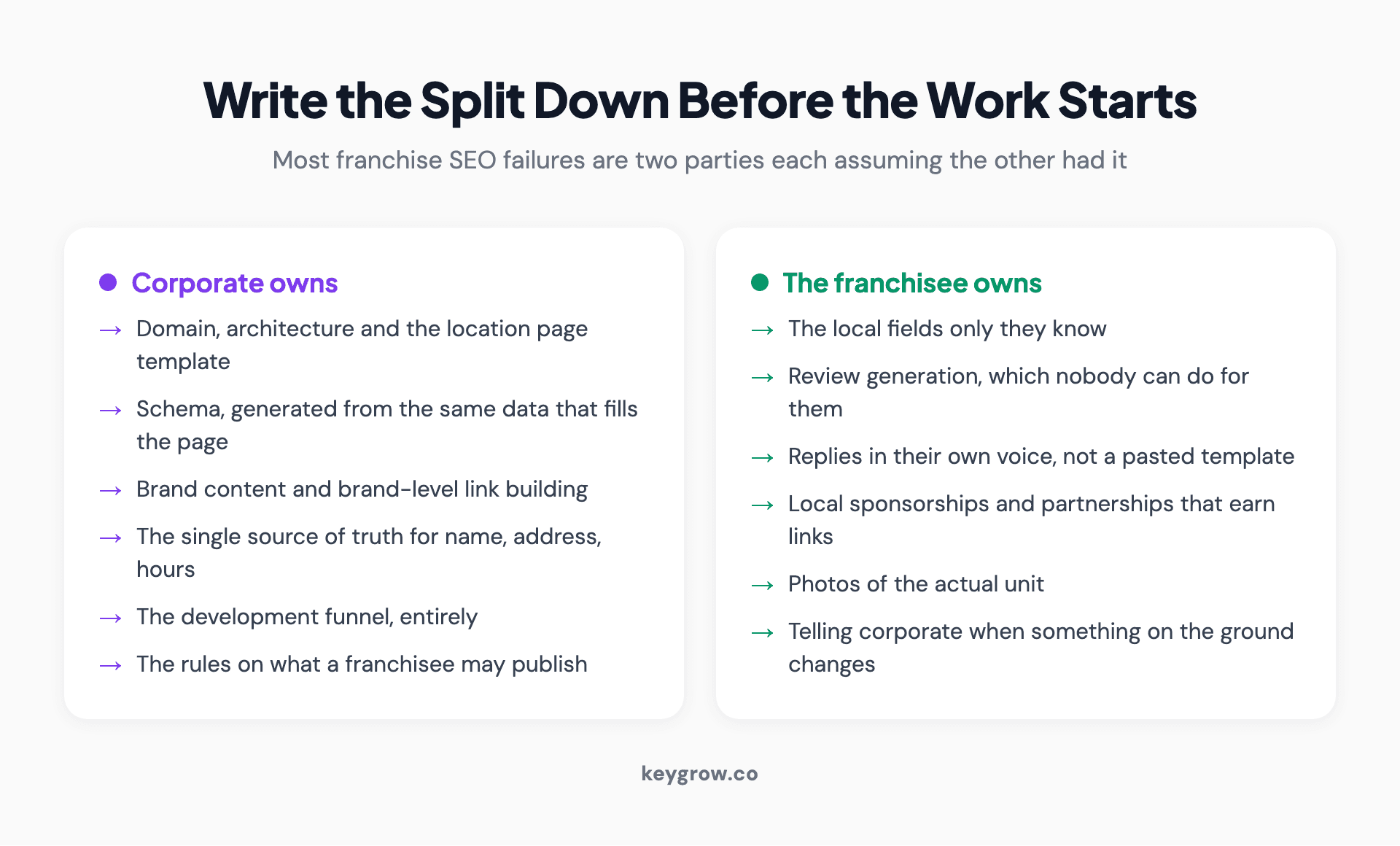
The division of SEO responsibilities between franchisor and franchisee, showing what each side owns and where the handoffs are.
Corporate owns: the domain and architecture, the location page template and the schema behind it, brand-level content and links, the profile source of truth, the reporting, the development funnel entirely, and the rules about what a franchisee may and may not publish.
The franchisee owns: the six local fields on their page, review generation, replies in their own voice, local partnerships and sponsorships that produce links, photos of the actual unit, and telling corporate when something on the ground changes.
The two most common breakdowns: corporate builds a beautiful template and never collects the local fields, so all two hundred pages read identically. Or corporate locks everything, the franchisee has no way to contribute, and the pages stay generic because the only people who know the local details cannot reach the form.
If you own one or two units and corporate controls the website
You have less room than the guides assume and more than you think. Everything outside the corporate domain is yours.
This is the reader nobody writes for, so here is the whole list, in order of return:
- Your Google Business Profile. Frequently the single asset a franchisee genuinely controls. Complete every field, add services individually, post monthly, answer the Q and A yourself, and load real photos of your unit.
- Reviews. Entirely yours. This is the biggest lever available to you and it does not require corporate's permission.
- Local links. The youth sports team, the chamber, the school fundraiser, the local news story about the opening. Corporate cannot get these for you and they are worth more locally than anything on the brand domain.
- Your local field submissions. If corporate has a form for location page content and you have not filled it in, that is a free improvement sitting on the table.
- Ask for what you cannot do. Most franchisors will approve a local landing page, a local blog contribution, or a photo refresh if a franchisee asks specifically. Very few franchisees ask.
- Your own site, only if the agreement allows it. Read the agreement first. Many prohibit it, and the ones that allow it usually require approval. An unapproved franchisee site is a fast way to a difficult conversation.
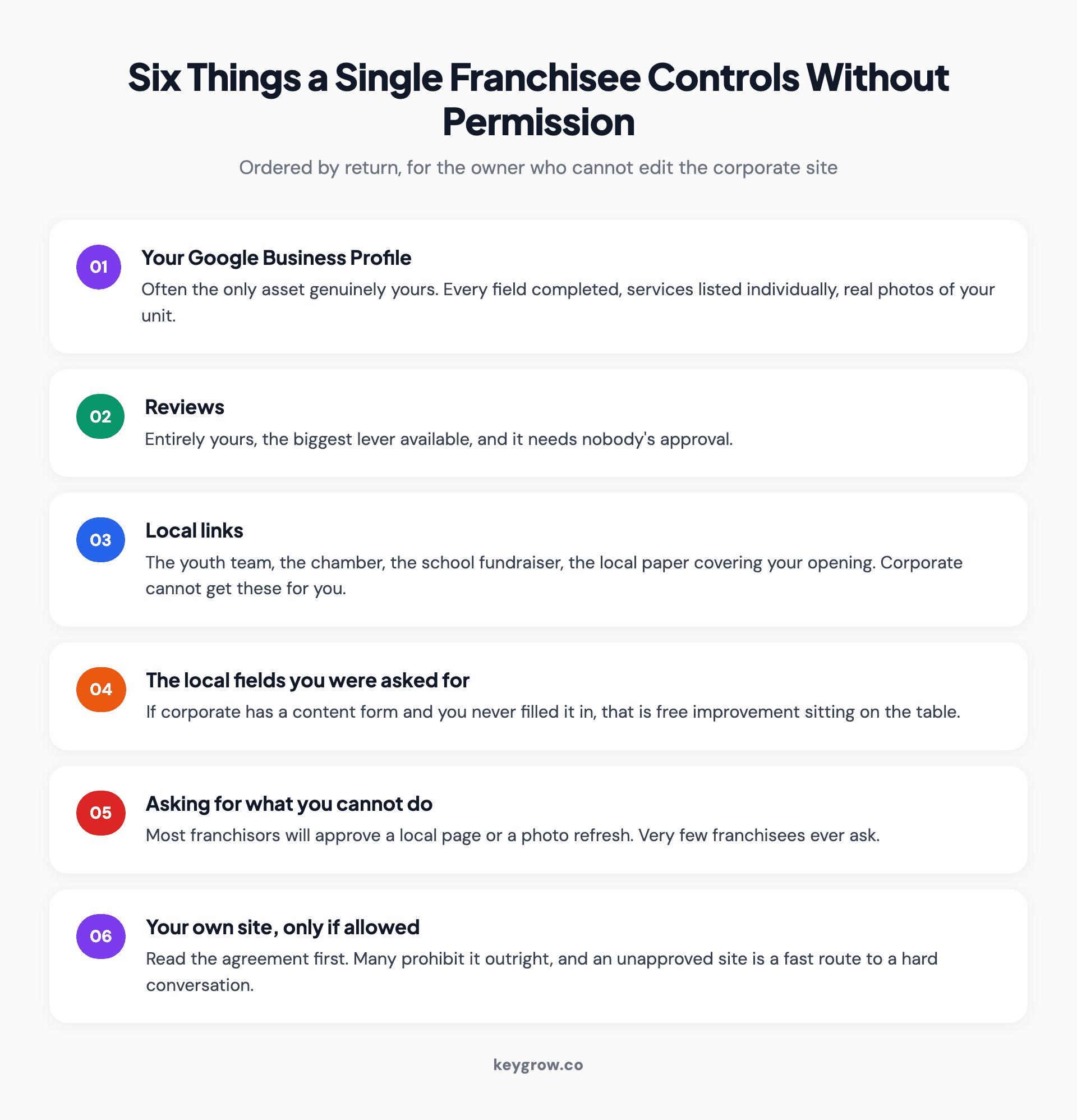
Six things a single franchisee controls without corporate permission, ordered by return.
If you have done all six and the corporate site is still the bottleneck, the honest advice is to organize. A regional council of owners asking for the same fix carries considerably more weight than one email.
What to measure across 140 locations without fooling yourself
Averages hide everything at this scale. Report the median, the bottom decile, and the count of units that moved, because a system average can rise while sixty locations get worse.

A person walking two colleagues through performance charts on a monitor.
The standard franchise dashboard is an average, and an average across 140 units is close to useless. Twelve flagship locations in dense markets can carry a number while the tail rots.
| Report this | Instead of | What it exposes |
|---|---|---|
| Median calls per unit | Total system calls | Whether the typical unit improved |
| Bottom decile by rating | Average rating | The stores that need operations help, not marketing |
| Units with zero reviews in 90 days | Total review count | Dormant locations before the franchisee complains |
| Count of units that improved | System traffic growth | Whether the program actually reached the tail |
| Development inquiries by page | Total site traffic | Which development content signs owners |
The opinion, and I will hold it against most agency reporting in this category: a franchise SEO report that leads with total system traffic is a report designed to be renewed rather than acted on. Ask for the bottom decile. If your provider does not have it, they are not looking at your system, they are looking at your domain.
When a franchise system should not be buying SEO
If your unit economics are unproven, if you are below roughly twenty units, or if operations quality varies wildly across the system, fix that first. Search will only distribute what you already are.
There is a real trap here. SEO at franchise scale amplifies. A system with strong operations and consistent delivery gets amplified into more of that. A system where a third of the units are struggling gets amplified into public evidence that a third of the units are struggling, at volume, in the reviews, permanently.
Under twenty units the maths usually favors doing it manually: get the profiles right, get the location pages genuinely local, and skip the platform. The tooling and process overhead that makes franchise SEO its own discipline does not pay for itself until the count is high enough that manual stops working.
And if your development funnel is the priority, that is a content project and a compliance review, not a local SEO program. Do not let a local SEO retainer absorb a budget that should be signing owners. Our SEO service scopes those as two separate projects for exactly this reason.
FAQs
Should each franchise location have its own website?
Almost never. Subfolders on the corporate domain let every location benefit from authority the brand earns, while separate domains make each unit start from zero. Subdomains are defensible for very large systems with real local marketing teams, but they split authority in the same way and need a reason. If you have inherited separate franchisee domains, consolidating is usually worth the disruption.
How do you avoid location pages being treated as duplicate content?
By putting something on each page that could only be true of that location: the manager, the actual hours, what is nearby, which services that unit offers, photos of the building, reviews from that store. Word count does not fix it. The reliable method at scale is a short form the franchisee fills in, because they hold the facts nobody at head office has.
Who should pay for franchise SEO, corporate or the franchisee?
Whatever the answer is, put it in writing before the work starts. Systems commonly fund architecture, templates, brand content and the profile management centrally from the marketing fund, and leave local link building and review generation with the owner. The failure mode is not the split itself, it is the split never being stated, so both sides assume the other is handling the middle.
How long does franchise SEO take to show results?
Profile work moves in six to eight weeks per location. Location pages typically take four to eight months to produce steady inquiries, and the development funnel is slower still because the buying cycle itself runs months. At system scale, expect the tail of locations to lag the leaders by a quarter or more, which is exactly why median matters more than average.
Can franchisees run their own Google Ads or SEO?
Only within whatever the franchise agreement and brand standards allow, and the answer differs by system. Most systems permit local profile management and review generation, restrict paid search on brand terms because franchisees end up bidding against each other, and require approval for anything published under the brand name. Read the agreement before spending anything.
What is franchise development SEO?
It is search work aimed at prospective franchise owners rather than customers: total investment, territory availability, what the first year involves, and honest qualification content. It lives on the corporate site, converts at a value no location page can match, and is currently dominated by brokerage and aggregator sites in most categories. Financial claims in it are subject to the same disclosure rules as the rest of your franchise sales material.
Do AI answers change anything for multi-location brands?
They raise the cost of inconsistency. Assistants assemble an answer from your profile, your location page and third-party listings at once, and when those disagree about hours or services the answer degrades or picks the wrong one. The systems that do well here are the ones already keeping a single source of truth, which is the same discipline that makes the map pack work. Our answer engine optimization work is largely about that consistency.
What to fix first, by seat
If you run marketing for the system: audit the development funnel this week, because it is probably empty and it is worth more per conversion than anything else on your list. Then fix the location page template so it demands local fields instead of accepting blanks.
If you own units: complete the profile, get reviews moving, chase three local links, and submit every local field corporate has ever asked you for. That is a weekend and it is most of the return available to you.
If you are not sure which of the two funnels is underperforming, that is usually a reporting problem rather than a marketing one, and the fix is the median-and-bottom-decile view rather than a bigger budget.
We work with multi-location and franchised businesses month-to-month with no lock-in, and we will tell you if your unit count is too low to need us yet. If you want a read on which funnel to fix first, start here, or see how the paid side of this works in franchise Google Ads.