


Franchise Google Ads is a governance problem wearing marketing clothes. Almost every expensive failure in a franchise account traces back to a decision that was never written down: who bids on the brand name, who owns the boundary between two territories inside an auction that has never heard of your territory map, and who pays for a click that lands on a shared website.
You can hire a very good PPC manager and still lose money on all three, because none of them are settled in the ads account. They are settled in the franchise agreement and the ad fund.
So this is not a setup guide. It is a list of the decisions that have to exist in writing before a single campaign is worth building, plus one rule that quietly changed in 2025 and made a chunk of the standard advice wrong.
Three models, and the one most systems land on
There are only three ways to run paid search across a franchise system, and each buys you a different problem.
| Model | Who runs it | What you gain | What breaks |
|---|---|---|---|
| Franchisor-controlled | Corporate runs everything, costs charged back | Consistency, no internal bidding | Local nuance lost, franchisees feel billed for something they cannot steer |
| Franchisee-controlled | Each owner runs their own | Local agility, owner accountability | Overlapping bids, inconsistent claims, uneven quality |
| Hybrid co-op | Fund covers brand and national, owners run local within guardrails | Both, in theory | Only works if the guardrails are specific and enforced |
Most mature systems end up hybrid, and most hybrid systems are hybrid in name only. The fund exists, the guardrails are a paragraph in a brand manual nobody reads, and enforcement is a quarterly email. That is the actual starting condition for most franchise accounts, and it is worth naming before designing anything.
The useful question is not which model is best. It is which decisions get written down, because a hybrid model with four specific written rules beats a franchisor-controlled model with none.
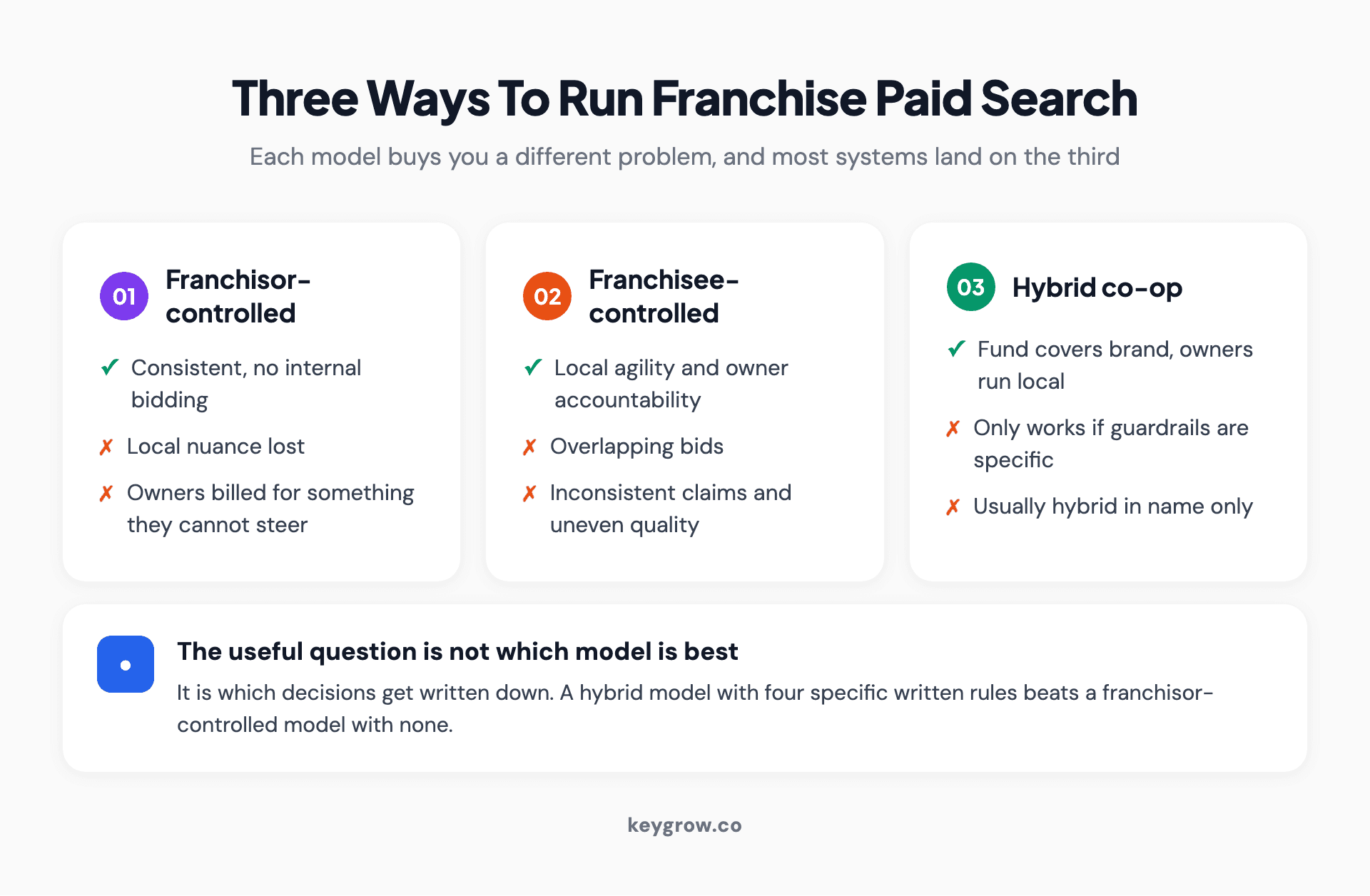
Three cards comparing franchisor-controlled, franchisee-controlled and hybrid co-op models for running franchise paid search, with what each gains and what breaks.
The rule most franchise ad advice is built on changed in 2025
For years the advice was blunt: two locations from the same brand cannot both show on one results page, so franchisees bidding on the same term are wasting money on a fight only one of them can win. The second half is still true. The first half is not.
Google's base rule is short. Under Google's ad network policies, "Using the Google Network to gain an unfair traffic advantage over other participants in the auction is not allowed."
What changed is the interpretation. On April 14, 2025, as Search Engine Land reported, Google clarified that the restriction on showing more than one ad for the same business, app or site applies only within a single ad location. Different ad locations on the same page are now permitted.
That matters to a franchise system more than to almost anyone else, because a franchise system is the textbook case of many advertisers sharing one brand and often one domain. It does not mean the coordination problem went away. It means the mechanism changed: you are no longer relying on Google to suppress the duplicate, which is exactly what a lot of systems were quietly doing instead of managing territory properly.
Treat it as a reason to write the rules down rather than a reason to relax.
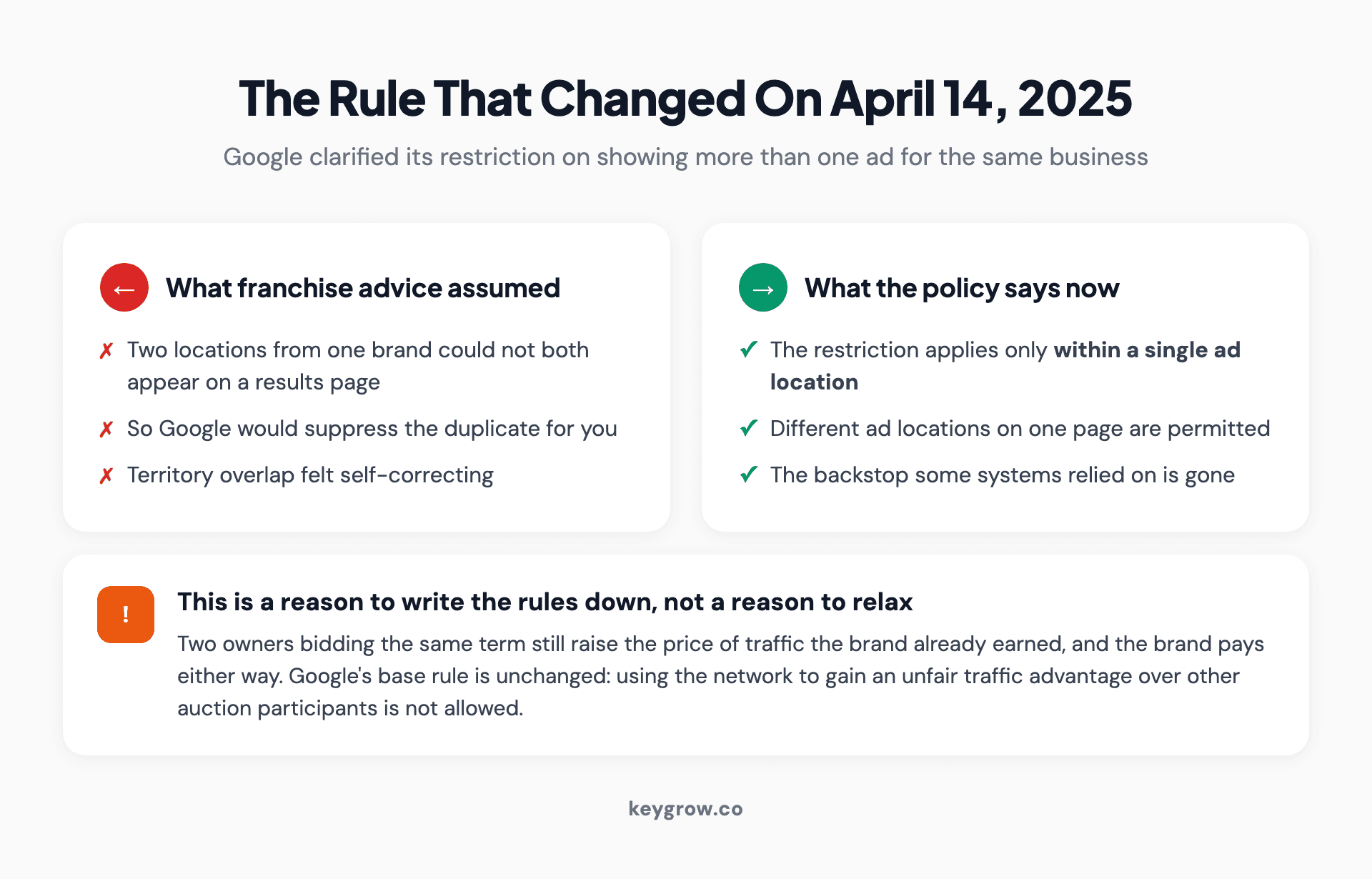
Before and after comparison of Google's double serving rule, showing that since April 14 2025 the restriction on more than one ad for the same business applies only within a single ad location.
Where two franchisees actually collide
Not everywhere. The collisions are specific and worth separating, because the fix is different for each.
On the brand name. Two owners bidding on the system's own name is the most expensive and most common conflict. It raises the price of traffic the brand already earned, and the brand pays either way.
On generic local terms in overlapping radii. Two locations twenty minutes apart, each targeting a fifteen mile radius, produce an overlap zone where they bid against each other on the same generic search. Nobody planned this. It emerges from two reasonable settings.
On the fringe of a territory. The searcher standing between two territories is genuinely ambiguous. This one is not fixable by rules alone and needs a stated tie-break: nearest location wins, or the territory the address falls in wins.
Where they do not collide is on their own city and neighborhood terms, which is most of the account. The conflict is smaller than franchise anxiety suggests, but it sits on the most valuable traffic in the system.
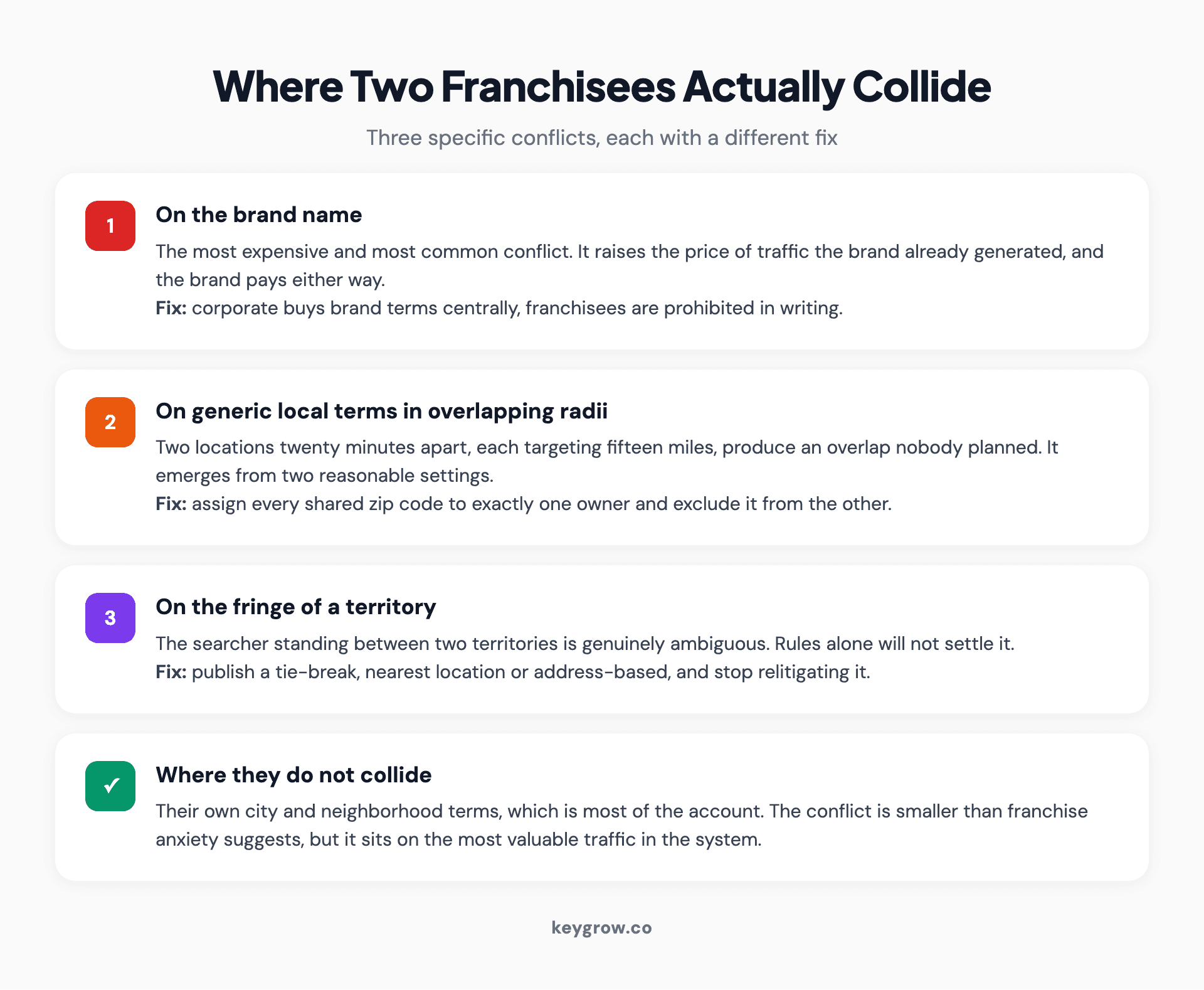
Four cards covering where two franchisees collide in the ad auction: the brand name, generic local terms in overlapping radii, territory fringes, and where they do not collide.
Brand terms belong to the system, and they leak
Brand searches should be bought once, centrally, and pointed at a location finder that routes properly. This is the single clearest rule in franchise paid search and the one most often broken.
Two things go wrong. The first is internal: individual owners bid on the brand to capture demand the brand generated, which converts well for them and costs the system money. The second is external, and worse.
Third-party lead resellers and aggregator sites bid on franchise brand names constantly. They rank a page about your brand, capture the searcher, and sell that lead back into your system or to a competitor. If corporate is not defending the brand term, somebody else is monetizing it. We wrote about the mechanics of this in competitor brand keyword bidding, and franchise systems are the most exposed of any business model because the brand is valuable and the defense is nobody's specific job.
The rule to write down is one sentence: franchisees may not bid on the system brand name or close variants, and corporate will run a defended brand campaign continuously. Then actually run it.

A produce display stacked with vegetables and pumpkins inside a small independent grocery shop.
Territory lines do not exist inside the auction
Your franchise agreement has a map. Google does not have that map, and no setting imports it.
Radius targeting is an approximation of a territory, not a translation of one. Two things routinely undo it:
- The location option defaults to presence or interest. Set every campaign to presence only, meaning people in or regularly in your targeted locations. Interest-based inclusion means paying for someone in another owner's territory researching your service.
- Radii overlap even when territories do not. A fifteen mile radius drawn around two locations eighteen miles apart overlaps substantially. Use excluded locations to carve the overlap out, and assign each shared zip code to exactly one owner in writing.
Zip code and city targeting is coarser than a radius but it maps far better onto a territory agreement, because territory agreements are usually written in the same units. For most franchise systems that is the right trade.
The fringe cases still need a human rule. Pick one, publish it, and stop relitigating it every quarter.
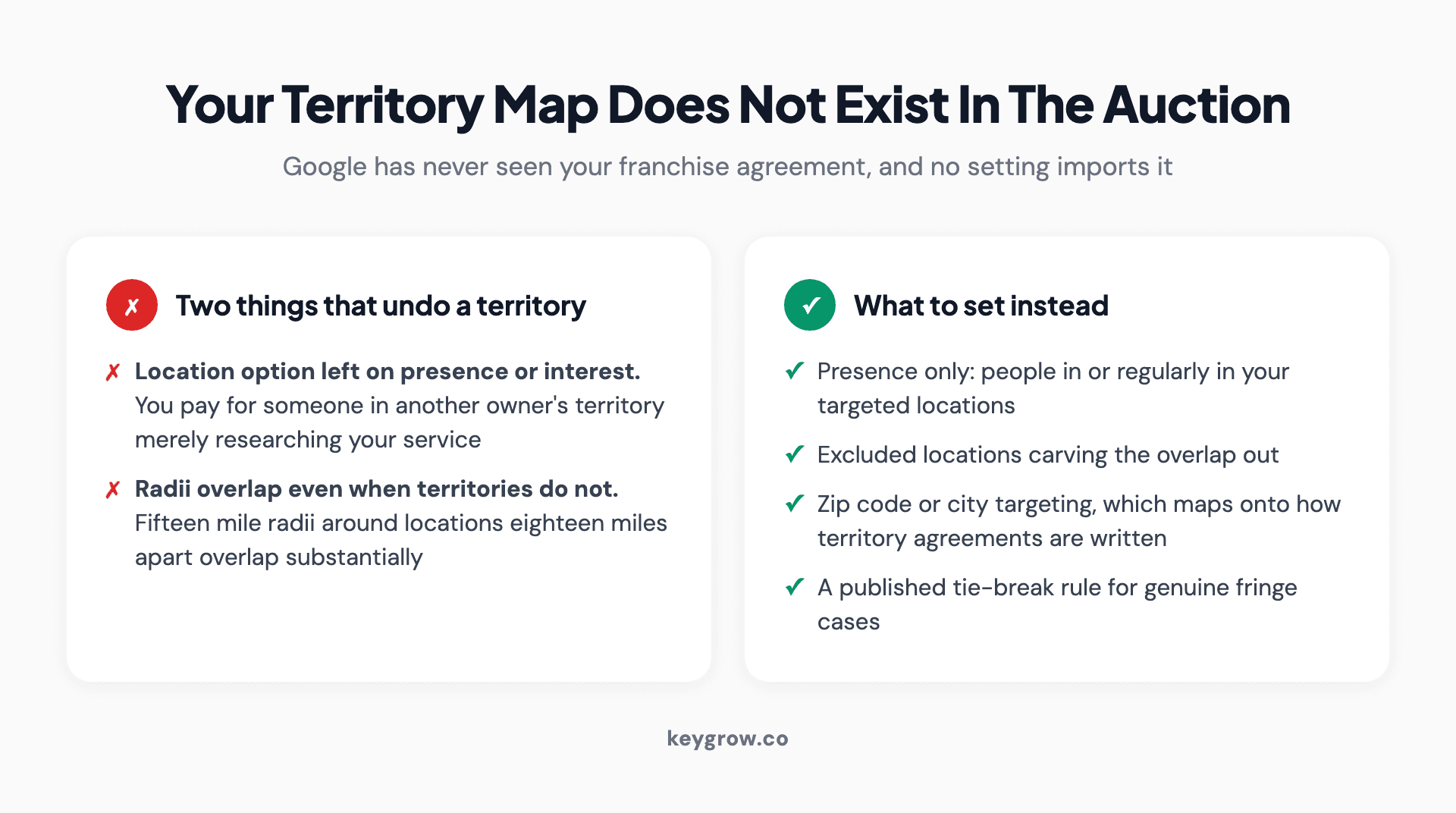
Two-column card layout showing the two settings that undo a franchise territory, presence-or-interest targeting and overlapping radii, against the settings to use instead.
Who pays for what, and say it in writing
The ad fund question causes more franchise friction than any targeting setting, and it is almost always underspecified.
A typical system charges into a national fund, and owners also spend locally. That is fine until nobody has defined which layer buys which click. Then a franchisee looks at their local invoice, sees they are also paying a percentage of revenue into a fund that runs brand campaigns, and reasonably asks what they are getting.
Four things worth putting in the document:
- What the fund buys. Brand terms, national campaigns, the shared measurement stack, creative production.
- What local budget buys. Non-brand local search, local landing pages, local promotions.
- How overlap zones are funded. Whoever owns the zip code funds it. Not both.
- What reporting each side gets. Owners paying into a fund should see what it produced, in leads and cost, not in impressions.
That last one is where most systems lose franchisee trust. A national ad fund is the easiest place in marketing to hide behind reach and impressions, because the people receiving the report have no way to audit it. If the fund report leads with impressions rather than cost per lead by market, franchisees are right to be suspicious.
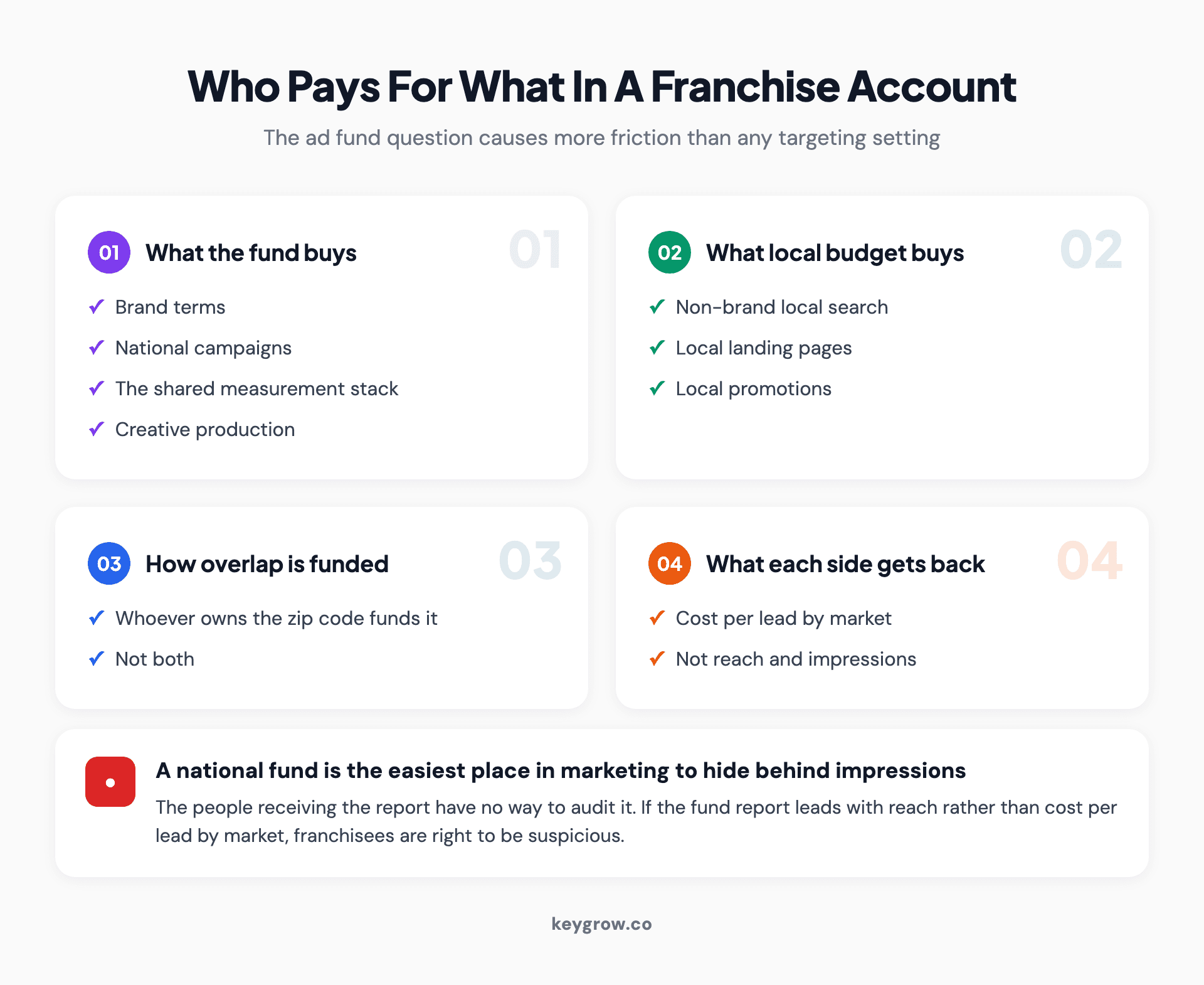
Four numbered cards splitting franchise ad spending: what the national fund buys, what local budget buys, how overlap zones are funded, and what reporting each side gets back.
One account or many?
One Google Ads account with a campaign per location, under a manager account, is the right default for most systems. Separate accounts per franchisee is the arrangement that produces the most accidental conflict.
The case for one account is practical rather than ideological. Shared negative keyword lists apply system-wide. Conversion tracking is defined once and defined the same way. Overlap is visible to whoever is looking, instead of invisible across account boundaries. And budget can be compared between markets without exporting three spreadsheets.
The case for separate accounts is real in exactly one situation: when franchisees genuinely control their own spend and want their own billing, and the system has no capacity to administer centrally. If that is you, the mitigation is a written shared negative list, a written territory allocation, and a standing brand-term prohibition. Those three documents do most of the work a single account would have done automatically.
Either way, use location assets so each ad carries the right address, and make sure the Business Profile for each location is claimed by someone who will still be there in two years.
What the landing page has to do
Sending local ad traffic to the corporate homepage is the most expensive default in franchise marketing, and it is the norm.
Somebody searched for a service in their suburb. They clicked an ad naming their suburb. They arrive on a national homepage with a store locator, a franchise opportunity banner, and no phone number for the location they wanted. The ad did its job and the page threw it away.
Every location needs its own page carrying that location's address, phone number, hours, staff, reviews and a booking action that works. Not a locator entry. A page.
We rebuilt a security services client's landing page around one clear action and the facts people needed before taking it, and the conversion rate went up 95 percent in four weeks on identical traffic. Nothing about that is franchise-specific, which is the point: the fix is cheap, it is repeatable across every location in the system, and it is worth more than any bidding change you could make. The trade-offs between a dedicated page and your main site are covered in our note on ad landing pages.
Franchisors can solve this once. Build the location page template centrally, populate it per location, and stop letting fifty owners each solve it badly.
What to measure when the buyer is the franchisee
Report by market, in the units an owner cares about, or the program loses political support and gets cut.
A franchise ad program has two audiences with different questions. Corporate wants system-wide cost per lead, coverage and consistency. The owner wants to know whether last month paid for itself in their store. A single blended report answers neither.
Build it to answer the owner's question first: leads, cost per lead, and booked jobs or transactions for their location, next to the same numbers for the system median. That comparison is the one thing that makes an underperforming owner engage rather than argue, because it separates "the ads do not work" from "the ads work everywhere except here, so let us look at your phone answering."
For service franchises where the job value swings widely, feed real transaction values back rather than counting leads. Our guide to lead value from PPC covers the mechanics.
The organic side has a funnel this post does not touch
Paid search serves the customer funnel. Organic serves that one too, and also the funnel that sells franchises, which no ad account is built for.
A prospective owner researching total investment, territory availability and what the first year involves spends months on it and rarely clicks an ad while doing so. That is a content problem with a compliance review attached, and it converts at a value no location page can match. We split both funnels out in SEO for franchises, including why the development half is usually sitting empty while brokerage sites answer for you.
Where franchise ad money leaks
Four patterns, in rough order of cost.
- Undefended brand terms. The cheapest, highest-converting traffic in the system, left to whoever wants it. Usually a lead reseller.
- Owners bidding against each other in overlap zones. Two reasonable radius settings, one auction, one bill that arrives twice.
- Local ads pointed at the corporate site. Covered above. Endemic, and the easiest thing on this list to fix.
- A fund with no market-level reporting. Not a media waste exactly, but it produces the political failure that ends programs: owners who stop believing the fund works and start spending unilaterally, which recreates every problem above.
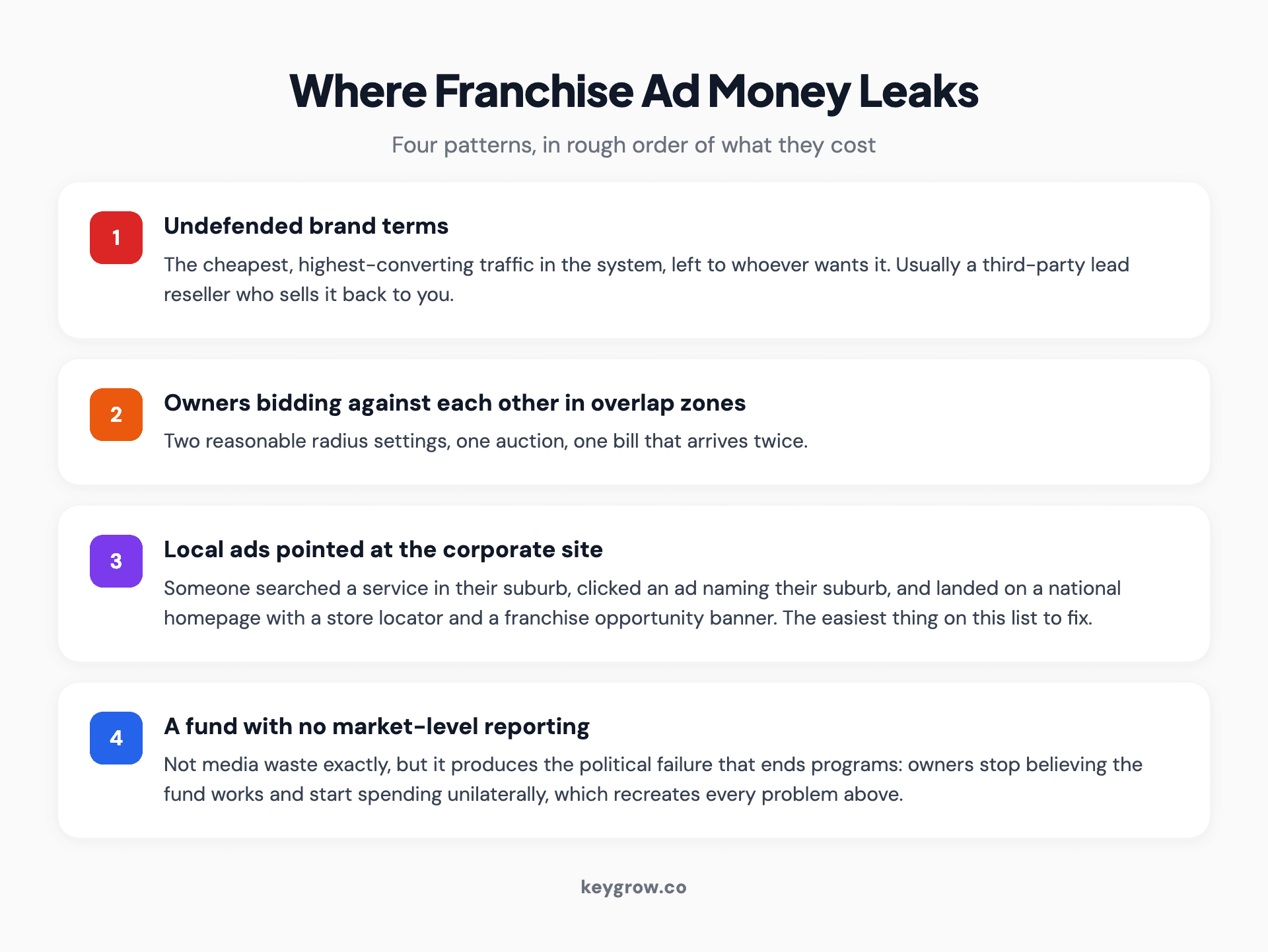
Four ranked cards showing where franchise ad money leaks, from undefended brand terms down to a national fund with no market-level reporting.
If you are running a multi-location system and want the governance written properly rather than described, that is the work our PPC management does. If you are a single franchisee wondering whether to run ads at all, the honest starting point is our piece on small business Google Ads.
FAQs
Should franchisees run their own Google Ads?
Only inside written guardrails. The workable version gives owners local non-brand search and local landing pages, while corporate runs brand terms centrally and publishes a shared negative keyword list and a territory allocation. Without those three documents, franchisee-run accounts reliably end up bidding against each other on the system's most valuable traffic.
Can two franchisees of the same brand show ads on the same search?
Since April 14, 2025, Google's policy allows more than one ad for the same business, app or site on a results page provided each appears in a different ad location. The previous restriction applied more broadly. This does not make internal competition a good idea: two owners bidding on the same term still raise the price of traffic the brand already earned.
Who should bid on the franchise brand name?
Corporate, centrally, and continuously. Brand searches are the cheapest and best-converting traffic a franchise system has. If nobody defends them, third-party lead resellers and aggregators will bid on the brand and sell the resulting leads back into the system or to a competitor.
How do you stop franchisees competing in overlapping territories?
Assign every shared zip code to exactly one owner in writing, set location targeting to presence only rather than presence or interest, and use excluded locations to carve overlap zones out of the neighboring campaign. Then publish a tie-break rule for genuine fringe cases so it is decided once rather than argued quarterly.
Should a franchise use one Google Ads account or one per location?
One account with a campaign per location, under a manager account, is the right default. It makes shared negative lists, consistent conversion tracking and cross-market comparison automatic, and it makes territory overlap visible instead of hidden across account boundaries. Separate accounts are defensible only when owners genuinely control their own billing and spend.
What should a national ad fund actually pay for?
Brand terms, national campaigns, the shared measurement setup and creative production, with local budget covering non-brand local search and local pages. Whichever it is, write it down and report back to the owners paying in, using cost per lead by market rather than impressions.
How much should a franchise location spend on Google Ads?
Set it per market rather than per system, because a location's cost per lead depends on local competition, not on the brand. The more useful control is a floor and a ceiling per location with the same conversion tracking everywhere, so you can compare markets honestly and move budget toward the ones returning.
The bottom line
Franchise paid search fails for governance reasons far more often than for technical ones. The account is rarely the problem. The absence of four written rules usually is: who bids on the brand, who owns each shared zip code, what the fund buys versus what local budget buys, and what gets reported back to the people paying in.
Write those four down and an ordinary PPC setup will perform well. Skip them and an excellent one will still leak, quarter after quarter, in ways that look like a media problem and are not.
One more time on the piece that changed: Google now permits more than one ad from the same business on a page when they sit in different ad locations. That removes a backstop some systems were relying on without knowing it. The coordination is yours to do now.