


Towing Google Ads convert better than almost any other kind of Google Ads, and most towing operators never find out because they judge the account on the wrong thing. The category your campaigns fall into posts a 15.51% conversion rate against an all-industry average of 8.18%, at a cost per lead of $29.96 against $66.69. Nearly double the conversion rate for less than half the cost. Nothing about that is because towing ads are well written. It is because the person searching is standing next to a vehicle that will not move.
Which means the interesting question for a tow operator is not how to write a better ad. It is what to do with a channel where persuasion has already been handled for you.
The number that should change how you run a towing account
WordStream's 2026 benchmarks cover 13,474 US search advertising campaigns between April 2025 and March 2026. Towing sits inside automotive repair and service, and that row is an outlier in the dataset.
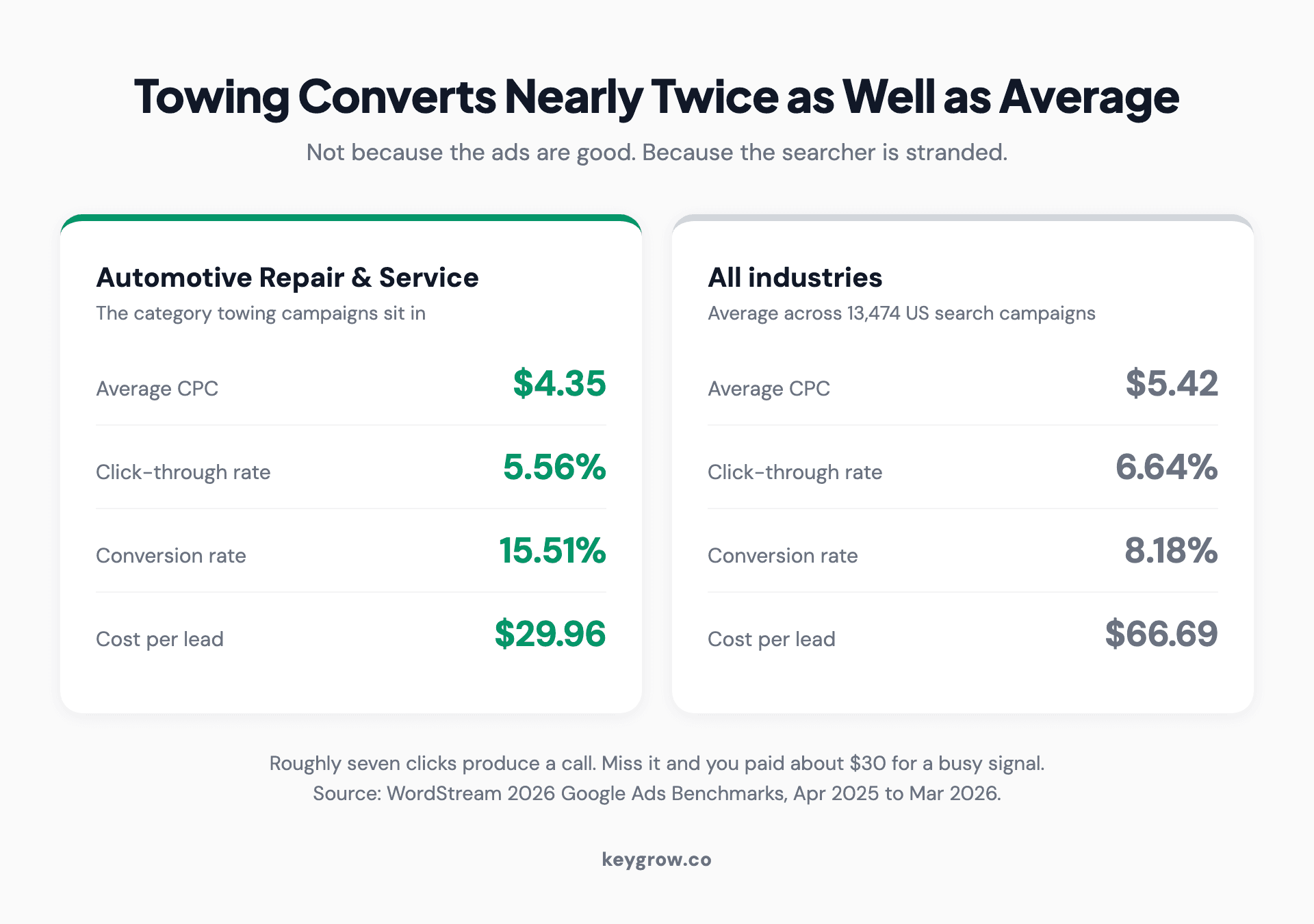
Comparison of Google Ads benchmarks for automotive repair and service against the all industry average, showing conversion rate of 15.51 percent versus 8.18 percent and cost per lead of $29.96 versus $66.69.
| Metric | Automotive Repair & Service | All industries |
|---|---|---|
| Average CPC | $4.35 | $5.42 |
| Average CTR | 5.56% | 6.64% |
| Conversion rate | 15.51% | 8.18% |
| Cost per lead | $29.96 | $66.69 |
Read the click-through rate first, because it is the one that looks bad. Automotive service ads get clicked less often than the average ad. Then look at what happens to the people who do click: more than one in seven of them converts. The ad is being ignored by everyone who does not need it and acted on immediately by everyone who does. That is close to a perfect filter, and you did not build it. Circumstance built it.
Now hold that next to what a towing account actually costs you when it goes wrong. At $4.35 a click and a 15.51% conversion rate, roughly seven clicks produce a call. If you miss that call, you paid about thirty dollars for a busy signal.
Towing is a dispatch problem wearing a marketing costume
Here is the thing almost no towing marketing guide will tell you, because it argues against buying more marketing: in this vertical, the campaign is rarely the constraint. The constraint is usually the twenty seconds after the phone rings.
A stranded driver is not comparison shopping. They are calling the first number that appears and, if nobody picks up within a few rings, the second. There is no consideration phase, no email nurture, no remarketing sequence that recovers them. The lead has a shelf life measured in seconds, and every operational weakness you have gets converted directly into wasted ad spend.
So before touching a keyword, get honest about three things:
- Answer rate after hours. Not your answer rate overall. Your answer rate between 11pm and 6am, which is when a meaningful share of the volume arrives.
- Time to answer. Three rings is the working target. A voicemail greeting hands the job to whoever picks up second.
- Time to arrival, honestly stated. If you tell the caller forty minutes and it takes ninety, the review that follows costs you more than the job earned.
If any of those three are weak, more clicks will make your problem more expensive rather than smaller. We would tell a towing company in that position to fix dispatch first and call us in a month, because an agency that will not tell you when the answer is not advertising is selling rather than advising.
Two businesses share the word towing
Most underperforming towing accounts we audit are running two unrelated businesses through one campaign.
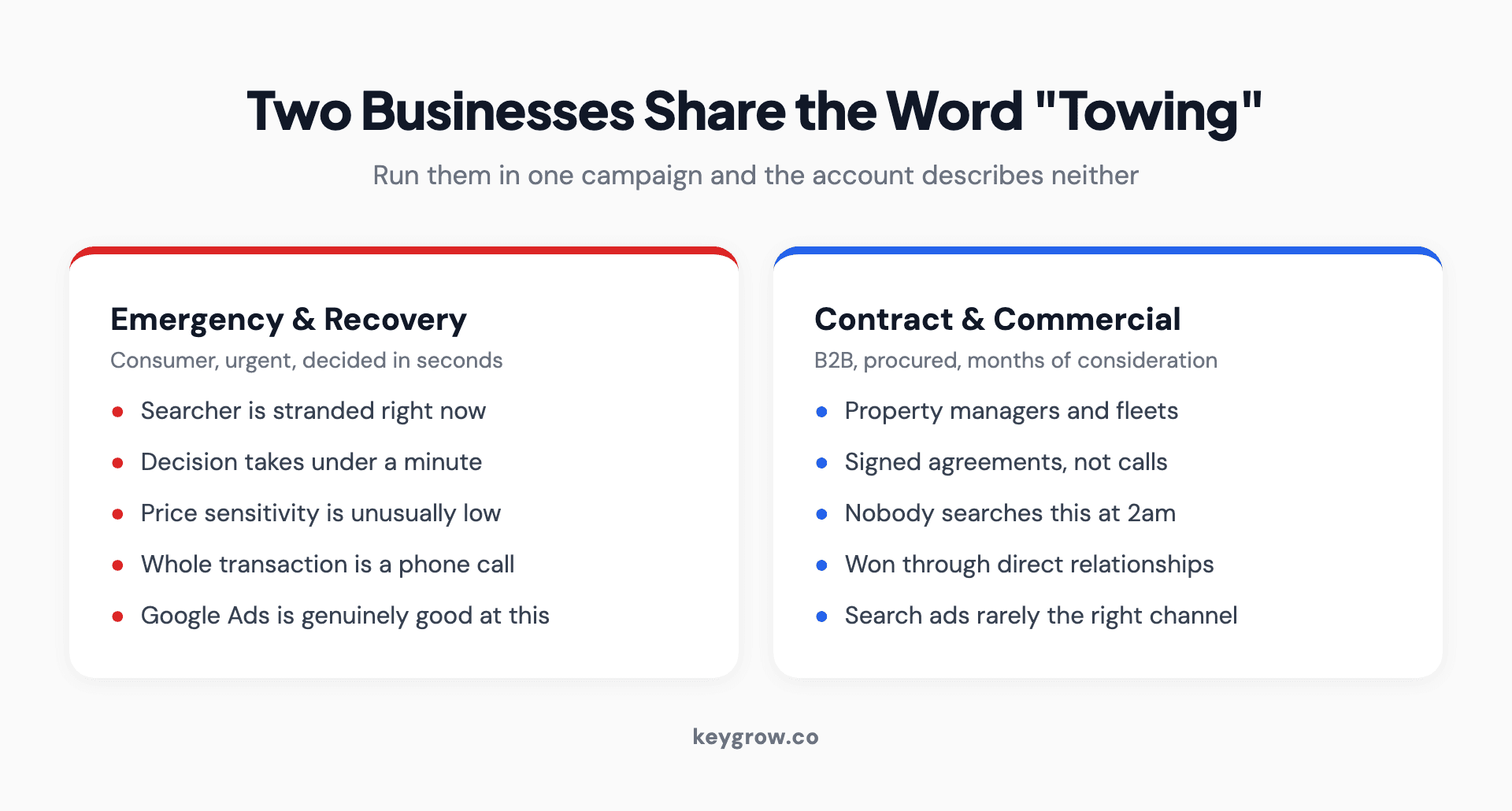
Two column comparison of emergency roadside towing versus contract and commercial towing, showing different buyers, search behavior, urgency and the campaign structure each requires.
Emergency roadside and accident recovery is a consumer business. The searcher is stranded, the decision takes seconds, price sensitivity at the moment of need is unusually low, and the entire transaction happens on a phone call. This is what Google Ads is genuinely good at.
Contract, impound and equipment transport is a business-to-business relationship. Property management companies, municipalities, dealerships, motor clubs and fleet operators sign agreements. Nobody is searching for an impound contractor at 2am with an urgent need. These deals come from relationships, procurement processes and long consideration cycles.
Running them together produces an account that satisfies neither. The emergency keywords hog the budget because they get all the volume, the commercial keywords never accumulate enough data to optimize, and the blended cost per lead is a number describing two things at once.
Separate them at the campaign level or, better, decide that Google Ads is for the emergency side and win the contract side through direct outreach where it actually lives.
Who you are actually bidding against
This is the part that surprises operators, and it explains why your cost per click keeps climbing while your competitor down the road swears they are not bidding more.
You are not only competing with other tow trucks. You are competing with roadside assistance networks, motor clubs and lead resellers who bid on the same emergency terms. Their economics are different from yours in a way that matters: a single click is worth more to them than it is to you, because they monetize the resulting call across a network of operators rather than against one truck's revenue on one job. Some of them sell the same lead more than once.
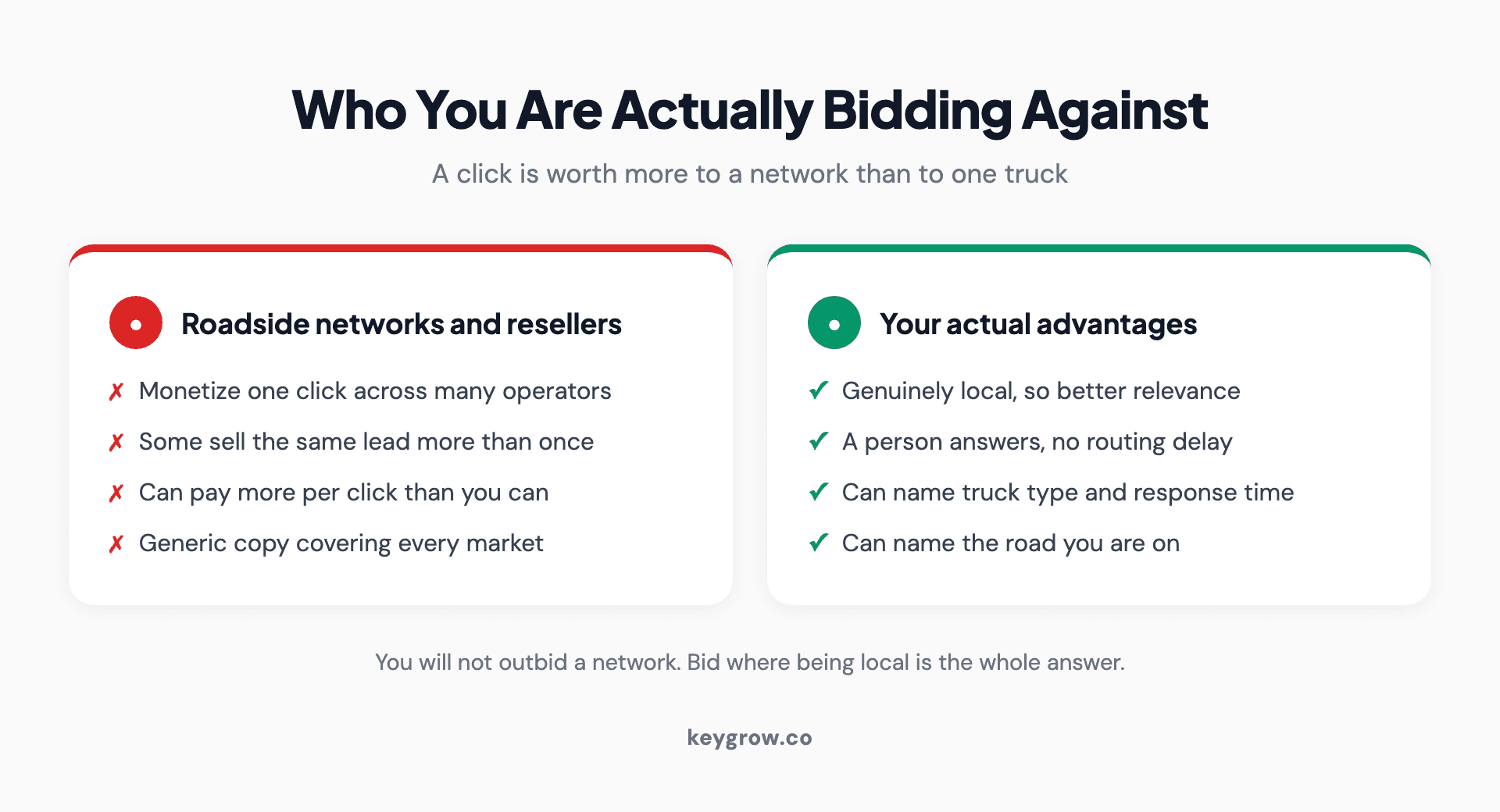
Diagram showing how a single towing search click is worth more to a roadside network or lead reseller than to an individual tow operator, and where the local operator's advantage lies.
You will not outbid that. Attempting to is how towing accounts quietly turn into charity.
What you have instead is three advantages an aggregator cannot copy:
- You are actually local. Hyper-tight geographic targeting on the roads you genuinely cover beats a national bidder's broad coverage, because your quality score and your relevance on a neighborhood-level query are better than theirs.
- You can answer the phone yourself. A network routes and delays. You pick up.
- You can be specific. Truck type, vehicle capability, response time from a named location. An aggregator's ad is generic because it has to cover every operator it works with.
Bid on the terms where being local is the whole answer, and let the aggregators have the generic national phrases.
The hours nobody else wants
Emergency towing demand does not follow business hours, and neither should your budget.
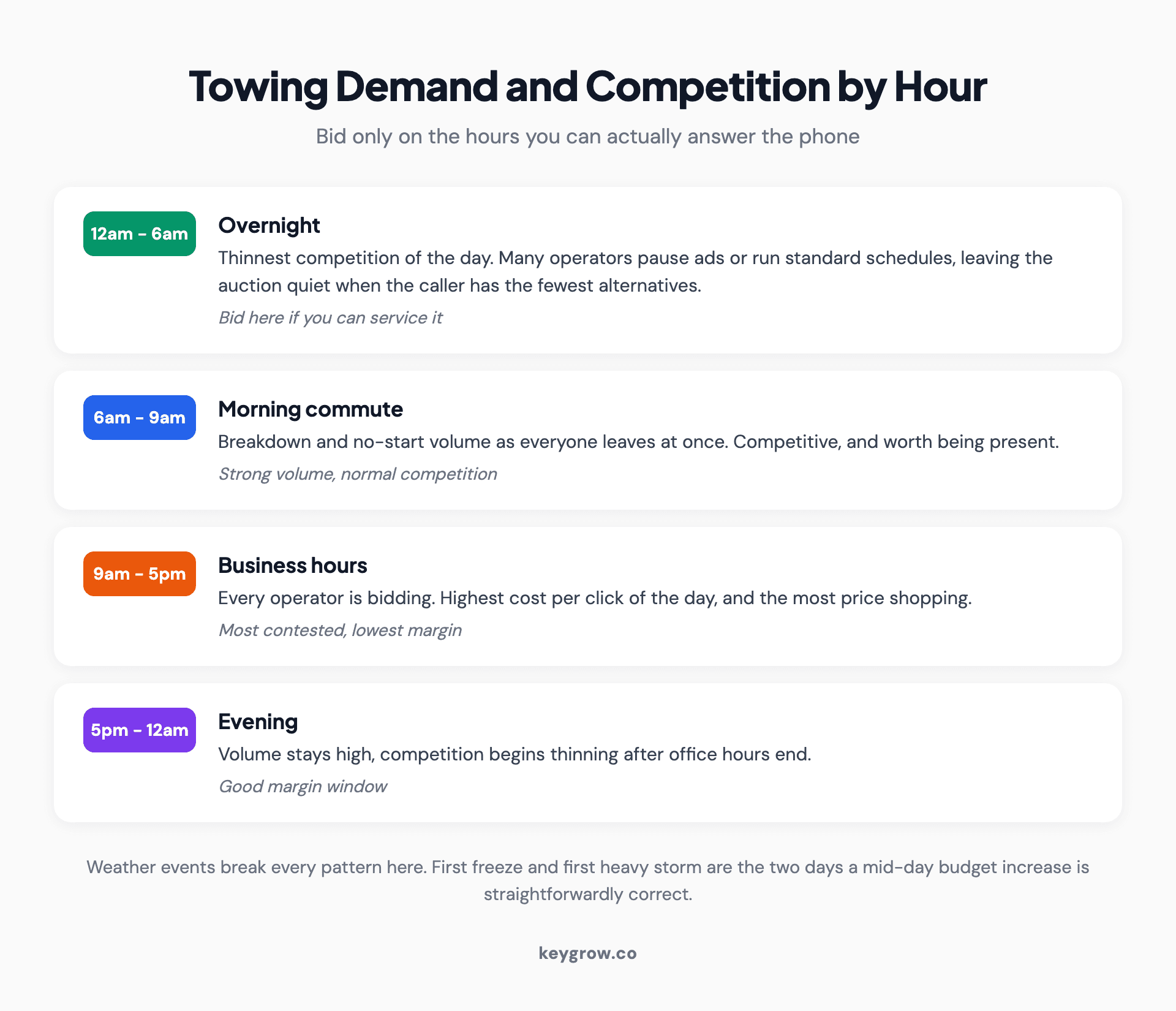
Chart style breakdown of towing demand and competition by time of day, showing overnight hours with thinner competition and weather events driving demand spikes.
Overnight, competition thins. Plenty of operators run their ads on a standard schedule, and some pause them entirely outside office hours, which leaves the auction quieter at exactly the moment when the searcher has the fewest alternatives and the least patience. If you have a truck available at 3am, that is when your money goes furthest.
Weather is the other pattern worth building around. First freeze, first heavy snow, first serious storm of the season. Demand spikes in a way no average monthly budget can absorb, and this is one of the few situations where raising a budget mid-day is straightforwardly correct.
The one caution: only bid on hours you can actually service. Buying 3am clicks and letting them go to voicemail is the single most expensive mistake available in this vertical, and at $4.35 a click it adds up faster than most operators expect.
The location targeting trap
Standard advice says to set a radius around your business. For towing, that advice is wrong often enough to be dangerous.
Your customer is not at their home or office. They are on a road, frequently a highway, sometimes unsure which municipality they are in, occasionally moving while they search. A radius drawn around your yard captures where you are, not where the breakdowns are.
Three adjustments that matter more than radius size:
- Target the corridors, not the circle. Highway stretches, interchanges, bridges and the roads with the worst surfaces in your area. Those are where your calls come from, and they rarely form a neat circle around your address.
- Check your presence settings. Google can serve ads to people in your targeted area and to people showing interest in it. For emergency towing you want physical presence, since somebody researching your town from another state is not stranded on your highway.
- Exclude what you cannot service. If you do not do heavy duty recovery, exclude the industrial corridors where those calls originate. Every irrelevant click is roughly $4.35 of nothing.
Call-only campaigns are gone, and most towing advice has not caught up
Every towing guide currently ranking for this topic tells you to run call-only campaigns. That advice is out of date, and following it now will waste your afternoon.
Google's own documentation is unambiguous. Per Google Ads Help, "February 2026: All options to create new call ads will be removed," and "February 2027: Existing call ads will stop receiving impressions." Google's stated replacement is to "add your phone numbers to responsive search ads as call assets," and it recommends migrating "immediately to ensure that your ads are eligible to be shown."
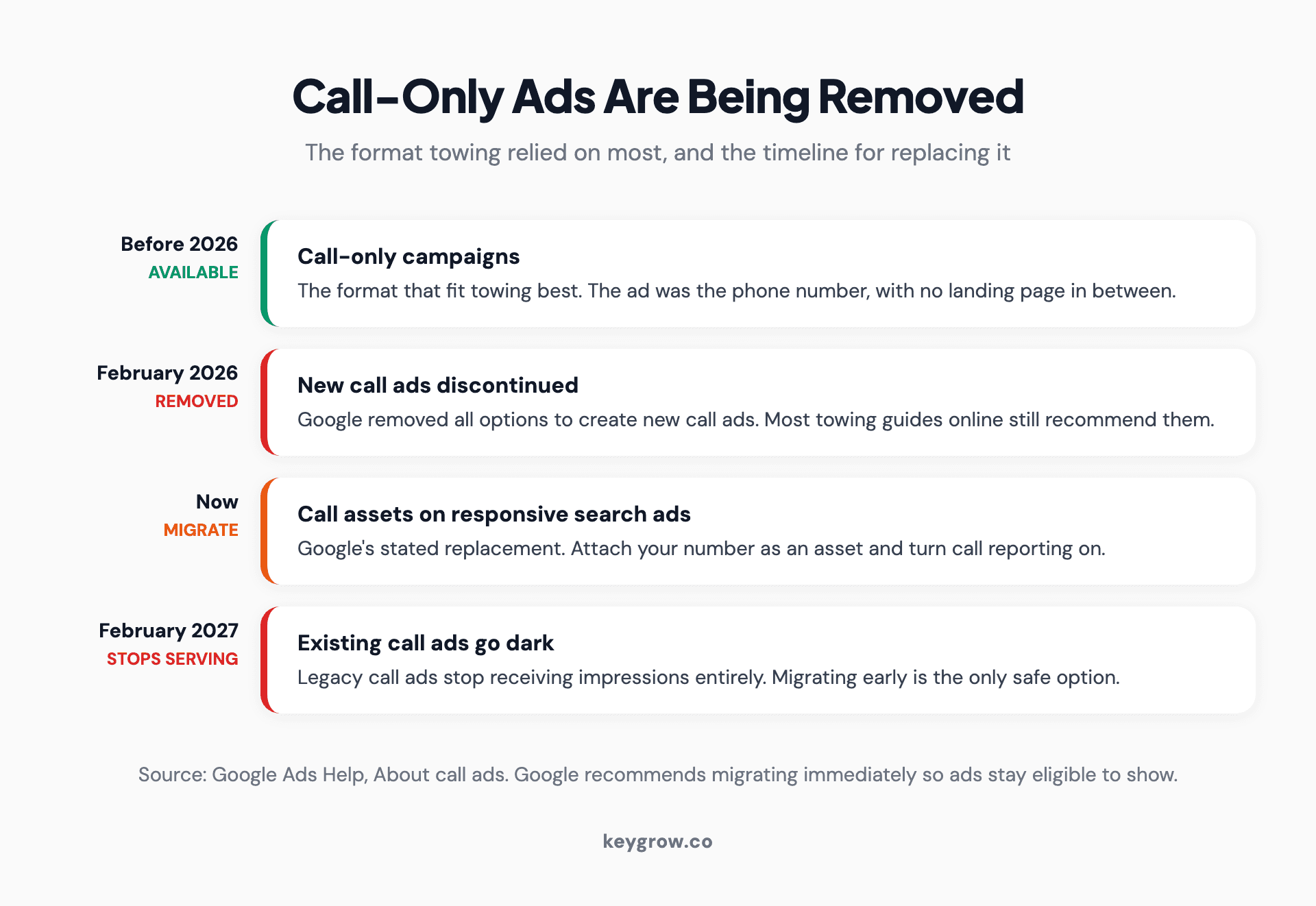
Timeline showing Google call ads removed for new creation in February 2026 and existing call ads losing impressions in February 2027, with call assets on responsive search ads as the replacement.
For a tow operator this matters more than it does for most advertisers, because call-only was the format that fit this business best. Three practical consequences:
- If you still have legacy call ads running, migrate now. They keep serving until February 2027 and then stop. Do not wait for the deadline to find out whether your replacement setup works.
- Call assets on responsive search ads are the format now. The phone number becomes an asset attached to a normal search ad rather than the whole ad. Set call reporting on so those calls register as conversions.
- Your landing page carries more weight than it used to. With a pure call ad, there was no page to lose anyone on. Now some share of clicks land on your site, and if that page is slow or cluttered you lose people you previously would have kept.
That page should be close to brutal:
- Phone number as the largest element on the screen, tappable, above everything
- Response time and service area in the first line
- Loads on a weak mobile signal, because that is the connection your customer has
- Nothing else at all
We had a phone repair client reach 115 or more inbound calls a month within seven months, and what made that number readable was tracking calls as the conversion rather than counting form fills that were never going to happen. Towing is the same shape of business. If your reporting leads with clicks and impressions, it is describing a business that is not yours.
How to structure a towing account
Four campaigns, in descending order of how much budget they deserve.
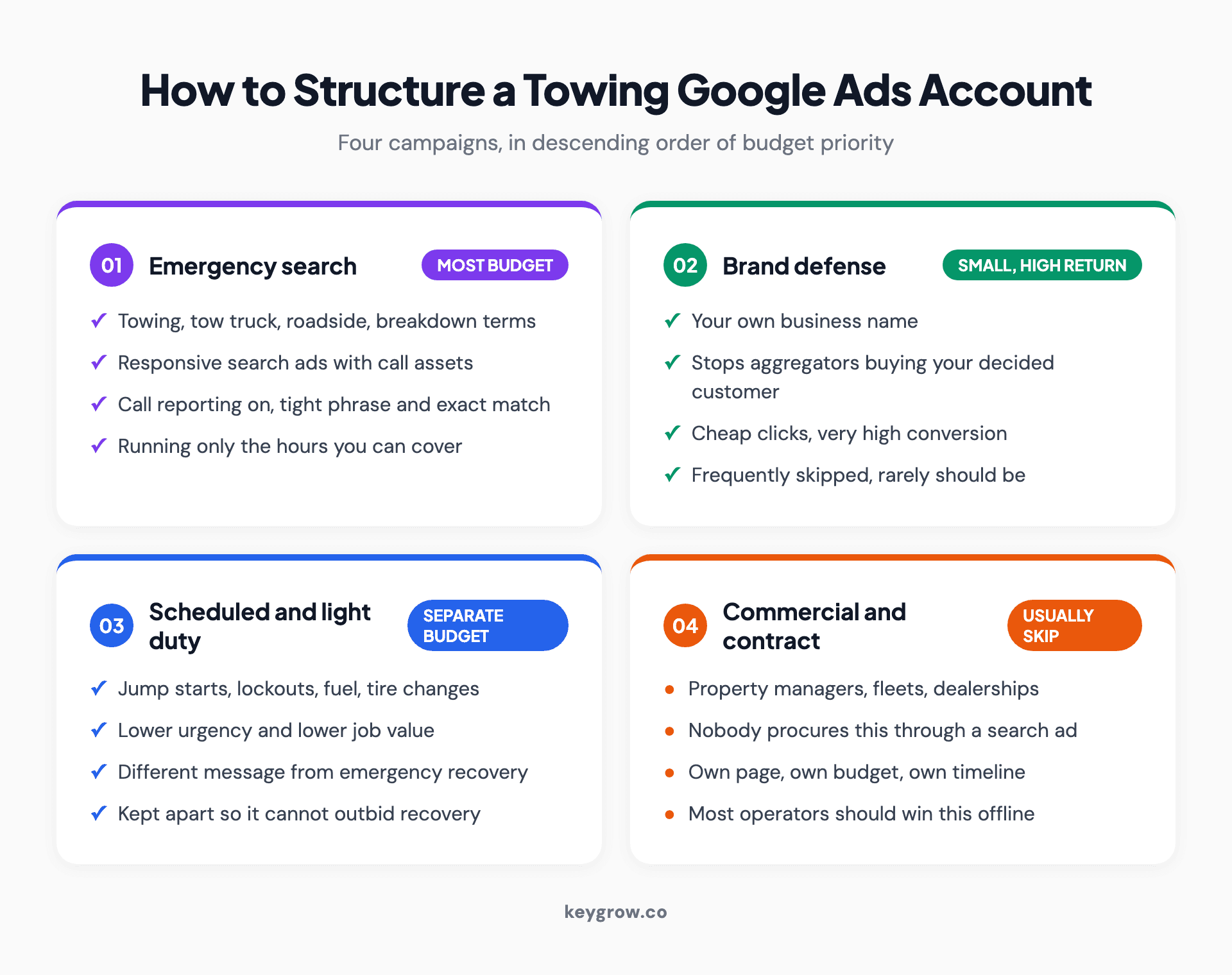
Four campaign structure for a towing Google Ads account covering emergency search, brand defense, scheduled and light duty work, and commercial contracts, with budget priority for each.
- Emergency search. Tight keyword set around towing, tow truck, roadside and breakdown terms plus your service geography. Responsive search ads with call assets, call reporting on, running the hours you can actually cover. This is most of the budget.
- Brand defense. Your own business name. Cheap, and it stops aggregators and competitors from buying the click of someone who already decided to call you. Small budget, high return, frequently skipped.
- Scheduled and light duty. Jump starts, lockouts, fuel delivery, tire changes, winch-outs. Lower urgency, lower value per job, and a very different message from emergency recovery. Separate campaign so it does not compete with the calls that pay more.
- Commercial and contract. Only if you genuinely pursue it through search, which most operators should not. Different keywords, different landing page, its own small budget, and judged on a completely different timeline.
Keep match types tight in the emergency campaign. Phrase and exact will cover the intent, and broad match in a query space this messy is where the budget disappears.
Ad copy for someone standing on a shoulder
The reader is stressed, on a phone, in bad light, possibly in the rain. Copy that would be a bit blunt in another industry is exactly right here.
What earns the call:
- A response time, stated as a number. "25 minute average response" beats "fast response" by a distance, and it is the single most useful thing you can put in a headline.
- Availability, plainly. Open now, 24/7, answering at 3am. Say the thing.
- The specific service. Flatbed, motorcycle, heavy duty, accident recovery. A driver with a lowered car or a bike needs to know you can take it.
- Where you are. A named road, suburb or corridor tells them you are close in a way "serving the metro area" does not.
- A price signal if you have a defensible one. Not the cheapest, just a number. Flat call-out fees convert well because they remove the fear of being gouged during an emergency.
What does not earn the call: family owned since 1987, fully insured and licensed, your satisfaction is our priority. All true, all irrelevant to somebody whose car is blocking a lane.
Negative keywords for a towing account
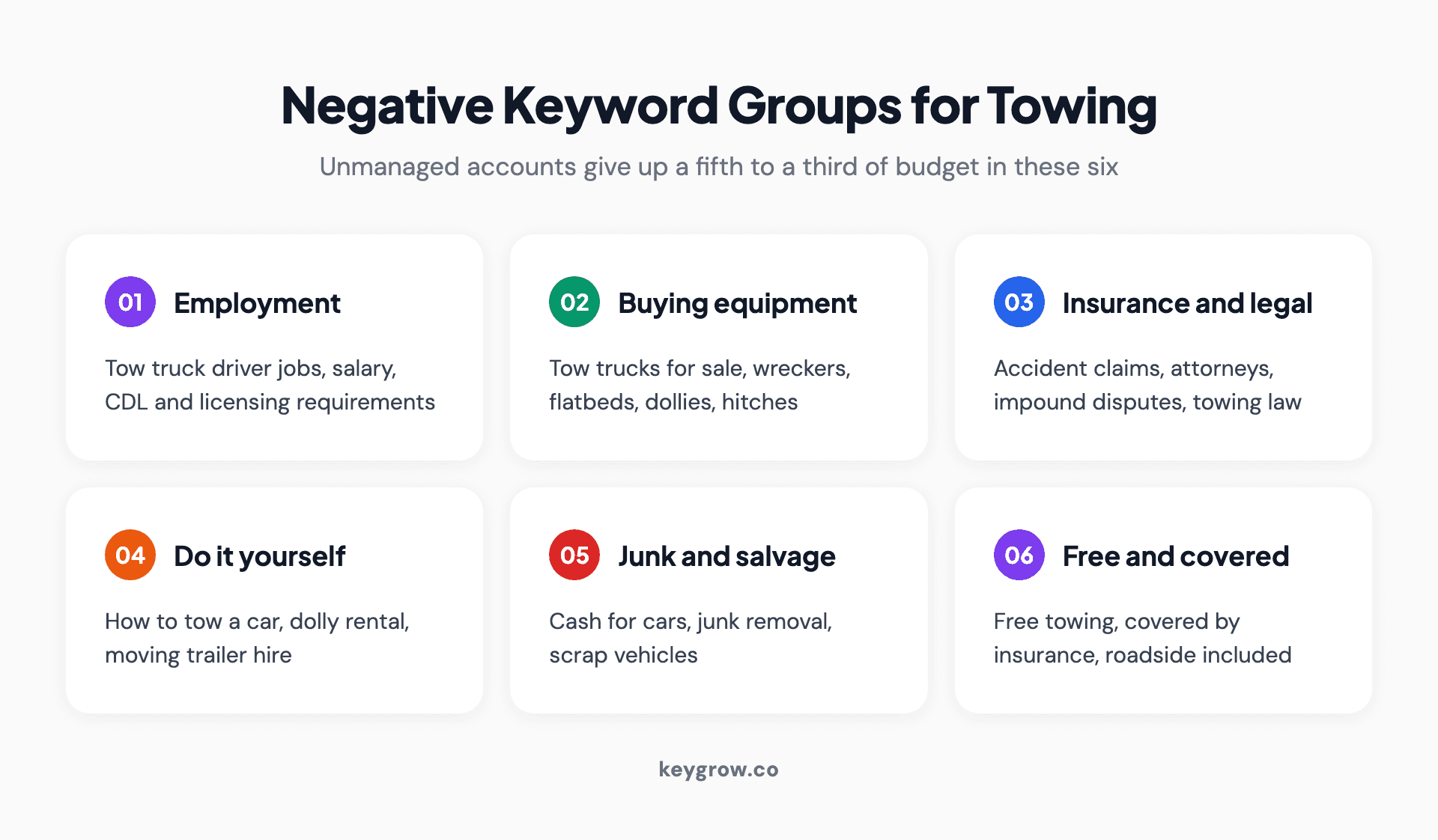
Six card checklist of negative keyword groups for towing Google Ads including employment searches, equipment purchase, insurance and legal queries, DIY, junk vehicle removal and free service searches.
Towing has a particularly messy query space, and the wasted spend hides in these six groups:
- Employment. Tow truck driver jobs, salary, licensing, CDL requirements. High volume, zero value.
- Buying equipment. Tow trucks for sale, wreckers, flatbeds, tow dollies, hitches. These are purchase queries from other operators.
- Insurance and legal. Accident claims, attorneys, impound disputes, towing law. Adjacent and useless.
- Do it yourself. How to tow a car, rental tow dollies, moving trailer rentals.
- Junk and salvage. Cash for cars, junk car removal, scrap. A different business unless you also run it.
- Free and cheap modifiers. Free towing, towing covered by insurance, roadside assistance included. People expecting somebody else to pay.
Pull the search terms report weekly for the first two months. In a category this broad, unmanaged accounts routinely give up a fifth to a third of budget here.
What to track when the job happens on the phone
Since almost every conversion is a call, your entire measurement problem is a call measurement problem.
- Call tracking with a minimum duration threshold. A thirty second floor filters out wrong numbers and hang-ups. Without it, your conversion count is inflated and your bidding is learning from noise.
- Answer rate as a reported metric. Missed calls are not a Google Ads problem, and they are the number most likely to be quietly destroying your return.
- Job value by call. A light-duty tow and a heavy recovery are not the same conversion. If your dispatch system can attach a value, push it back into the account so bidding optimizes toward the profitable jobs.
- Cost per completed job, not cost per call. Some calls are out of area, some are price shoppers, some are people who found another truck first.
When a towing company should skip Google Ads
Plainly, because it will save somebody three months of spend.
Skip it if your answer rate is poor. This is the big one. Fix dispatch, then advertise.
Skip it if you are already at capacity. One truck fully utilized does not need more calls, it needs better-paying ones, and that is a contract sales problem rather than an advertising one.
Skip it if you only want commercial contracts. Nobody procures an impound contract through a search ad. Your time is better spent with property managers and dealerships directly.
Start with your Google Business Profile instead if you are brand new. A complete profile with real reviews earns emergency calls without a click cost, and for a single-truck operator with more time than money that is the correct first move. Come to paid search when the free channel is maxed out.
If you are past those and want the account built properly, our Google Ads management covers the structure, the call tracking and the dayparting rather than just the keywords.
FAQs
How much do towing Google Ads cost?
The automotive repair and service category averages $4.35 per click with a cost per lead of $29.96, against an all-industry average of $5.42 and $66.69. Emergency towing terms in dense urban markets run higher, particularly where roadside assistance networks are bidding. A single-truck operator can run a meaningful campaign on $800 to $1,500 a month; multi-truck operations covering a metro usually need $2,500 or more.
Do Google Ads work for towing companies?
Better than for most industries. The automotive repair and service benchmark conversion rate is 15.51%, nearly double the all-industry average of 8.18%, because the person searching has an immediate problem and no patience for comparison shopping. The channel works. What usually fails is the phone answering process behind it.
Can towing companies still use call-only ads?
No. Google removed the option to create new call ads in February 2026, and existing call ads stop receiving impressions in February 2027. The replacement is call assets attached to responsive search ads, which Google recommends migrating to immediately. Most towing guides still recommending call-only campaigns were written before that change.
What negative keywords should a towing company add?
Start with employment terms, equipment purchase queries, insurance and legal searches, do-it-yourself towing, junk and salvage removal, and free or insurance-covered modifiers. Review the search terms report weekly for the first two months, since towing has an unusually broad query space and wasted spend accumulates quickly.
Should I run ads overnight?
Only if you can service the calls. Overnight competition is thinner because many operators run standard schedules, so the clicks are often cheaper and the caller has fewer alternatives. That advantage disappears entirely if the phone goes to voicemail, and you still pay for the click.
How do I compete with roadside assistance networks bidding on my keywords?
You do not outbid them, because a click is worth more to a network that monetizes it across many operators than to a single truck. Compete on locality instead: tight geographic targeting on the roads you actually cover, specific ad copy naming your response time and truck capability, and a phone answered by a person. Those are the things a national bidder cannot replicate.
What is a realistic cost per lead for a towing company?
The category benchmark is $29.96 per lead. Emergency towing in a competitive metro often runs higher, in the $40 to $70 range, while suburban and rural markets can come in well under the benchmark. Measure cost per completed job rather than cost per call, since a meaningful share of calls are out of area or price shopping.
Is Local Services Ads worth it for towing?
It can be, where towing is an eligible category in your market, because you pay per lead rather than per click and the Google Guaranteed badge sits above the standard results. Availability varies by location and category, so check whether it is offered for your service type before planning a budget around it.
Answer the phone first
The data on this channel is unusually friendly to towing companies. A 15.51% conversion rate and a $29.96 cost per lead describe a category where the hard part of marketing has already been done for you by circumstance.
That means the room to improve is almost entirely operational. Answer rate, response time, honest arrival estimates, and the discipline to bid only on the hours and roads you can genuinely serve. Get those right and a modest budget performs. Get them wrong and a large budget just buys more expensive voicemail.
If you want a second opinion on which of those two your account is currently doing, we will look at it. You might also want our breakdown of negative keywords first, since in this vertical that list does more work than the ad copy ever will.