


Local SEO pricing sits between $500 and $3,000 a month for most small businesses, with one-time projects running $500 to $5,000 and hourly consulting between $75 and $200. That is the market, according to WebFX's pricing data, and it is also close to useless on its own.
A range that wide is not a price, it is a shrug. What you need is the second number: how many hours of actual work your retainer buys, and whether that number of hours can produce the outcome you are paying for.
This post is about getting from the first number to the second one.
What the market charges, by model
Four ways to buy local SEO, and they suit different situations rather than different budgets.
| Model | Typical range | Suits | Watch out for |
|---|---|---|---|
| Monthly retainer | $500 to $3,000 | Ongoing work, most businesses | Retainers below roughly $500 buy very few hours |
| One-time project | $500 to $5,000 | A fix-up, a migration, a reset | Nobody maintaining it afterwards |
| Hourly consulting | $75 to $200 | You have staff who will do the work | Advice with no execution behind it |
| In-house hire | Around $40,000 a year | Multi-location, or SEO is core to the model | One person cannot cover technical, content and outreach |
Agency rates run roughly 30 percent above freelancer rates, according to survey data Semrush compiled from about a thousand respondents. That premium buys coverage rather than skill. A freelancer who gets sick, gets busy, or takes a full-time job leaves you with nothing in progress.
Read the retainer as hours, because that is what it is
Published prices back that range up: in our 2026 SEO price study, plans sold as local SEO start at a median of $800 a month. Divide the retainer by a realistic hourly rate and you get the honest size of the engagement. A $500 monthly retainer at agency rates is somewhere between three and five hours of work. Not five hours a week. Five hours a month.
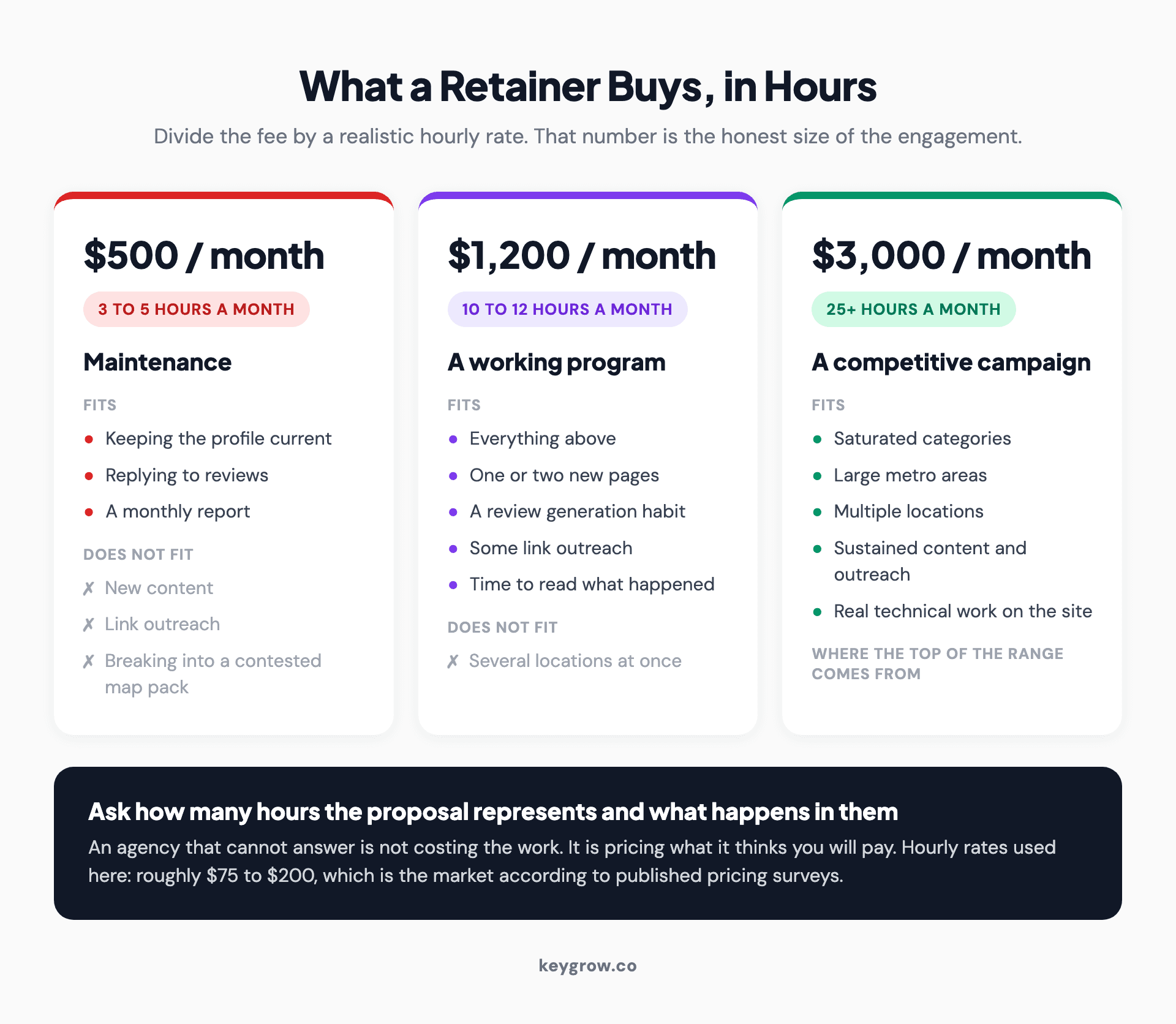
Three tiers of local SEO retainer expressed as monthly hours, showing what fits inside each one and what does not.
Once you see it that way, most of the confusion in this market disappears.
Four hours a month is maintenance. Somebody keeps the profile current, posts something, replies to reviews, and sends a report. That is a real service and it has real value for a business already ranking. It will not move a business that is not.
Ten to twelve hours a month is a working program. There is time for the profile, a page or two of new content, review generation, and some link outreach, with enough left over to look at what happened.
Twenty-five hours and up is a competitive campaign. This is what it takes in a saturated category, in a large metro, or across multiple locations, and it is where the upper end of the price range comes from.
The test to apply to any proposal: ask how many hours a month it represents and what happens in them. An agency that cannot answer that is not costing the work, it is pricing what it thinks you will pay. The same test works on social quotes, which our social media management pricing guide breaks down line by line.
What is actually in a local SEO package
Most of the difference between quotes is not the item list. It is which items are one-time and which recur, and how much of the recurring work is genuinely recurring.
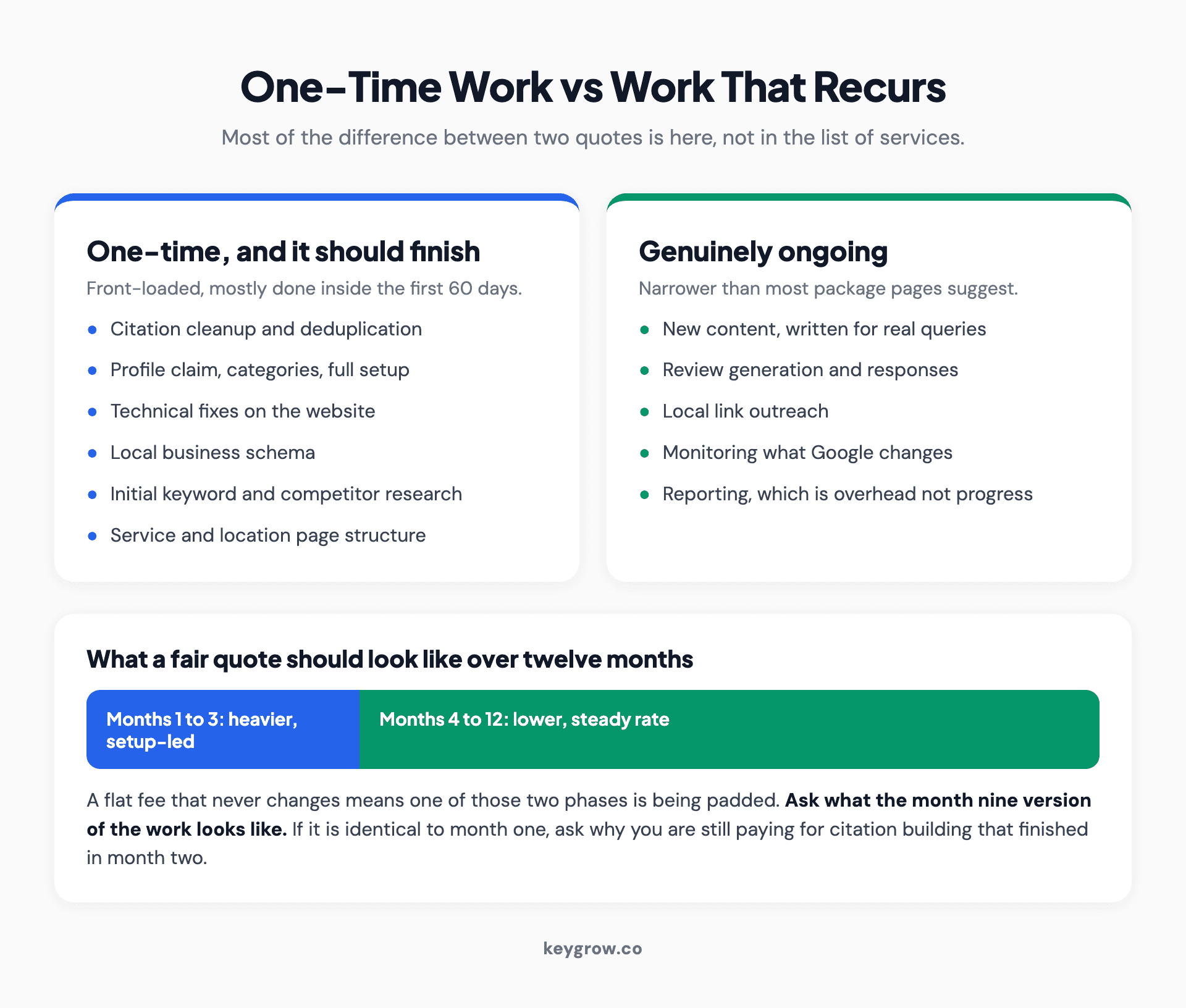
Which parts of a local SEO engagement are one-time setup and which genuinely recur every month.
The one-time work is real and it has an end. Citation cleanup, category and profile setup, technical fixes on the site, schema, the initial keyword and competitor research. Front-loaded, mostly done in the first 60 days, and then finished. If you are still being billed monthly for citation building in month nine, you are funding a subscription to a completed task.
The genuinely ongoing work is narrower than package pages suggest: new content, review generation, link outreach, and monitoring the profile for the things Google keeps changing. Reporting is ongoing too, though reporting is overhead rather than progress.
This matters because the shape of a fair quote changes over time. A higher first quarter, then a lower steady rate, is a more honest structure than a flat fee that never moves. Ask what the month nine version of the work looks like. If it is identical to month one, one of those two months is being padded.
The five things that actually set your price
Two businesses in the same trade can get quotes 400 percent apart and both be fair. These are the reasons.
Competition in your category and city. A plumber in a metro with forty established competitors needs more content, more links and more patience than one in a town with four. Same work, different volume of it.
Number of locations. Each location is its own profile, its own review stream, its own page. It is not linear, because the strategy is shared, but it is not free either.
How many services you sell. A single-service business needs a handful of pages. A general contractor covering twelve service lines needs twelve sets of everything.
Where you are starting. A site with no local pages, an unclaimed profile and inconsistent citations has more first-quarter work in it than a site that is basically fine and just not winning.
Who you hire. Freelancer, small agency, large agency, in-house, each with a different rate and a different failure mode.
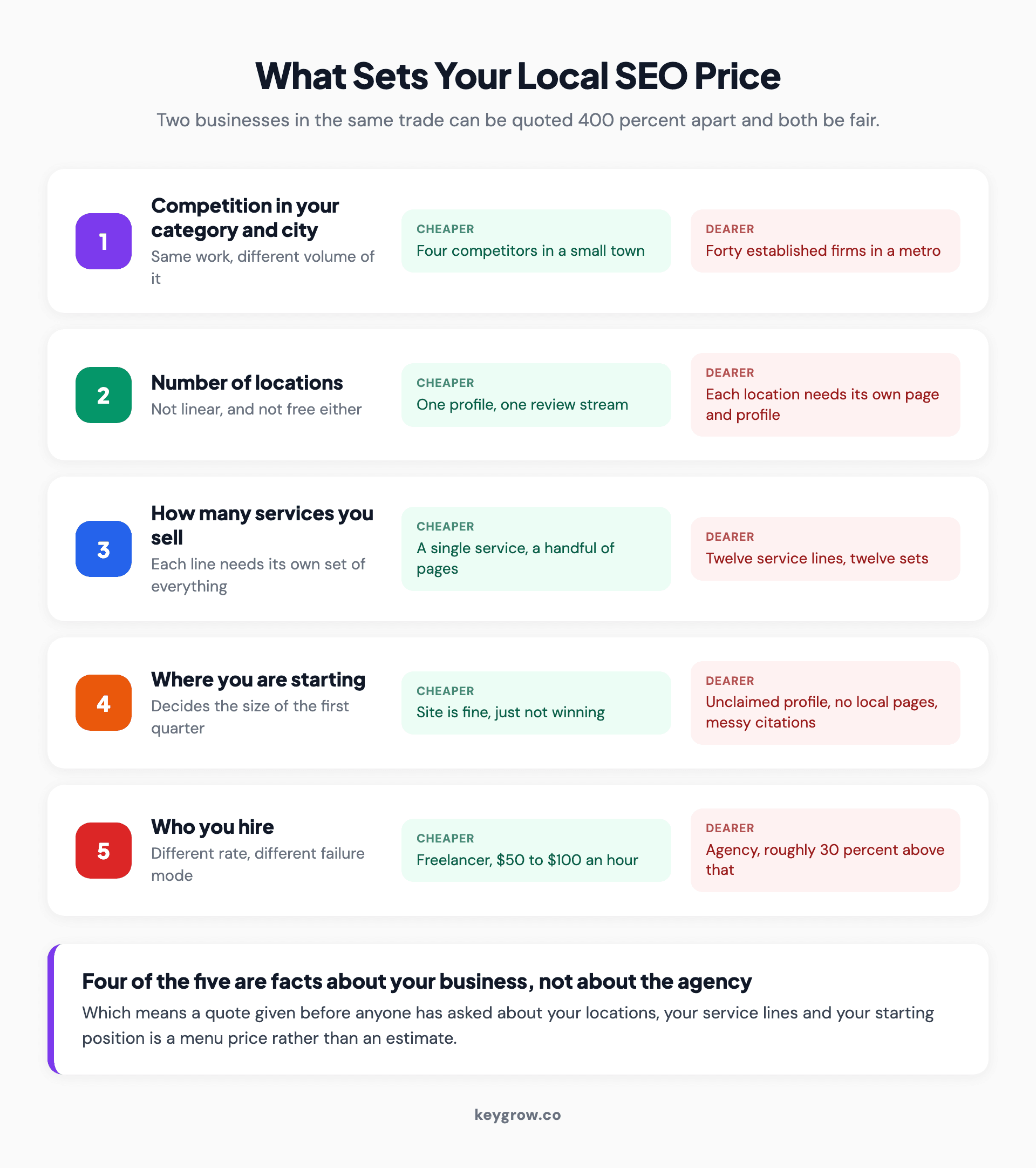
The five factors that decide where a local SEO quote lands inside the market range.
Notice that four of the five are facts about your business, not about the agency. A quote given before anyone has asked about your locations, services and starting position is a menu price, not an estimate.
Work back from what a job is worth
Here is the calculation that makes the price question answerable, and almost nobody publishes it.
Take your average job value. Multiply by the share of enquiries you close. That gives you the value of one additional lead. Now divide the monthly fee by that number and you know how many extra leads a month the engagement has to produce to break even.
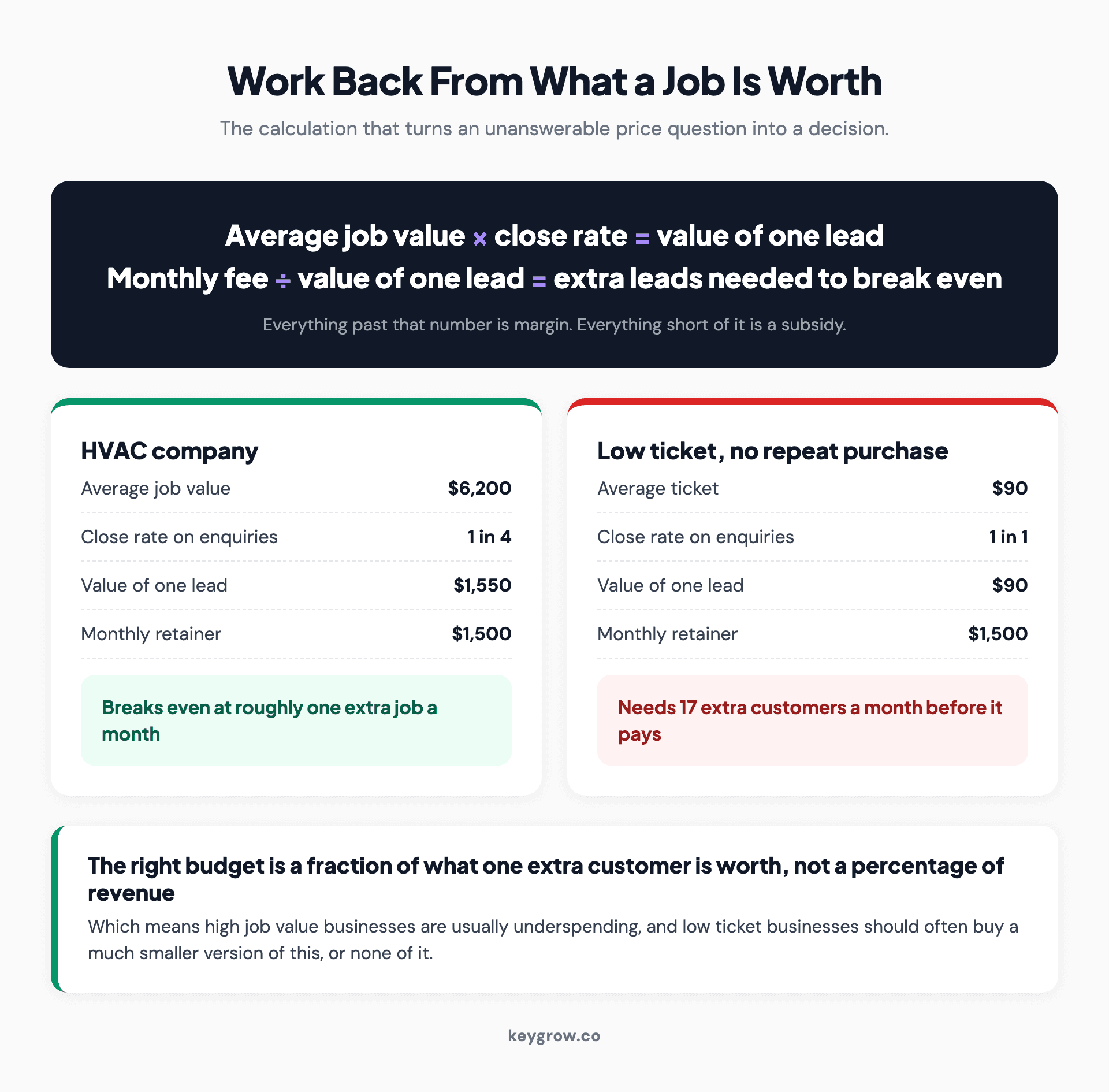
How to work out how many extra leads a local SEO retainer has to produce before it pays for itself.
A worked example. An HVAC company with an average job value of $6,200 that closes one in four enquiries is earning about $1,550 per lead. At a $1,500 monthly retainer, the engagement breaks even at roughly one extra job a month. Everything past that is margin.
Run the same math on a business with a $90 average ticket and no repeat purchase, and the retainer needs to produce seventeen extra customers a month before it pays for itself. Same fee, completely different decision.
This is why the honest answer to "how much should local SEO cost" is a fraction of what one extra customer is worth to you, not a percentage of your revenue. High job value businesses should be spending more than they usually do. Low ticket businesses should often not be buying this at all, or should be buying a much smaller version of it.
Multiple locations, and the arithmetic people get wrong
Five locations do not cost five times one location. They usually cost somewhere between two and three times, and the reason is worth understanding before you negotiate.
The shared work is genuinely shared. Keyword research, the site structure, schema, the content system, the review process, the reporting framework. Built once, applied five times.
The per-location work is genuinely per-location. Each profile is claimed, categorized, photographed and monitored separately. Each one collects its own reviews. Each one needs a page that is not a template with the city name swapped, which is where most multi-location programs quietly fail.
So the sensible structure is a base fee plus a per-location fee, with the per-location number well below the single-location price. If an agency quotes you a flat multiple of the single-location rate, they have not thought about your account yet.
There is one more thing multi-location businesses should ask about, and it rarely comes up in a sales call: what happens when two of your own locations start competing for the same searches. It happens at around the four-location mark in a dense city, and fixing it is a service area and content problem rather than a pricing one.
What a cheap retainer is really buying
The $199 to $400 tier exists, it is not automatically a scam, and you should know exactly what it is.

Two people going through a printed proposal across a desk.
At that price the work is almost always automated or offshore, and usually both. Citation submissions run through software. Profile posts are scheduled from a template. The report is generated. There is very little human judgment in it, because human judgment at that price would be an hour a month.
For a business that already ranks and just needs the lights kept on, that can be a reasonable purchase. For a business trying to break into a competitive map pack, it is a monthly payment for the appearance of activity, and the report will show impressions climbing while the phone stays quiet.
The failure mode to watch for is worse than wasted money. Cheap providers lean on the tactics that scale cheaply: keyword-stuffed business names, bulk directory submissions, review requests that filter for happy customers. Those carry suspension risk, and a suspended profile costs more to fix than a year of the retainer you saved on.
Agency, freelancer, or the person you already employ
| Option | Typical cost | Best when | Fails when |
|---|---|---|---|
| Freelancer | $50 to $100 per hour | Budget is tight and the scope is narrow | They get busy, and you are not the priority |
| Small agency | $1,000 to $3,000 a month | You want coverage across skills without a hire | The account is too small for their senior people |
| Large agency | $3,000 and up | Multi-location, complex, or paid plus organic | You get the process, not the practitioner |
| In-house | Around $40,000 a year plus tools | SEO is central and there is enough work to fill a role | One person cannot be strong at all of it |
| Existing staff, trained | The cost of their time | A single location with simple needs | It is the first thing dropped in a busy week |
That last row is the one most small businesses should look at hardest, and the one almost no agency will raise with you.
The contract terms that matter more than the price
A cheaper retainer on a twelve month lock-in is more expensive than a dearer one you can leave.
Twelve month contracts in this industry are a confession. The term exists to collect the fee through the quarter when nothing visible is happening, which is exactly the quarter you should be free to walk away from. Our local SEO work is month to month, cancel anytime, and that is not generosity. It is the discipline of having to be worth the fee again every thirty days.
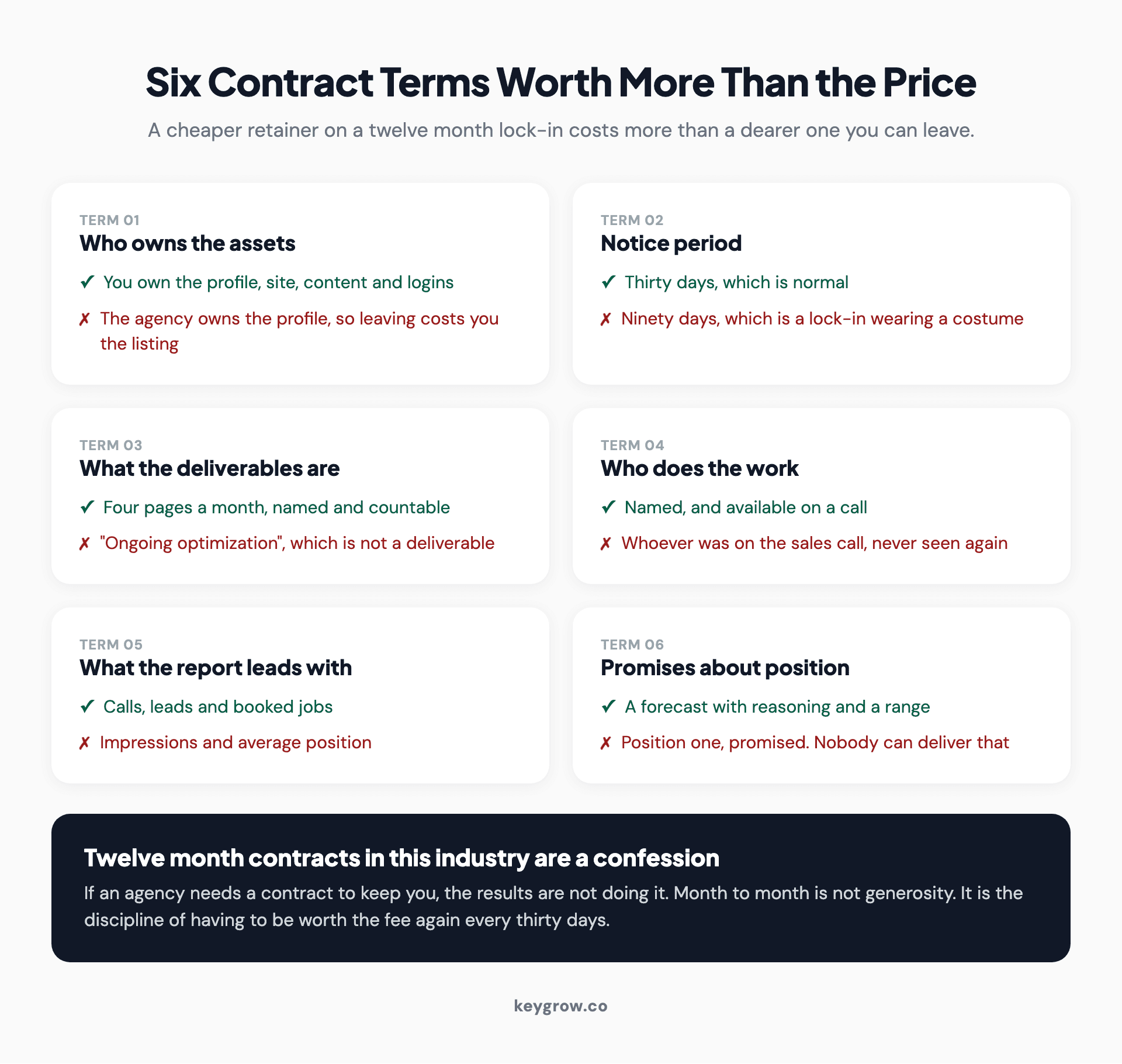
Six contract terms to check on a local SEO proposal, and what each one signals about the agency.
Check these six before you sign anything.
- Who owns the assets. The Google Business Profile, the website, the content, the reporting logins. If the agency owns the profile, leaving costs you the listing.
- Notice period. Thirty days is normal. Ninety is a lock-in wearing a costume.
- What the deliverables actually are. "Ongoing optimization" is not a deliverable. Four pages a month is.
- Who does the work. The person on the sales call is often not the person on the account.
- What the report leads with. Calls and leads, or impressions and rankings. This tells you what the agency thinks its job is.
- Any promise of position one. There are only two ways to hit a promised rank: pick a phrase with nobody behind it, or do something to the profile you would not want explained to you beforehand.
The cheapest option is the one nobody quotes you
Zero dollars a month plus about two hours of your own time, and for a single location it outperforms most $300 retainers.

A shop owner working at a laptop behind the counter of her store.
The highest return per hour in this whole category is unglamorous and nobody bills for it well. Claim the profile. Set the category properly. Ask each customer for a review while you are still standing in front of them. Reply to all of them. Make the website say plainly what you do and where you do it. An agency charging you $2,000 a month opens with that same list.
So what are you buying when you pay somebody? Not access to hidden work. You are buying the fact that it still happens in the month your van broke down, a supplier let you down and the review requests were the obvious thing to drop. That is a genuine service and it is worth money. It is just not the thing the sales deck describes.
The fee starts making sense when your own hours are worth more elsewhere, when you need to reach past the radius proximity hands you for free, when you run several locations, or when something has broken that you do not know how to unpick. We turn single-location businesses away when none of that is true yet.
If you want the mechanics of the DIY version, our guide to Google Maps SEO covers what to change and in what order.
Knowing whether the money worked
Set the measurement up before the first invoice, because it is very hard to argue about results with no baseline.
Record four things on day one: calls and direction requests from the profile over the last 90 days, your grid coverage for two or three money keywords, the number and date of your most recent reviews, and organic traffic to your service pages. Those are the before numbers.
Then be patient in a specific way. A doctor's practice in Dubai that committed to a full year of organic work looked unremarkable for the first quarter and finished at 1,519 percent organic traffic growth with 130 plus patient calls a month. The first three months of any local SEO engagement are mostly cost. That is the deal, and an agency that pretends otherwise is setting you up to cancel in month three having paid for the hard part and left before the payout.
We wrote about the timeline in more detail in how long local SEO takes, and about what the return looks like once it arrives in how local SEO increases profits.
FAQs
How much does local SEO cost per month?
Most small businesses pay between $500 and $3,000 a month, with the figure driven by how competitive your category is, how many locations you run, how many services you sell, and what condition your site and profile are in when you start. One-time projects typically run $500 to $5,000 and hourly consulting $75 to $200.
Is a $500 a month local SEO package worth it?
It buys roughly three to five hours of work, so it depends entirely on what those hours are for. For a business already ranking that needs maintenance, it can be good value. For a business trying to break into a competitive map pack, it is not enough time to change anything, and the report will show activity rather than results.
Should local SEO be a monthly fee or a one-time project?
Both, in sequence. Citation cleanup, profile setup, technical fixes and schema are one-time work that should finish. Content, reviews, links and monitoring are genuinely ongoing. A fair structure is often a heavier first quarter followed by a lower steady rate, rather than the same fee forever.
How much does local SEO cost for multiple locations?
Less per location than a single location, because the strategy, site structure and reporting are shared. Expect a base fee plus a per-location charge well below the single-location rate. Five locations typically land at two to three times the cost of one, not five times.
Can I do local SEO myself instead of paying an agency?
Yes, and for a single-location business with a couple of spare hours a month it is often the right call. Claiming the profile, setting the correct primary category, gathering reviews consistently and fixing the website basics covers most of the available gain. Hire when the opportunity cost of your own time exceeds the fee.
Why do local SEO quotes vary so much for the same business?
Because they are pricing different amounts of work, and often nobody has said how much. Divide any quote by a realistic hourly rate to see the engagement size, then ask what happens in those hours. Quotes that cannot be explained this way are priced on what the agency thinks you will pay.
How long before local SEO pays for itself?
Work out the value of one extra lead by multiplying your average job value by your close rate, then divide the monthly fee by that number. That tells you how many extra leads a month you need to break even. Timing-wise, expect the first quarter to be mostly cost and real movement from month four onward.
What should be included in a local SEO package?
Profile optimization and management, review generation and response, local content, local link building, technical and on-page work for local relevance, and reporting that leads with calls rather than rankings. Ask which of those items are one-time and which recur, because the answer explains most of the price.
What to do with a quote
Take whatever number you have been given and do two things with it before you respond.
Divide it by $120 an hour to see roughly how many hours a month you are buying, then ask the agency to account for those hours. And multiply your average job value by your close rate to see how many extra leads make the fee worth paying. Those two numbers turn a price you cannot evaluate into a decision you can.
If the hours do not add up to the outcome, the quote is too low rather than too high, and a retainer that cannot do the job is the most expensive thing on this page.
We price local SEO on the work the account actually needs, month to month with no lock-in, and we say no to businesses who would be better off doing it themselves. If you want a number for your situation, tell us your city and trade and we will give you one along with the reasoning.