


Almost nobody types "auto repair shop". They type "grinding noise when I brake", or "how much to replace a water pump", or "check engine light on but car drives fine".
Most SEO for auto repair shops is built for the wrong query. Shops publish a services page listing brakes, transmissions, diagnostics and A/C, then compete for "mechanic near me" against every other shop in town and the franchised chains with national link profiles. Meanwhile the searches that come first, the ones a worried driver actually types at 9pm, sit unanswered.
Those earlier searches are cheaper to rank for, they arrive before the customer has picked a shop, and they are the part of this you can win.
The sequence a driver goes through before "mechanic near me"
Four searches usually happen, in order, and only the last one is contested.
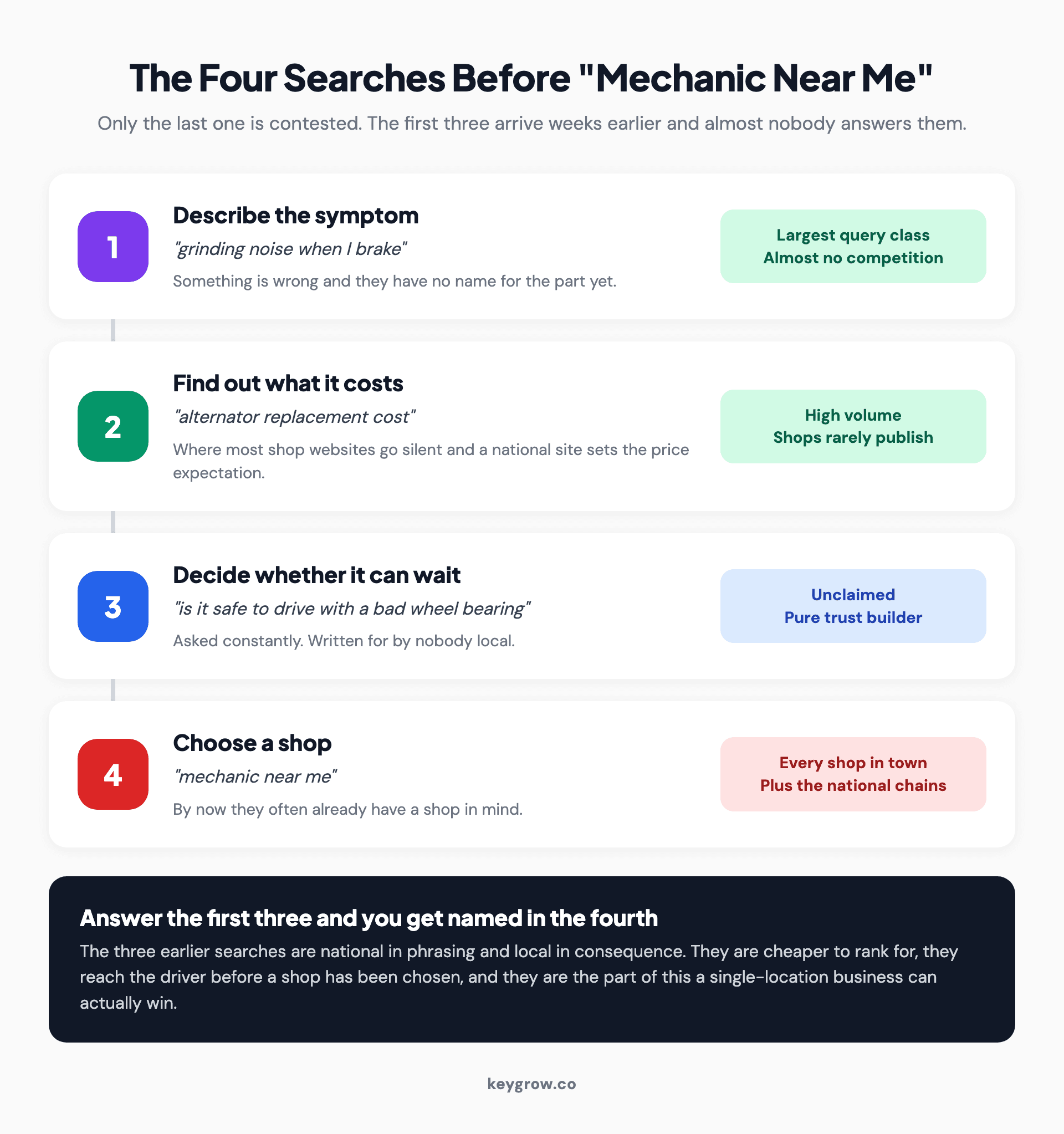
The four searches a driver runs before choosing an auto repair shop, from describing a symptom through to booking.
Describe the symptom. Something is wrong and they do not have a name for it. "Car shakes at highway speed." "Squealing when I turn the wheel." This is the largest and least contested query class in the category.
Work out what it means and what it costs. Once they have a name for the part, the next search is the price. "Alternator replacement cost." This is where most shops go silent and lose the customer to a national content site.
Decide if it can wait. "Is it safe to drive with a bad wheel bearing." Nobody writes this and it is asked constantly.
Choose a shop. Only now do they search for a mechanic, and by this point they often already have a shop in mind, because somebody answered the first three questions.
This is where the volume actually is. Around 46 percent of Google searches carry local intent according to BizIQ's 2026 data, but local intent is the last step of the four, not the first. The three searches before it are national in phrasing and local in consequence.
The strategy follows directly. Answer the first three and you get named in the fourth.
Build a page for the symptom, not the service
A page called "Brake Repair" competes with every brake page in your city. A page called "Grinding Noise When Braking" competes with almost nothing, and it catches the driver two weeks earlier.

A technician working on a vehicle raised on a lift in a repair shop bay.
The mapping is straightforward once you look at your own job sheets.
| What they type | What it usually is | Page you should have |
|---|---|---|
| Grinding noise when braking | Worn pads, scored rotors | What a grinding brake noise means and what it costs to fix |
| Car shakes at highway speed | Wheel balance, warped rotors, tires | Why a car shakes above 60 and how a shop diagnoses it |
| Check engine light on, drives fine | Sensor, evap, misfire, loose cap | What to do when the light is on and nothing feels wrong |
| Squealing when I turn | Power steering, belt, suspension | Steering noises, what each one means |
| A/C blowing warm | Refrigerant, compressor, blend door | Why the air stopped getting cold and what it costs |
| Burning smell after driving | Oil leak, clutch, brakes, belt | Burning smells, ranked by how urgent they are |
Each page does the same three jobs: name the likely causes honestly, give a price band, and say whether it is safe to keep driving. Then one line about booking a diagnostic.
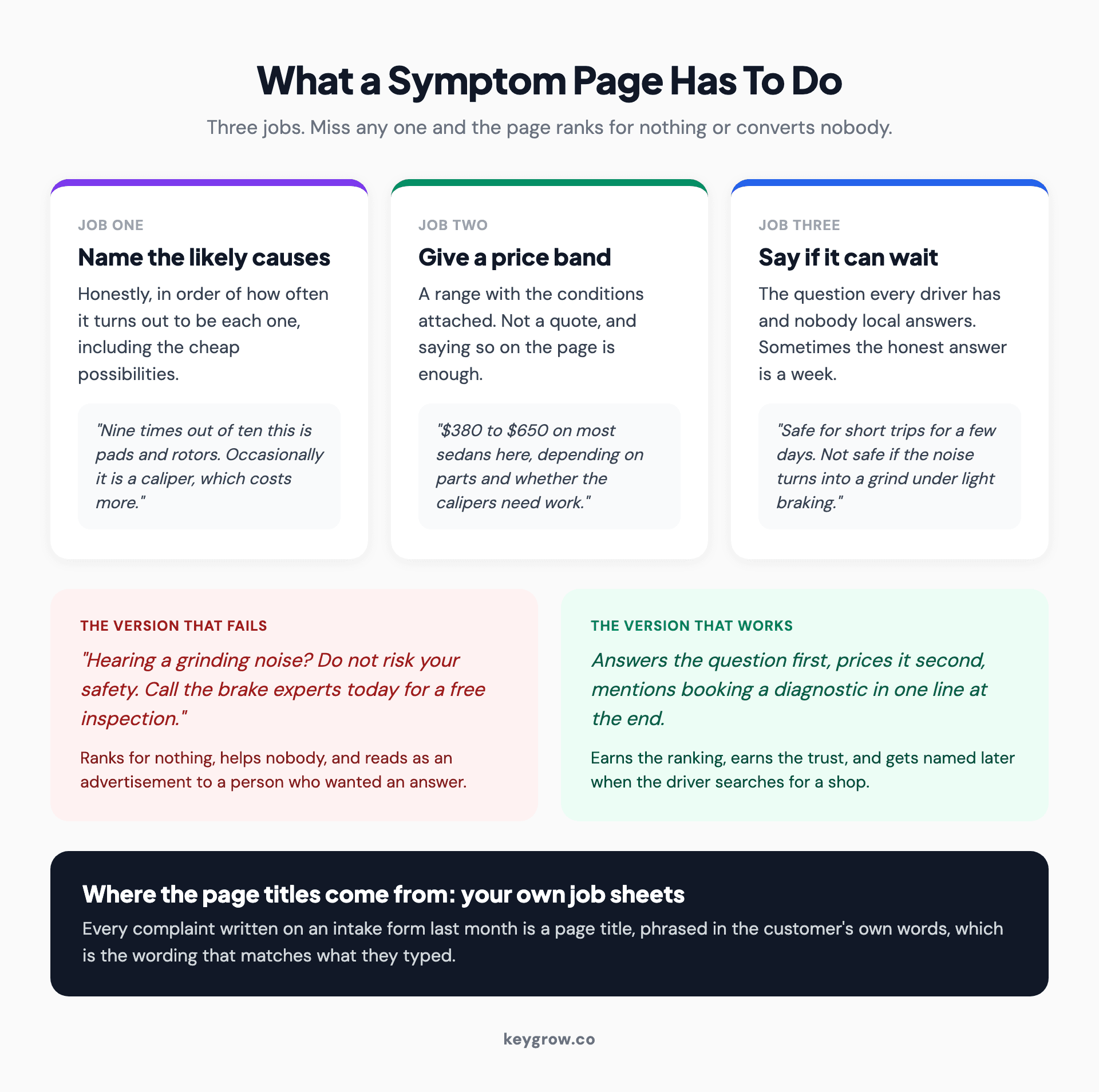
The three things a symptom page has to do to earn the call, and the mistake that stops most of them working.
The mistake that ruins these pages is writing them as advertising. A page that says "if you hear a grinding noise, call the experts today" ranks for nothing and helps nobody. The page has to actually answer the question, including the part where sometimes the answer is cheap and sometimes the driver can wait a week.
Where do the pages come from? Your job sheets. Every complaint written on an intake form last month is a page title, in the customer's own words, which is the wording that matches the search.
The price question, and why silence loses the job
The single most searched thing after a symptom is what it costs, and most shop websites do not contain a number anywhere.
The reasoning is understandable. Every job is different, quoting blind is a good way to be wrong, and the shop does not want to be beaten on a number out of context. So the site says "call for a quote", and the driver goes to a national site that publishes a range, and forms their price expectation there instead.
Publishing a band is not quoting. "Front brake pads and rotors on most sedans run $380 to $650 here, depending on parts and whether the calipers need work" is honest, defensible, and does three things a quote request cannot. It earns the cost search. It sends the bargain hunters somewhere else before they occupy your service advisor for twenty minutes. And it makes you the shop that raised the subject of money first, which is rarer than it should be.
This is a conversion problem as much as a ranking one, and the two are connected. One of our automotive clients, a mobile detailing business, was buying bookings at roughly $100 each and landing every click on a homepage. We built them a single page whose only job was taking a booking, and the number fell to $22 while bookings climbed 650 percent between August and December. The traffic did not change. The destination did. A published price band does the same job on an organic page: it removes the reason to open a second tab.
The makes you specialize in are worth a page each
If your shop is genuinely better at something, say which, by name of the make, and give it a real page rather than a line on the services list.
Specialist searches are lower volume and much higher intent. Somebody searching for a shop that works on a specific import marque, or diesel trucks, or hybrids, has already decided they do not want the general chain. They convert at a rate the generic terms never approach.
Three rules for these pages.
Only claim what is true. A make page for a marque your techs have not trained on produces the worst kind of lead, the one you have to turn away after they have driven across town.
Show the evidence. The scan tool you own for that platform, the training your techs hold, the number of those vehicles you see a month, the specialist tools in the bay. This is the difference between a page that ranks and a page that converts.
Name the common jobs for that platform. Every make has three or four repairs it is known for at a certain mileage. Those are the searches, and they are close to unclaimed.
The same logic applies to systems rather than makes. If you are the shop in town that does transmissions properly, or diagnostics other shops gave up on, that is a page. "We fix what the other shop could not" is a real search behavior.
Your profile has to list services, not categories
The Google Business Profile work for a repair shop is mostly the services list, and it is the section most shops leave half empty.
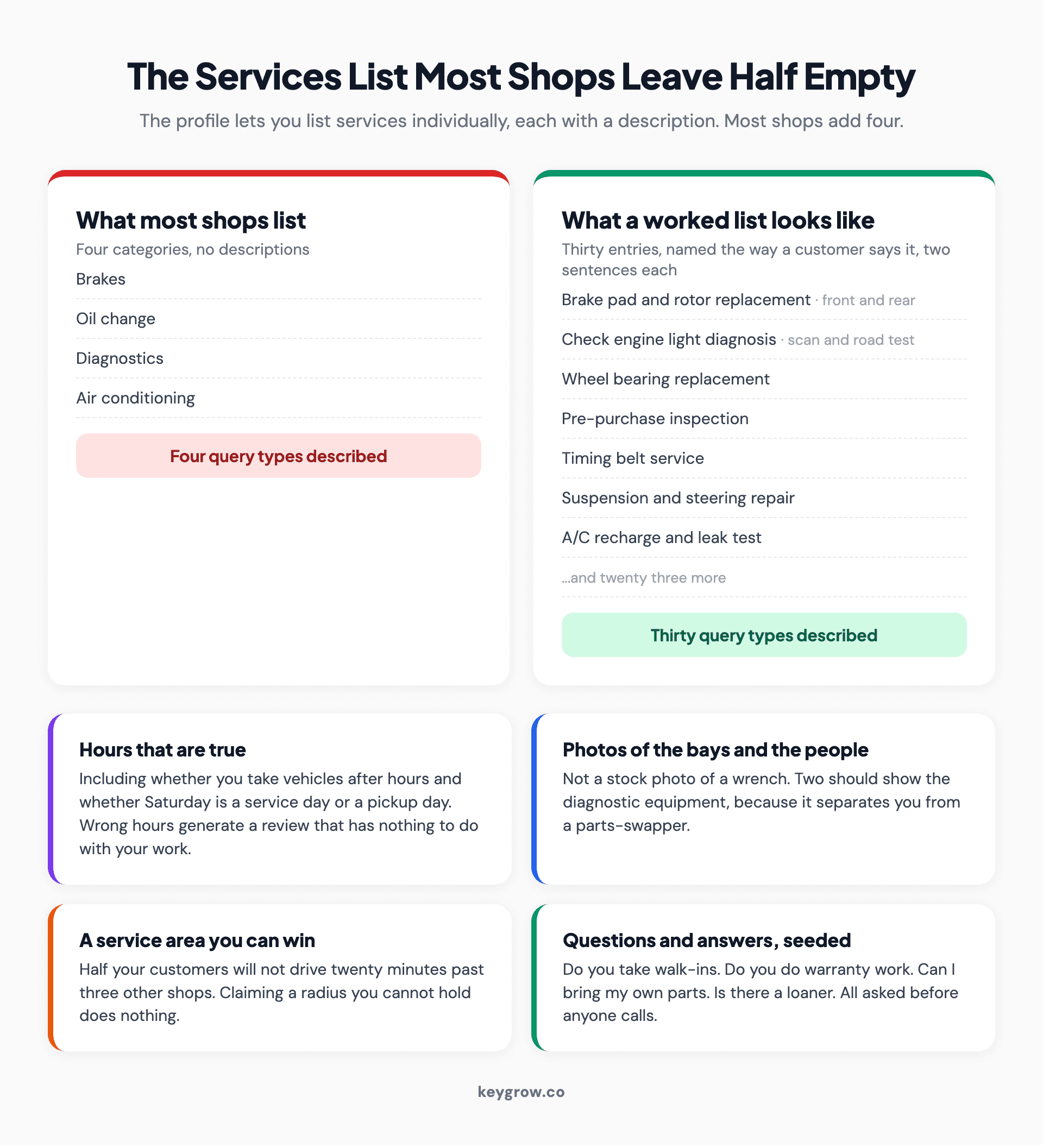
What a fully worked Google Business Profile services list looks like for an auto repair shop, against the version most shops leave.
The profile lets you list individual services with descriptions. Most shops add four and stop. A shop that adds thirty, each named the way a customer would say it and each with two sentences of description, is telling Google about thirty query types instead of four.
Beyond that list, four things matter more here than in other trades.
Hours that are true, including whether you take vehicles after hours and whether Saturday is a real service day or a pickup day. Wrong hours generate an angry review that has nothing to do with your work.
Photos of the bays, the equipment and the technicians, not a stock photo of a wrench. Drivers are deciding whether to trust strangers with an expensive object. Two of those photos should show the diagnostic equipment, because it separates you from a parts-swapper.
The service area, set honestly. Half your customers will not drive twenty minutes past three other shops, and claiming a radius you cannot win does nothing.
Questions and answers, seeded with the real ones: do you take walk-ins, do you do warranty work, can I bring my own parts, do you offer a loaner. Those get asked before anyone calls.
Google's own structured data guidance covers the AutoRepair markup on the website side, which reinforces the same information.
Reviews when the customer cannot check the work
Almost nobody who reviews a repair shop can verify what happened under the hood. They are reviewing how they were treated around a transaction they could not audit, and that changes what a good review strategy looks like.
The reviews that do the most work here mention three things: what the problem turned out to be, that the price matched the estimate, and that something was explained rather than just done. You cannot script that, but you can ask in a way that produces it. "If you leave us a review, it helps other people if you mention what was wrong with the car and whether the price came out where we said."
Two situations specific to this trade are worth planning for.
The diagnostic that found nothing. The customer paid for an hour of diagnosis and drove away with no repair, and feels they paid for nothing. This is the most common one-star review in the category and it is preventable with a sentence at drop-off about what the diagnostic fee buys.
The repair that did not fix it. Sometimes the second fault was hiding behind the first. Handled well, this is a five-star review about honesty. Handled badly, it is the review that costs you the next six months.
Reply to all of them, and answer the bad ones with a timeline rather than a defense. A calm reply listing the dates and what was done convinces the next reader in a way that arguing never will, which is the whole argument for replying to reviews at all.
The trust page most shops never build
Certifications, warranty terms and who actually touches the car. Three things drivers care about and almost no shop website states plainly.
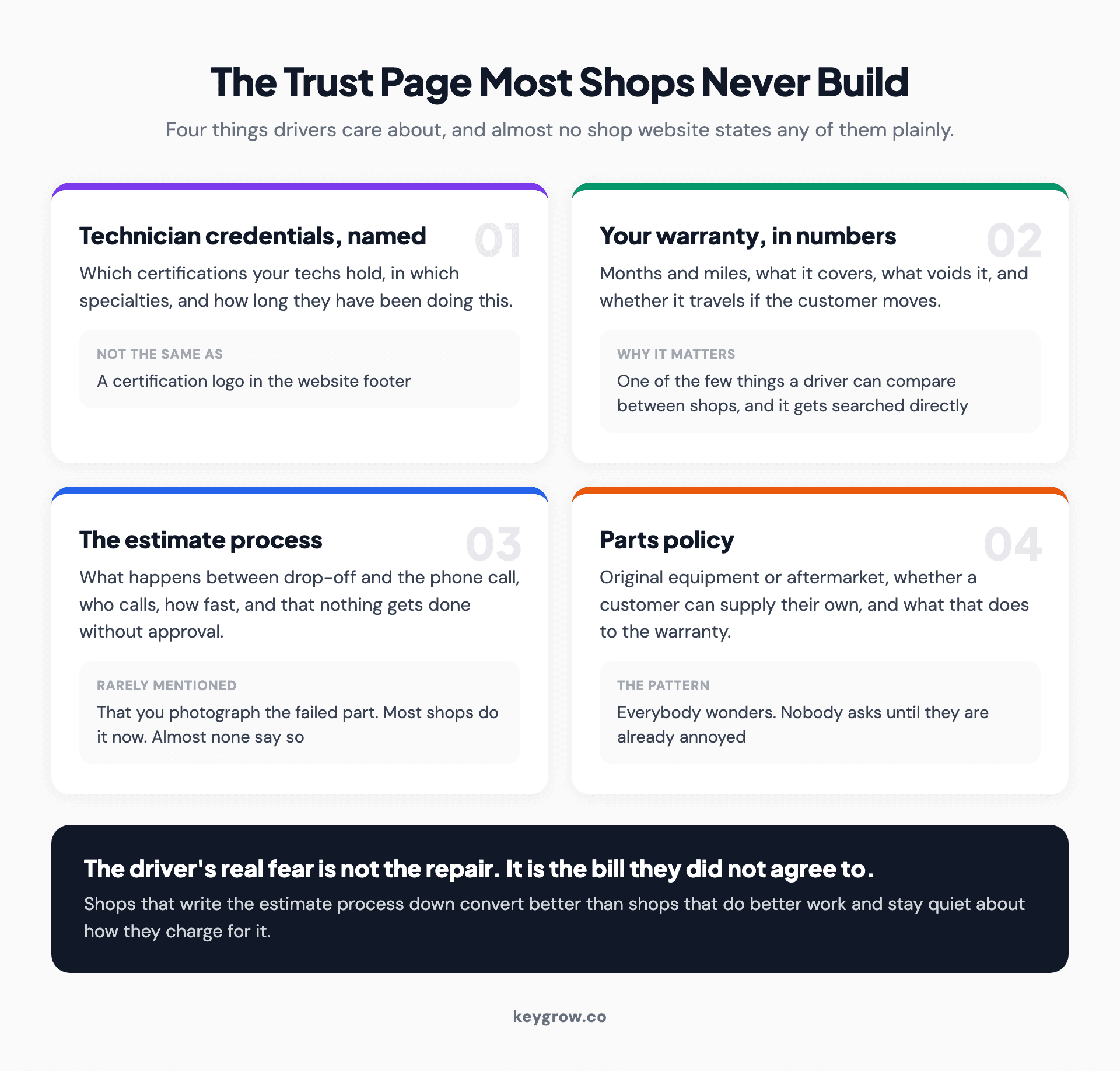
The four elements of an auto repair trust page, from technician credentials to the warranty terms and the estimate process.

A technician holding a handheld diagnostic scan tool in a workshop.
Technician credentials, named. Which certifications your techs hold, in which specialties, and how long they have been doing this. A logo in the footer is not the same as a page that says who is in the building.
Your warranty, in numbers. Months and miles, what it covers, what voids it, and whether it travels if the customer moves. This gets searched directly, and it is one of the few things a driver can compare between shops.
The estimate process. What happens between drop-off and the phone call, who calls, and how fast. Say if you photograph the failed part, because most shops do now and almost none mention it. Say plainly that nothing gets done without approval. Shops that write this down convert better, because the driver's real fear is not the repair, it is the bill they did not agree to.
Parts policy. Whether you use original equipment or aftermarket, whether the customer can supply their own, and what that does to the warranty. Everybody wonders. Nobody asks until they are annoyed.
Fleet and commercial accounts are a different website problem
If you service business vehicles, that is a separate audience with a separate buying process, and it does not belong on the same page as brake pads.
A fleet manager is not searching for a symptom. They are searching for capacity, turnaround, invoicing terms and whether you can handle a class of vehicle. The decision is made once and lasts years, which makes it worth more than any individual repair and worth a page of its own.
That page needs different content. Bay count. Vehicle classes you are equipped for. Turnaround commitments in hours rather than adjectives. Your invoicing terms. Preventive maintenance scheduling, if you run it. And any inspection program you are approved for. None of that interests a retail customer, and mixing the two makes both pages worse.
It is also the part of a repair shop's search footprint with the least competition, because most shops treat fleet work as something that arrives by word of mouth.
Links a repair shop can actually get
Prominence is the slow half of local ranking, and a shop has more sources than most trades because it sits in a physical community.
The realistic ones:
- The parts supplier or program network you already buy through, most of which run a locator
- The certification body you already pay for, which usually lists certified shops
- The car club, track day group or enthusiast forum for the makes you specialize in
- The towing companies you already work with, reciprocated properly
- The used car dealer or two who send you pre-purchase inspections
- Local sponsorship, which in this trade is usually a team or a school program
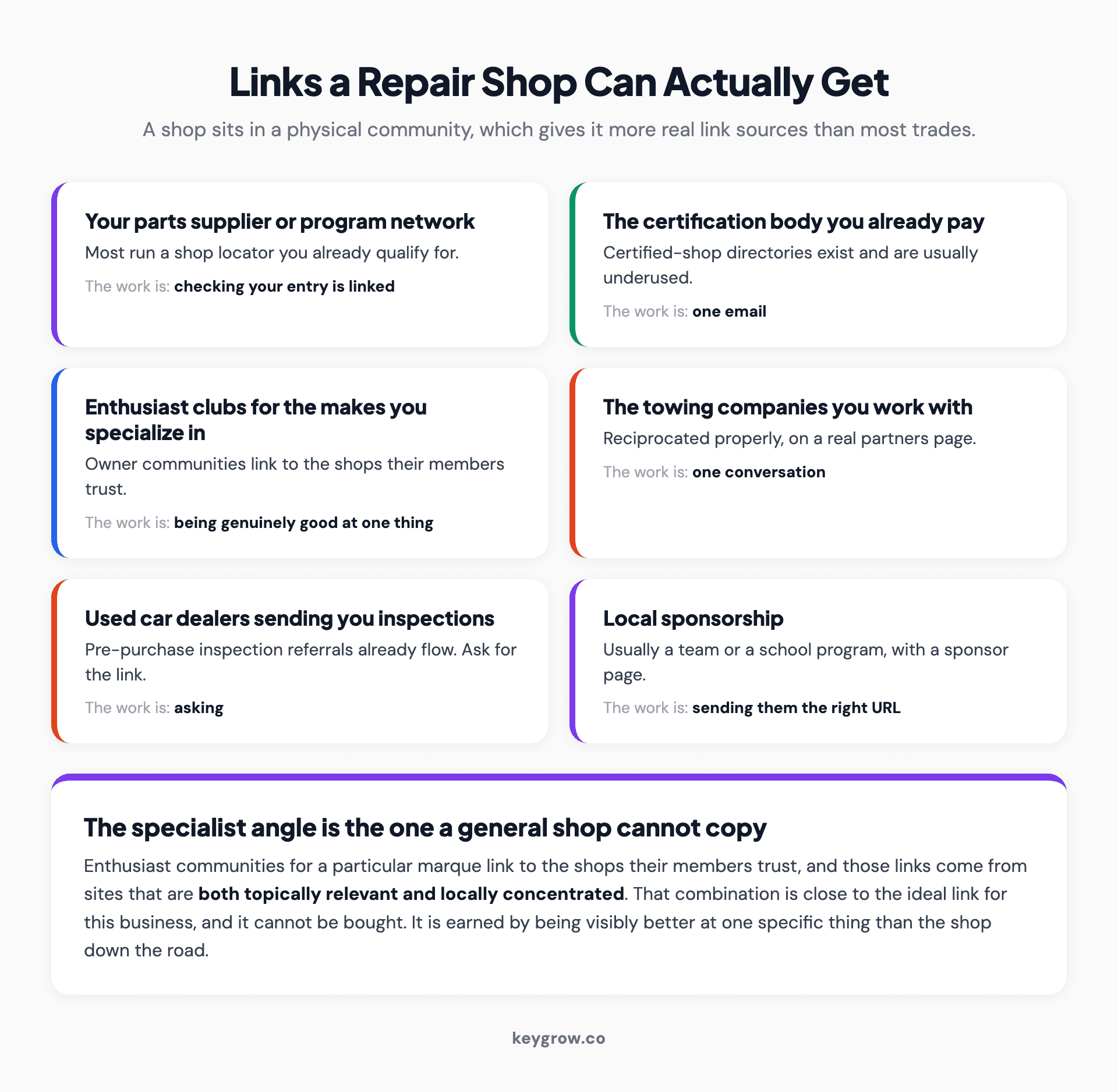
The six link sources realistically available to an auto repair shop, most of them from suppliers and partners it already works with.
The specialist angle does something here that a general shop cannot copy. Enthusiast communities for a particular marque link to the shops their members trust, and those links come from sites that are both topically relevant and locally concentrated. That is close to the ideal link for this business and it is earned by being genuinely good at one thing.
What to measure, and the number that lies
Track booked repair orders from organic, average repair order value from organic, and calls that turn into a vehicle in the bay. Rankings tell you nothing on their own.
The number that lies is total organic traffic. Symptom pages pull in a lot of people who live nowhere near you, because "what does a grinding brake noise mean" is a national query. That traffic is not worthless, it earns links and it builds the topical footprint that helps your local pages, but it will make your traffic chart look better than your bay schedule.
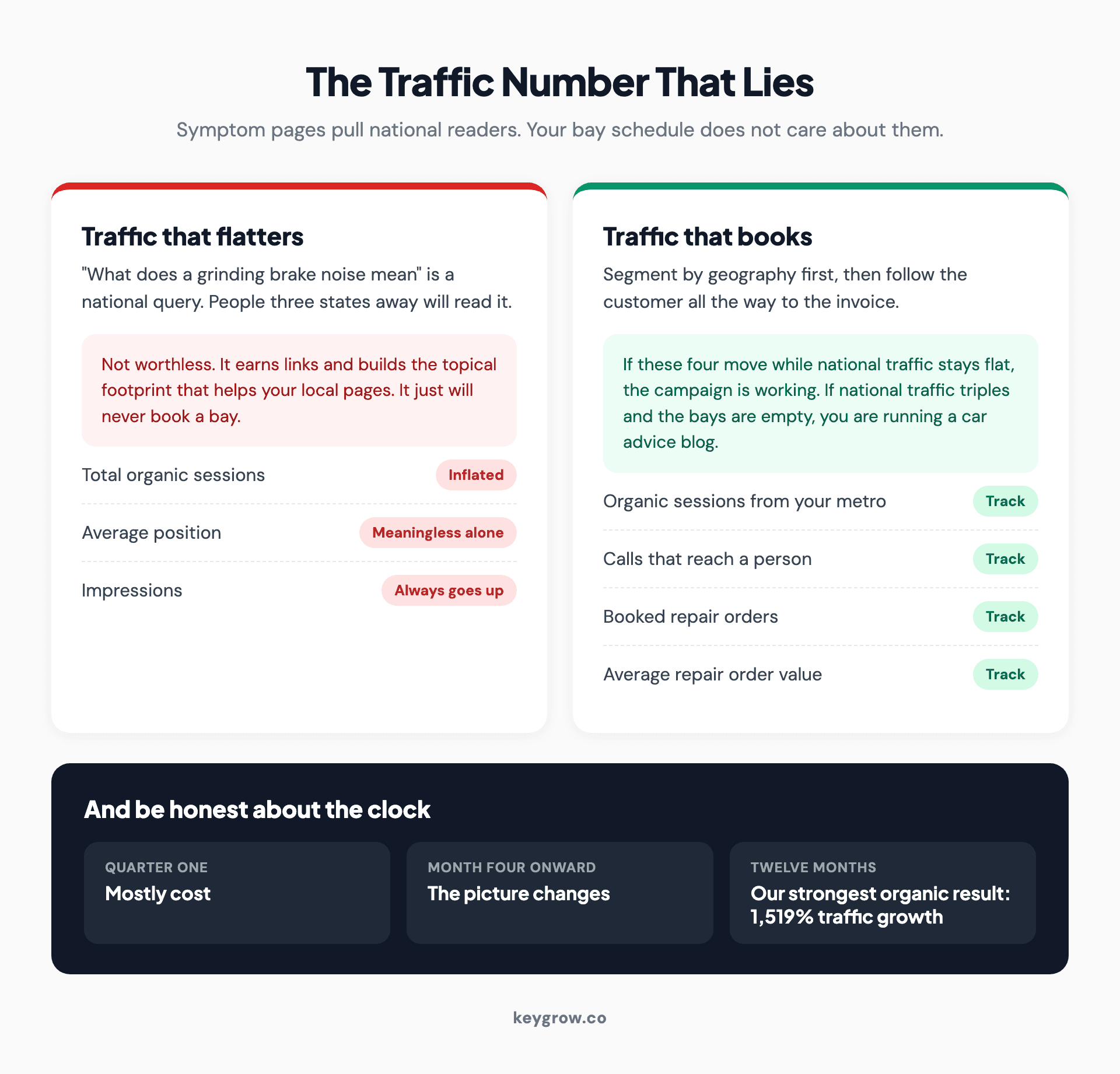
Why total organic traffic misleads an auto repair shop, separating national symptom readers from local traffic that books.
Segment it. Traffic from your metro, calls, form submissions, and booked repair orders. If those four move and national traffic stays flat, the campaign is working. If national traffic triples and the bays are empty, you are running a car advice blog.
Then there is the clock, which nobody enjoys hearing about. This is a compounding asset rather than a campaign, so quarter one reads as pure cost and the picture only changes from around month four. Our best organic result needed a full twelve months to arrive at 1,519 percent traffic growth. Shops that pull the plug in month three have paid for the difficult part and walked away before it paid anything back. If you want the month-by-month version of that curve, we mapped it out separately.
Shops that should not buy SEO yet
Four situations where the money goes somewhere else first.
If your bays are already full and you are turning work away, more leads do not help you. Raise prices or add capacity, and revisit this when one of those is done.
If you cannot answer the phone during business hours, fix that before anything. Every SEO campaign for a repair shop is ultimately measured in phone calls, and a shop that misses half of them is paying to generate voicemails.
If you are a single bay with one technician and a full book, the arithmetic rarely clears. Claim the profile, gather reviews, and spend the money on the second lift.
If you are opening in three months and have no history, spend the first quarter on the profile, the reviews and the basics rather than on content. Prominence needs a business that exists.
We build automotive repair SEO month to month with no lock-in, and we will tell a shop with full bays to spend the money elsewhere.
FAQs
How long does SEO take for an auto repair shop?
Profile and website fixes can produce movement inside a month. Symptom and cost pages usually take three to six months to rank because they need to be indexed, gather some links and accumulate engagement. Expect the first quarter to look like cost and the picture to change from around month four.
What keywords should an auto repair shop target?
Start with symptom searches drivers actually type, like a noise or a warning light, then cost searches for the specific repairs you do most, then safety questions such as whether a fault can wait. Only then the competitive terms with your city in them. The first three groups are cheaper to rank for and reach the customer earlier.
Is Google Business Profile enough for an auto repair shop?
It is the single most important piece and it is not enough on its own. The profile wins the map pack near your address, but the symptom and cost searches that reach drivers before they choose a shop happen on the website. Shops that only work the profile are competing entirely inside a radius set by geography.
Should an auto repair shop publish prices on its website?
Publish bands rather than quotes. A range with the conditions attached ranks for the cost searches, filters out people who were never going to pay your rate, and positions you as the shop that talked about money first. It is not a quote, and saying so on the page is enough.
How many reviews does an auto repair shop need?
There is no threshold that matters as much as the trend. Recent reviews that mention the specific fault, whether the price matched the estimate, and whether something was explained do more work than a large old total. A shop adding four a month usually outperforms one that collected two hundred and stopped.
Do specialist pages for particular vehicle makes actually work?
Yes, when they are true. Drivers looking for a shop that knows their specific vehicle convert far better than generic searchers, and the enthusiast communities around those makes are one of the few sources of genuinely relevant local links. Never build one for a make your technicians are not trained on.
What is the difference between SEO and Google Ads for a repair shop?
Search ads buy the bottom of the funnel immediately and stop the day you stop paying. SEO earns the symptom and cost searches that happen earlier and keeps them. Most shops with a limited budget should run ads on emergency terms and build content for everything upstream of them.
How do I know if my SEO is working?
Look at organic traffic from your own metro, calls, form submissions and booked repair orders, in that order. Total organic traffic will be inflated by symptom pages pulling in national readers. If your metro traffic and your booked jobs are both rising, it is working, whatever the overall chart says.
Start with last week's job sheets
Pull the last thirty intake forms and read the complaint field. That is your content plan, written in the customer's words, ranked by how often the problem occurs in your area.
Turn the ten most frequent into pages that name the likely causes, publish a price band and say honestly whether it can wait. Add a services list to your profile that runs to thirty entries instead of four. Then ask every customer for a review that mentions what was wrong with the car.
That is the whole first quarter, and it is more than almost any shop in your city is doing.
If you want the symptom list built out and the pages written, tell us what you specialize in and we will show you what the search volume looks like for your area first.