


A design engineer types "17-4 stainless CNC machining short run" into Google on a Wednesday afternoon. She has a drawing, a ship date and no supplier yet. She opens four tabs from the first page, reads the capability pages, and sends an RFQ to two shops. None of those shops knew she existed an hour ago.
That search is the whole case for SEO for manufacturing. It is also the limit of it. SEO pays a manufacturer when four things are true: buyers you can't name search for a process or part you make, one new account is worth more than a year of the work, the plant has room for the orders, and you can wait about a year for the payback. Miss one and the money usually does more somewhere else.
Most of what ranks for this search is a list of 10 to 28 tactics. The tactics are fine. They skip the question a plant manager asks first, though: is this worth doing for us at all? We'll answer that, then get to the work.
Four conditions that decide whether SEO pays
SEO is worth funding when search demand, account value, spare capacity and patience all line up. If two of the four fail, spend the budget elsewhere.

Icon grid of the four conditions that decide whether SEO for manufacturing pays: buyers you can't name search for what you make, one new account covers a year of SEO cost, the plant has capacity for new orders, and you can wait about twelve months, plus what to do if one or two conditions fail.
Run them in order. The first one is the cheapest to check and kills the most bad ideas.
Condition 1: Buyers you can't name are searching
SEO only pays if strangers search for what you make. Check your Search Console queries, your last 20 RFQs and a keyword tool before spending anything.
The channel itself is not the problem. In the GlobalSpec 2026 report, 77 percent of 753 technical buyers said they use a search engine more often than a generative AI platform when looking for information, against 8 percent who lean on AI. Even among engineers 35 and under, 66 percent reach for search first.
The harder check is whether they search for what you make. Do these three, in this order:
- Google Search Console. Open Performance and read the queries. If you see process and material terms, not just your company name, there is demand you are already brushing against.
- Your last 20 RFQs. Write down how each buyer described the part in their own words. Those phrases are your keyword list, and they beat anything a tool suggests.
- A keyword tool. Expect small numbers. Industrial terms often show 10 to 90 searches a month.
Small is fine. A term with 30 searches a month can be worth more than a consumer keyword with 30,000, because one of those 30 people is holding a drawing for a 5,000-piece run.

A metal rod held in a lathe chuck while a cutting tool machines it, the kind of specific process a manufacturing buyer searches for by material and tolerance.
Where this condition fails: you build to print for three OEMs, and every one of them found you because a buyer moved companies and brought you along. Nobody types "tier two supplier that my old boss trusted" into a search bar.
Condition 2: One new account pays for a year
Do the math before the marketing. If one or two new accounts cover a year of SEO cost, the risk is small. If you need twenty, it isn't.
Start with the market cost. Backlinko's pricing survey of more than 300 SEO professionals found $1,001 to $2,500 a month is the most common retainer range. Our own breakdown of SEO cost by industry explains why quotes land outside it.
Now a worked example. These are illustrative numbers for a contract machine shop, not a client's figures. Swap in your own.
| Line | Number |
|---|---|
| First-year orders from an average new account | $60,000 |
| Gross margin on that work | 25% |
| Gross profit per new account, year one | $15,000 |
| SEO at $2,000 a month for 12 months | $24,000 |
| New accounts needed to break even in year one | 1.6 |
| Same account in year two, if it reorders | Another $15,000, no new acquisition cost |
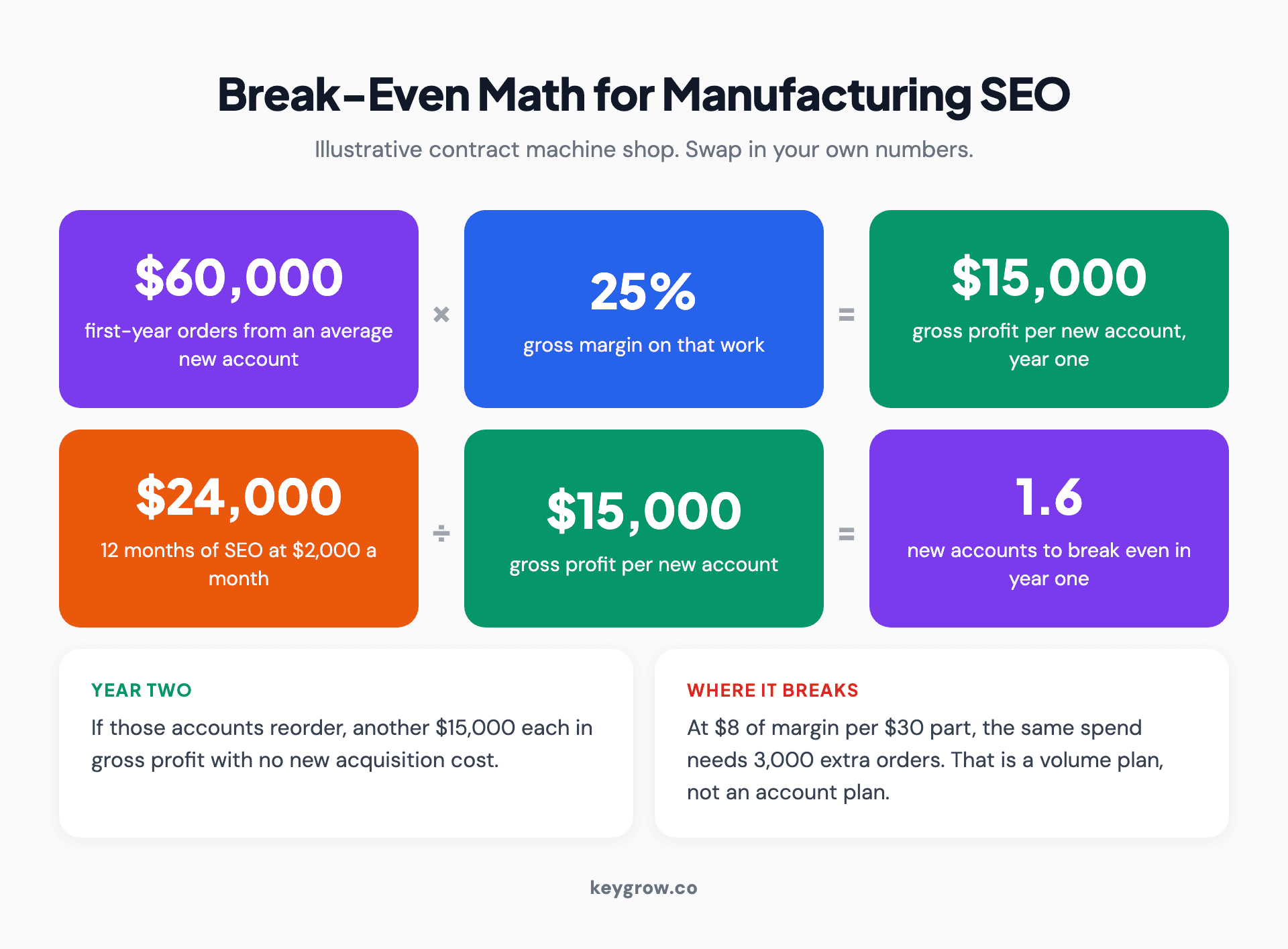
Break-even math for SEO for manufacturing in four steps: $60,000 in first-year orders from a new account, 25 percent gross margin giving $15,000 gross profit, $24,000 for twelve months of SEO at $2,000 a month, so 1.6 new accounts cover year one and reorders in year two are profit.
Two accounts and the year is paid for. Reorders make the second year mostly margin.
Compare a maker of $30 replacement parts selling direct online at $8 of margin each. That business needs 3,000 extra orders to cover the same spend, which is a volume game closer to ecommerce than to industrial SEO. It can still work. It is a different plan with different keywords.
One tip on the inputs: ask accounting for the average first-year revenue of your last five new customers. Not the biggest one, the one everybody remembers.
Condition 3: The plant can take the work
If you are booked nine months out, more RFQs turn into quotes you decline, and decline slowly. That is worse than no RFQ, because the buyer remembers.
Capacity also tells you where to aim. Point SEO at the work you want more of: the high-margin process, the 5-axis machine that sits idle on Fridays, the finishing line running one shift. A shop that tries to rank for every capability it lists ends up thin on all of them.

An automated production line with a touchscreen control panel in a manufacturing plant, a reminder that SEO should target the lines and machines with spare capacity.
A useful exercise is to list your processes in a column, then mark each one with current utilization and margin. The rows with low utilization and good margin are your first SEO pages. The rest can wait.
Condition 4: You can wait a year
Organic search takes months to turn into RFQs. Plan on twelve months before judging it, and fund it from money that can wait.
Our clearest proof isn't a manufacturer, but the time curve is the same shape. A doctor's practice in Dubai committed to SEO for a full year. The first three months looked unimpressive. By month twelve, organic traffic was up 1,519 percent and the practice was taking 130+ patient calls a month.
Manufacturing adds a second delay on top. A buyer who finds your capability page in month six may not issue a purchase order until month ten, after first articles, a quality review and a supplier setup form.
This is where we hold a firm view: SEO compounds. It looks unimpressive for the first quarter and very good after a year. Businesses that quit at month three have paid for the hard part and walk away just before the payout. If your budget has to show RFQs by next quarter, that is a real constraint, and SEO is the wrong tool for it.
When SEO is the wrong spend
Skip SEO, or keep it to basics, when a few named accounts send all your work, distributors carry all your volume, or you need RFQs this quarter.
| Your situation | Better move than SEO |
|---|---|
| Three customers, all from referrals | Account management and a clean capability page for due diligence |
| Distributors move nearly all your volume | Open datasheets, a where-to-buy page, and content your distributors can reuse |
| You need RFQs in the next 90 days | Paid search on process keywords, landing on a capability page |
| Booked out for nine months or more | Wait, and fix site basics in the meantime |
| Buyers can only source from an approved supplier list | Getting on the list matters more than ranking |
You may not need an agency even if SEO does make sense. A single plant with someone who can spare a few hours a week can cover the basics alone: verify Google Search Console and Bing Webmaster Tools, set up a Google Business Profile with the right manufacturing category, write one page per process with materials and tolerances in plain text, and publish a quality page with certification numbers. Our guide to web design for manufacturers shows what those pages need to hold.
Hire help when the hours you would spend on it are worth more on the shop floor than the fee is in your bank account.
What manufacturing SEO work involves
Manufacturing SEO is mostly page building: one page per process or product family, specs in HTML, proof of quality, and links from the trade world you already belong to.
The rep used to answer the first round of questions. Now the page has to. A Gartner survey of 646 B2B buyers, reported by Digital Commerce 360, found 67 percent prefer a rep-free buying experience. On a manufacturer's site, that turns into four jobs.
- Process and product pages. One page per process, material or product family, each built around the words from your RFQs. Put materials, tolerances, part size limits and typical volumes in an HTML table. A spec that lives only in a PDF is hard to compare and hard to read on a phone.
- Application pages. "CNC machining for medical devices" is a different search, and a different buyer, from "CNC machining". If an industry sends you real work, give it a page with examples.
- Cleanup. Manufacturers collect old PDFs, duplicate pages from acquired companies, and catalog pages with a part number and no text. These dilute the pages that should rank, so they get merged, redirected or rewritten.
- Links from your own trade. Your state manufacturing association, the distributors who carry your line, the supplier directories buyers already use, and customer stories you have permission to publish. You already belong to most of these. Ask for the link.
AI answers sit on top of much of this now. The same GlobalSpec research found 75 percent of technical buyers have noticed AI summaries above search results, and most of them read the summary and then keep going into the results. Pages that state the spec plainly near the top are the ones those summaries quote, which is the core of answer engine optimization.
How the first year usually runs
Expect technical fixes and page building first, early long-tail rankings around months four to six, and a fair verdict at month twelve.
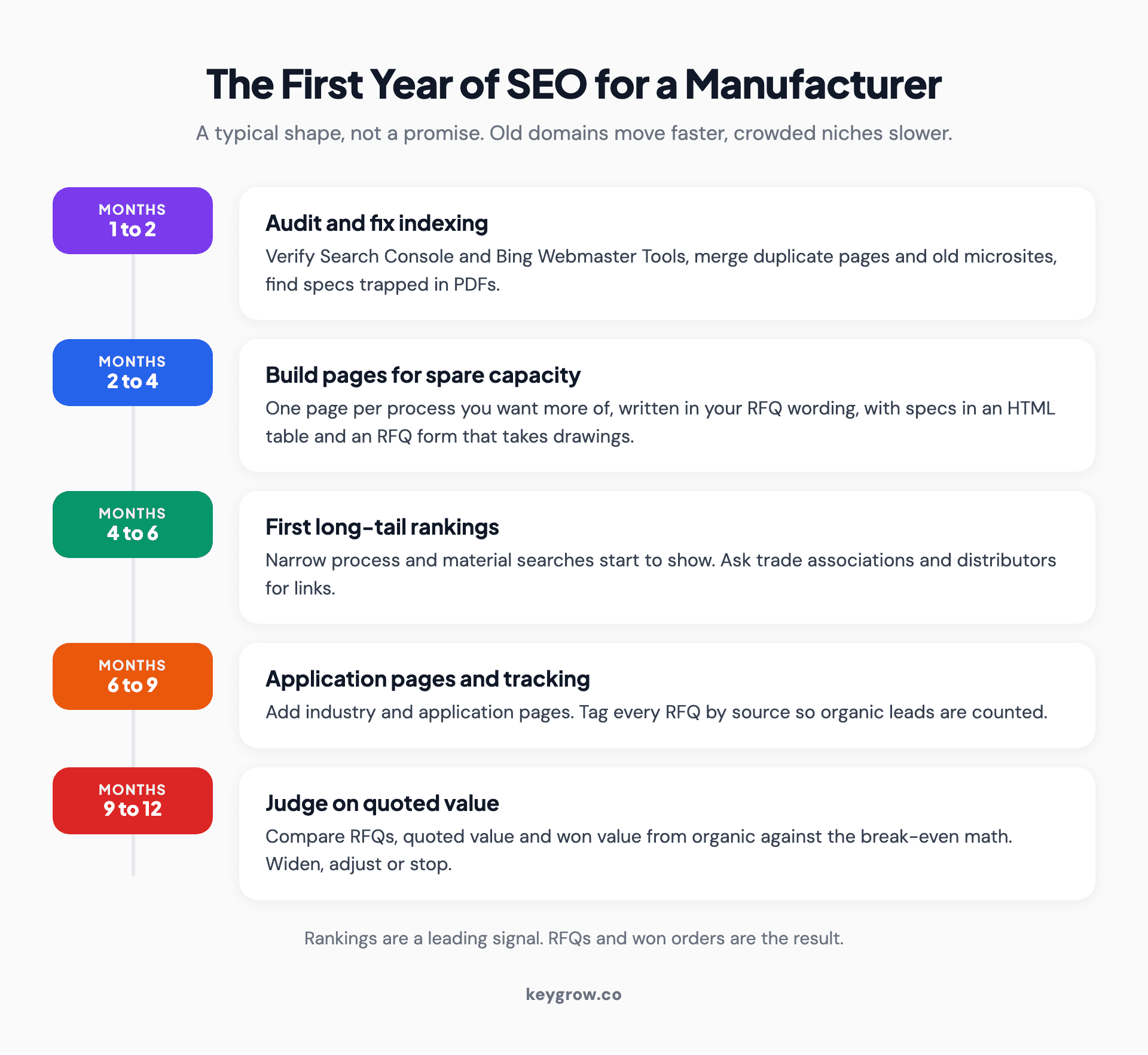
Twelve-month timeline for SEO for manufacturing: months one and two for the audit and indexing fixes, months two to four for process pages aimed at spare capacity, months four to six for first long-tail rankings and trade links, months six to nine for application pages and tracking RFQs by source, and months nine to twelve for judging quoted value and deciding to widen or stop.
That is a typical shape, not a promise. A shop with an old domain, a clean site and a narrow process can move faster. A new site in a crowded niche will move slower.
Measure the right thing along the way. Rankings are a leading signal, nothing more. Add a "how did you find us" field to the RFQ form or tag form submissions by source, then track three numbers each month: RFQs from organic search, the value you quoted on them, and the value you won. If month twelve shows quoted value climbing and one or two won accounts, the math from Condition 2 is working.
SEO or paid search first?
Paid search is faster and stops when you stop paying. SEO is slower and keeps working. Many manufacturers should run paid search briefly to learn which terms bring RFQs.
| SEO | Paid search | |
|---|---|---|
| Time to first RFQ | Months | Days to weeks |
| When you stop paying | Pages keep ranking for a while | Leads stop the same day |
| Best fit | Long-tail process and material searches | Testing which processes draw RFQs |
| Main cost | Content and technical work | Clicks, often expensive in industrial niches |
The pattern we like: run 60 to 90 days of PPC management on your top process terms, see which ones produce real RFQs, then build SEO pages around the winners. Our post on B2B PPC covers what makes those campaigns work, and why SEO matters in B2B explains why tiny traffic numbers can still carry big deals.
FAQs
Is SEO worth it for manufacturing companies?
It is worth it when buyers search for the processes or parts you make, one new account covers a year of the cost, and the plant has capacity. It is usually not worth it if a few named accounts send all your work or distributors handle all your volume.
How long does SEO take for a manufacturer?
Plan on twelve months before judging results. Early long-tail rankings often show up around months four to six, but industrial sales cycles add more months between the first visit and the first purchase order.
How much does SEO for manufacturing cost?
Backlinko's survey of more than 300 SEO professionals found $1,001 to $2,500 a month is the most common retainer range. The right number for you depends on how many process pages need writing and how much technical cleanup the site needs.
What keywords should a manufacturer target?
Start with the exact phrases buyers use in your RFQs: process plus material plus a qualifier, such as a tolerance, volume or industry. These terms often show only 10 to 90 searches a month, and that is fine when each searcher may represent a large order.
Does local SEO matter for manufacturers?
It matters for shops that win work from nearby buyers, such as job shops, fabricators and anyone whose buyers want to visit the plant. A verified Google Business Profile with the right category is enough for most. National product manufacturers should focus on product and application pages instead.
Should a manufacturer start with SEO or PPC?
If you need RFQs this quarter, start with paid search. If you can wait, start SEO now. Many manufacturers do both, using a short paid search test to find which process terms produce RFQs, then building SEO pages around those terms.
Where a plant should start
Run the four checks this week. Read your Search Console queries, pull your last 20 RFQs, do the break-even math with your own margin, and look at which machines have room.
If they pass, pick the one process you most want more of and build that page properly, with the spec table, the equipment, the certifications and an RFQ form that takes drawing files. Track RFQs from it for 90 days before building the next one.
If you want a second opinion on the checks, our SEO services team will tell you honestly whether SEO fits your plant, and you can request a quote here.