


Most small business sites do not have a design problem. They have a words problem.
The layout is fine. The photos are fine. Then the headline says "Welcome to our website," the services page lists eleven things in one paragraph, and the only button on the first screen says "Learn More." Visitors leave, and the owner books a redesign.
Website copywriting is writing the words on your site (headlines, service descriptions, proof, buttons, the about page) so a visitor understands what you do, believes you, and takes the next step. On most small business sites, the words are what does the selling. The design just holds them.
The proof is in a rewrite: one homepage first screen, taken apart line by line. After that comes the copy each page type needs, what it costs when the owner, a freelancer or an agency writes it, and an honest section on when to write it yourself and pay nobody.
What website copywriting covers, and what it does not
Website copywriting covers every word a visitor reads on your pages with one aim: getting them to call, book, buy or fill in a form. Blog articles and ads are related work with different jobs.
| Type | Main job | Judged by | Example |
|---|---|---|---|
| Website copywriting | Turn a visitor into a call, booking or sale | Leads and sales per page | Homepage headline, service page, contact page |
| SEO content writing | Get found for a search and answer it | Rankings, organic visits, AI citations | A guide to what a roof replacement costs |
| Ad copywriting | Win the click | Click-through rate, cost per lead | A Google search ad |
The lines blur on service pages, which have to rank and convert at the same time. If getting found is the problem, our guide to SEO content writing covers that half. If the ads are the problem, start with how to write PPC ad copy. This post is about the words that turn a visit into a lead once someone has arrived.
Why the first screen gets rewritten first
The first screen is where the reading happens. In a Nielsen Norman Group eyetracking study, people spent about 57 percent of their page-viewing time above the fold and 74 percent within the first two screenfuls.
That study tracked more than 130,000 eye fixations from 120 participants, published in 2018. Phones change where the fold sits, not the habit. Whatever is on your first screen is the copy most visitors will ever read, so it gets fixed before anything else.
It has five questions to answer before anyone scrolls:
- What do you do?
- Where, or for whom?
- Why you rather than the next tab?
- How do I know you are real?
- What do I do next?
Most homepages answer the first one, vaguely, and leave the other four to the visitor.
A worked rewrite: one homepage first screen, line by line
The business here is made up, a roofing company we will call Ridgeline Roofing. The "before" version is a composite of lines that turn up on real small business homepages all the time, and the bracketed figures in the "after" are placeholders for your own.
| Line | Before | After | What changed |
|---|---|---|---|
| Menu | Home, About Us, Our Story, Services, Residential, Commercial, Gallery, Blog, Contact | Roof repair, Roof replacement, Storm damage, Reviews, and the phone number | Nine links became four things people came to buy, plus a tappable number |
| Headline | Welcome to Ridgeline Roofing | Roof repair and replacement in Tulsa and Broken Arrow | Says what and where. The logo already says who |
| Subhead | Quality, integrity and excellence since 1998 | Free inspection, photos of every problem we find, and a written price before any work starts | Adjectives nobody can check became a process anyone can picture |
| Body line | We are a family-owned company dedicated to providing the highest quality roofing solutions | Cut | It was true of every roofer in the city |
| Proof | Your satisfaction is our top priority | [4.8] stars from [212] Google reviews. Licensed and insured, [license no.] | A claim became evidence |
| Button | Learn More | Book a free inspection | Names the action and its price, which is nothing |
| Second option | None | Or call [918-555-0142] | For people who would rather talk than type |
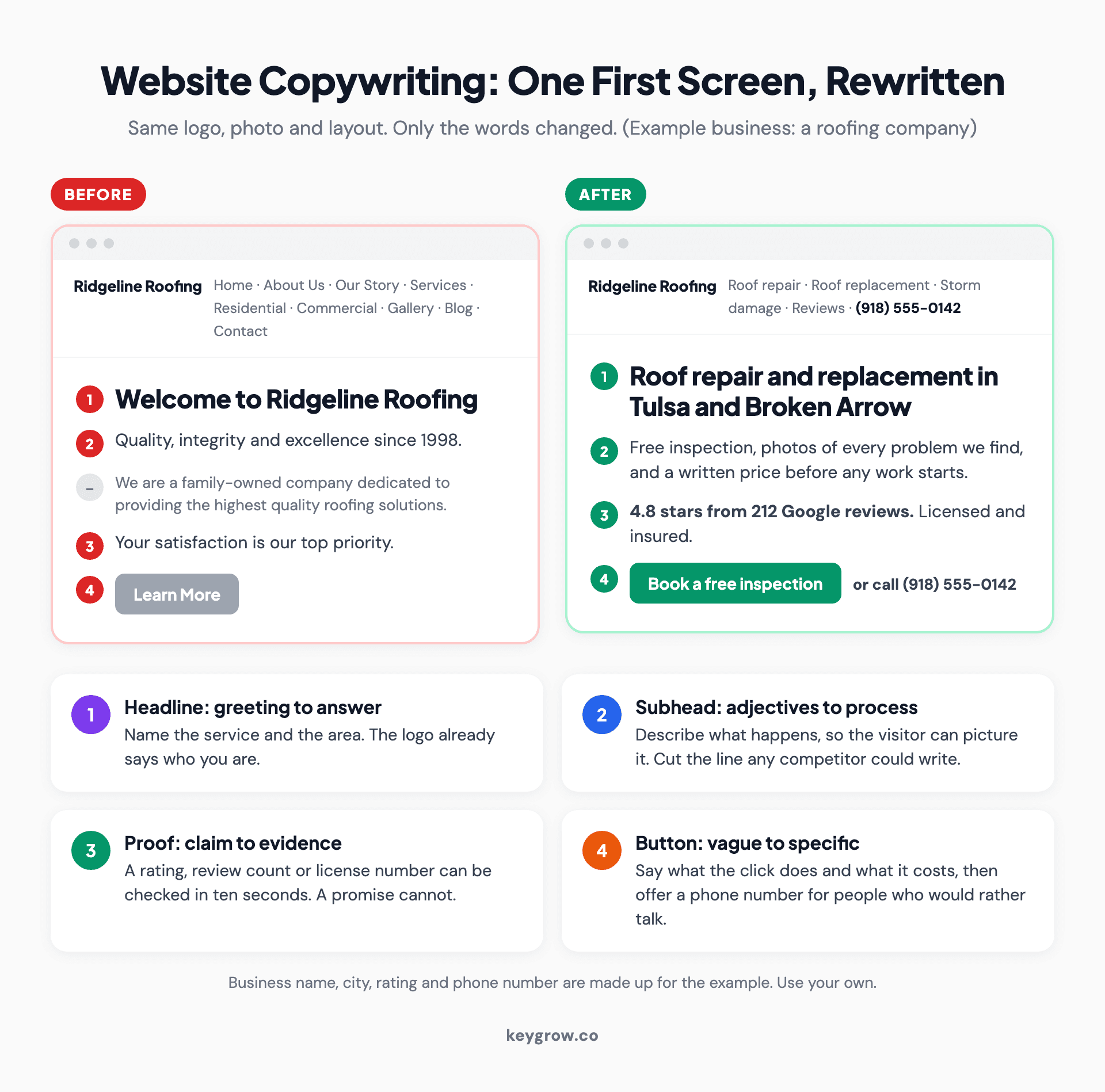
Annotated before-and-after website copywriting example for a roofing company homepage first screen: the before version has a nine-link menu, a Welcome headline, a quality-integrity-excellence subhead and a Learn More button; the after version names the service and city, describes the inspection process, shows a review count and license, and uses a Book a free inspection button with a phone number.
What each change is doing
Start with the headline. "Welcome" carries no information, and the search that brought someone here was a service and a place, so the new headline just repeats both.
The subhead is where most of the persuasion moved. Quality, integrity and excellence are words any competitor can also claim, and most of them do. Once every roofer in town is committed to excellence, the phrase stops telling anyone anything. A free inspection with photos and a written price before work starts is something a visitor can picture, and it quietly answers the fear a homeowner rarely says out loud: being sold a roof they did not need.
"Your satisfaction is our top priority" cannot be checked, so nobody weighs it. A star rating, a review count and a license number can be checked in ten seconds. Thin on reviews? Use something else a stranger could verify, like years trading or a named neighborhood you have worked in.
And "Learn More" asks for a click without saying what the click buys.
The logo, photo, colors and layout are untouched. The first screen grew by about ten words. Length was never the issue. Vague words were.
The rest of the page, from the proof section to the form, follows the same logic, and our lead generation website teardown walks through it zone by zone.
What copy does each page on your site need?
Each page type has one job, and the copy follows from it. The homepage routes, service pages sell, the about page proves you exist, and the contact page removes the last doubt.
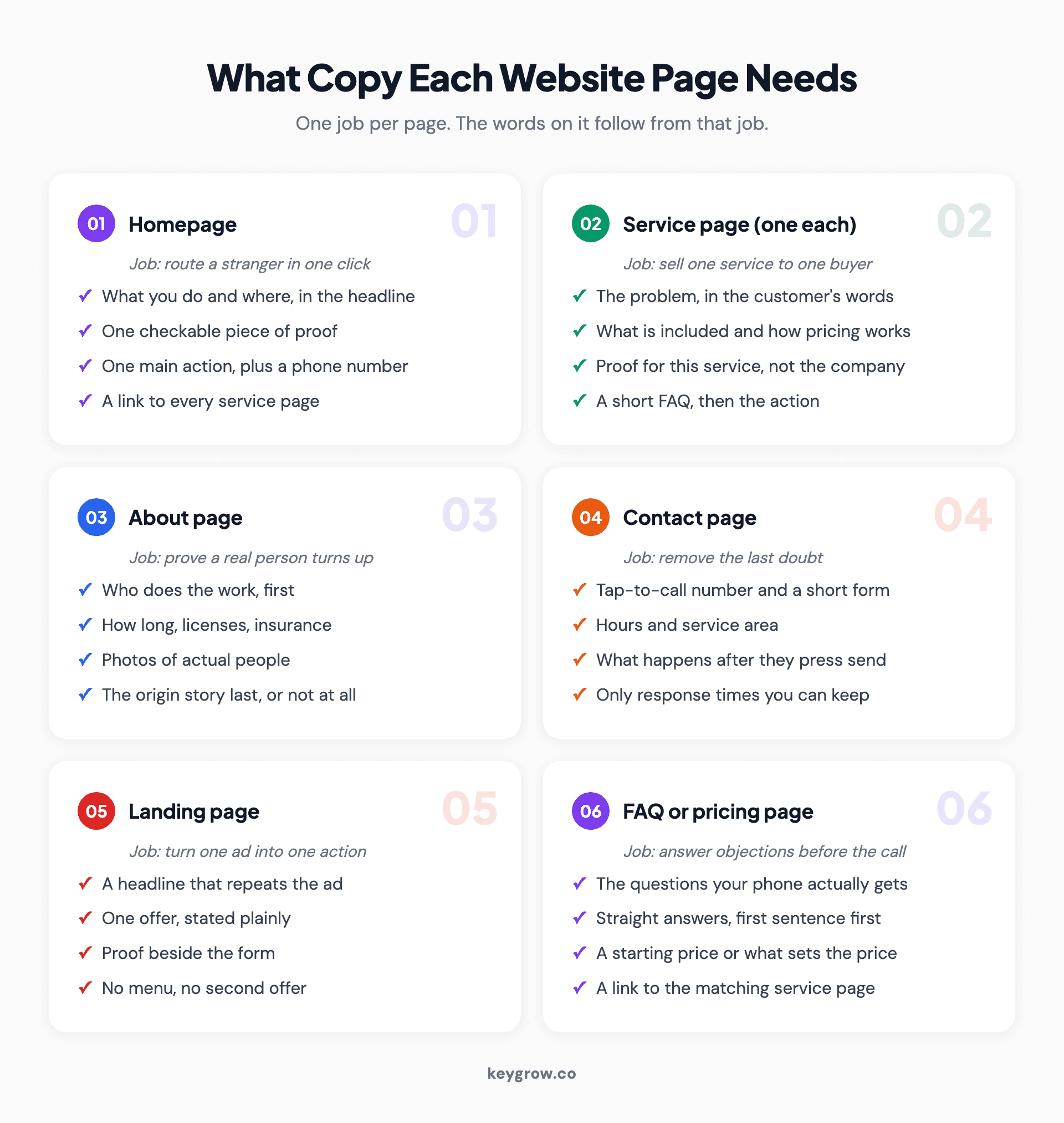
Checklist grid of the website copy each page type needs: homepage, service pages, about page, contact page, landing page, and FAQ or pricing page, each with its one job and the lines it must include.
| Page | Its one job | The copy it must include | Rough length |
|---|---|---|---|
| Homepage | Route a stranger to the right page in one click | What, where, proof, one main action, a link to each service | 300 to 600 words |
| Service page (one per service) | Sell one service to one buyer | The problem in their words, what is included, how pricing works, proof for this service, a short FAQ, the action | 600 to 1,200 words |
| About page | Make you real | Who does the work, how long you have done it, licenses, photos of actual people | 300 to 600 words |
| Contact page | Remove the last doubt | Phone, a short form, hours, service area, what happens after they submit | 100 to 250 words |
| Landing page | Turn one ad or campaign into one action | A headline that matches the ad, one offer, proof near the form, no menu | 250 to 800 words |
| FAQ or pricing page | Answer objections before the call | The questions your phone actually gets, answered straight | As long as the questions need |
The lengths are a rough guide, not a target. A page is long enough when the buyer has nothing left to ask.

A designer sketching page wireframes and sticky-note layouts at a desk beside a laptop.
Service pages are where most small sites fall short. One "Services" page listing everything forces a homeowner with storm damage and a homeowner pricing a full replacement to read the same paragraph, when they have different fears and different budgets. Give each service its own page and its own words. It also gives each service a page that can rank for its own search.
An about page is a trust check, not a biography. Visitors open it to check that a real person will turn up. Lead with who does the work, then how long, then the licenses. The origin story can go last, or go.
On the contact page, say what happens next. "We call you back within one business day and book a time to look at the roof" gives a nervous visitor a reason to press send, because it tells them what they are agreeing to. Only write a response time you can keep.
Landing pages are the strictest copy job on the list. The headline repeats the ad, there is one offer, and the menu is gone. Which traffic belongs on a landing page and which on the homepage is its own question, covered in our post on landing page vs homepage. For paid traffic, a dedicated page with copy written for the ad is usually the better destination, and our landing page design service builds that page.
An eviction law firm we worked with shows why. Its ads already pointed at a landing page, and it was getting 1 conversion a week from 22 clicks, at $240 per conversion. Session recordings showed visitors arriving and not knowing what to do next. We built a separate page around one clear call to action, rewrote the ad copy and split-tested side campaigns. Within a week the firm had 21 conversions from 189 clicks at $31.79 each (September to October 2022). The copy was not the only change, but the confusion it fixed was the one the recordings showed. The eviction law firm case study has the full breakdown.
How to write website copy, in six steps
Write from your customers' words, in the order visitors meet the pages, and cut last. Most of the work is collecting material before you write a sentence.
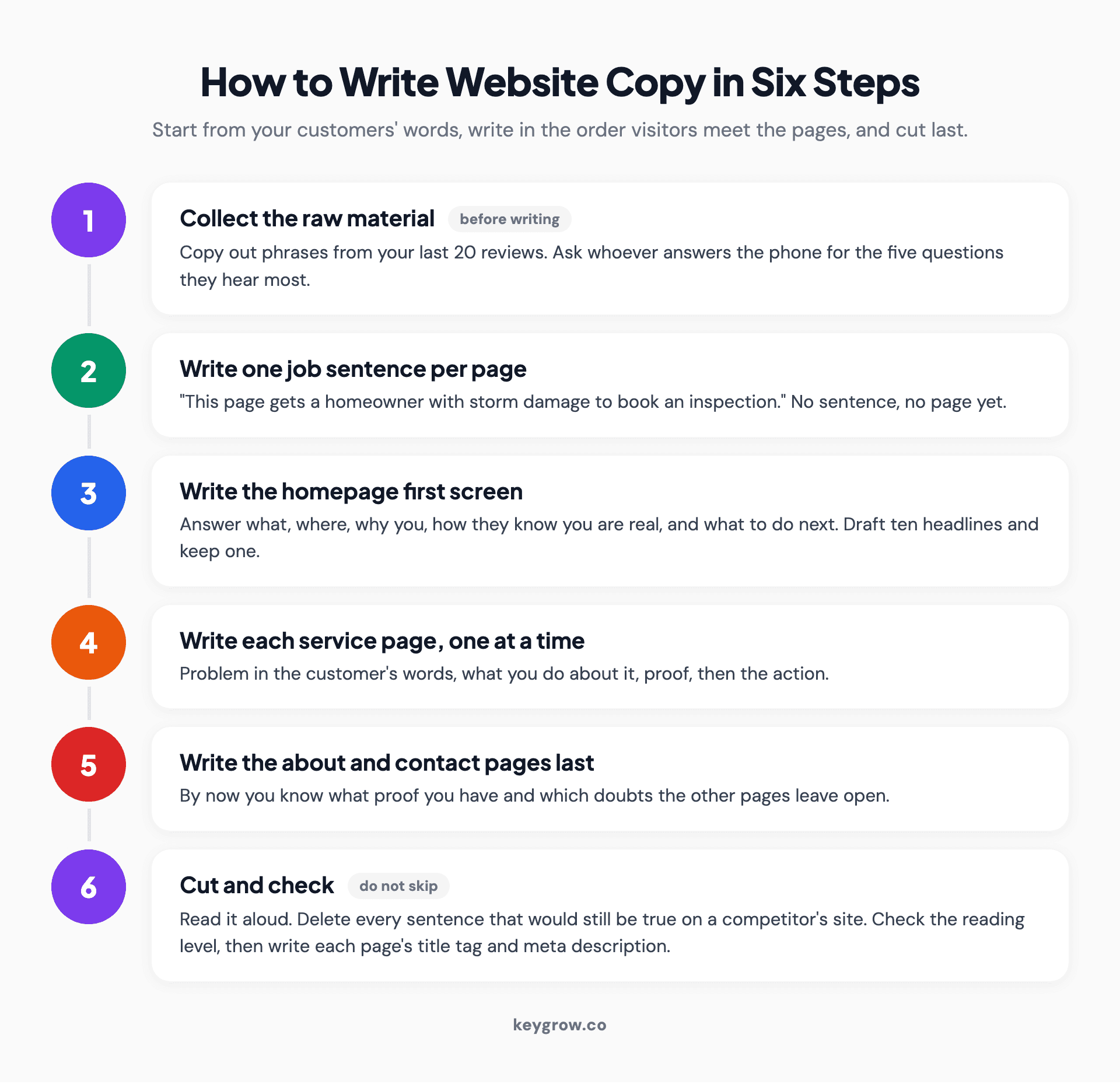
Six-step process for writing website copy: collect customer phrases from reviews and phone calls, write one job sentence per page, write the homepage first screen, write each service page, write the about and contact pages, then cut and check reading level.
- Collect the raw material. Read your last 20 reviews and copy out the phrases customers use. Ask whoever answers the phone for the five questions they hear most. Those phrases become headlines, and those questions become your FAQ.
- Write one sentence per page that states its job. "This page gets a homeowner with storm damage to book an inspection." If you cannot write that sentence, the page is not ready to exist.
- Write the homepage first screen. Answer the five questions from earlier. Write ten headlines and pick one. The first one you write is usually the welcome mat.
- Write the service pages, one at a time. Open each with the problem in the customer's words, then what you do about it, then proof, then the action. These pages do most of the selling.
- Write the about and contact pages last. By now you know what proof you have and which doubts the other pages leave open.
- Cut and check. Read it aloud. Delete every sentence that would still be true on a competitor's site. Run it through a readability score checker and aim for plain language, since plenty of visitors are reading on a phone in a hurry. Then write a title tag and meta description for each page; a meta title and description generator gives you a first draft to edit.
Do not skip step 6. First drafts run long because the writer is still working out what they think.
Who should write your website copy?
The owner knows the business best, a freelancer writes fastest, and an agency can bundle the copy with the build. Cost runs from your own evenings to a few thousand dollars for a small site.
| Who writes it | What it costs | Best when | Watch out for |
|---|---|---|---|
| You, the owner | Your time, often a few evenings for a five-page site (our estimate) | Small site, more time than budget, you know how you want to sound | Writing about yourself instead of the customer's problem |
| Freelance copywriter | A median 32 to 87.5 cents per word, or $65 to $75 an hour (EFA 2026) | You want a professional voice and can brief the writer well | A writer who never hears your customers or your phone staff |
| In-house writer | A median $76,910 a year for writers and authors (BLS, May 2025) | You publish constantly across many pages and channels | Too much capacity for a site that changes twice a year |
| Agency, bundled with the build | Included in the build price on some plans, ours among them | You are building or rebuilding the site anyway | Copy written after the design, just to fill boxes |
Here is the arithmetic on a typical small site. Five or six pages at around 500 words each is about 3,000 words. At the work-for-hire business and marketing rates in the EFA rate chart, that is roughly $960 to $2,625 from a freelancer, before revision rounds. A salaried writer, at the median the BLS publishes in its writers and authors profile, only makes sense when there is a year of writing to do.

Two people reviewing a website draft together on a laptop at a meeting table.
If you are rebuilding the site anyway, it is worth asking whether copy is in the quote. Every one of our website design and development plans includes professional copywriting; the Business Website plan is $1,400 for up to six pages, with the writing and the build in one price. Whoever writes it, the trade-off is the same. You still have to supply the raw material, because nobody else can invent your reviews, your prices or the questions your phone gets.
Two questions sort the good writers from the rest. Ask whether they will talk to you or your staff before writing. Then ask to see a before and after from a past client, not just a portfolio of finished pages. A writer who only works from a questionnaire will give you a polished version of what you already have.
When should you write it yourself?
Write it yourself when the site is small, the business is mostly you, and you have more time than budget. Pay someone when your hours are worth more than the fee, or when you have a draft and cannot see what is wrong with it.
Our view is that doing it yourself is the right call more often than agencies admit. At the freelance rates above, the copy for a five-page site runs roughly $960 to $2,625. For a one-person business with quiet evenings, that money often does more as ad budget or a decent camera for job photos. You already know the questions customers ask. A hired writer has to interview you to learn them.

A laptop and an open notebook on an empty cafe table, set up for a quiet evening of writing.
Hand it off when any of these is true:
- You have rewritten the homepage headline four times and it still starts with "Welcome."
- Every page is about you ("we are," "our team," "we have been") and none starts with the customer's problem.
- You are about to send paid traffic to the site. Ads turn weak copy into a cost you pay per click.
The mistakes that turn up on almost every small business site
These seven come up so often that you can check your own homepage against them in five minutes.
- A headline that starts with "Welcome to." The visitor knows they arrived.
- Adjective soup: quality, integrity, excellence, commitment. Swap each word for the fact that proves it, or delete it.
- One services page for everything.
- "Learn More" buttons, when the button could say book, call or get a price.
- Copy that is all "we" and "our." Count them against "you" and "your" on your homepage, and if "we" wins, rewrite.
- Copy written last. When the design is finished first, the words get squeezed into boxes sized for placeholder text, so get at least the first screen written before anyone signs off the layout.
- No price signal at all. People comparing services want to know whether you are in their range, and a starting price or a plain explanation of what sets the price beats silence.
Does website copy still matter for SEO and AI answers?
Yes. Search engines and AI assistants read the same words your visitors do, and a page that says what it offers in its first sentence is easier for both to understand and quote.
The overlap has limits. Website copy does not need a keyword in every paragraph, and forcing one in makes it read worse. Put the service and place in the headline, the title tag and the first paragraph, give each service its own page, and write everything else for the person reading it. The headline from the rewrite above, "Roof repair and replacement in Tulsa and Broken Arrow," does both jobs at once. "Welcome to Ridgeline Roofing" does neither.
FAQs
What does a website copywriter do?
A website copywriter writes the words on your site's pages: headlines, service descriptions, calls to action, and the about and contact pages. Good ones start by interviewing you and reading your reviews, because the best lines usually come from what customers already say. Many also write the title tag and meta description for each page.
How much does website copywriting cost?
The Editorial Freelancers Association's 2026 rate chart puts work-for-hire business and marketing writing at a median 32 to 87.5 cents a word, or $65 to $75 an hour. For a five or six page small business site of about 3,000 words, that works out to roughly $960 to $2,625. Some web design agencies include copywriting in the build price instead.
What is the difference between website copywriting and content writing?
Website copywriting persuades someone already on your site to act, and it is judged by leads and sales. Content writing, such as blog posts and guides, informs and attracts visitors, usually through search. Service pages need both.
How many words should a homepage have?
Enough to say what you do, where, why you, how visitors know you are real and what to do next, which often lands between 300 and 600 words. The first screen matters far more than the total. A short homepage that routes people to strong service pages beats a long one that tries to sell everything.
Can AI write my website copy?
AI tools can produce a quick first draft, but it will sound like every other site in your industry because it was built from them. The parts that convert, such as your prices, your process, your reviews and the questions customers ask on the phone, have to come from you. Use AI to tighten and restructure your own material, not to invent it.
Should website copy be written before or after the design?
Before, or at least alongside it. When the design is locked first, the copy gets cut to fit boxes that were sized for placeholder text. Writing the homepage first screen and one service page before the layout is signed off lets the design fit the message.
Rewrite the first screen first
If you change one thing this week, change the first screen of your homepage. Replace the welcome with what you do and where. Swap the adjectives for a process. Put one checkable piece of proof underneath, and give the button a verb that says what happens next. Then do the same for each service page, one at a time.
If you would rather have the copy written as part of a rebuild, tell us about your site and we will tell you plainly whether it needs new words, a new site, or neither.