


Picture a 2,000-word service page about tankless water heater installation. The keyword appears 14 times, there is a section called "Why Choose Us," and after a year live it ranks nowhere.
The person searching "tankless water heater installation cost" wanted a number. The page makes them read 400 words first, so they leave for the next result.
SEO content writing closes that gap. SEO content writing is writing a page so it answers the search behind a keyword better than the pages already ranking, in a structure Google and AI assistants can read and quote. The keyword tells you which question to answer. The writing is the answer.
Further down, we rewrite one of those paragraphs line by line and share the brief we fill in before every post. There is also a section on when you should not pay anyone for this at all.
What SEO content writing is, and what it is not
SEO content writing is answer work, not keyword placement. You pick a search, read what ranks for it, and write the most useful page for that search. Most of the optimization is structure.
It gets blurred with two other kinds of writing that have different jobs.
| Type | Main job | Judged by | Example |
|---|---|---|---|
| SEO content writing | Answer a search better than the current results | Rankings, AI citations, qualified visits | A guide to what a tankless install costs |
| Copywriting | Persuade a reader already on the page | Conversion rate | The headline and button on a booking page |
| General content writing | Inform an audience you already have | Opens, replies, shares | A newsletter |
A service page needs the first two: SEO writing to get found, copywriting to turn the visit into a call.
It is also not a word count. Google's helpful content guidance asks whether you are writing to a set length because you heard Google prefers one, then says in brackets that it does not. We set length from the pages ranking for each keyword, and our guide on how long a blog post should be for SEO shows that 15-minute count.
What makes SEO content rank now?
Four things: the page matches the intent of the search, says something the top results do not, answers early, and is linked into the rest of the site.
Intent decides the format. If the top five results are short checklists, a 3,000-word essay is not standing out. It is answering a question nobody asked.
Information gain comes next. On a competitive search, page one is often the same article written five times. The page that adds a worked example, a number from your own jobs or a rule for deciding gives Google a reason to rank it. Our post on why unique content matters in SEO goes further.
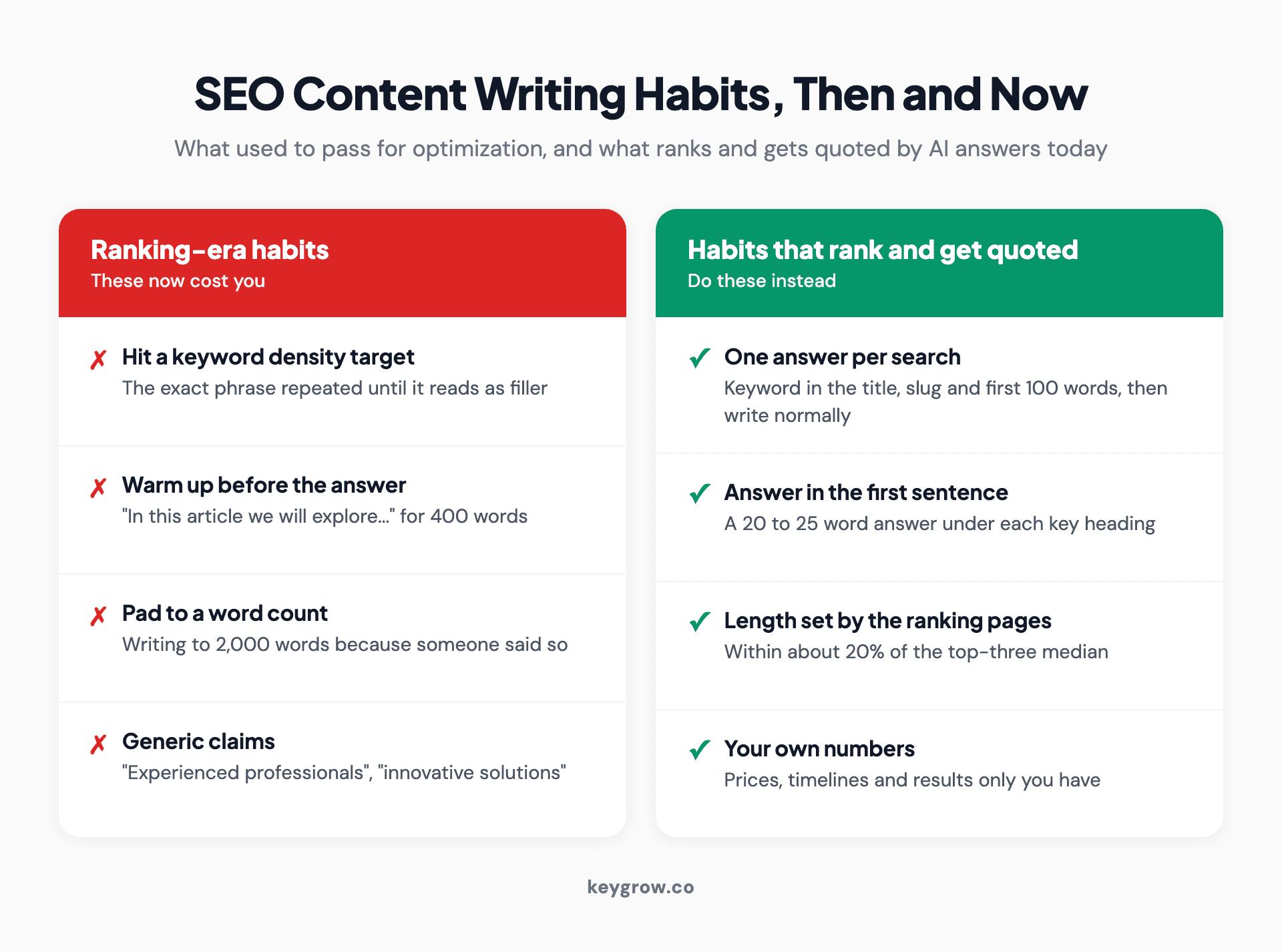
Two-column comparison cards of SEO content writing habits: the ranking-era habits that now cost you (keyword density targets, warm-up intros, padding to a word count, generic claims) versus the habits that rank and get quoted (one answer per search, the answer in the first sentence, length set by the ranking pages, your own numbers).
Answer-first structure has changed most, and our position is blunt: burying the answer and padding to a word count now cost you. Researchers at Princeton and Georgia Tech tested ways to make pages more visible inside AI-generated answers, and the GEO study found the best methods raised visibility by up to 40 percent. Adding statistics, quotations and cited sources were among them. Padding was not.
Links finish the job. A page nothing links to is slow to be found and hard to trust.
A worked example: one paragraph, before and after
The quickest way to see SEO content writing is to watch one paragraph get rewritten. This is the opening of a typical plumbing service page. The business is made up; the pattern shows up in most content audits we run.
Before: If you are wondering about tankless water heater installation cost, you are not alone. At our company, we understand that tankless water heater installation cost is an important consideration for your family. Tankless water heaters are an innovative solution for your home's hot water needs, and our team of experienced professionals has proudly served the community for over 20 years. In this article, we will explore everything you need to know about tankless water heater installation cost, so keep reading to learn more.
What is wrong with it
- No answer. Eighty-three words in, the reader has no price, no range and no idea what drives either.
- The keyword three times in four sentences. That is writing to a density target, and a person reads it as filler.
- Claims nobody can check. "Innovative solution" and "experienced professionals" sit on every competitor's page.
- A promise to explain later. "Keep reading to learn more" admits the answer is buried.
After: A tankless water heater install usually costs between [your low figure] and [your high figure], and three things decide where your job lands: gas or electric, whether your gas line or electrical panel needs an upgrade, and whether the unit goes where the old tank was. A gas-to-gas swap in the same spot sits at the low end. Converting a gas tank to an electric tankless unit that needs a new panel sits at the top. We price every job after one look at the gas line and the panel, because those two account for most of the difference.
What the rewrite changed
The answer is now the first sentence, so a skimmer, a featured snippet or an AI assistant can lift it without the rest. The keyword appears once. Google understands the topic fine without the phrase on repeat.
The cost drivers are the information gain. Most competing pages quote a national average and stop there, and a homeowner cannot do much with an average.
The brackets are deliberate. Those figures have to come from your own invoices, because the moment you copy another site's range, your paragraph is their paragraph again. And it ends on a next step, which is where the copywriting takes over.
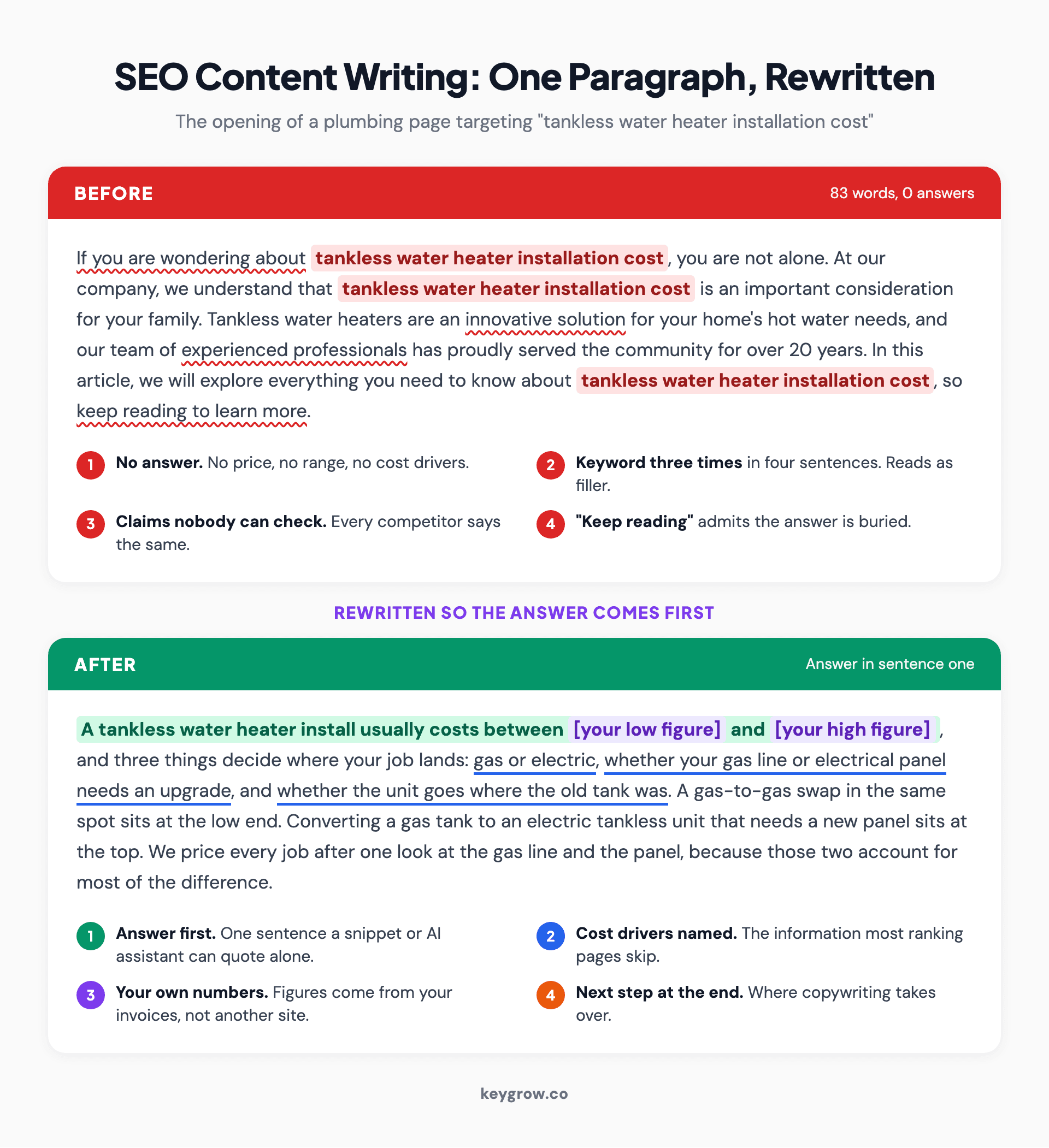
Annotated before-and-after example of SEO content writing: a keyword-stuffed opening paragraph about tankless water heater installation cost with four problems marked, rewritten so the answer comes first, the cost drivers are named and the price comes from the business's own invoices.
How we write SEO content, step by step
Seven steps, in order. Most of the work happens before the draft.
- Read the top five results in full. Note format, headings, the questions answered and where each goes thin. Take the median word count of the top three; your length sits within about 20 percent of it.
- Fill in the brief (template below). If you cannot write the "what we add" line, do not start drafting.
- Write the answer first. The first 100 words answer the search on their own, keyword included. Under each main heading, one or two sentences of answer, then the detail.
- Add what only you know. Your own prices, and the question customers keep asking on the phone. No AI tool can write this part.
- Cut it into sections that stand alone. Around 120 to 180 words between headings suits readers and AI systems that quote one section at a time. Comparisons go in tables.
- Edit for reading level. Short sentences, plain verbs. A readability score checker will tell you if you are above roughly a tenth grade level.
- Write the title and meta description last. Title under 60 characters with the keyword near the front, description under about 150. A meta title and description generator gives you drafts, and our title tag best practices cover the rules.
Once it is live, link to it from two or three older related pages.
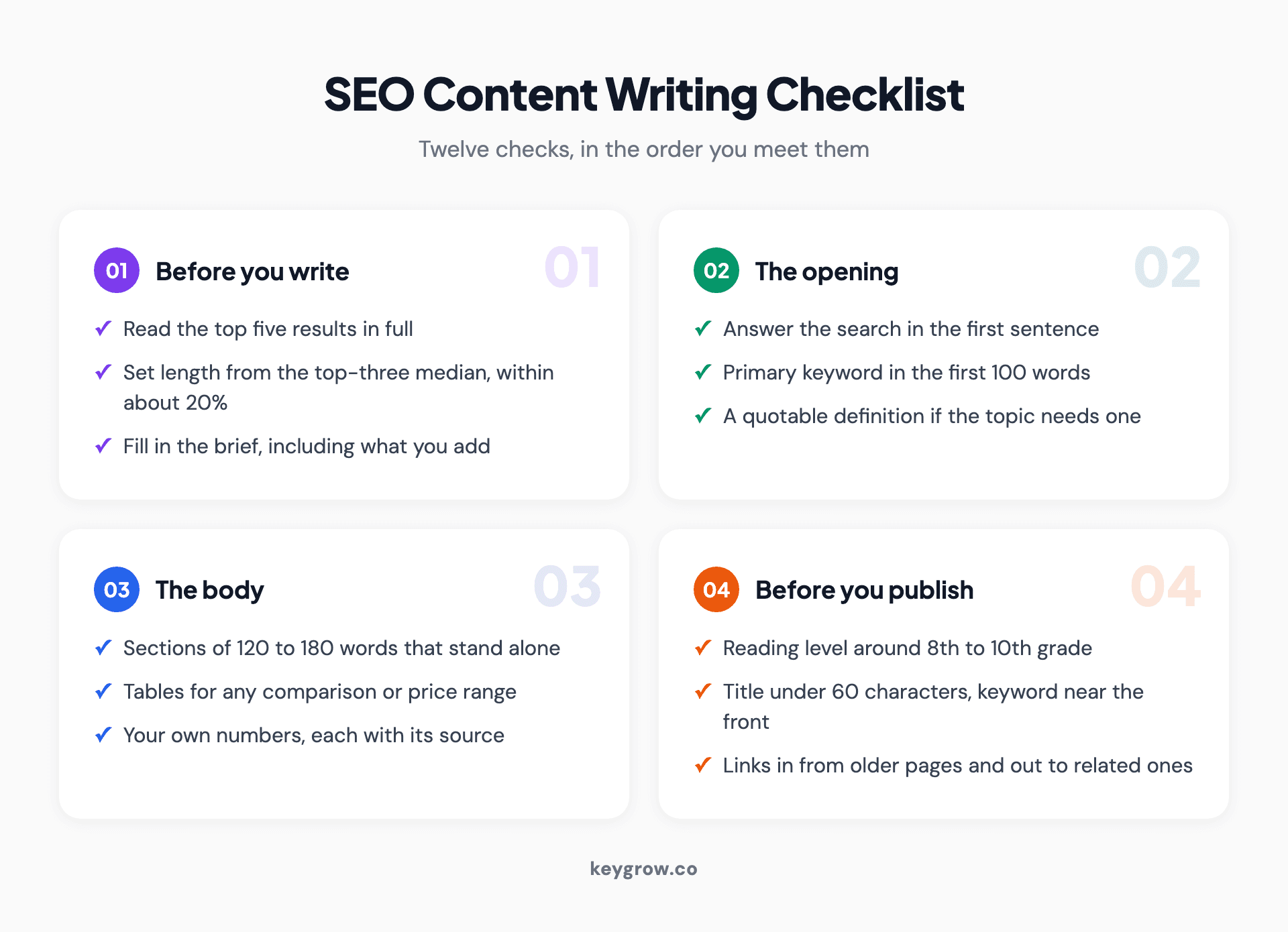
Four-card SEO content writing checklist: before you write (read the top five, set length from the top-three median, fill the brief), the opening (answer in the first sentence, keyword in the first 100 words), the body (sections of 120 to 180 words, tables for comparisons, your own numbers), and before you publish (reading level check, title under 60 characters, internal links in and out).
The SEO content brief template we use
A brief is one page, filled in before any writing, that says what the post must cover and what it adds. The example column is the brief for this post.
| Field | What goes in it | Example (this post) |
|---|---|---|
| Primary keyword | One search, with volume and difficulty | seo content writing, about 1,000 a month |
| Cluster | Up to four close variations, same intent | seo writing, how to write seo content |
| Format | What the top results are | Definitional guides and step lists |
| Length range | Top-three median, plus or minus 20 percent | About 1,800 words |
| Must-cover topics | Headings every ranking page shares | Definition, keywords, structure, links, meta |
| Gaps | What the ranking pages skip | No worked example, no brief, advice from 2023 |
| What we add | One sentence. "More detail" does not count | A real-style paragraph rewritten line by line |
| Answer draft | The 40 to 60 word opening answer | The definition in the third paragraph |
| Proof | Your numbers, a client result, a cited source | Our 12-month organic result, Google's guidance |
| Links | Three to five internal, two or three external | Length guide, readability tool, SEO service |

Printed planning sheets and a pen on a wooden desk beside a laptop, the kind of one-page brief filled in before a draft starts.
The "what we add" line does the most work. Google's guidance asks whether a page provides original information, research or analysis. If the honest answer is no, a tidier outline will not save the draft.
Where the keyword goes, and where it does not
Put the primary keyword in the title, the H1, the URL slug, the meta description and the first 100 words. After that, write normally. Use variations in a few headings, phrased the way people ask. Alt text describes the image for people who cannot see it; it is not a keyword slot.
There is no density target. Google's spam policies describe keyword stuffing as filling a page with keywords to manipulate rankings, including repeating words until they sound unnatural. Read your paragraph aloud. If it sounds like the before example, cut.
Writing for AI answers as well as Google
The same page now has two readers: Google's ranking systems and AI assistants that quote one section at a time. Answer-first writing serves both.
That means a 20 to 25 word answer under each key heading, sections that make sense lifted out alone, and numbers paired with their source. "SEO content writing is..." gets quoted. "In this article, we will explore..." does not.
We have offered AEO since before AI search went mainstream, and the lesson runs both ways: a page built to be quoted also tends to rank. Our walkthrough on structuring a page for AEO covers the layout. If you want citation work handled across the whole site, that is what our answer engine optimization services do.
How long before SEO content pays off?
Low-competition pages can rank within weeks. Competitive topics take months, and the gains compound over a year if you keep publishing and updating.
Our clearest example is a doctor's practice in Dubai, where much of the work was educational content answering the questions patients search for. Over 12 months, organic traffic grew 1,519 percent and monthly phone calls went from 5 to 130+. The first quarter looked like nothing was happening, which is normal.
When you do not need to pay a writer
If you know your trade, you can write good SEO content yourself. A plumber who has priced 200 water heater jobs knows more about what drives the cost than any freelance writer. The hard part is structure, and this page covers it.

A hand holding a pen over a printed page, reviewing a draft line by line.
DIY makes sense with one location, a few spare hours a month and a list of questions customers ask on the phone. Write one page per question, answer it in the first sentence, add your own numbers. Ten pages like that put you ahead of most local sites, which rarely answer anything.
Hire help when the keywords are competitive, when you need more than a few pages a month, or when your hours are worth more on jobs than at a keyboard. Our SEO content writing services cover keyword research, content planning and writing alongside the technical and link work, month-to-month.
FAQs
What does an SEO content writer do?
An SEO content writer researches what people search for, studies the pages that already rank, and writes a page that answers the search better. They also handle headings, the title, the meta description and internal links. The good ones bring real expertise or interview someone who has it.
How long should SEO content be?
As long as the top-ranking pages for that keyword show it needs to be. Count the main text of the top three results and stay within about 20 percent of their median. Google says it has no preferred word count.
Can AI write SEO content?
AI can outline and draft, but it cannot add your prices or your judgment, and that is the part that ranks. Google judges whether content is helpful, not which tool produced it. Using automation mainly to manipulate rankings breaks its spam policies.
How many keywords should one page target?
One primary keyword plus a few close variations with the same intent. If two keywords would each want a different page, write two pages. A page aimed at both usually ranks for neither.
How do I know if my content is SEO friendly?
Check that it answers the search in the first 100 words, uses the keyword in the title, URL and opening, has clear headings, and links to and from related pages. Then watch Search Console for impressions on your target terms over the following weeks.
Write the answer first
If you change one habit, make it this: open every page with the answer to the search, in a sentence that could be quoted on its own. Then fill in a brief, add the numbers only you have, and cut the rest.
If you would rather hand the research and writing to a team, tell us what you need and we will show you which pages to write first.