


There is no ideal word count for a blog post. Not 1,500, not 2,450, and not the 2,000-word minimum you may have seen in a content brief.
That is Google's position before it is ours. Google's SEO Starter Guide says there is "no magical word count target, minimum or maximum, though you probably want to have at least one word." Its helpful content guidance asks whether you are writing to a word count because you heard Google prefers one, then answers itself: "(No, we don't.)"
So how long should a blog post be for SEO? As long as the pages already ranking for your query show it takes. Find the top three articles for the exact search, count their main text, take the middle number and aim within about 20 percent of it. After that, you win or lose on what you cover.
We ran the method on this question before drafting. The three top articles came in at 3,673, 2,494 and 1,747 words, which put this post's range at roughly 2,000 to 3,000.
Where the magic numbers came from
Every famous word count is an average from one study's sample of pages. None of those studies found that length itself makes a page rank.
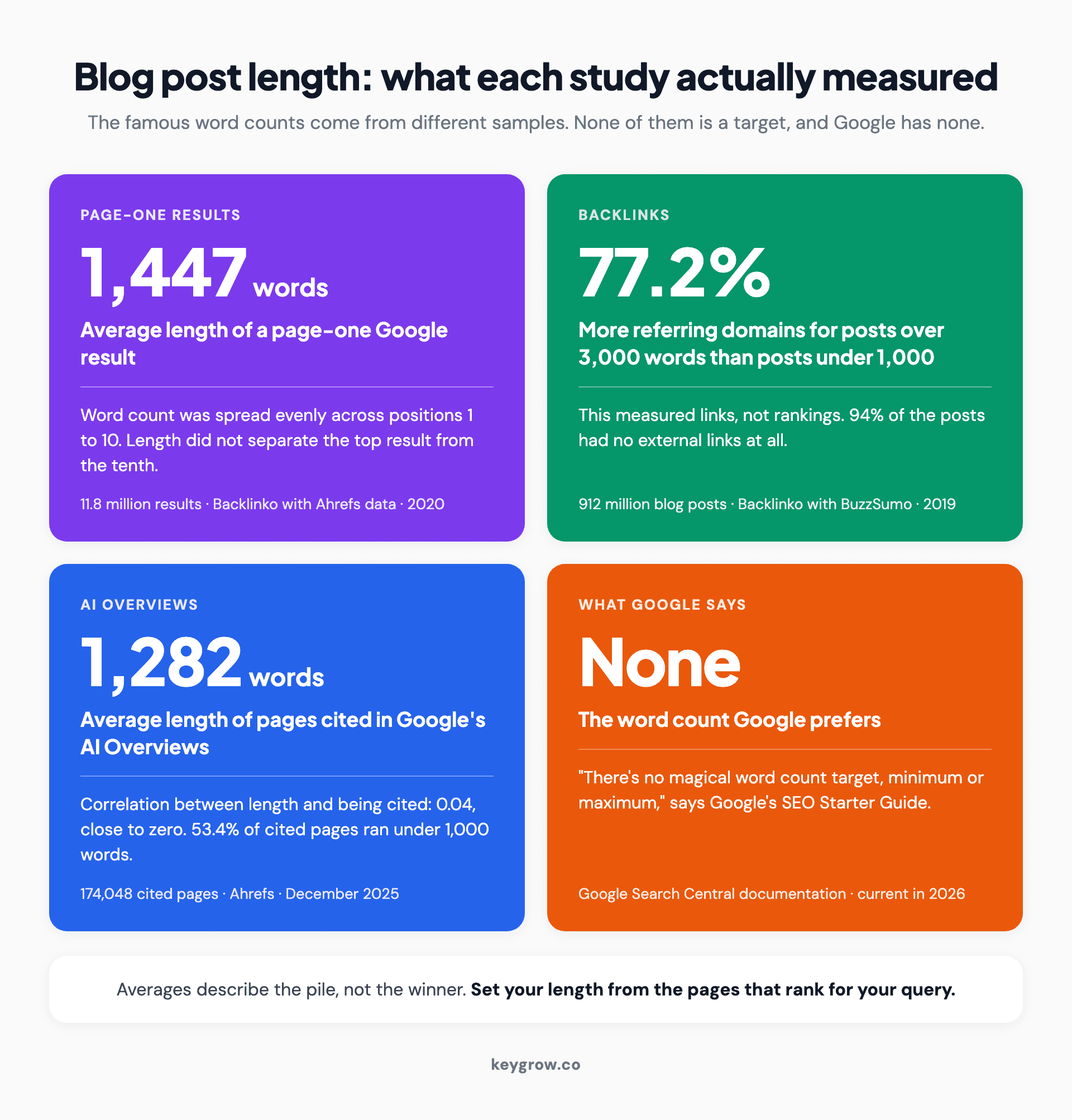
Stat strip comparing what three blog length studies measured with Google's position: 1,447 words was the average page-one result in an 11.8 million result study, 77.2 percent more referring domains for posts over 3,000 words, 1,282 words was the average page cited in AI Overviews with a 0.04 correlation, and Google says it has no preferred word count.
The most quoted figure, 1,447 words, is the average length of a first-page result in Backlinko's 2020 study of 11.8 million Google results, built on Ahrefs data. Read past the headline. The same study found word count "evenly distributed among the top 10 results" and "no direct relationship between word count and rankings." The number people treat as a target came from research that found length didn't separate first place from tenth.
A year earlier, Backlinko and BuzzSumo had analyzed 912 million blog posts. Posts over 3,000 words earned 77.2 percent more referring domains than posts under 1,000. That measured links, not rankings.
For AI search, there is Ahrefs' 2025 study of 174,048 pages cited in Google's AI Overviews. They averaged 1,282 words, and the correlation between length and being cited was 0.04, about as close to zero as data gets.
And the 2,450-word "sweet spot" on page one for this very query? A publisher describing results on its own blog, with no method attached.
All of these are correlation studies or one site's observations. They describe the pile of pages that rank, and longer pages may simply come from bigger sites with more links. An average cannot tell you whether length did any of the work.
Do longer blog posts rank higher?
Not because of their length. Google says length alone doesn't affect ranking, and in the big correlation studies word count barely separates top results.
Google has said this for years. In 2021, John Mueller of Google put it about as plainly as anyone at a search engine can: "From our point of view the number of words on a page is not a quality factor, not a ranking factor."
There is one honest nuance, and it sits in the same SEO Starter Guide. Google notes that when you vary your wording naturally, "you have more chances to show up in Search simply because you are using more keywords." A page that covers more sub-questions can appear for more long-tail searches.
That is a reach effect from covering more ground. Word count earns nothing on its own here, and the effect ends the moment the extra words stop answering anything.
Long posts earn more links, which is a different claim
Long posts earn more links on average, and links help rankings. What people link to, though, is citable material like original data and worked examples.
Links do still count. Google's guide to its ranking systems says PageRank, its original link analysis system, "continues to be part of our core ranking systems." So there is a plausible chain running from long posts to links to rankings.
The weak point is the assumption that length causes the links. People link to things they can cite: original numbers, a worked example, a clear framework, a table that settles an argument. Those take space, so link-worthy posts tend to run long.
Padding takes space too, and nobody links to it. In that same 912 million post sample, 94 percent of posts had no external links at all.
AI Overviews don't want a word count either
AI answers don't favor long or short pages. Ahrefs found a near-zero correlation between length and AI Overview citations. Where the answer sits matters more.
One article on page one for this query says AI Overviews prefer concise content. Others argue AI wants exhaustive guides. The Ahrefs data supports neither. Of the cited pages, 53.4 percent ran under 1,000 words, 30.6 percent ran 1,000 to 2,000, and 16 percent ran past 2,000. Short pages and long guides both get cited, and length didn't predict a page's position among the citations either.

A woman typing on a laptop with a blog article and its images open on the screen.
Placement does matter. Our position is that answer-first structure is non-negotiable. One large study of ChatGPT citations found roughly 44 percent came from the first third of a page. A 3,000-word post that buries its answer under four paragraphs of warm-up is long in the wrong place. Put the answer in the first 100 words, then earn the rest.
Is a short blog post thin content?
No. Thin means the page adds nothing, not that it is short. Google's rater guidelines say quality content comes in all formats and all lengths.
The September 2025 edition of the guidelines Google gives its search quality raters says high and low quality main content come in "all lengths," from short videos to full documentaries. Raters judge whether the content achieves the page's purpose in a satisfying way. A 400-word answer to a 400-word question passes. A 3,000-word page that never answers anything does not.
The 300-word floor in some SEO plugins is a plugin setting. Google's own guide says there is no minimum, so treat the plugin's warning as a nudge against empty pages and nothing more.
What "complete" means depends on the query:
| Query type | Example search | A complete answer covers | Common padding |
|---|---|---|---|
| Quick fact or definition | what is a 301 redirect | The answer, one example, the usual confusion | A history of redirects |
| How-to | how to claim a Google Business Profile | Every step in order, what you need first, where people get stuck | Tips that fit any task |
| Cost | how much does a new roof cost | Price ranges, what moves the price, a sample quote | Paragraphs of "it depends" before any number |
| Comparison | seo vs ppc | The criteria, a side-by-side table, a verdict for each situation | Each option's full sales pitch |
| Local service question | how often should a septic tank be pumped | The answer, what changes it, the signs you need a pro now | Filler about "your area" |
Adding words won't rescue a page that is stuck
If a page isn't ranking, extra words rarely fix it. Check indexing, internal links, intent match and authority first, and expect gains to take months.
Mueller again, in the same 2021 answer: "just blindly adding more and more text to a page doesn't make it better." When a post stalls, the cause usually sits somewhere else:
- Google may not have indexed it. URL Inspection in Search Console answers that in a minute.
- Nothing links to it. A page with no internal links pointing at it is an orphan: crawlers and visitors can't reach it from the rest of your site. Our guide to orphan pages covers the fix.
- It answers a different question from the one searchers ask. Put its headings next to the top three results and the gap usually shows.
- The site hasn't earned Google's trust yet.
That last one is the slow part, and only time and links fix it. A doctor's practice in Dubai committed to SEO with us for a full year, and months one through three looked unimpressive on the surface. By month twelve, organic traffic had grown 1,519% and the practice was taking 130+ patient calls a month. That came from consistent technical fixes, content and authority building. No word count trick shortens that curve, and our explainer on why SEO takes so long walks through what happens in those months.
When people do pad a stuck page, this is usually what goes in:
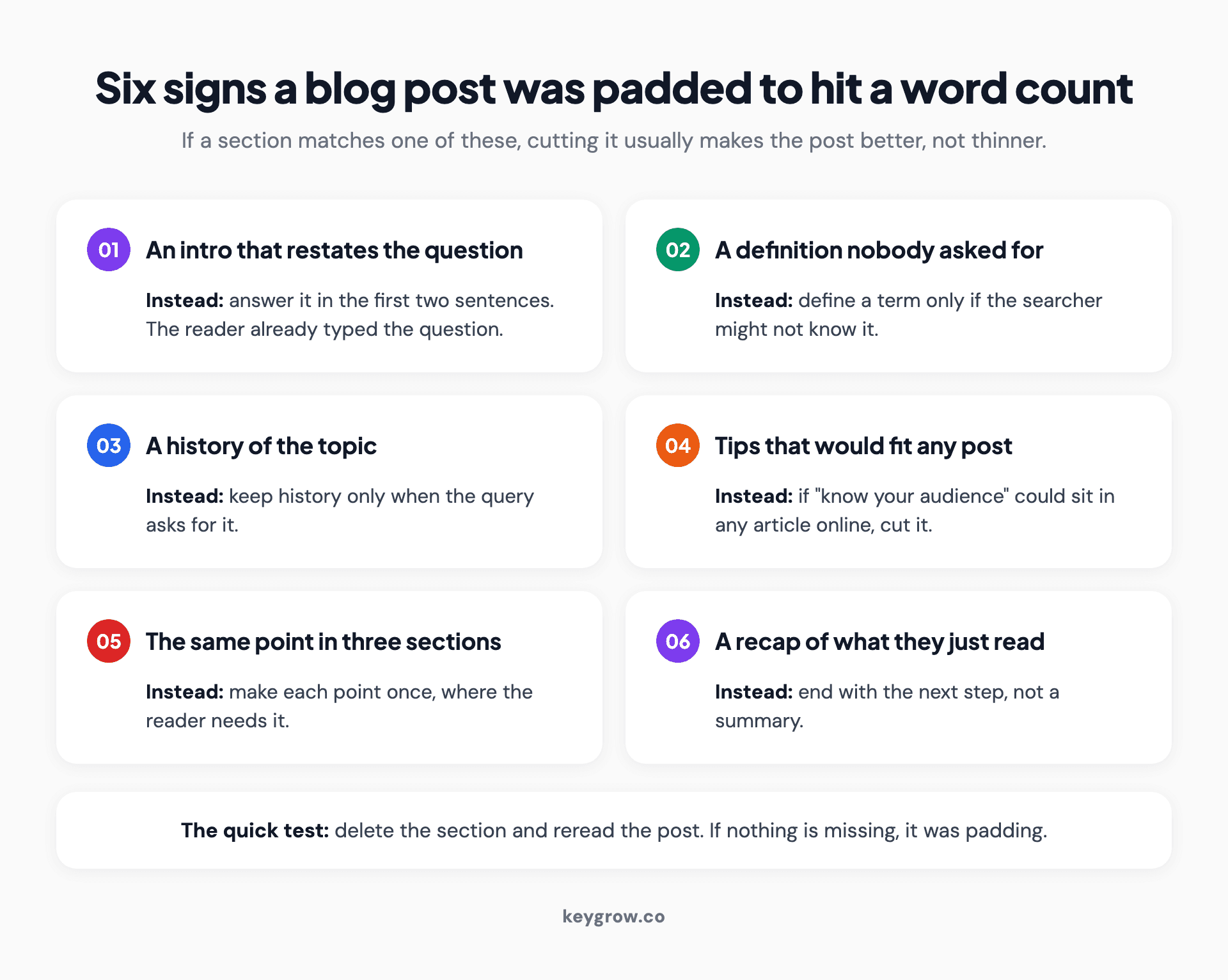
Six signs a blog post was padded to hit a word count: an intro that restates the question, a definition nobody asked for, a history of the topic, generic tips, the same point repeated, and a closing recap, each with what to do instead.
How to measure the pages that rank for your query
Search your exact query, skip results that aren't articles, count the main text of the top three, take the median and aim within 20 percent.
In 2019, someone on Reddit asked for a tool to compare the word counts of the top Google results for a query. Mueller replied: "Word count is not a ranking factor. Save yourself the trouble."

A person writing notes on a clipboard at a wooden desk.
He's right about the ranking factor. We measure anyway, for a different reason. The ranking pages are the best evidence you have of how much ground searchers expect covered, and word count is a rough proxy for that scope. Use it as a guide, never as a score to beat.
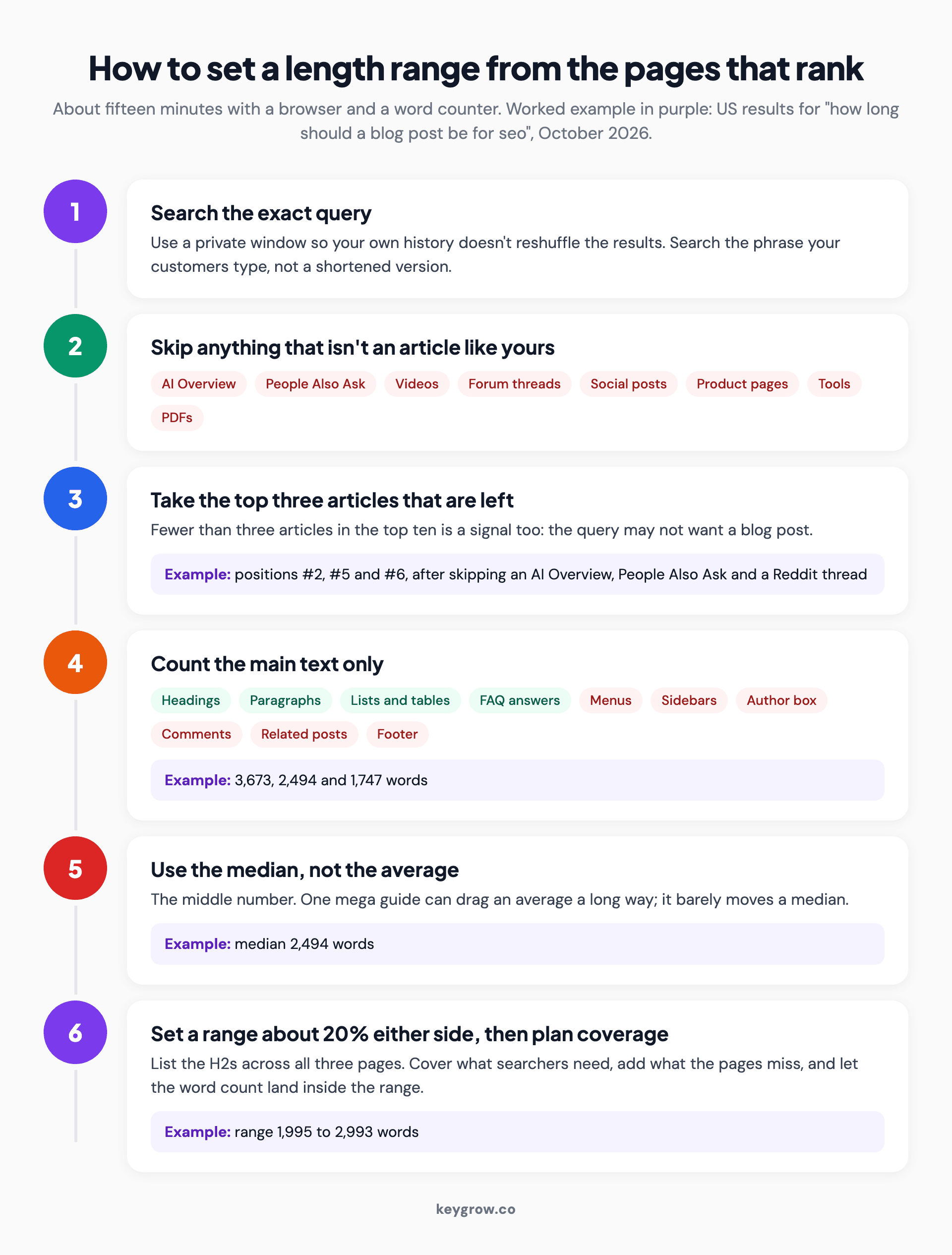
Six-step process for setting a blog post length range from the pages that rank: search the exact query, skip results that are not articles, take the top three articles, count main text only, use the median, and set a range about 20 percent either side, with a worked example.
- Search the exact phrase in a private window, so your own browsing doesn't reorder the results. Use the full phrase your customers type.
- Skip anything that isn't an article like yours. AI Overviews, People Also Ask boxes, videos, forum threads, social posts, product pages, tools and PDFs answer the query in a different format, so their length tells you nothing about yours.
- Take the top three articles left. If fewer than three of the top ten are articles, stop. The query probably wants a different kind of page.
- Count the main text only. Copy from the first line under the headline to the end of the article, FAQ included, and leave out menus, sidebars, author boxes, comments, related posts and the footer. Paste it into a free word counter and note the number.
- Take the median, the middle of your three numbers. An average lets one mega guide skew the result.
- Set a range about 20 percent either side. Then list the H2s across all three pages, because that list is the coverage searchers expect. The range only tells you roughly how much room it takes.
Count your own draft the same way, main text only, or the comparison means nothing.
Here is the method run on this exact query, using US results from October 1, 2026:
| Position | Result | Main-text words | Counted? |
|---|---|---|---|
| 1 | AI Overview | n/a | No, not an article |
| 2 | Website builder's guide | 3,673 | Yes, top three |
| 3 | People Also Ask | n/a | No, not an article |
| 4 | Reddit thread | n/a | No, forum |
| 5 | SEO plugin maker's guide | 2,494 | Yes, top three |
| 6 | App builder's guide | 1,747 | Yes, top three |
| 7 | Writing community post | 1,970 | No, outside the top three |
| 8 | SEO trade publication | 2,007 | No, outside the top three |
| 9 | LinkedIn post | n/a | No, social post |
| 10 | Email platform's guide | 1,512 | No, outside the top three |
The median of the top three is 2,494 words, so the range runs from 1,995 to 2,993. The average of the same three is 2,638, close to the median here. If the top page were a 6,000-word mega guide instead, the average would jump to 3,414 while the median stayed put at 2,494.
Look at the order, too. The longest article on the page is 2.4 times the length of the shortest, and the 1,747-word guide at position 6 outranks two longer ones.
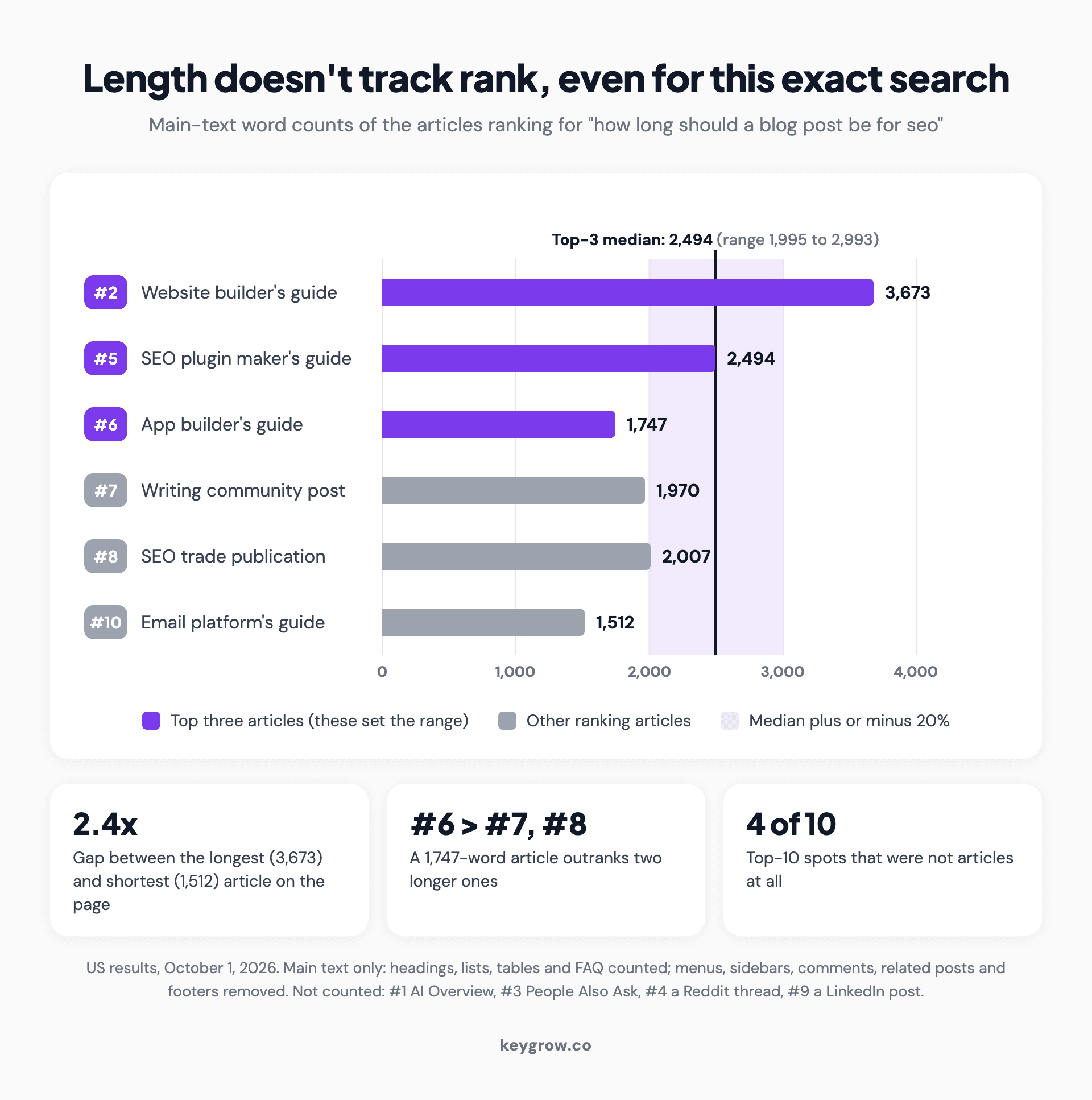
Bar chart of main-text word counts for the six articles ranking for how long should a blog post be for seo, in position order, with the top three highlighted, a top-three median of 2,494 words and a range of 1,995 to 2,993.
None of this needs an agency or a paid tool. A browser and a word counter cover it in about fifteen minutes, and if you write your own posts, it is worth doing every time.
When to break the range
Go longer only for coverage the top pages lack, shorter when they pad, and skip the blog post when the results aren't articles at all.
Going longer is right when the top pages skip something searchers need, like a worked example, a cost table or the step everyone gets stuck on. It is also right when the query is broad and your page is the hub for narrower posts. Pillar pages attract their own magic number, usually 3,000 to 10,000 words, and our content pillar strategy guide explains why a pillar page is defined by its job, not its length. Either way, write down what the extra words add before you write them.

A hand holding a red pen over a blank spiral notebook on a dark wooden table.
Shorter wins when the top pages pad. If they open with three paragraphs of throat-clearing and close with a recap, you can answer the same questions in fewer words. Just check you still cover everything they cover.
Sometimes the range is the wrong question entirely. If the top ten is product pages, tools or videos, a blog post is the wrong format. The same goes for most local "near me" searches, where the map results and ads fill the screen before any article shows up.
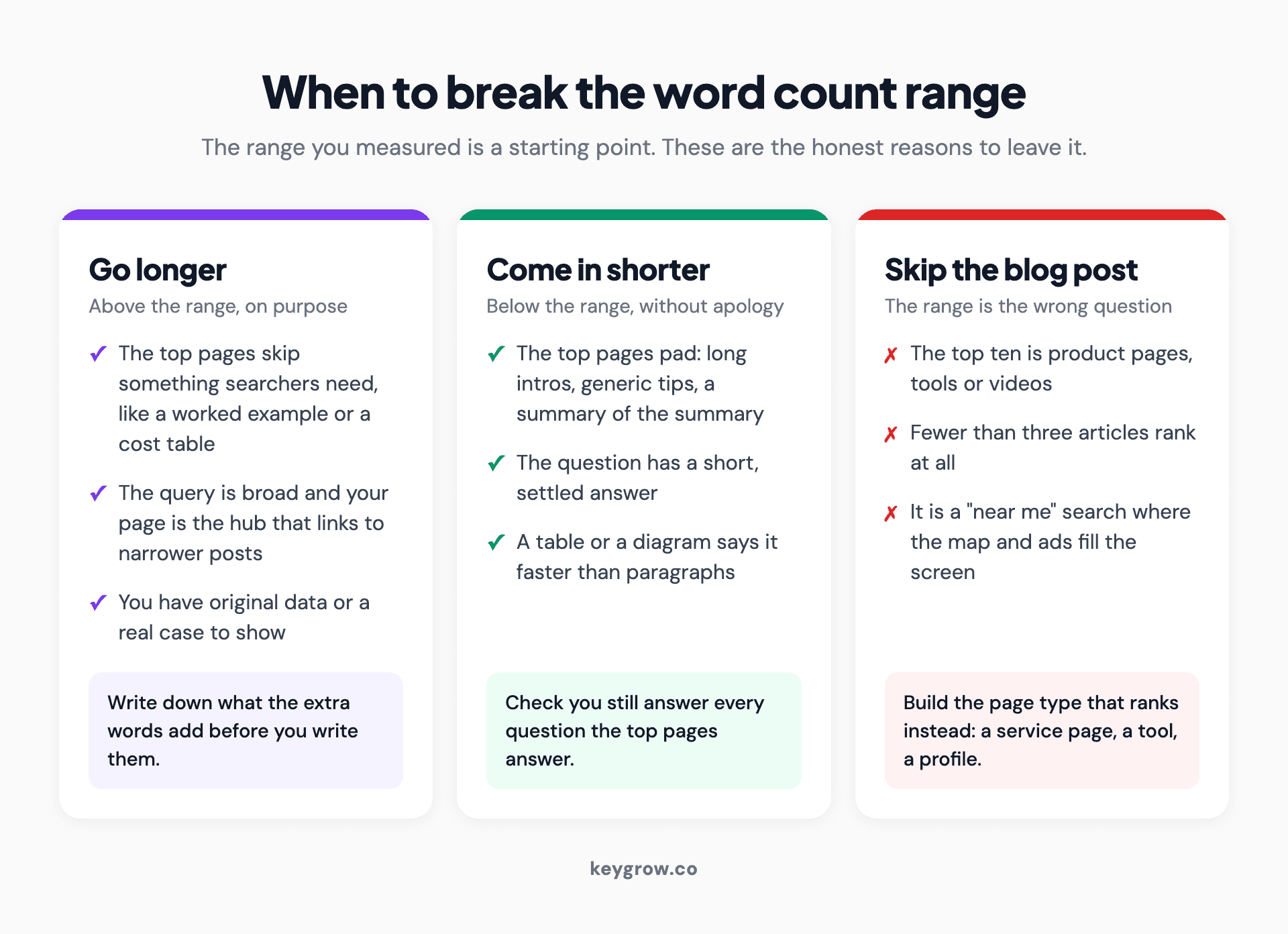
Three cards on when to break a measured word count range: go longer for coverage the top pages lack, come in shorter when they pad, and skip the blog post when the results are not articles.
FAQs
Is 500 words enough for a blog post?
It is if the question takes about 500 words to answer well, because Google has no minimum. If the top three articles for your query run 1,800 words, though, a 500-word post is probably missing things searchers expect. Check their headings before you publish.
Does word count affect Google rankings?
Not directly. Google's documentation says the length of the content alone doesn't matter for ranking. Longer pages can show up for more long-tail searches because they cover more sub-questions, and thorough posts tend to earn more links, but the length itself is not scored.
How long should a blog post be for AI Overviews?
There is no preferred length for AI Overviews either. Ahrefs found a 0.04 correlation between word count and being cited across 174,048 cited pages, and more than half of those pages ran under 1,000 words. Put a direct answer in the first 100 words, then cover the rest.
Is a 4,000-word blog post too long?
Only if the query doesn't need it. If the top-ranking articles run 3,500 to 4,500 words because the topic has many parts, 4,000 is normal for that search. If they run 1,200, a 4,000-word post is mostly padding and buries the answer.
Should I make my old blog posts longer?
Yes, if you are adding something that's missing, such as a step, an example or a question searchers now ask. Google's John Mueller has said that blindly adding text doesn't make a page better. Compare the post with what ranks today and fill the real gaps.
How many words should a blog post be in 2026?
There is no 2026 number, and there wasn't a 2025 one either. The method that holds up is to measure the top three articles ranking for your exact query and land within about 20 percent of their median length.
Write to the question, then stop
Length is an output, not an input. Before your next post, run the fifteen-minute measurement on its target query and write the range at the top of the draft. Then give each section one question to answer, and cut anything that answers nobody. If that lands at 900 words, publish 900. If it takes 3,000, every section should still be doing a job.
This post landed inside its own measured range because there was a lot of bad advice to clear away first. Yours might not need that.
If you would rather hand this research to someone, along with the links and technical work that move rankings more than word count ever will, that is part of our SEO service. Month-to-month, cancel anytime.