

SEM (search engine marketing) is the umbrella term for getting your business seen on search engines, and PPC (pay-per-click) is the advertising model that powers the paid half of it. You pay a fee each time someone clicks your ad. So when people say "SEM and PPC" they are usually pointing at the same activity from two angles: SEM is the goal, PPC is how you pay for it.
That is the short version, and it would be the whole article except for one inconvenient fact: the industry does not actually agree on what SEM means. Ask five marketers and you will get two different answers, both confident. This guide gives you the clean definitions, shows how the words nest together, and then explains why the disagreement exists so you can decode whichever version you hear in a sales call.

A magnifying glass resting beside a laptop, representing search engine marketing.
What is SEM?
SEM is every method you use to appear on a search engine results page, whether you pay for the spot or earn it. It is a category, not a single tactic.
Picture the results page for "emergency plumber near me." Some listings are labeled "Sponsored." Some are the map pack. Some are the plain blue links below. Getting your business into any of those positions is search engine marketing. The term was popularized by Danny Sullivan around 2001 to cover the whole spectrum: optimizing for organic rankings, managing paid listings, and everything in between.
Here is where the confusion starts. In its original and textbook sense, SEM includes SEO (the organic side) and paid search (the paid side). But over the past two decades, agencies and ad platforms narrowed the word until, for many people, SEM now means paid search only. Both usages are alive today. We will settle which one you should assume below.
What is PPC?
PPC is a pricing model: you pay only when someone clicks, not when your ad is shown. It is how the paid side of search gets billed, and it also runs on social and display, not just search engines.
The distinction that trips people up: PPC describes *how you pay*, while SEM describes *where the ad runs*. A pay-per-click auction decides which advertiser appears and what each click costs. You set a maximum bid, the platform runs a real-time auction for every search, and you are charged a click at a time.
And PPC is not confined to Google. The same pay-per-click model powers ads on Meta, Microsoft Advertising, LinkedIn, and more, per Semrush's glossary. So in one narrow way PPC is actually broader than SEM: PPC-on-search sits inside SEM, but PPC also spills out onto social feeds and display banners where the word "search" no longer applies.
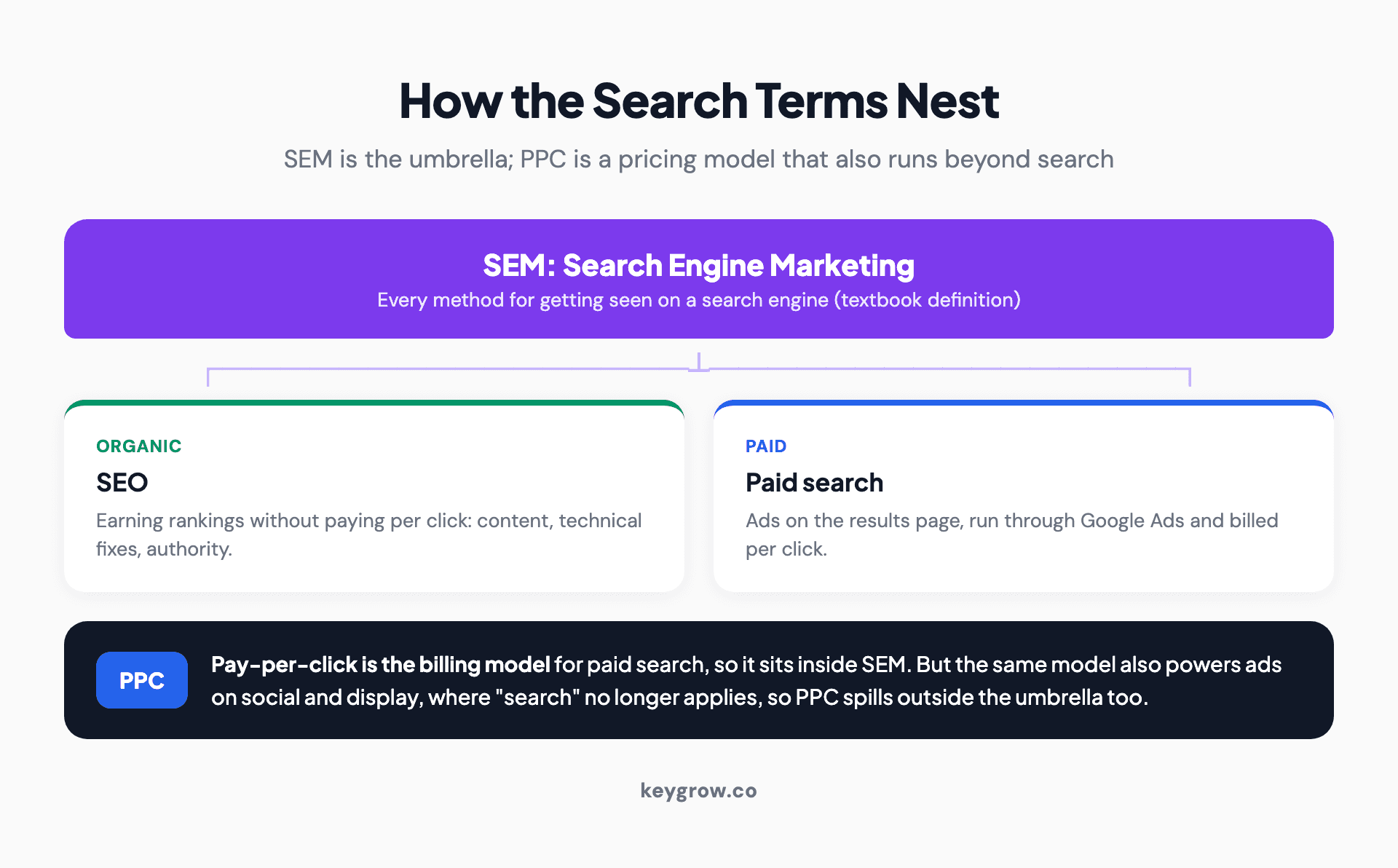
Diagram of how SEM, SEO, PPC, and paid search nest: SEM as the umbrella over organic SEO and paid search, with PPC shown as a pricing model that also extends to social and display.
Where do SEO and Google Ads fit?
SEO is the organic, unpaid half that classic SEM includes; Google Ads is the tool that runs your PPC campaigns and, in doing so, is the main vehicle of paid SEM.
Two more words get thrown into the same sentence, so let us place them.
- SEO (search engine optimization) is the work of earning rankings without paying per click: content, technical fixes, and authority. Under the original definition, SEO is part of SEM. Under the modern paid-only definition, it sits beside SEM rather than inside it.
- Google Ads is Google's pay-per-click platform. It is simultaneously a PPC tool (you pay per click) and the primary way businesses do paid SEM (the ads run on search). One product, two labels, both correct.
So the full nesting, in the textbook version: SEM is the umbrella. Under it sit SEO (organic) and paid search. PPC is the billing model for that paid search, and Google Ads is the tool you use to run it.
Why the definitions disagree
Sources split into two camps because the term genuinely shifted meaning over twenty years. Textbook SEM includes SEO; everyday agency SEM means paid search.
This is the part every other guide skips, and it is the reason you keep getting contradictory answers.
Camp A, the umbrella view: SEM covers both organic and paid. This is the historical definition and what you will find in most glossaries and training material.
Camp B, the paid view: SEM means the paid side of search marketing, and SEO is a separate discipline. Search Engine Journal treats SEO as its own thing, noting that while "circa 2001, SEO referred to a part of SEM," today SEM covers paid search along with other paid channels like display and remarketing.
Both are defensible. Even encyclopedic definitions now describe SEM as promoting sites "primarily through paid advertising," and note the term is often used exclusively to mean pay-per-click advertising in commercial circles. The honest takeaway: when a vendor says "we do SEM," they almost always mean paid ads. When a textbook says SEM, it means the whole search picture. Ask which one they mean before you sign anything.
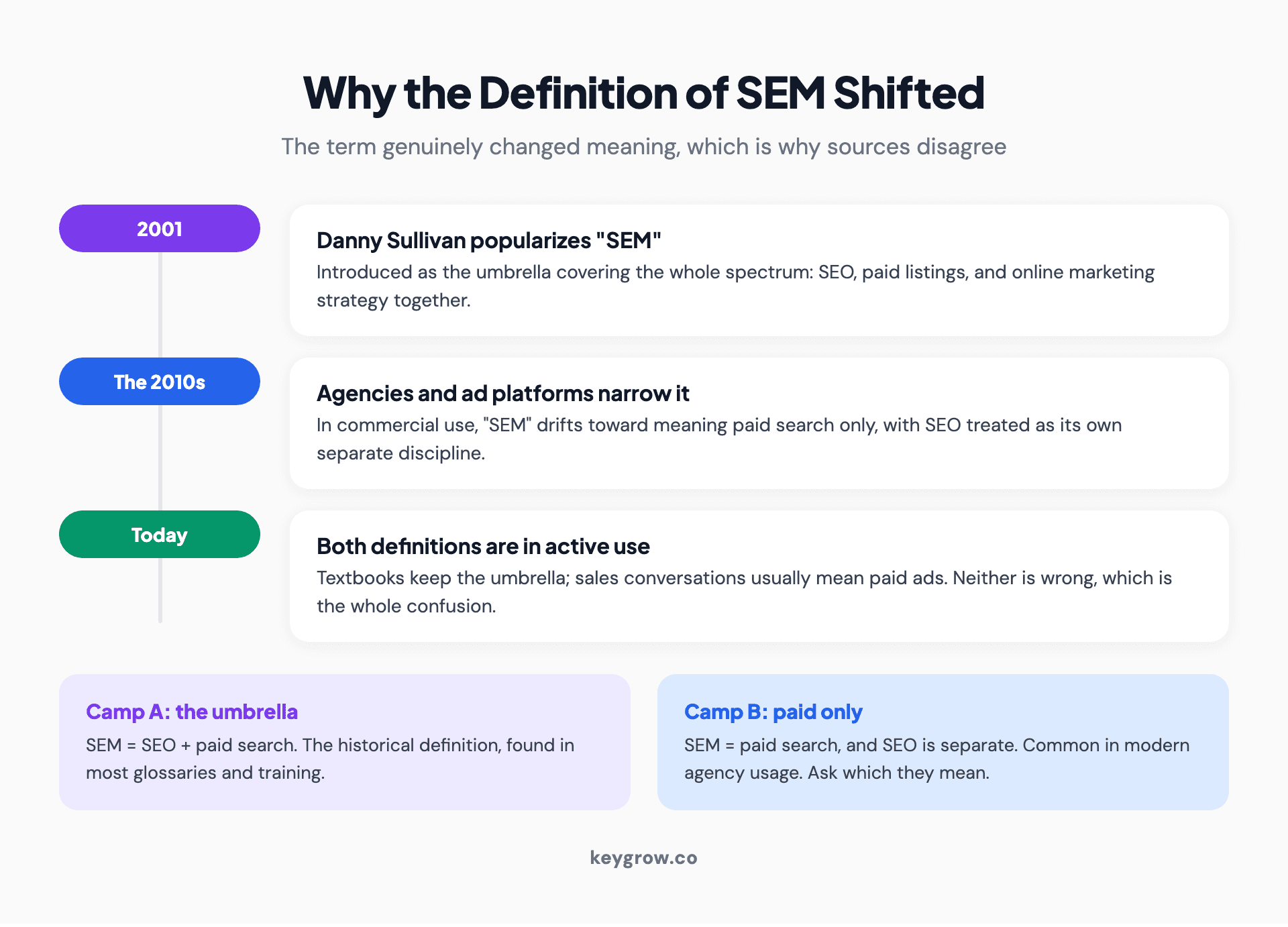
Timeline showing SEM's definition narrowing: coined by Danny Sullivan in 2001 as an umbrella including SEO, then narrowed by agencies and ad platforms until SEM commonly means paid search today.
SEM, PPC, SEO, and Google Ads at a glance
Here is the whole vocabulary in one table, using the textbook definitions so the relationships stay clear.
| Term | What it is | Paid or organic | Where it runs |
|---|---|---|---|
| SEM | Umbrella for all search-engine visibility | Both | Search engines |
| SEO | Earning rankings without paying per click | Organic | Search engines |
| Paid search | Ads on search results pages | Paid | Search engines |
| PPC | Pricing model: pay per click | Paid | Search, social, display |
| Google Ads | The tool for running PPC on Google | Paid | Search, YouTube, display, more |
The one row that surprises people is PPC. It is the only entry that is a billing method rather than a place or a channel, which is exactly why it does not line up neatly against the others.
Which term should you actually care about?
For a business owner, the vocabulary debate does not matter. The only distinction that changes what you spend money on is organic versus paid.
Strip away the acronyms and you have two ways to appear on a search page. You can earn the spot over months through SEO, which compounds and keeps working after you stop paying. Or you can rent the spot instantly through PPC, which produces clicks the day you launch and stops the moment your budget runs out. That is the real decision. Everything else is labeling.
To make the paid side concrete: across all industries in 2026, the average search ad costs about $5.42 per click with a 6.64 percent clickthrough rate, per LocaliQ's benchmarks. Costs swing hard by field, from around $1.63 per click in arts and entertainment to nearly $9.87 for legal services. Knowing your industry's click cost tells you far more about your budget than knowing whether SEO technically lives inside SEM.
Most established businesses run both. Paid search buys immediate visibility and data while SEO builds durable traffic underneath it. If your budget only covers one, the honest answer depends on how fast you need customers, which we walk through in our guide on whether PPC is worth it.
FAQs
Is PPC the same as SEM?
Not exactly. PPC is the pay-per-click pricing model, and SEM is the broader activity of marketing on search engines. PPC on a search engine is a form of SEM, but PPC also runs on social and display where the "search" part no longer applies, so the two words are related rather than identical.
Does SEM include SEO?
It depends which definition you use. The original, textbook definition of SEM includes both SEO (organic) and paid search. The modern, everyday usage, especially in agency sales, often narrows SEM to mean paid search only and treats SEO as separate. Both are in active use.
Is Google Ads SEM or PPC?
Both. Google Ads bills on a pay-per-click model, so it is a PPC platform, and because those ads run on search results, it is also the main tool for doing paid SEM. The two labels describe the same product from different angles.
Which is cheaper, SEO or PPC?
PPC costs money on every click and stops producing the moment you stop paying, while SEO costs time and effort upfront but keeps delivering traffic without a per-click fee once rankings hold. PPC is cheaper to start; SEO is usually cheaper per visitor over the long run.
Is paid search the same as PPC?
Almost, in casual use. Paid search means ads shown on search engine results, and those ads are billed on the pay-per-click model, so people use the terms interchangeably. The small difference is that PPC as a billing model also exists outside search, on social and display.
Do I need both SEM and PPC?
If PPC means your paid search ads, then running PPC is already doing paid SEM, so you are not choosing between two separate things. The real choice is whether to add organic SEO alongside your paid ads, and for most businesses with the budget, running both outperforms either alone.
Where this leaves you
SEM is the goal of getting found on search engines. PPC is the pay-per-click model that powers the paid route to that goal. SEO is the organic route. Google Ads is the tool. And the reason it all felt confusing is that the industry quietly changed what SEM means without telling anyone, so half the sources you read use the old definition and half use the new one.
You do not need to win that argument. You need to decide whether to earn your visibility, buy it, or both, and then spend accordingly. If you want a second opinion on which mix fits your margins and timeline, our team maps it out with you, month-to-month, no lock-in. The vocabulary is optional. The decision is not.