


The myth that sells most Facebook ads for dentists is that Facebook is the cheap channel. The clicks are cheap. The leads are not.
In LocaliQ's 2026 benchmarks, dental traffic campaigns on Facebook paid $0.61 a click, about the all-industry average. Dental lead campaigns paid $61.56 per lead, against $27.39 across all industries. That is more than double.
So do Facebook ads work for dentists? Yes, for one job: putting a single elective offer in front of people near your practice who weren't looking for a dentist today. Treat them as a cheaper Google and they disappoint. Here are the six myths we hear most from practice owners, and what is true in 2026.
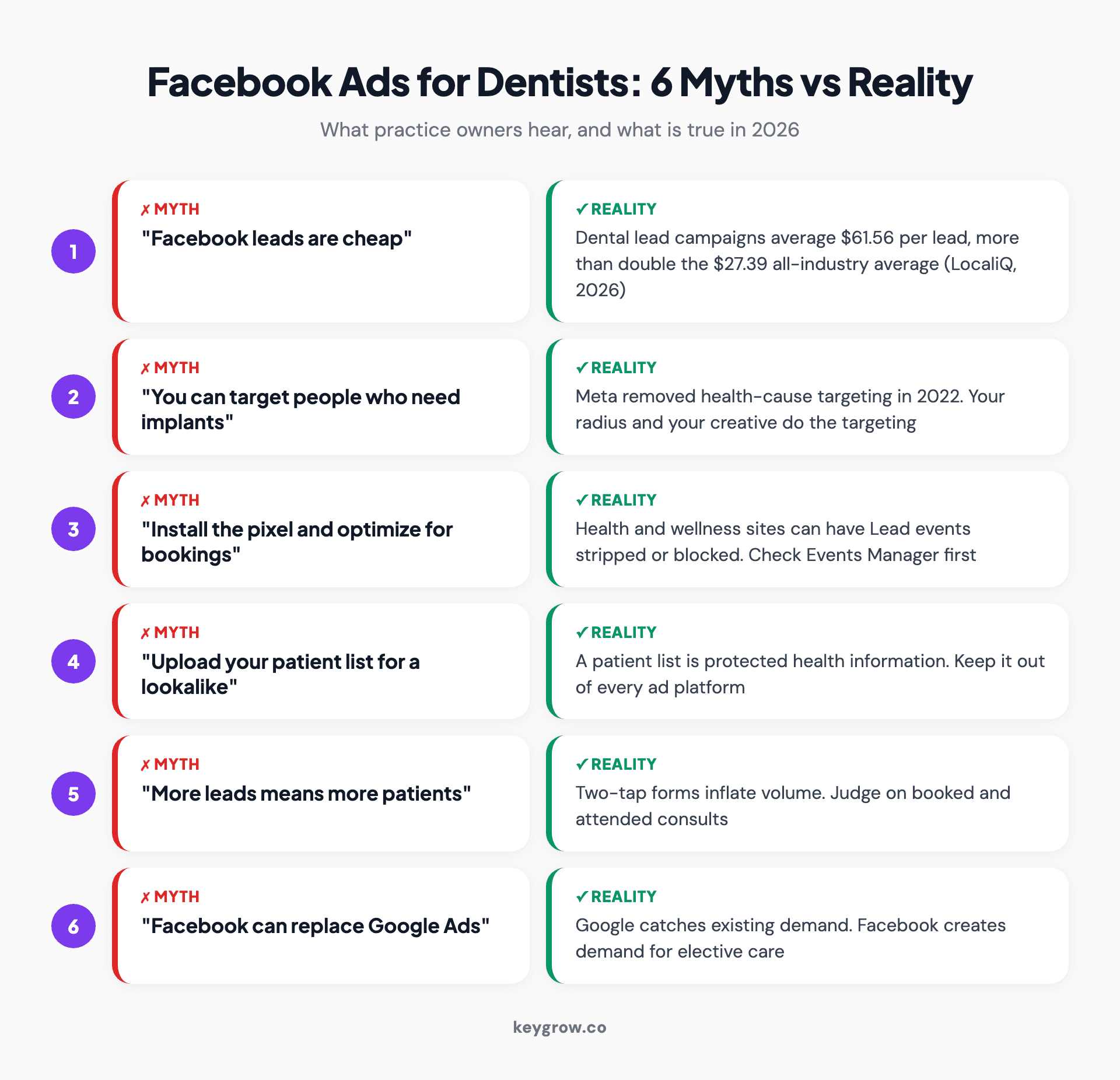
Six myth and reality cards about Facebook ads for dentists: cheap leads versus a $61.56 average dental cost per lead, targeting people who need implants versus location and creative doing the targeting, pixel optimization versus Meta's health data restrictions, patient list lookalikes versus HIPAA risk, more leads versus booked consults, and Facebook replacing Google versus Facebook creating demand Google captures.
Myth 1: "Facebook leads are cheap"
Reality: a dental lead from Facebook averages $61.56. That is cheaper than a search lead, but it comes from someone who was scrolling, not someone who typed a need.
The search row below comes from LocaliQ's healthcare search benchmarks, which we broke down in our guide to Google Ads for dentists.
| Channel and campaign | Click-through rate | Cost per click | Conversion rate | Cost per lead |
|---|---|---|---|---|
| Facebook traffic, dentists | 1.55% | $0.61 | n/a | n/a |
| Facebook leads, dentists | 1.62% | $5.70 | 6.07% | $61.56 |
| Facebook leads, all industries | 2.70% | $1.80 | 8.54% | $27.39 |
| Google search, general dentistry | 5.06% | $7.03 | 7.74% | $84.77 |
The Facebook figures come from LocaliQ's 2026 benchmarks, updated in September 2026.
A $0.61 click looks wonderful on a report, which is exactly why some agencies open with it. A click is not a patient. The number that matters is the one no benchmark can give you: how many of those leads sat in your chair.
Myth 2: "You can target people who need implants"
Reality: you can't target anyone by a dental condition. Location and your creative do the targeting, and Meta's algorithm finds the people who respond.
Meta removed detailed targeting options tied to health causes in January 2022. Interest targeting like "dental implants" either no longer exists or gets treated as a loose suggestion under Advantage+ audience, so guides that still say to target "people interested in dental care" are a few years out of date.
Your copy has a rule to follow too. Meta's personal attributes policy bans ads that assert or imply something about the viewer's health. "Embarrassed by your stained teeth?" gets rejected. "Teeth whitening in Westfield, $199 this month" does not.
What works instead:
- A radius drawn around the practice, sized to how far your patients actually drive
- An age range only if the offer demands it (aligners for adults, say)
- An image of your real team or your real office, not a stock smile
- An offer specific enough that the right person stops scrolling and everyone else keeps going
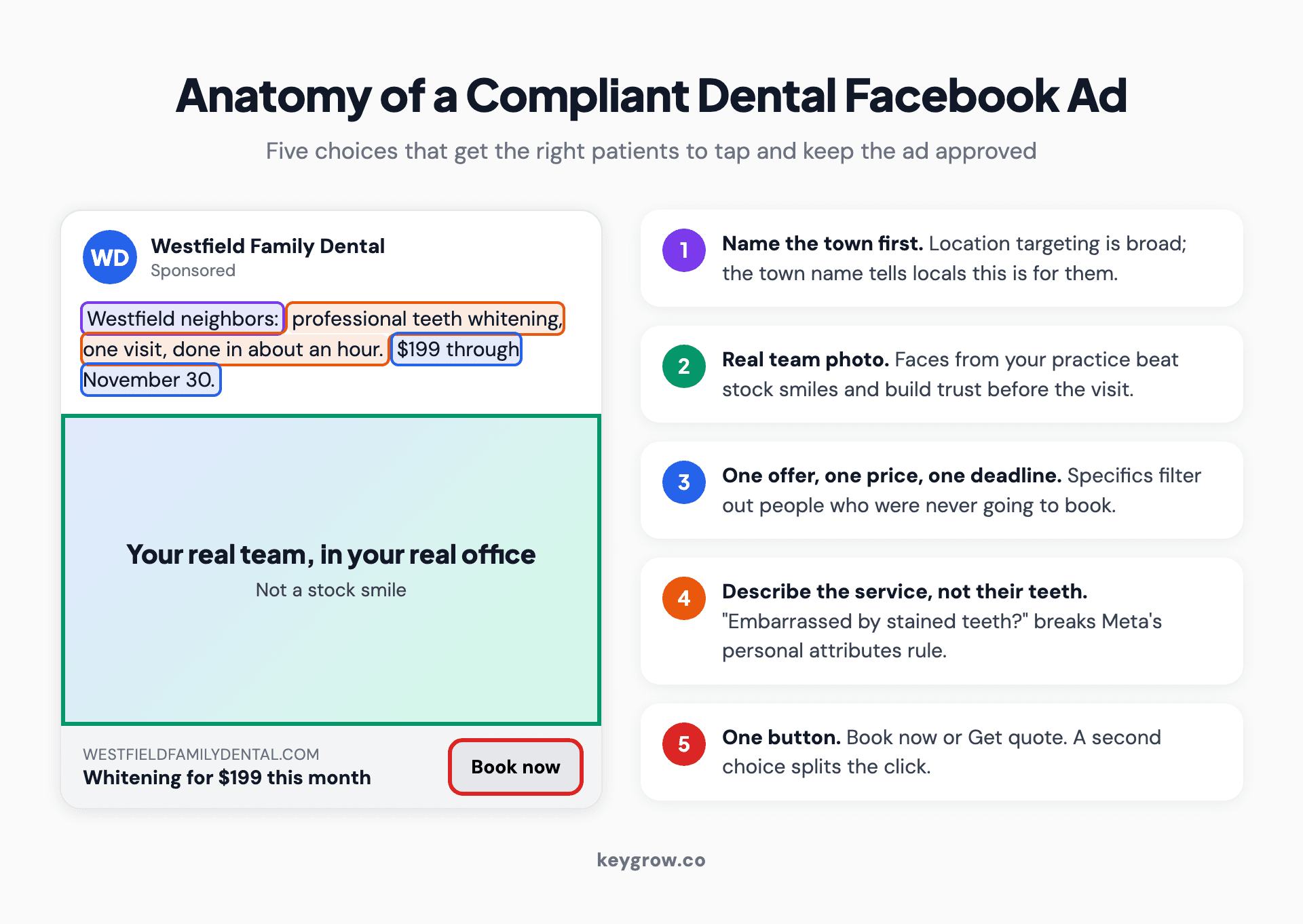
Annotated mockup of a compliant dental Facebook ad showing five callouts: the town name in the first line, a real team photo instead of stock, one named offer with a price, copy that describes the service instead of the viewer's teeth, and a single Book now button.
The creative is the targeting now. Name aligners, a price and your town, and the people who tap are mostly nearby adults who want aligners.
Myth 3: "Install the pixel and let Meta optimize for bookings"
Reality: many dental websites now sit in Meta's health and wellness data category, which strips or blocks the conversion events that optimization depends on.
Since early 2025, Meta has put health and wellness sites in a restricted data category. Per Stape's breakdown, restrictions come in three levels. The mild level removes URL details after the domain, including UTM parameters. The moderate level can block standard events like Lead and Purchase. The severe level blocks all event sharing in some regions. Moving the pixel to the Conversions API does not get around any of it.
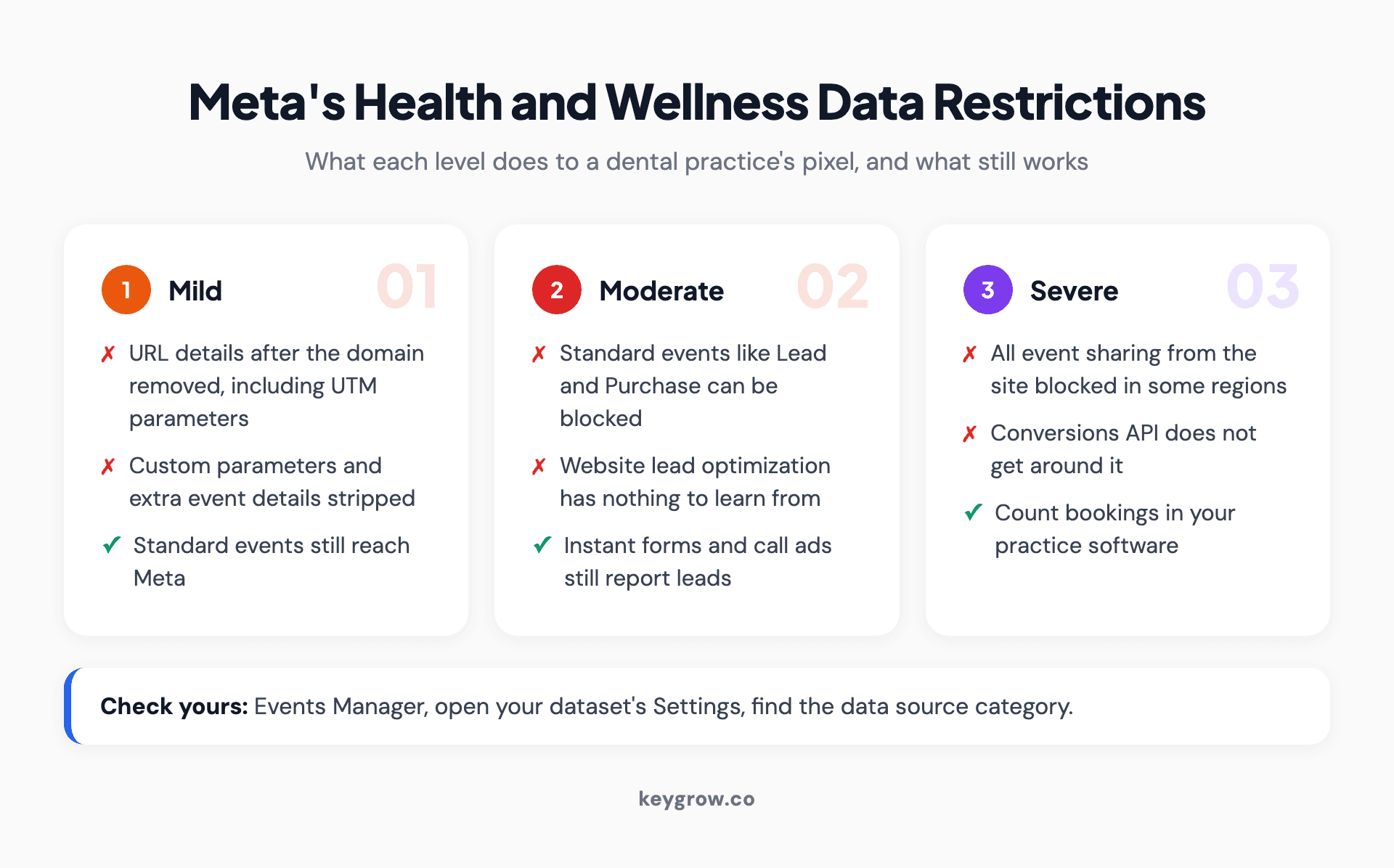
Three restriction levels Meta applies to health and wellness websites: mild strips URL details and custom parameters, moderate can block standard events like Lead and Purchase while instant forms and call ads still report leads, and severe blocks all event sharing in some regions even through the Conversions API, with a note to check the data source category in Events Manager settings.
Check your status in Events Manager under your dataset's Settings (data source category). If your Lead event is blocked, a website-leads campaign has nothing to learn from. Two routes still work:
- Instant forms, submitted inside Facebook or Instagram, so nothing depends on your site's pixel.
- Click-to-call or click-to-message ads, with the front desk logging every booking by source.
Either way, count bookings in your practice software, not Ads Manager.
Myth 4: "Upload your patient list for a lookalike"
Reality: for a dental practice covered by HIPAA, a patient list is protected health information. Uploading it to an ad platform is a disclosure question for your compliance advisor, not a marketing shortcut.
The pixel carries a similar risk. In June 2024 a federal court in Texas vacated part of HHS's guidance on tracking technologies, the part about unauthenticated public pages. According to Hall Render's summary, the rest of the bulletin stands, and the firm advised providers not to relax their approach. Patient portals and logged-in pages are still squarely in scope.
We are not lawyers, and this is not legal advice. The practical line we use with dental clients is simple:
- No pixel on patient portals, intake forms or any page that asks about symptoms
- No patient lists uploaded to any ad platform
- Lead forms that ask for a name, a phone number and the offer they want, and nothing about their health
Google already blocks customer lists for health advertisers outright. Meta just leaves the decision, and the risk, with you.
Myth 5: "More leads means more patients"
Reality: an instant form fills in the name and number from the person's profile, so a lead can take two taps. Volume goes up, and intent often stays home.

A woman checking her phone outdoors, the moment a dental Facebook ad either earns a tap or gets scrolled past.
Add friction in the right place. Switch the form to "higher intent", add one qualifying question ("whitening, aligners, or an implant consultation?") and one about timing, and call every lead the same hour, because a two-tap lead forgets you by dinner.
We learned this in a different industry. A cash home buyer's lead quality turned around once we targeted serious-intent searches only and wrote copy that put off browsers: serious leads rose 600% between December and January. That was Google Ads, but the lesson carries over: filter first, then scale. Our guide to Facebook ads for leads covers the form settings step by step.
Myth 6: "Facebook can replace Google Ads"
Reality: they do different jobs. Google catches demand that already exists. Facebook creates demand for things people were putting off.
| Patient | What they do | Best channel |
|---|---|---|
| Cracked tooth at 11pm | Searches "emergency dentist near me" | Google search |
| Due a cleaning, new to the area | Searches, reads reviews, calls | Google search and your Google Business Profile |
| Has thought about aligners for two years | Searches nothing until something prompts them | Facebook and Instagram |
| Wants whiter teeth before a wedding | Responds to a dated, priced offer | Facebook and Instagram |
Nobody in pain scrolls Instagram looking for a dentist. Travel brands use Facebook the same way, selling the trip before anyone has picked a destination (our Facebook ads for travel blueprint maps it). Run emergency and routine care through search with proper dental PPC management, and give Facebook the elective work. The same campaign also runs on Instagram by default; if you want to price that side, see our breakdown of Instagram ads cost.
What a profitable offer looks like on paper
Work out your break-even cost per lead before you spend a dollar. It's the case value, times how many leads book and show up, times how many of those accept treatment.
The numbers below are assumptions to show the method, not benchmarks. Use your own.
| Whitening offer | Aligner consult offer | |
|---|---|---|
| Net margin per accepted case | $300 | $2,000 |
| Leads who book and show | 1 in 4 | 1 in 4 |
| Consults who accept | 1 in 2 | 1 in 3 |
| Break-even cost per lead | $37.50 | $166.67 |
| Against the $61.56 benchmark | Loses $24.06 per lead | $105.11 of headroom |
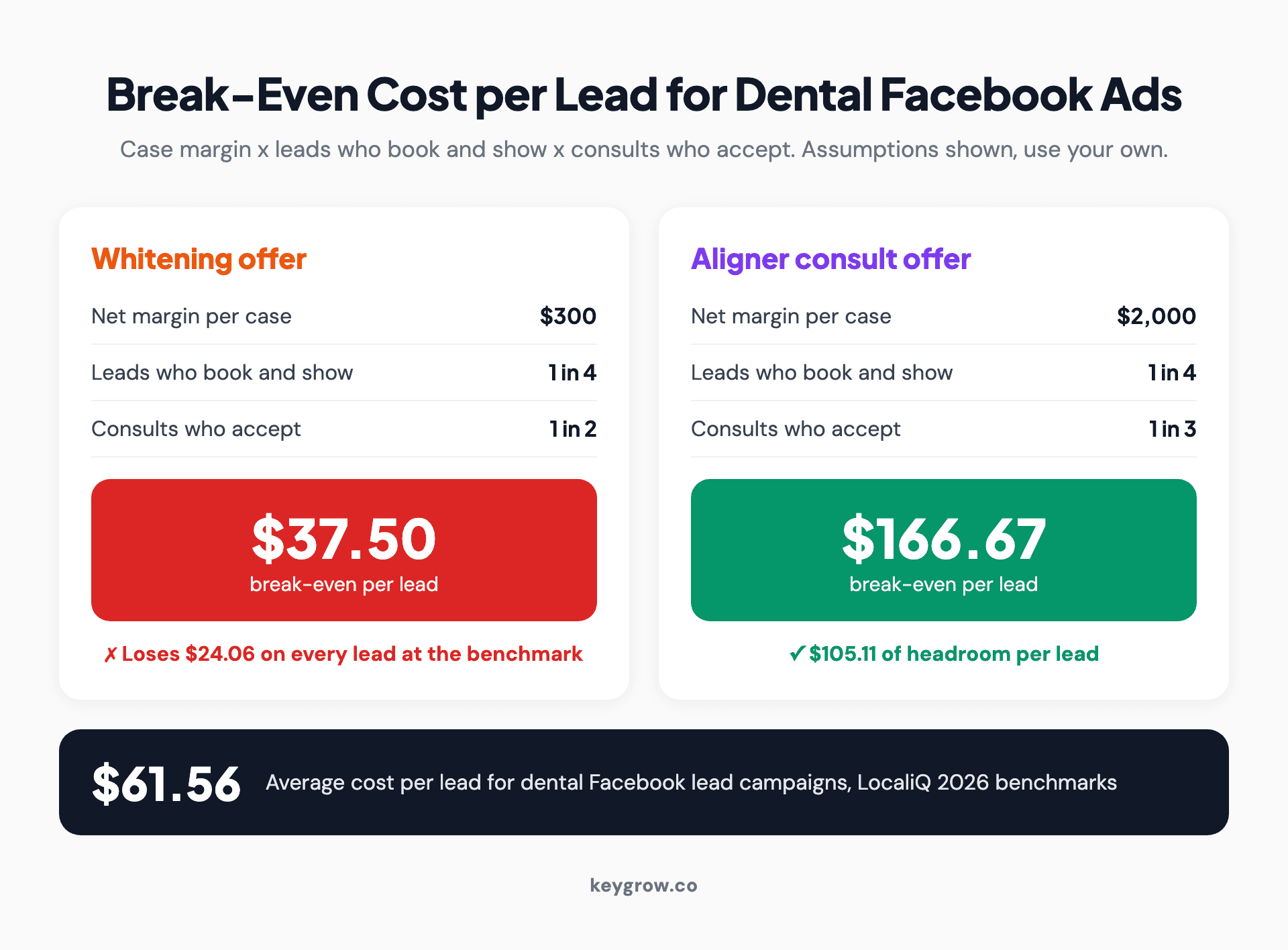
Worked example of break-even cost per lead for dental Facebook ads: a $300 whitening case with 1 in 4 leads showing and 1 in 2 accepting breaks even at $37.50, below the $61.56 benchmark, while a $2,000 aligner case with 1 in 3 accepting breaks even at $166.67.
Practices that gave up on Facebook usually ran a low-ticket teaser at benchmark lead prices and lost money on each case. A whitening offer can still pay if those patients stay for years of hygiene visits, but then judge it on lifetime value, deliberately.
When Facebook ads are the wrong call
Skip them, or wait, if any of these is true:
- Your schedule is already full six weeks out. You'd be paying for patients you can't see.
- Nobody calls leads back within the hour. Two-tap leads go cold fast, and a voicemail box is where ad budgets go to die.
- You can't fund a real test. Twenty leads at the $61.56 benchmark is $1,231.20 for the month, and much less than that leaves 30 days of data that tells you nothing.
- The growth you want is emergency and insurance work, which is search demand. Spend there first.

A dentist in a blue gown adjusting the exam light while a patient sits in the chair, the visit a dental Facebook ad has to end in.
And plenty of single-location practices don't need an agency for this at all. If you have one offer, a front desk that calls back fast, and an hour a week, you can run one instant form campaign in Ads Manager yourself and read the results in your practice software. Hire help when you are running several offers, or when the time you spend in Ads Manager costs more than the fee.
FAQs
Do Facebook ads work for dentists?
Yes, for elective treatments like aligners, whitening, veneers and implant consultations, where the patient was not already searching. They work poorly for emergency and routine care, which people find through search. Judge them on booked and attended consults, not clicks.
How much do Facebook ads cost for dentists?
LocaliQ's 2026 benchmarks put dental lead campaigns at $5.70 per click and $61.56 per lead. Dental traffic campaigns averaged $0.61 per click, but traffic campaigns are not built to produce patients. Your own cost depends on the offer, the market and the form.
How much should a dental practice spend on Facebook ads?
Enough to buy roughly 20 leads in a month for one offer, which is about $1,231 at the benchmark cost per lead. Below that, 30 days rarely gives you a usable answer. Scale only the offer whose leads actually book.
Are Facebook ads HIPAA compliant for dentists?
The ads themselves can be, but the tracking around them is where practices get into trouble. Keep the Meta pixel off patient portals and any page that asks about symptoms, never upload patient lists, and keep lead forms free of health questions. Confirm your setup with your compliance advisor.
Should dentists use Facebook ads or Google Ads?
Most practices need Google search first, because emergency and routine patients search when they need you. Facebook earns its place once search is covered and you have an elective offer with enough margin to absorb a $61.56 lead. The two do different jobs.
What is the best Facebook ad offer for a dental practice?
One specific, priced, time-limited elective offer, such as a free aligner consultation or a set whitening price this month. Vague brand ads and broad "new patients welcome" messages tend to produce cheap clicks and few bookings.
Run one offer for 30 days
Pick the elective treatment with the best margin. Draw one radius around the practice. Build one higher-intent instant form with a qualifying question, and put a named, priced offer and a photo of your real team in the ad. Fund it for roughly 20 leads, call every lead the same hour, and on day 30 count booked consults in your practice software, not in Ads Manager.
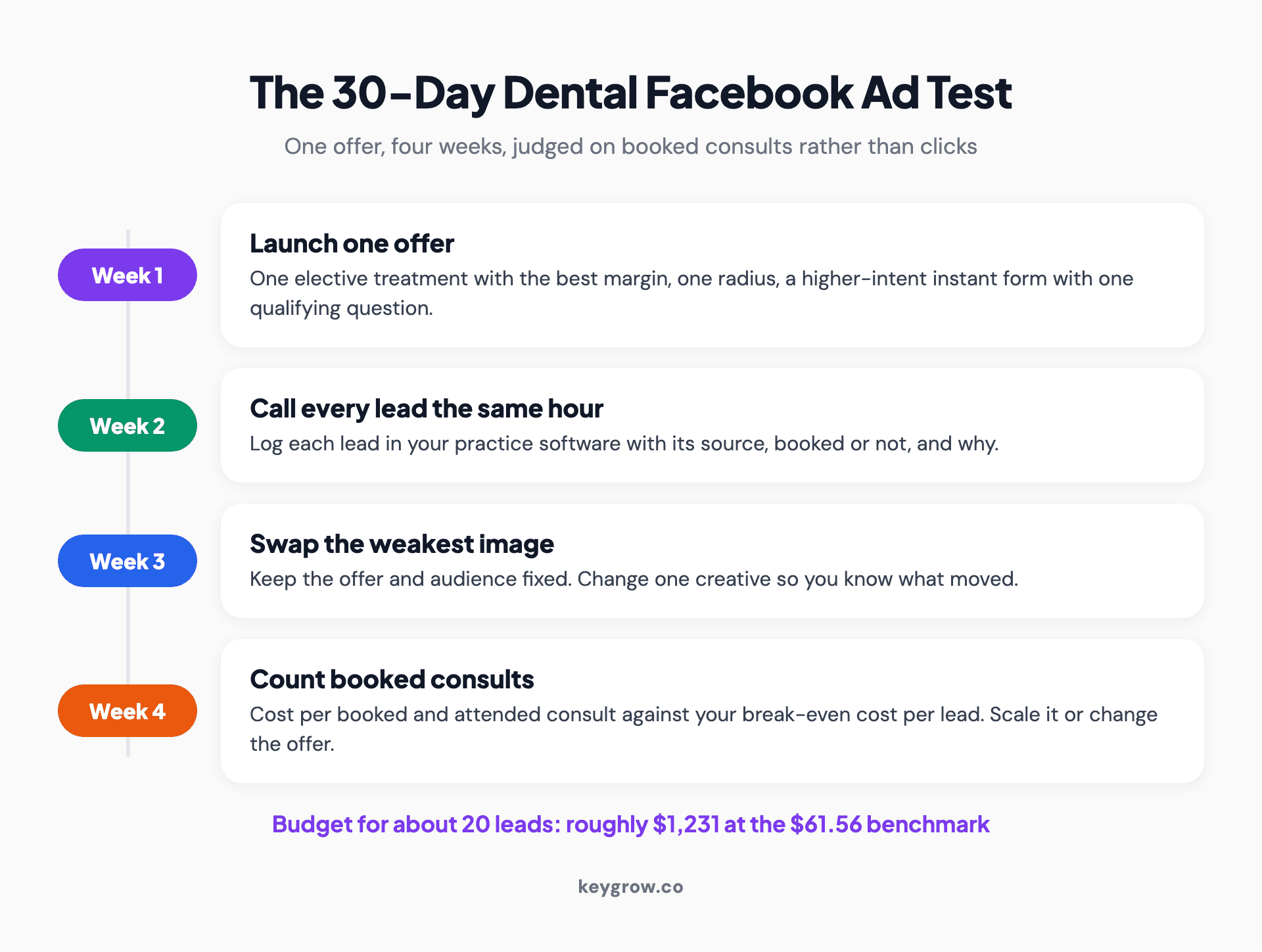
Four-week plan for a dental Facebook ad test: week one launches one elective offer with a higher-intent form, week two calls every lead the same hour and logs bookings, week three swaps the weakest image, week four counts booked and attended consults against break-even cost per lead.
If cost per booked consult beats break-even, scale it. If not, change the offer before the audience.
If you'd rather have someone run the test with you, our dental social media marketing team builds it on month-to-month terms, cancel anytime. Or get a quote and tell us which treatment you want more of.