


$0.40 to $2 a click. $2 to $6 per thousand impressions on a well-run campaign. About $27 a lead. Those are the numbers behind Instagram ads cost in 2026, and the first two come from WordStream's 2026 roundup of the larger benchmark studies.
The third comes from LocaliQ's Meta benchmarks, updated September 23, 2026: lead campaigns averaged $27.39 per lead and $1.80 per click across industries. That data measures Facebook ad campaigns, which also run on Instagram unless you switch the placement off. Nobody we found publishes an Instagram-only lead benchmark with a public sample, so this is the closest honest number.
There's no rate card. You set a budget, Meta runs an auction for every impression, and you pay whatever you win at. The click price rarely decides whether it pays. Your industry's cost per lead does, along with how many of those leads you actually book. That's what this guide works through, with a real budget at the end.
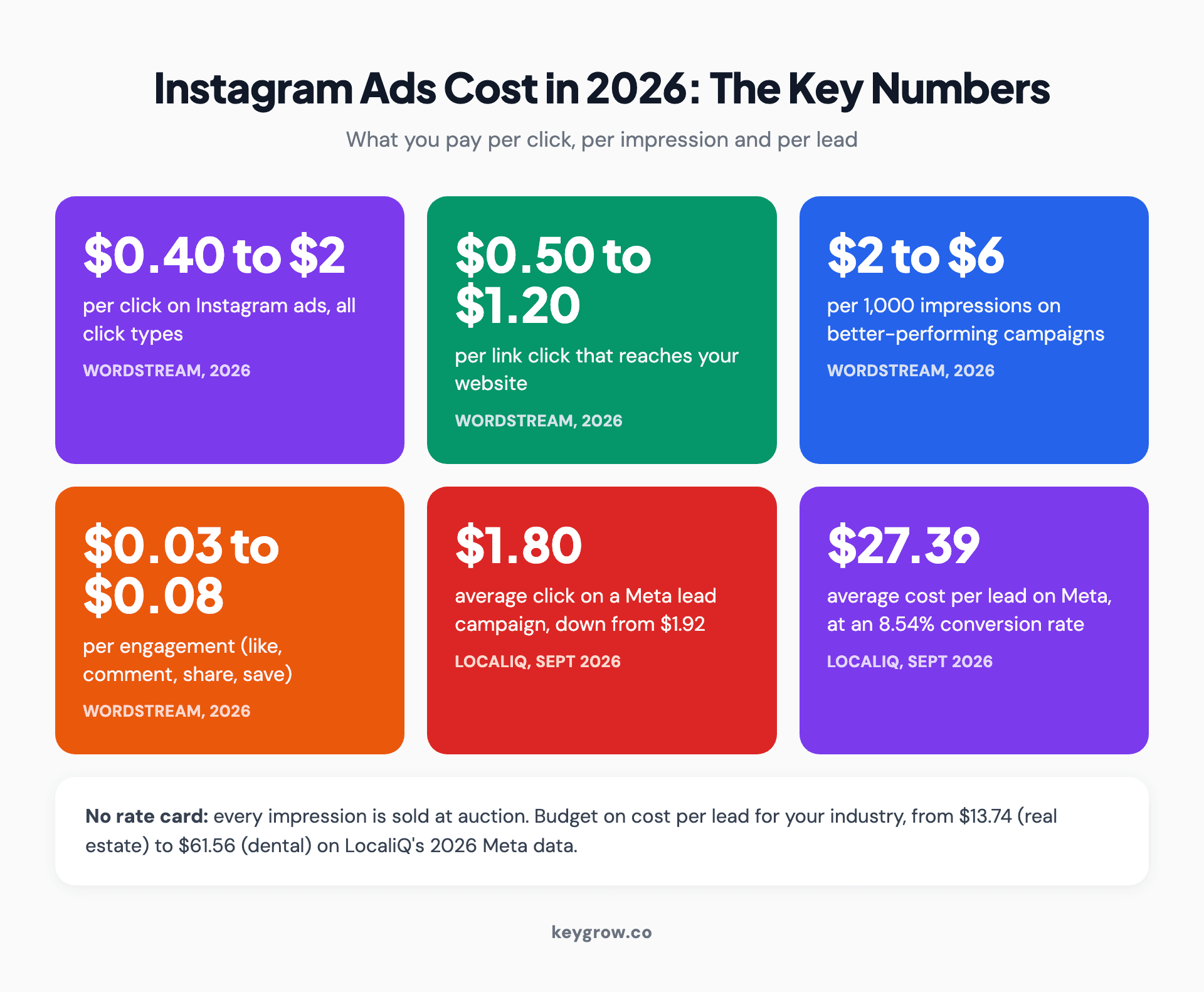
Stat strip of Instagram ads cost in 2026: $0.40 to $2 per click and $0.50 to $1.20 per link click per WordStream, $2 to $6 CPM for better-performing campaigns, $0.03 to $0.08 per engagement, and LocaliQ's 2026 Meta lead campaign averages of $1.80 per click and $27.39 per lead.
Instagram ad costs in 2026, metric by metric
Expect $0.50 to $1.20 per link click, $2 to $6 per thousand impressions on a healthy campaign, and roughly $14 to $62 per lead depending on your industry.
| What you pay for | Typical 2026 cost | Source | What it is good for |
|---|---|---|---|
| Any click (likes, profile taps, expands) | $0.40 to $0.70 | WordStream | Almost nothing. It flatters reports |
| Link click to your site | $0.50 to $1.20 | WordStream | Traffic and retargeting pools |
| 1,000 impressions (CPM) | $2 to $6, better-performing campaigns | WordStream | Awareness, launches |
| Engagement | $0.03 to $0.08 | WordStream | Testing which creative people stop for |
| Click on a traffic campaign | $0.60 | LocaliQ, Meta-wide | Cheapest visits |
| Click on a lead campaign | $1.80 | LocaliQ, Meta-wide | Clicks Meta expects to convert |
| Lead | $27.39 average, 8.54% conversion rate | LocaliQ, Meta-wide | The number to budget on |
Read the last row first. A business owner can't deposit an impression, and the lead is the first number in this table that turns into revenue.
WordStream also puts a healthy click-through rate at about 2 percent. If yours sits well under 1 percent, the creative is the problem, and Meta charges you more for showing it.
Why does every guide quote a different number?
They measure different clicks, different placements and different years. Compare like with like, or the averages contradict each other.
Search this topic and you'll find Instagram clicks priced anywhere from 40 cents to $3.35. Nobody is lying, exactly. Four things split the numbers:
- Some count every click. "Clicks (all)" in Ads Manager includes likes and profile taps, while link clicks are the ones that reach your site, and those cost more.
- Some quote one placement. The $3.35 figure repeated across several ranking guides is for Feed only. A platform-wide number blends in cheaper Stories and Reels inventory.
- The objective changes the price. On LocaliQ's 2026 data, a click on a traffic campaign cost $0.60 and a click on a lead campaign cost $1.80. Same auction, three times the price, because Meta is shopping for people likely to fill in a form.
- The sample matters. Several of the higher numbers come from ecommerce agencies, and their data includes holiday sales. A roofer in March isn't bidding against them.
Facebook and Instagram sell from one auction, so the only fair comparison is cost per result. Our breakdown of Google Ads versus Facebook ads makes the same point across platforms.
What leads cost by industry
Real estate leads averaged $13.74 on Meta in 2026. Dental leads cost $61.56. Your industry moves the price more than any setting does.
| Industry (LocaliQ 2026, Meta lead campaigns) | Avg cost per lead | Lead conversion rate | Traffic campaign CPC |
|---|---|---|---|
| Real Estate | $13.74 | 9.95% | $0.55 |
| Health & Fitness | $27.11 | 7.98% | $0.64 |
| Physicians & Surgeons | $32.14 | 6.41% | $0.61 |
| Automotive (for sale) | $35.52 | 4.15% | $0.70 |
| Home & Home Improvement | $42.95 | 5.32% | $0.63 |
| Beauty & Personal Care | $50.91 | 5.63% | $0.50 |
| Dentists & Dental Services | $61.56 | 6.07% | $0.61 |
| Attorneys & Legal Services | Not reported | Not reported | $0.69 |
Notice how flat the traffic column is. Clicks cost roughly the same in every industry, between $0.50 and $0.70. Leads vary more than four to one, because a stranger is far more willing to request a home valuation than to book a dental exam.
Visual businesses tend to beat their category on Instagram, because a before-and-after does the selling before anyone clicks. That's why med spa social media marketing leans so hard on paid Reels. A trade like roofing can still work, but roofing social media marketing usually pays through retargeting people who already visited the site, not cold Instagram traffic.
What does $10, $25, $50 or $100 a day buy?
Divide your monthly spend by your industry's cost per lead. At $25 a day, the all-industry average buys about 27 leads a month.
| Daily budget | Monthly spend | Leads at real estate CPL ($13.74) | Leads at all-industry CPL ($27.39) | Leads at dental CPL ($61.56) |
|---|---|---|---|---|
| $10 | $300 | about 22 | about 11 | about 5 |
| $25 | $750 | about 55 | about 27 | about 12 |
| $50 | $1,500 | about 109 | about 55 | about 24 |
| $100 | $3,000 | about 218 | about 110 | about 49 |
These are averages, so your first month will land above or below them. The useful part is the shape. A dental practice at $10 a day gets about five leads a month, which is too few to tell a good ad from a lucky one.
Ads Manager shows the minimum daily budget for your account when you type a number into the ad set. It's usually a few dollars. The minimum Meta will accept and the minimum that teaches you something are very different numbers.
Worked budget: a med spa spending $1,500 a month
At Beauty & Personal Care averages, $1,500 buys about 505 clicks and 28 or 29 leads. What happens after the form decides whether it paid.

An esthetician giving a client a facial in a dark, modern treatment room, the kind of service a med spa promotes with Instagram ads.
Here's the pattern in practice, using LocaliQ's 2026 lead campaign numbers for Beauty & Personal Care (the closest category to a med spa):
- Spend $1,500 for the month, which is $50 a day.
- At $2.97 per click on a lead campaign, that buys about 505 clicks.
- At a 5.63% conversion rate, 28 or 29 of them fill in the form, at roughly $51 to $54 a lead.
- Say one lead in three books a consult. That's 9 or 10 consults.
- Say half of those buy. That's 4 or 5 new clients.
Steps 4 and 5 are our assumptions for illustration, not benchmarks. Swap in your own booking and close rates; they're the two numbers you control.
Four or five new clients for $1,500 is $300 to $375 each. If a first treatment brings in $400 and half of new clients come back three more times, that's a good month. If you can't say what a client is worth over a year, you can't say whether $350 is cheap.
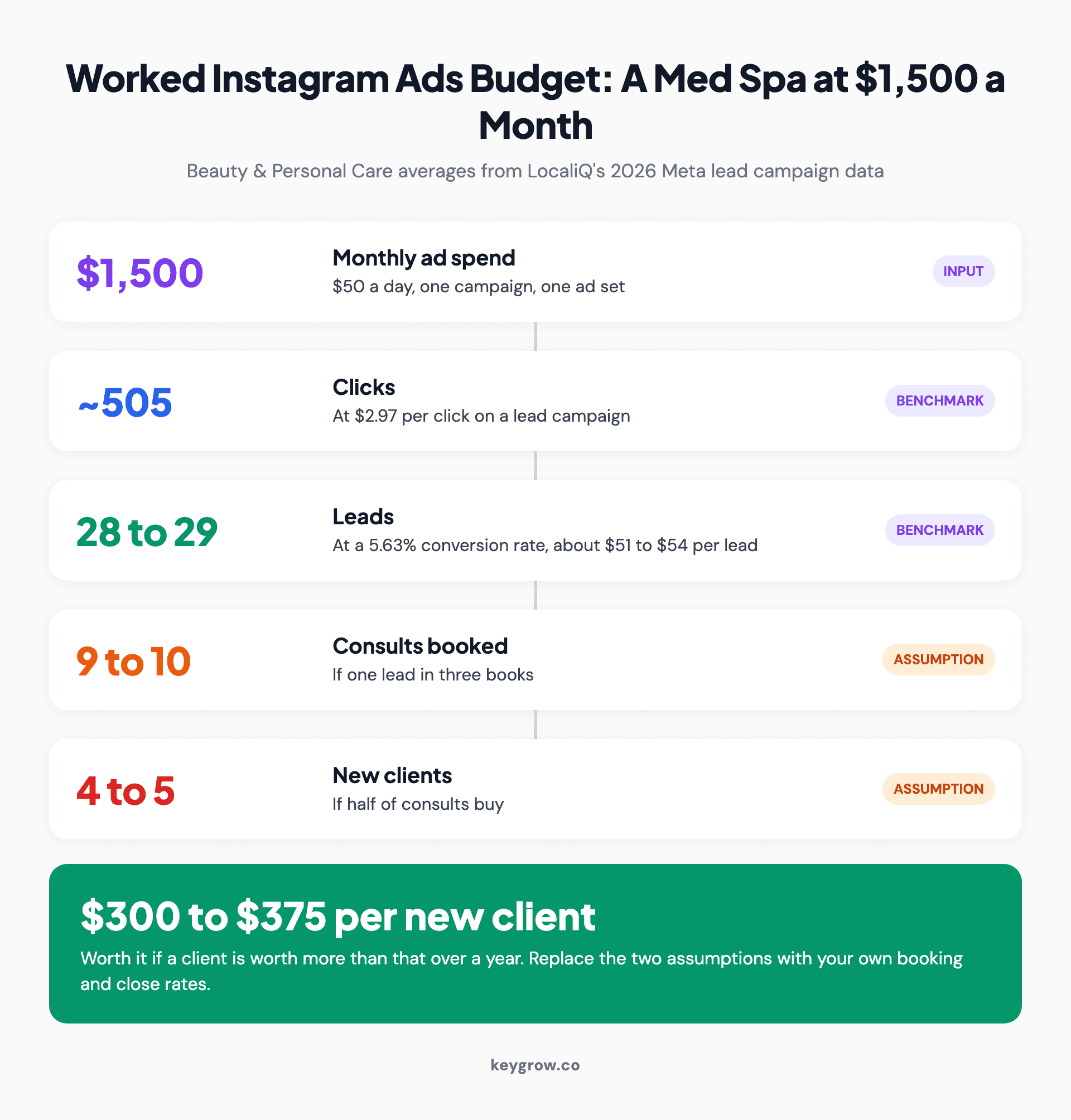
Flow of a $1,500 monthly Instagram ads budget for a med spa: $1,500 buys about 505 clicks at $2.97, about 28 leads at a 5.63 percent conversion rate, about 9 consults if one in three books, and 4 to 5 new clients if half buy, for roughly $300 to $375 per new client.
Why small budgets stay "Learning Limited"
Meta wants about 50 optimization events per ad set in seven days. At $50.91 a lead, that's $363.64 a day, so most local budgets never get there.
Meta says an ad set needs about 50 of its chosen events in a week to exit the learning phase. The math for a med spa: 50 leads times $50.91 is $2,545.50 a week. Our $1,500-a-month example produces about seven leads a week.
So the ad set sits in "Learning Limited," and that's survivable. Most local accounts live there. What hurts is making it worse:
- Splitting $50 a day across three ad sets, so each one learns a third as fast
- Editing targeting or creative every few days, which restarts learning
- Judging results daily when a week holds six or seven leads
Run one campaign, one ad set and three or four ads. Leave it alone for 30 days and judge the month as a whole.
Costs that never show up as CPC
Ads Manager shows media cost only. Management fees, creative, Apple's fee on iPhone boosts and a weak landing page all sit outside it.
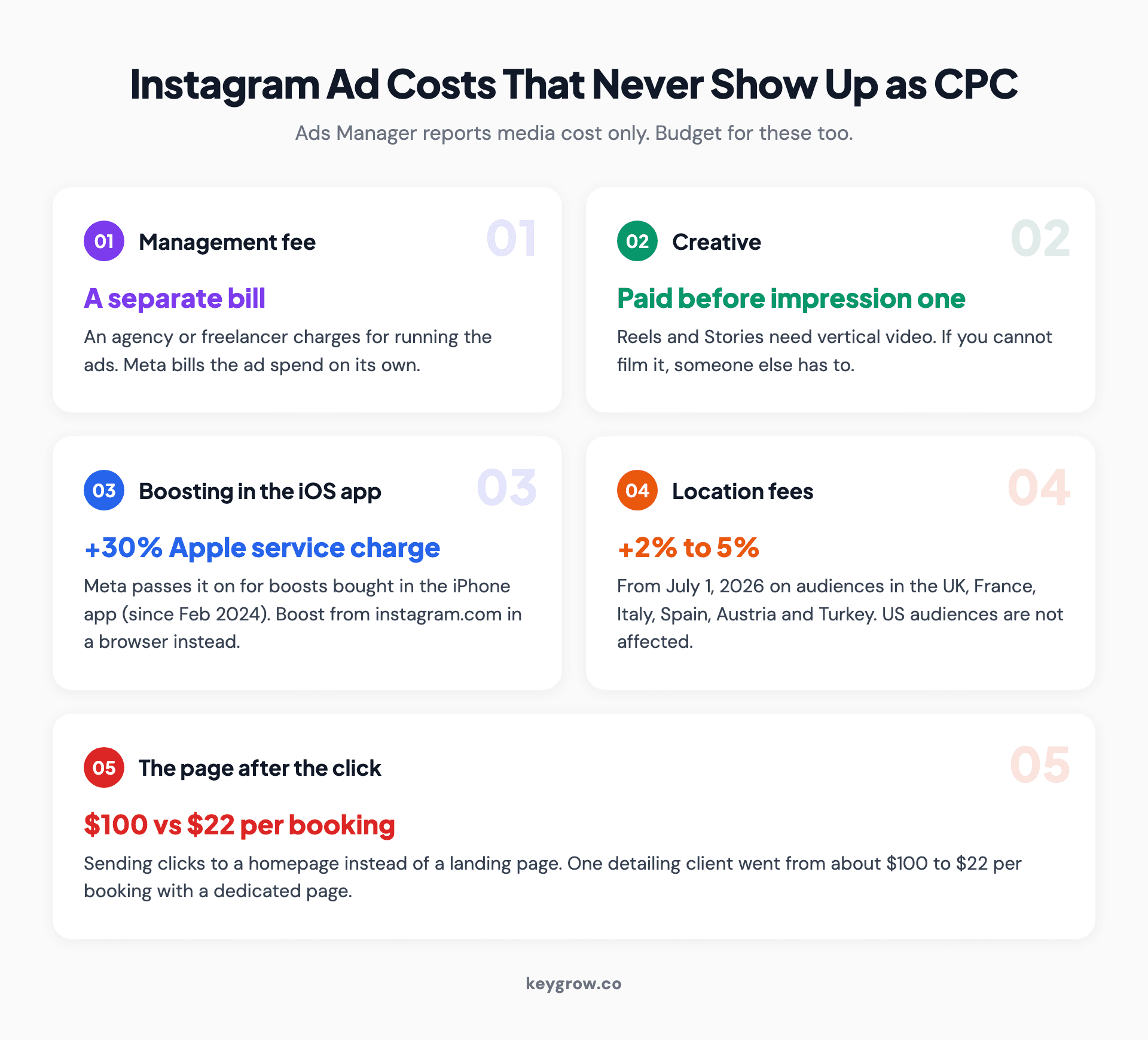
Five cards of Instagram ad costs that sit outside the CPC: management fees billed separately from ad spend, creative production for Reels and Stories, Apple's 30 percent service charge on boosts bought in the iOS app, Meta's 2 to 5 percent location fees on audiences in six countries from July 2026, and the cost of sending clicks to a homepage instead of a landing page.
If someone runs the ads for you, their fee is a separate bill from what Meta charges. Our guide to social media management pricing covers what agencies and freelancers charge and how to read the quote.
Reels and Stories want vertical video. If you can't film it yourself, someone has to, and you pay for that before the first impression.
Then there's Apple. In February 2024, Meta began passing Apple's 30 percent service charge onto boosts bought inside the iPhone app, per Social Media Today. Meta's own advice was to boost from instagram.com in a browser instead. Check the checkout screen before you pay.
Outside the US, Reuters reported in March 2026 that Meta would add 2 to 5 percent from July 1 on ads shown to audiences in the UK, France, Italy, Spain, Austria and Turkey. Ads shown to US audiences don't carry it.
The biggest hidden cost is the page after the click. Sending ad traffic to your homepage is the most expensive default in paid advertising. A mobile detailing business we worked with was paying about $100 per booking with every click landing on the homepage. A dedicated booking page took that to $22, and monthly revenue went from $1.2K to $5.1K between August and December 2022. Those were Google Ads clicks, but a thumb on a phone behaves the same coming from a Reel. If the page is the weak link, landing page design is cheaper to fix than any bid.
Boost the post or build a campaign?
Both buy from the same auction. A boost is fine for reach on a post that already works; a lead goal needs Ads Manager.

A hand holding a phone open to instagram.com in a mobile browser, where boosts can be bought without the app store's service charge.
A boost takes two minutes and gives you a budget, a duration and a broad audience. Ads Manager takes an afternoon the first time and gives you a lead objective, retargeting audiences, placement control and split tests. The auction prices both the same way. The difference is what you tell Meta to find.
A boosted post optimizes for attention by default. That's fine for an event next week or a Reel that is already pulling messages. It's a bad way to buy leads, because nothing in the setup tells Meta that a lead is what you want. Our guide to running Facebook ads for leads walks through the instant form settings that keep junk out, and the same forms run on Instagram.
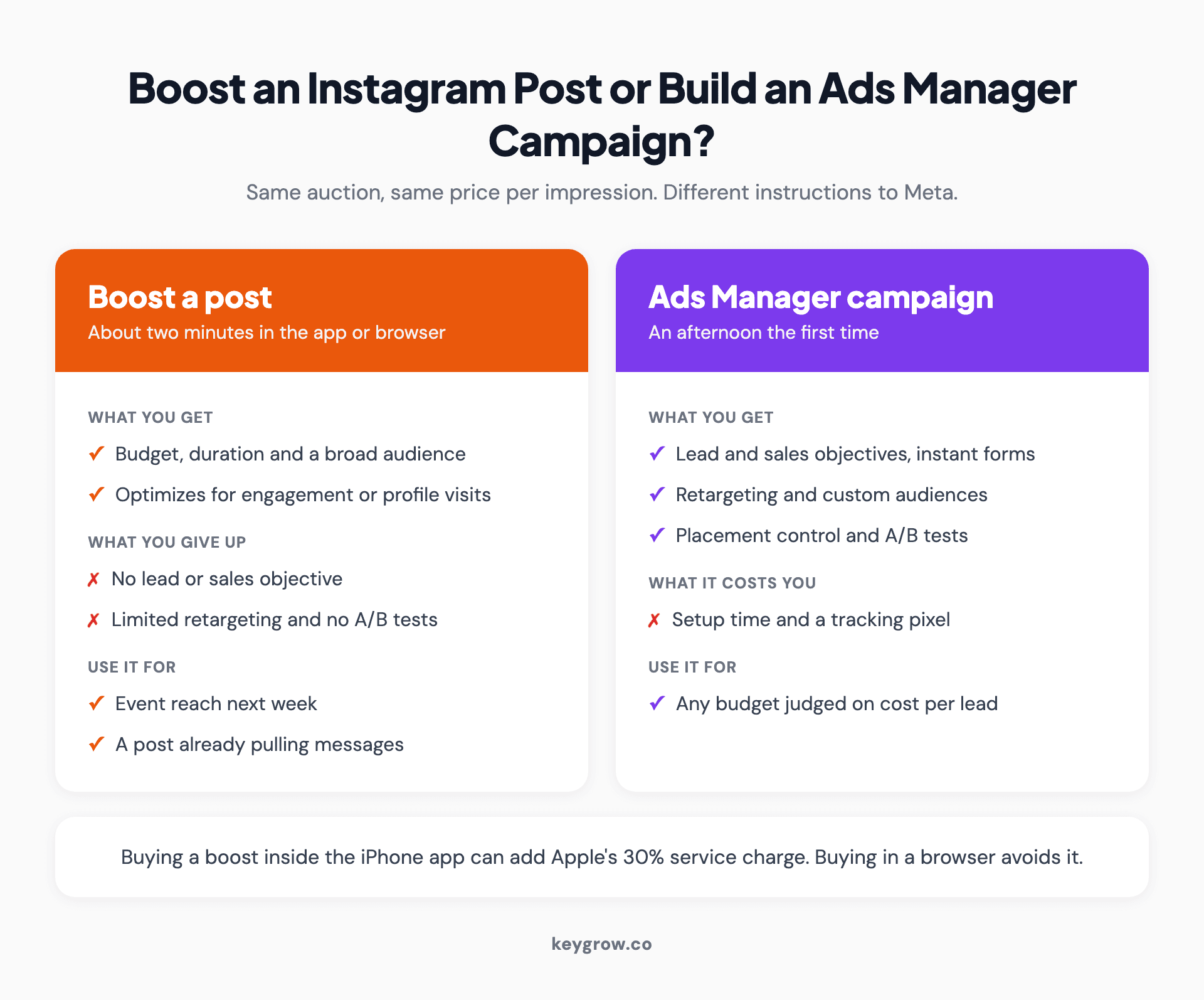
Comparison cards of boosting an Instagram post versus building a campaign in Meta Ads Manager: a boost takes two minutes, optimizes for engagement or profile visits, uses basic targeting and suits event reach or a proven post; Ads Manager takes longer, offers lead and sales objectives, retargeting and custom audiences, placement control and A/B tests, and suits any budget judged on cost per lead.
When Instagram ads are the wrong spend
Skip paid Instagram if your customers search in a hurry, if nobody can answer leads within hours, or if your budget buys fewer than ten leads a month.
Someone with a burst pipe is typing "emergency plumber" into Google, not scrolling Reels. Urgent, high-intent services usually do better with search ads and PPC management than with interruption ads on Instagram.
Speed matters as much as the ad. Instagram leads go cold fast, and a lead form answered the next afternoon is money spent twice.
And small budgets in expensive categories teach you very little. A dental practice at $10 a day buys about five leads a month. Put that money into a Google Business Profile, reviews and a better booking page first.
You may not need an agency at all. A business with a strong post, a browser and $10 a day can run a fair boost test on its own. Hire help when the hours cost more than the fee, or when you're 60 days in and can't tell what's working.
FAQs
How much do Instagram ads cost per day?
Whatever daily budget you set. Meta may spend a little more on a busy day, but it keeps the weekly total in line with your budget. Ads Manager shows the minimum when you type a number into the ad set. A useful test for a local business usually starts between $20 and $50 a day.
How much does it cost to boost a post on Instagram?
A boost costs the budget and duration you pick, from a few dollars a day. Buying the boost inside the iPhone app can add Apple's 30 percent service charge, which Meta says you avoid by boosting from instagram.com in a browser.
Are Instagram ads cheaper than Facebook ads?
Neither is reliably cheaper, because both sell from the same Meta auction. Several benchmarks put Instagram Feed clicks above the Facebook average, while Reels and Stories impressions cost less. Compare the two on cost per lead or sale, not cost per click.
What is a good CPC for Instagram ads?
For a link click, $0.50 to $1.20 is normal according to WordStream's 2026 figures. Lead campaigns pay more per click, $1.80 on average in LocaliQ's 2026 Meta data, because Meta targets people more likely to convert. A high CPC is fine if the cost per lead fits your margins.
How much should a small business spend on Instagram ads per month?
Enough to buy 20 to 30 leads at your industry's cost per lead. That's about $750 at the all-industry average of $27.39 and closer to $1,500 for dental or beauty. Less than that and a month of data can't separate a good ad from a lucky week.
Why are my Instagram ads so expensive?
The usual causes are a low click-through rate, a narrow audience, a sales or lead objective, or the October to December rush. Fresh vertical video and a broader audience lower the cost per impression. A faster landing page lowers the cost per lead.
Set the test budget
Pick your industry's cost per lead from the table, multiply by 25 and run that for 30 days in one campaign with three or four ads. That's the test budget.
At the end of the month, count leads, booked appointments and new customers, then divide the spend by each. If cost per customer fits what a customer is worth, raise the budget 20 percent at a time. If it doesn't, fix the page or the offer before you touch the bid.
If you'd rather we ran it, our social media advertising team works month to month, cancel anytime. Or tell us what you sell and we'll tell you honestly whether Instagram is the right place for the first dollar.