


The top of page bid in Google Ads is not the price of the top spot. It isn't your bid either. It's a range built from other advertisers' bids, and plenty of accounts end up paying more than its high end.
That bid is one of three things "Google Ads top of page" can mean, and most of the confusion comes from mixing them up. Top of page means your ad showed among the top ads, the block next to the top organic results. Google uses the phrase for the top of page bid estimates in Keyword Planner and the Keywords tab, for the top and absolute top impression rates in your reports, and for the Target impression share strategy that bids to put you there.
Below is what each one measures, then a worked example of when the top spot earns its premium.
What "top of page" means in Google Ads
Top of page means your ad showed among the top ads, next to the top organic results. Absolute top means it was the very first of those ads.
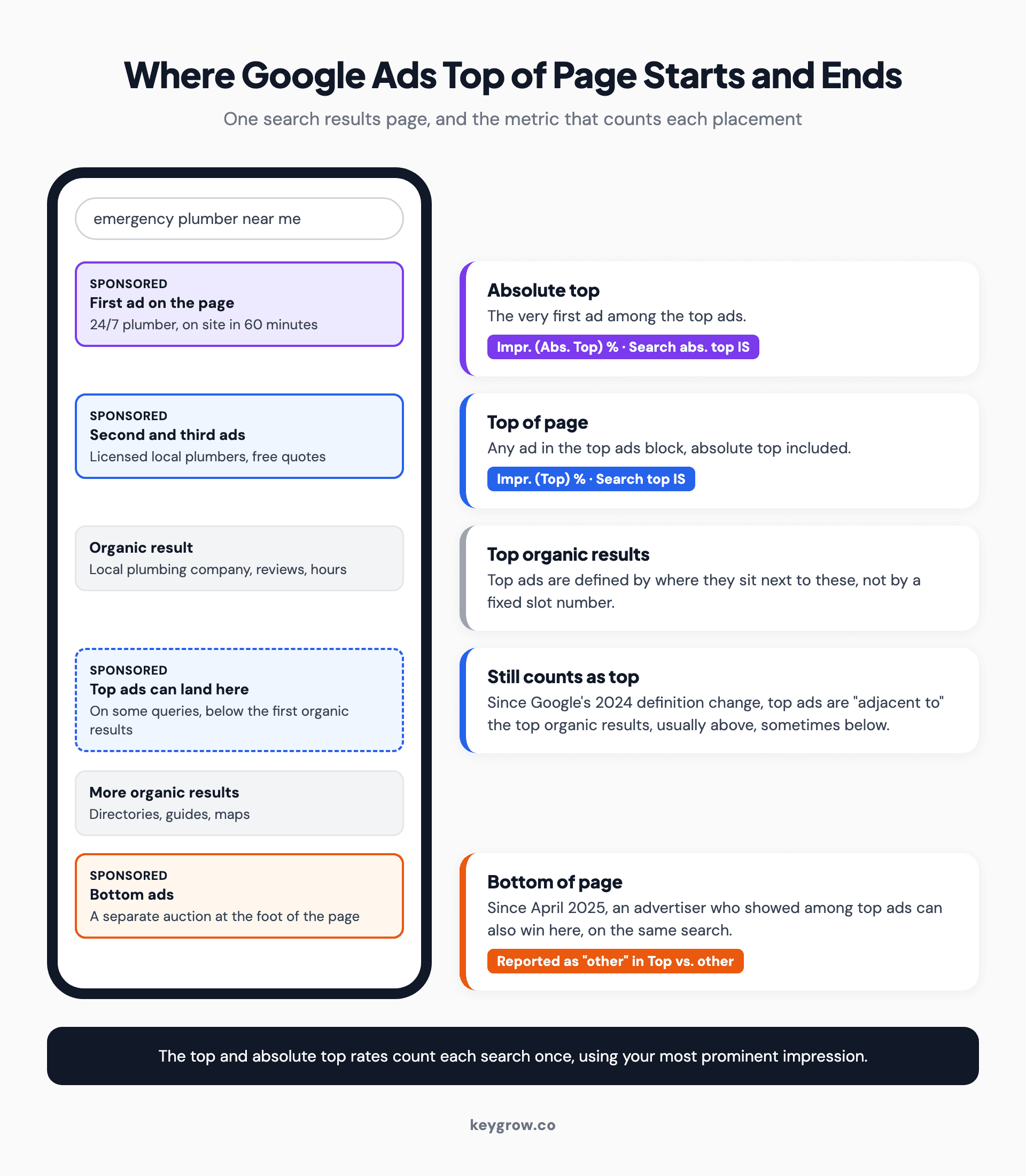
Annotated phone search results page showing where Google Ads top of page starts and ends: the absolute top ad, the rest of the top ads block, top ads that can sit below the first organic results on some queries, the organic results, and the bottom ads auction where a top advertiser can now appear a second time, with the metric that counts each placement.
"Top" got looser in 2024. Top ads used to mean ads above the organic results. Per Google's metric definitions, they are now ads adjacent to the top organic results: generally above them, below them on some queries. Google called it a change to the wording, not to how the metrics are calculated.
A year later it moved again. In April 2025 Google let advertisers who showed among top ads also enter the separate auction for ads at the bottom of the page, so one search can show your business twice. Per Google's announcement, its tests saw about 14 percent more bottom-ad conversions. So the "other" in your "Top vs. other" segment now includes those bottom placements.
Each corner of the account uses the phrase for something different:
| Term | Where you see it | What it measures | The common misread |
|---|---|---|---|
| Top of page bid (low range) and (high range) | Keyword Planner | Roughly the 20th and 80th percentile of bids that got ads shown among top ads, last 30 days | "That's what a click will cost me" |
| Est. top of page bid | Keywords tab, manual bidding only | The bid you likely need for a top ad when a search exactly matches your keyword | "Bid this and the top is mine" |
| Impr. (Top) % and Impr. (Abs. Top) % | Campaign, ad group and keyword reports | The share of your impressions shown among top ads, or as the first ad | "Higher is always better" |
| Top of page rate | Auction insights | How often each competitor's ad showed among top ads | "They're beating me, so I should bid more" |
| Target impression share | Bid strategy settings | Google sets your bids to hit a top, absolute top or anywhere goal | "A cheap way to be first" |
All five describe one auction. If it's still a black box, our walk-through of how the Google Ads auction works follows a single search from keyword to invoice.
The top of page bid is a range of other people's bids
The Keyword Planner range shows what other advertisers bid to reach the top ads over the last 30 days. It isn't your price, and it isn't a ceiling.
Per Google's Keyword Planner documentation, the low range is "an approximation of the 20th percentile" and the high range approximates the 80th, for the location and network you selected. Picture every bid that put an ad among the top ads last month, lined up from lowest to highest. The low range sits a fifth of the way along. The high range sits four fifths along.
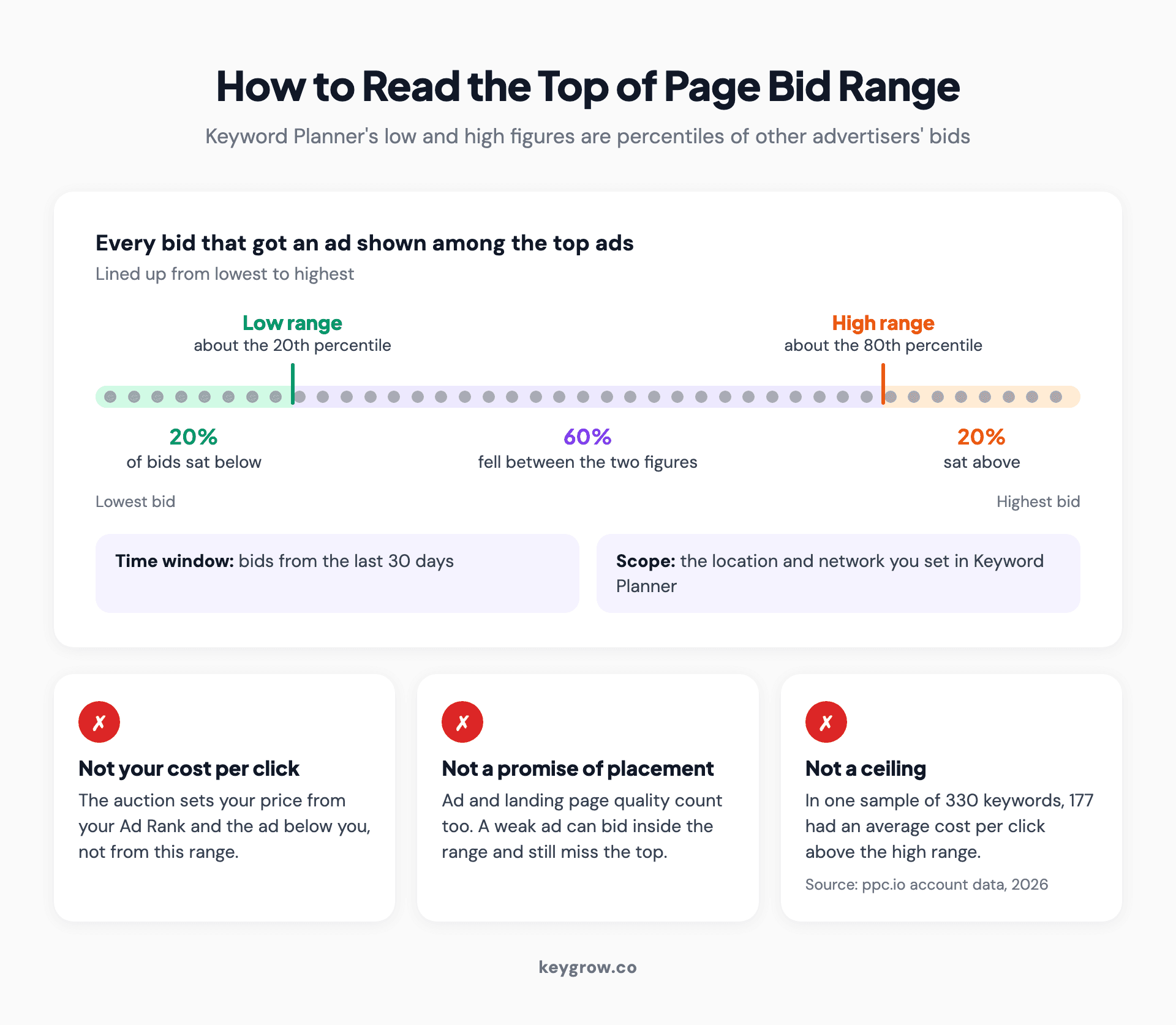
Diagram of how to read the Google Ads top of page bid range in Keyword Planner: a line of bids that reached the top ads over 30 days, with the low range at the 20th percentile and the high range at the 80th, plus three notes on what the range is not: your cost per click, a promise of placement, or a ceiling on what you will pay.
Your own costs drift from that range for two reasons. Google ranks ads on quality as well as bid, so a strong ad needs less and a weak one needs more. And the range covers whatever location you set, so a national figure says little about one suburb.
How far off can it be? In one agency's account data, Planner returned a range for 330 keywords across 35 US accounts (July 30 to October 28, 2026). For 177 of them, the average cost per click landed above Planner's high end. Only 3 came in below the low end, and the median keyword paid 1.03 times the high. The author puts it down to small local targeting and bids aimed at the top on buyer searches. Treat the high end as a typical price for a strong position, not the most you'll pay.
The Keywords tab has its own column, Est. top of page bid. It only shows on manual bidding, and it applies to searches that exactly match the keyword. Google bases it on your Quality Score and recent competition, and says a very high estimate "may mean that the quality of your ads and website is poor." If yours looks steep, raising your Quality Score usually brings it down faster than a bigger bid.
Top and absolute top impression rates: where your ads actually showed
Impr. (Top) % is the share of your impressions that showed among top ads. Impr. (Abs. Top) % is the share that showed as the first ad.

Two people pointing at a laptop screen while reviewing campaign reports, where Google Ads top of page and absolute top impression rates show up.
As an illustration, a keyword with 1,000 impressions, 700 among top ads and 200 in the first slot, reads about 70 percent and 20 percent. Each search counts once, even when your ad showed at the top and again at the bottom.
This is where people get caught. Google says not to bid toward these rates, because "they may decrease as bids increase." A bigger bid can win you entry to tougher, pricier auctions where you land lower. So a top rate that falls after a bid increase can mean you're winning more auctions, not fewer.
To bid on position, Google points you to the share columns instead: Search top IS and Search abs. top IS, which divide by the top impressions you were eligible for. Our guide to impression share in Google Ads covers those, along with the lost IS columns for budget and rank.
Target impression share: asking Google to put you on top
Target impression share is a bid strategy. You choose a placement (absolute top, top, or anywhere on the page) and a percentage, and Google sets each bid to hit it.
Pick 65 percent at absolute top, and Google bids to put you first in 65 percent of the auctions where you could have shown there. A Max CPC limit caps the bids, though Google warns that a cap set too low stops the strategy reaching its target. Bid adjustments are ignored, apart from a -100 percent device setting, and it runs on the Search Network only.
Google's own example is a brand campaign set to 100 percent, and that's where we'd use it. Someone typing your business name wants you, and a competitor's ad sitting above your listing is the expensive outcome.
On non-brand lead generation it buys position whether or not the clicks turn into calls. It has no idea what a lead is worth to you.
Is the top spot worth it? A worked example
The top ad usually gets more clicks and costs more per click. Whether it pays depends on what the extra leads cost, not on its average cost per lead.

A kitchen sink and faucet by a window, the kind of urgent plumbing job behind many Google Ads searches where the first ad gets the call.
Google's help pages say top ads "typically have higher CPCs than ads elsewhere," because the Ad Rank bar for the top block is higher. Here's one keyword for a plumbing company, run two ways for a month. Every figure in the table is an assumption for the example, not a benchmark.
| One keyword, one month | Absolute top | Third ad (still top of page) |
|---|---|---|
| Impressions | 1,000 | 1,000 |
| Click-through rate | 8% | 5% |
| Clicks | 80 | 50 |
| Cost per click | $14.00 | $9.00 |
| Spend | $1,120 | $450 |
| Conversion rate | 12% | 11% |
| Leads | 9.6 | 5.5 |
| Cost per lead | $116.67 | $81.82 |
Third place wins on cost per lead, easily. That's the wrong comparison, though. The top spot bought 4.1 extra leads for an extra $670, or $163.41 per extra lead.
Now value a lead. Assume a typical job leaves $400 of gross profit and you book half your leads, so each lead is worth $200. At the top, the keyword clears $800 after ad spend ($1,920 of lead value minus $1,120). In third place it clears $650. The top wins by $150, because each extra lead cost less than it was worth.
Change one assumption. If the job is a drain clearing worth $240 in profit, a lead is worth $120. Now the top spot clears $32 for the month and third place clears $210. Clicks and cost per lead didn't move. Only the job value did.
So compare the cost of each extra lead with what a lead is worth. Average cost per lead hides it. If you run a plumbing company and would rather have that math done on every keyword with live numbers, our Google Ads for plumbers service works from your real job values.
When the top of page pays, and when to let it go
Pay for the top when the first ad gets the call and each extra lead costs less than it's worth. Otherwise the second to fourth ad is usually the better buy.
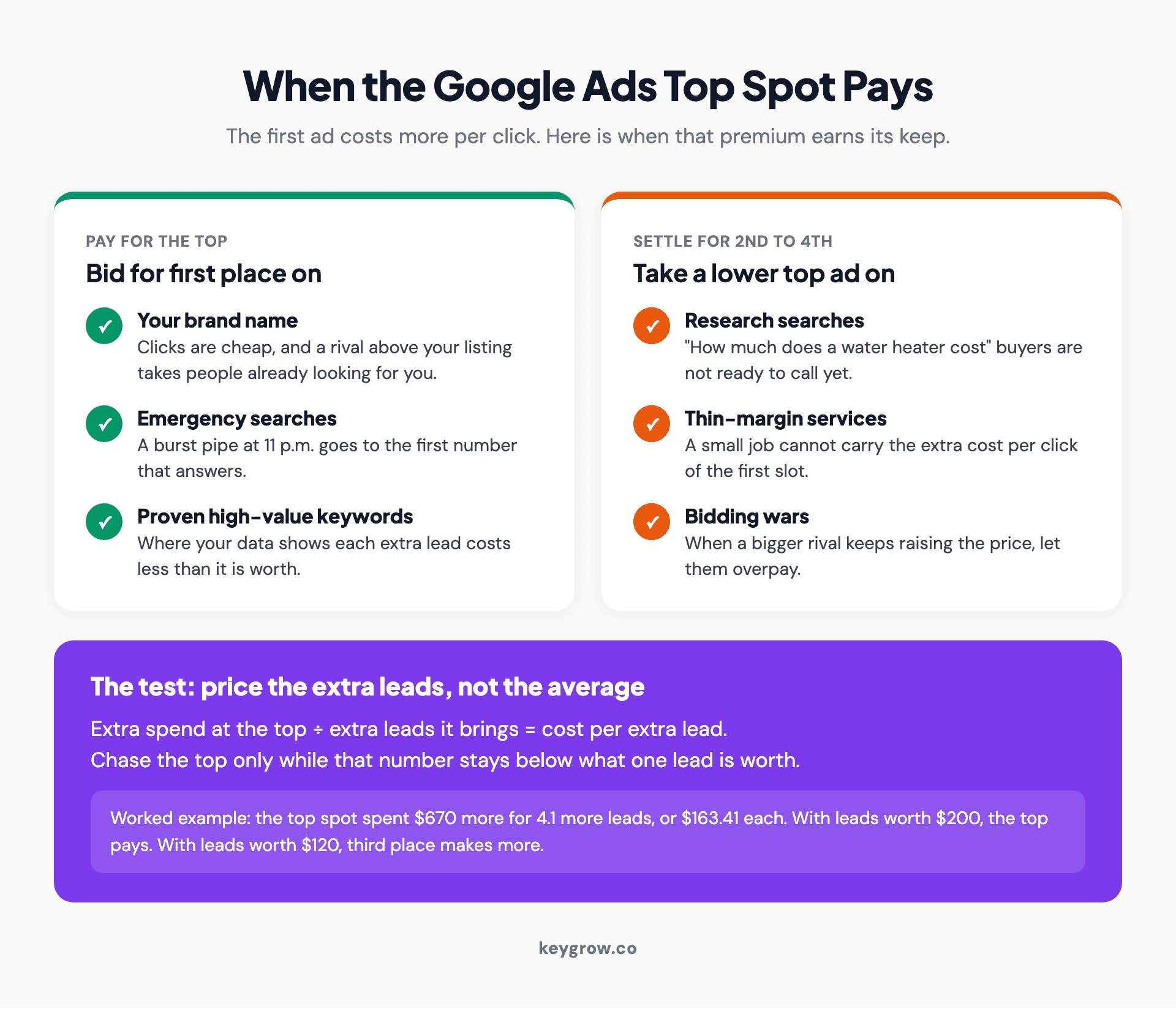
Comparison cards showing when the Google Ads top of page spot pays: brand searches, emergency searches where the first number gets the call, and keywords where each extra lead costs less than a lead is worth, against when to settle for the second to fourth ad: research searches, thin margins, and keywords where a bigger rival keeps raising the price, plus the test: the cost of each extra lead must stay below what a lead is worth.
Your brand name is the easy case. Those clicks are cheap, and a rival above your own listing takes customers who were already looking for you.
Emergencies come next. A "burst pipe" search at 11 p.m. tends to go to the first number that answers, and being third on a panic search is close to not showing at all. After that, chase the top only on keywords where your own data says the extra leads pay.
Settle for second to fourth on research searches ("how much does a water heater cost"), on thin-margin services, and wherever a bigger competitor keeps pushing the price. If they want to overpay for first place on a low-value term, let them.
Watch for one report in particular: the one that opens with a 90 percent absolute top rate and never mentions cost per lead. Vanity-metric reporting is the industry's favorite habit, and position is its newest outfit. Rank doesn't pay rent. Booked jobs do.
How to test the top spot in your own account
Your account already holds the answer for your keywords, split by where the ad showed.
- Add the columns. Impr. (Top) %, Impr. (Abs. Top) %, Search top IS, Search lost top IS (rank), Conversions and Cost / conv.
- Segment by "Top vs. other." Google recommends this segment for comparing ad locations. Compare conversion rate and cost per conversion, top against other, on your 10 to 20 best keywords.
- Price a lead. Gross profit per job times the share of leads you book. Our Google Ads ROI calculator will do the arithmetic.
- Raise bids only where the extra leads pay. Change one thing at a time and give it a few weeks of data before you judge it.
- Recheck a month later. If lost top IS (rank) fell but cost per lead climbed past what a lead is worth, back off.
FAQs
What is the top of page bid in Google Ads?
It's a range in Keyword Planner showing what other advertisers bid to get their ads among the top ads over the last 30 days. The low range is roughly the 20th percentile of those bids and the high range roughly the 80th. Use it to plan, not as a price, because your actual cost per click can land above or below it.
What is the difference between top of page and absolute top?
Top of page means your ad showed anywhere among the top ads, the block next to the top organic results. Absolute top means it was the first ad in that block. Every absolute top impression also counts as a top impression, so your absolute top rate can't exceed your top rate.
Why is my Google ad not showing at the top of the page?
Usually your Ad Rank fell short of the higher threshold Google sets for top ads, or your budget ran out. Ad Rank weighs your bid alongside ad and landing page quality, the search context and your ad assets. The Search lost top IS (rank) and (budget) columns tell you which one it was.
What is a good absolute top impression rate?
There's no universal number. Aim high on your brand name. On other keywords, a good rate is whatever keeps the cost of each extra lead below what a lead is worth to your business.
Can I bid for a specific ad position in Google Ads?
Not for a numbered slot like second or third. Target impression share lets you aim for absolute top, the top ads or anywhere on the page, with a percentage goal. Everything else is decided auction by auction.
Bid for the lead, not the slot
Position is a means. You're buying calls and booked jobs at a cost the business can carry.
We saw this on a cash home buyer campaign that was drowning in junk leads. A higher spot on the page wouldn't have fixed it. Filtering did: negative keywords, tighter match types and qualifying language in the ads. Between December and January, serious leads rose 600 percent and cost per lead fell from $313 to $124, without a bigger budget.
If you run one service in one area with a few dozen keywords, the test above is an afternoon with a spreadsheet, and you don't need an agency for it. Once the account outgrows that afternoon, our Google Ads management team runs the same math with you each month, month-to-month.