


It's 10:47 on a Tuesday night in Fort Worth. The pipe under Dana's kitchen sink has just burst, and she types "emergency plumber near me" into her phone.
Before her results finish loading, an auction has already run. So how does Google Ads work? Businesses tell Google which searches they want to show up for and the most they'll pay for a click. Every time someone searches, Google ranks the ads that match on bid, ad quality and the context of that search, then shows the winners in order. Showing up is free. The winners pay only when someone clicks, and usually less than their maximum.
Here's her search, followed to the invoice. The plumbers are invented; the mechanics are Google's.
Which ads get into the auction?
Only ads whose keywords match her search, and that pass basic eligibility checks, enter the auction. Match types and negative keywords decide who gets in.

Bidders crowded into a tent at a 1939 livestock auction in Marshalltown, Iowa, the slow, in-person version of the auction Google now runs for every search.
Each keyword's match type sets how loosely it can match what Dana typed. Broad match, the default, can match related searches, even ones without the keyword's direct meaning. Phrase match needs the search to include that meaning, and exact match needs the same meaning or intent. Negative keywords block searches you never want to pay for, like "plumber jobs." Google then drops ads that can't run, like one scheduled to stop at 6 p.m. or one that was disapproved.
Our take: broad match without negative keywords is a donation to Google. Google applies it to every keyword by default and calls it "critical" to pair broad with Smart Bidding. In Optmyzr's 2026 study of 30,000 accounts, non-brand conversions on broad match cost $24.11, against $16.91 on exact. Broad did come close to phrase in lead gen accounts, so it can earn its keep once negatives and real conversion data fence it in. Left unfenced, it tells you what it matched after you've paid for it.
How the Google Ads auction scores every ad
Google scores each eligible ad with an Ad Rank. Your bid is one of six inputs, and the rest measure quality and the moment.
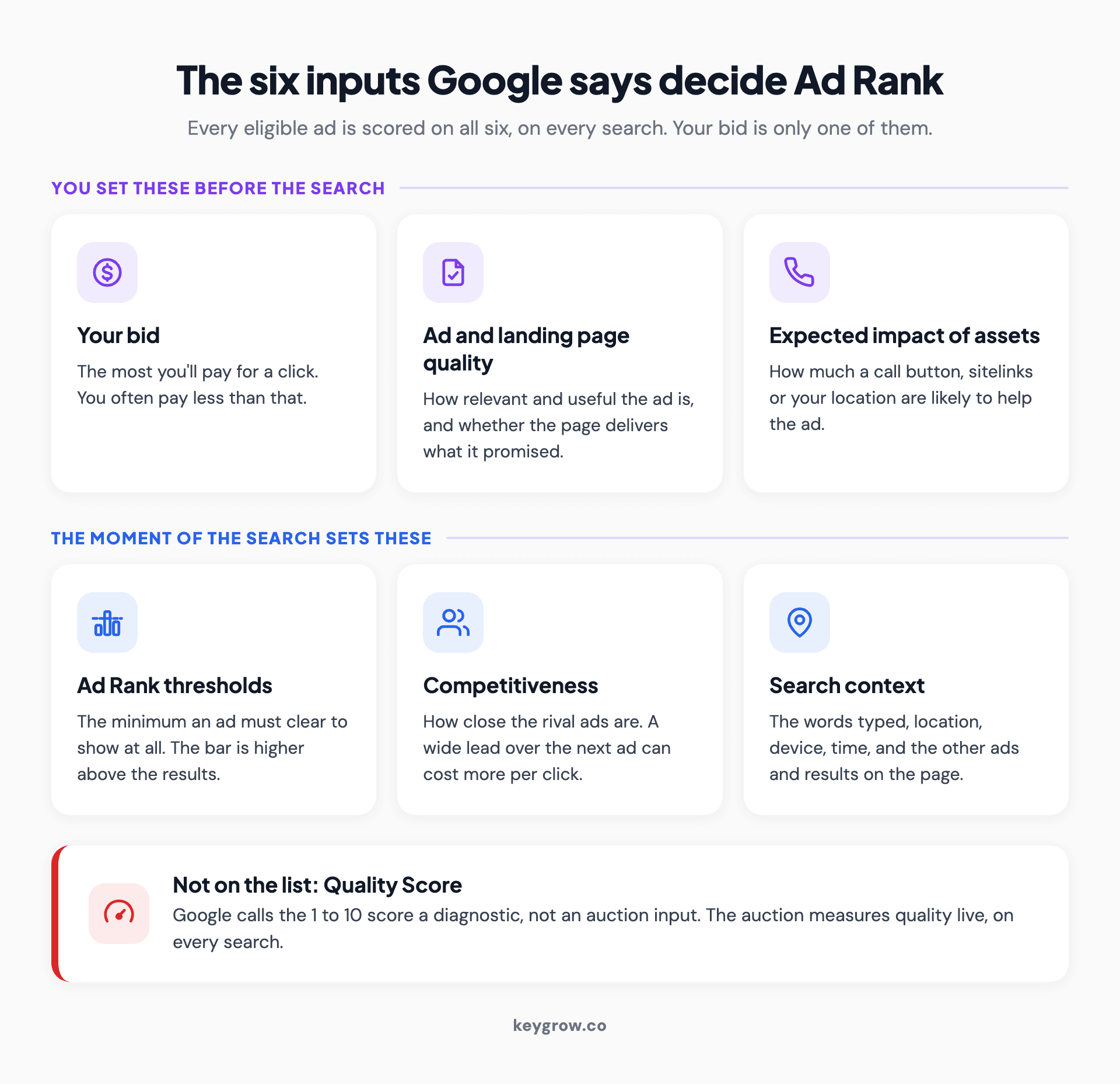
Icon grid of the six inputs Google says decide Ad Rank, split into three you shape before the search (your bid, ad and landing page quality, expected impact of assets) and three set by the moment (Ad Rank thresholds, competitiveness of the auction, context of the search), with a note that Quality Score is a diagnostic, not an auction input.
Google's Ad Rank page lists the six. You control three before anyone searches: your bid, the quality of your ad and landing page, and the expected impact of assets like a call button. The rest arrive with the search. Google sets minimum thresholds an ad has to clear, rivals may be close behind or far back, and context counts too, meaning Dana's exact words, her location, her device and the hour. Ad Rank gets calculated twice per auction, once to decide whether an ad can show and again to rank it.
Quality Score isn't on that list, and Google's help page says so flatly: "Quality Score is not an input in the ad auction." The 1 to 10 number in your account is a diagnostic, while the auction takes its own live read of quality on every search. Our guide to improving your Quality Score covers what the number is good for. And "Ad Rank = max bid x Quality Score" is the classic textbook simplification, not how Google describes the auction today.
Four plumbers, one auction (a simplified model)
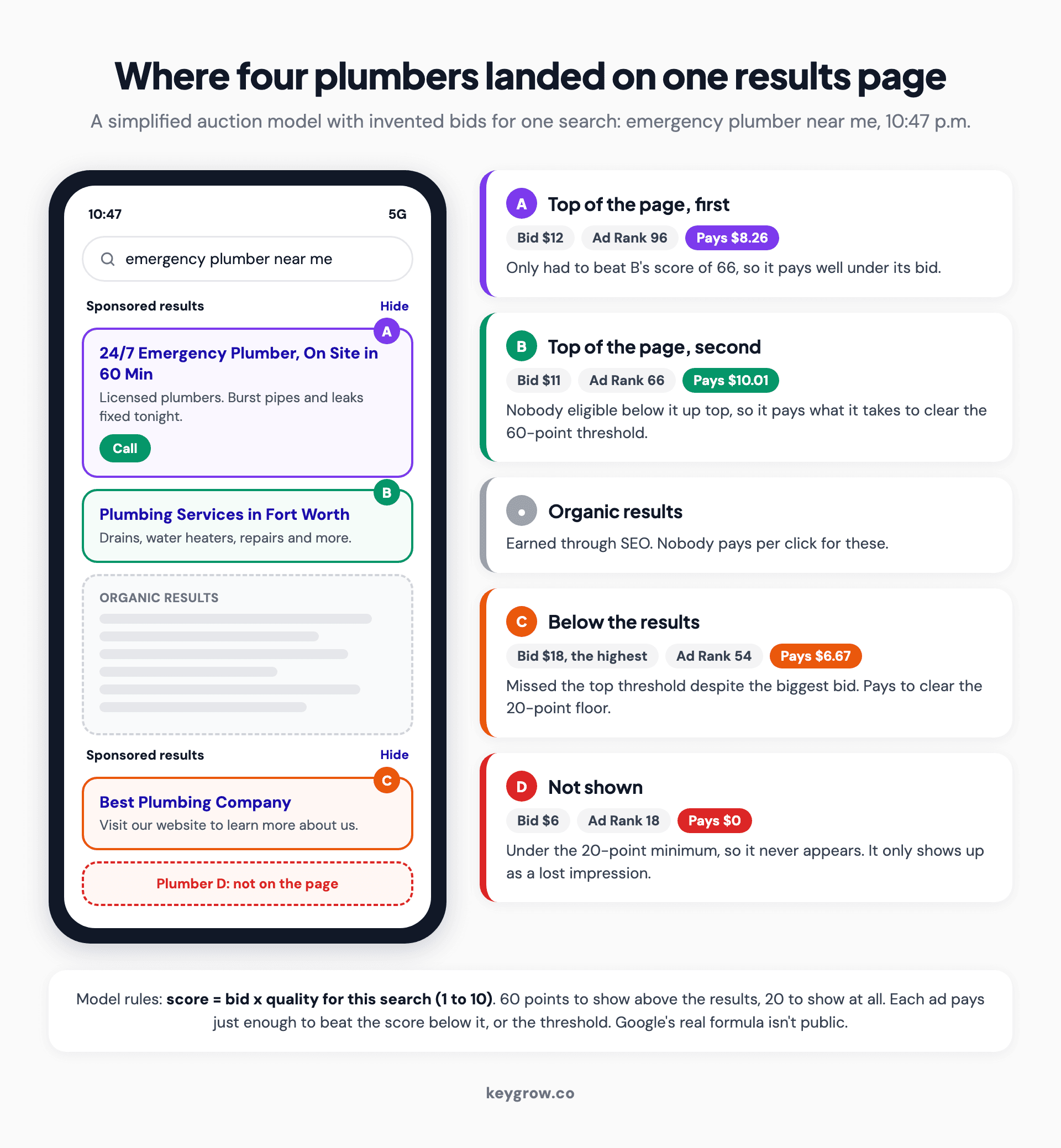
In this simplified model, the highest bidder lands below the organic results, and the best ad wins the top spot for less than it bid.
Google publishes no formula, so this is a teaching model: the classic bid-times-quality cartoon, plus the thresholds Google describes. The 1 to 10 quality figure applies to this one search and isn't the Quality Score in your account. Showing above the results takes 60 points, and showing at all takes 20. Each winner pays the smallest amount, to the cent, that beats the score below it, or the threshold if nobody is there.
| Plumber | Max bid | Quality for this search | Ad Rank | Where it shows | Pays per click |
|---|---|---|---|---|---|
| A: "24/7, on site in 60 minutes," call button, fast page | $12 | 8 | 96 | Top, first | $8.26 |
| B: decent ad, general services page | $11 | 6 | 66 | Top, second | $10.01 |
| C: generic ad, homepage | $18 | 3 | 54 | Below the organic results | $6.67 |
| D: generic ad, slow page | $6 | 3 | 18 | Not shown | $0 |
C bid the most and still missed the top of the page, because 54 points didn't clear 60. Its ad sits below the organic results, where by Google's own account ads usually get fewer clicks. A paid $8.26 on a $12 bid because it only had to beat B. B paid the most of anyone: with a middling ad, clearing the bar took $10.01. D never showed. Its only trace is a lost impression in a report its owner may never open.
Annotated mockup of a phone results page for the search emergency plumber near me, showing Plumber A and Plumber B as sponsored ads at the top with their Ad Rank and price per click, organic results in the middle, Plumber C as a sponsored ad below the results, and Plumber D missing because its Ad Rank fell under the minimum.
On Dana's screen, A's call button lets her dial straight from the results. Real auctions add more than this model: a wide lead over the next ad can cost extra, and the same search on a laptop at noon would produce different numbers.
Who sets the bid now: you or Google?
With Smart Bidding, Google sets a fresh bid for every auction from signals like device, location and time. You set the goal and budget.
The example assumed hand-set bids. Manual bidding still exists, but Google pushes Smart Bidding. Its four strategies (Maximize conversions, Maximize conversion value, Target CPA and Target ROAS) each set a bid at auction time from the device, location, hour and exact words searched. It learns from the conversions you track. Count the wrong thing and it gets very good at buying the wrong thing.
The campaign type decides which auctions you enter in the first place:
| Campaign type | Where the ads show | What decides who sees them |
|---|---|---|
| Search | Google search results | Keywords, plus AI Max features if you turn them on |
| Performance Max | Every Google channel, from one campaign | Conversion goals, assets and audience signals |
| Shopping | Search results and the Shopping tab | Your Merchant Center product feed |
| Demand Gen | YouTube, Discover, Gmail and the Display Network | Audiences and creative |
| Display | Websites and apps on the Display Network | Audiences and placements, now moving into Demand Gen |
| Video | YouTube and video partner sites | Audiences and the content being watched |
AI Max for Search isn't its own campaign type. It's a set of features inside a Search campaign that widen matching, tailor the ad text and let Google pick the landing page. For most local businesses the first campaign should be plain Search. Our guide to using Google Ads for a small business covers that setup, and why Google Ads is so complicated sorts out what you can ignore.
The click is where you start paying
A click is what you pay for. Whether Dana's click was worth $8.26 depends on what happens next, on a page Google doesn't control.

Two people pointing at a laptop screen while reviewing a landing page, the part of a Google Ads campaign that decides whether a paid click turns into a customer.
If she lands on a page with the phone number at the top, she calls, and $8.26 was a bargain. If she lands on a homepage with a slider and six menu items, she hits back and taps B. A still paid.
We've seen this with real money. An eviction law firm came to us already running ads to a landing page, getting 1 conversion a week from 22 clicks at $240 per conversion. Visitors didn't know what to do next, so they left. We rebuilt the page around one clear action, restructured the campaigns and tested side campaigns on small slices of budget. Within a week the firm had 21 conversions from 189 clicks, at $31.79 each (September to October 2022).
Google got paid for the clicks either way. Whether the firm got anything back depended on the page.
How does Google Ads charge you?
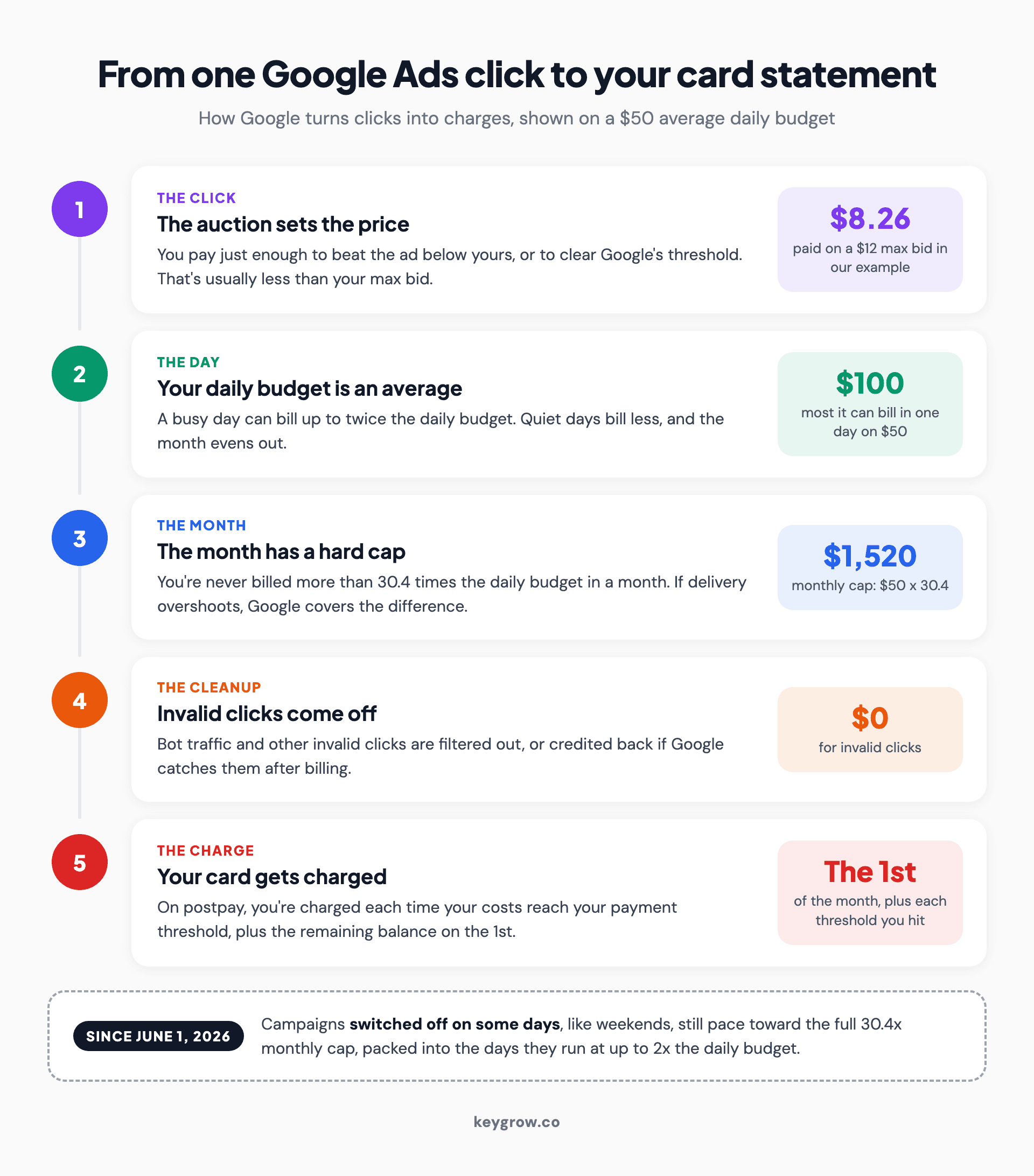
You pay per click, and your daily budget is an average. A busy day can bill double it, while a month caps at 30.4 times.
Process flow of how one Google Ads click becomes a charge: the auction sets the price per click, the daily budget is an average that can bill up to two times on a busy day, the month is capped at 30.4 times the daily budget, invalid clicks are filtered or credited, and the card is charged at each payment threshold and on the first of the month.
Say Plumber A sets $50 a day. The Saturday after a hard freeze, Google can spend up to $100. Quiet days offset the busy ones, and across the month it can't bill more than $1,520, which is $50 times 30.4. Google's spending limits page spells it out, despite plenty of guides claiming you can't spend past your daily budget. If delivery ever overshoots the limits, Google absorbs the difference.
Since June 1, 2026, a campaign switched off on some days, say weekends, still paces toward that full monthly limit by packing the spend into the days it runs. Weekday-only advertisers should recheck their daily budget.
Then the card. On postpay, Google's automatic payment setting, you're charged each time your costs reach your payment threshold and again on the 1st of the month for the rest. The threshold can climb as you keep hitting it, say from $50 to $200 or more. Invalid clicks, like bot traffic, get filtered out or credited back. If you plan in monthly numbers, divide by 30.4, or let our Google Ads budget calculator work backward from a revenue goal.
FAQs
How much does Google Ads cost per click?
There's no price list. Each click costs what the auction requires to beat the ad ranked below yours, or to clear Google's threshold if nobody is below you. With manual bidding you won't pay more than your maximum bid, apart from any bid adjustments you set.
Do you pay for Google Ads if nobody clicks?
Not on a standard Search campaign, where you pay per click and an ad that's only seen costs nothing. Some Display and Video campaigns charge per thousand impressions or per view instead, depending on the bid strategy.
Does the highest bidder always get the top spot?
No. Ad Rank weighs your bid alongside ad and landing page quality, the search context, the competition, Google's thresholds and the expected impact of your assets. Google's own help pages say a more relevant ad can win a higher position, at a lower price, than a competitor bidding more.
Can Google Ads show up in AI Overviews?
Yes. Ads can appear above or below AI Overviews, and in the US they can also appear inside them, matched to the overview's content as well as the search. Google says inside placements need broad match or keywordless targeting such as AI Max or Performance Max.
Read the auction from your own account
Every step of Dana's search leaves a trace in your account, if you know where to look.
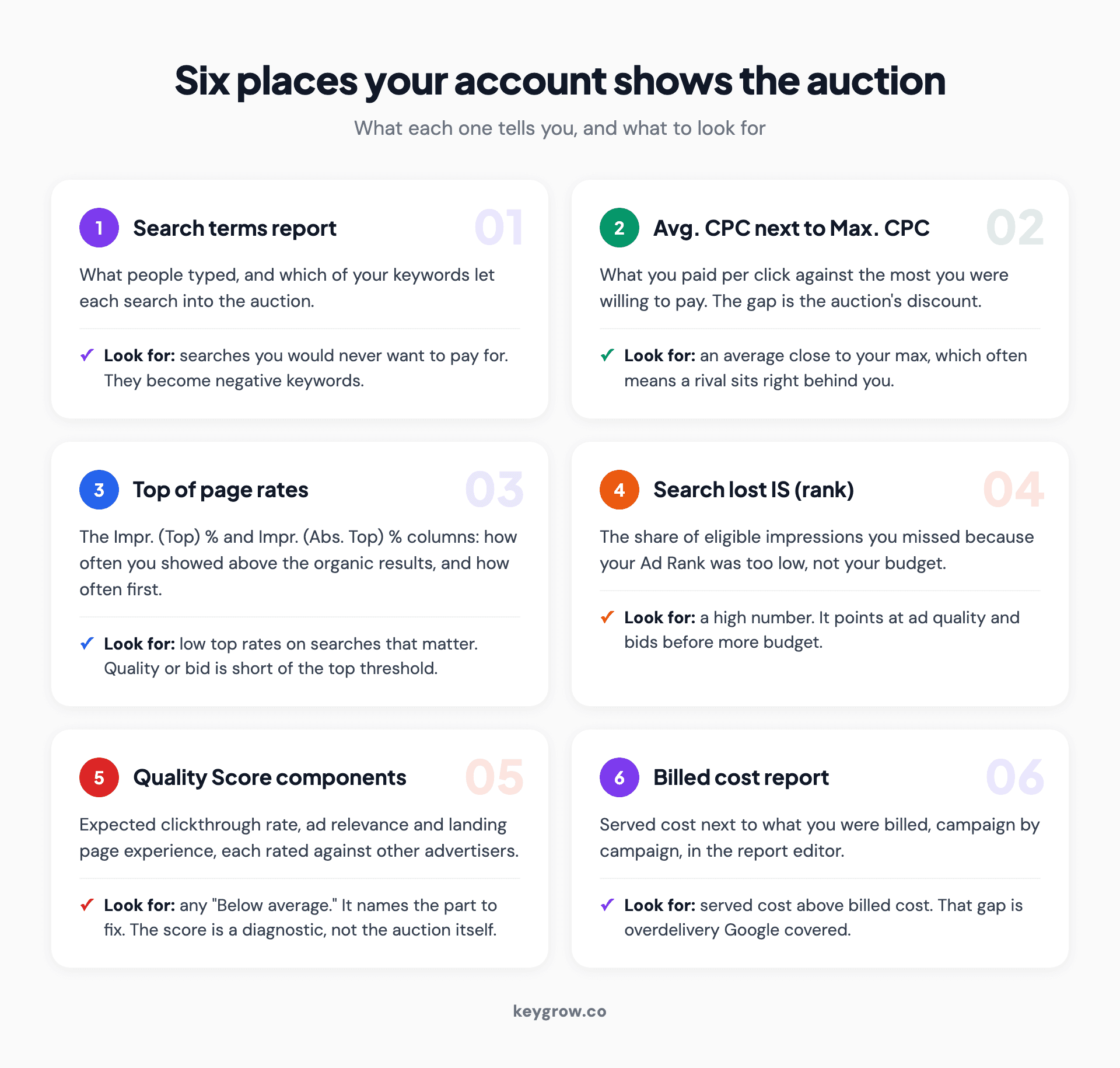
Checklist of six places in a Google Ads account that show the auction from the inside: the search terms report, average CPC next to your max bid, top and absolute top impression rates, search lost impression share due to rank, the Quality Score components, and the billed cost report.
Start with the search terms report, which shows what people typed rather than what you meant. Then put your average CPC beside your max bid, if you set one. The gap is the auction's discount. Search lost impression share due to rank tells you how often you were Plumber D.
If you run one service in one town and can spare an hour a week for those columns, you don't need an agency. When the account outgrows that, or the hour keeps not happening, our PPC management team reads them with clients weekly, month-to-month.