

A personal injury click in a major metro can cost more than $100. The average across all industries sits at $5.42 per click, with the average cost per lead at $66.69, per LocaliQ's 2026 benchmarks. So if you've opened your billing page and wondered why Google Ads is so expensive, you're not imagining it.
Google Ads is expensive for three reasons stacked on top of each other: an auction where your competitors set the price, years of rising advertiser demand chasing the same buyers, and Google's own pricing adjustments, which came out in federal court. A fourth reason gets less airtime because it's uncomfortable: a lot of the cost is self-inflicted. Most accounts we audit are quietly overpaying for their own settings.
This post walks through all four, with the actual math. By the end you'll know what a click should cost you, why yours costs more, and which part of the bill you can actually do something about.
The auction decides your price, not a rate card
There is no price list for Google Ads. Every time someone searches, Google runs an instant auction among the advertisers bidding on that query, and your price is set by the advertiser below you, not by your own bid.
Two numbers decide everything. Your Ad Rank is roughly your bid multiplied by your Quality Score, Google's 1-10 rating of how relevant your ad and landing page are to the search. Your actual cost per click is the Ad Rank of the advertiser just below you, divided by your Quality Score, plus one cent. That's the simplified model Google itself used for years to teach the auction, via its chief economist's well-known explainer. Today's auction adds more variables, but the divide-by-quality mechanics still hold, and almost nobody writing about ad costs ever works them through.
Run the numbers for three advertisers fighting for the same click:
| Advertiser | Max bid | Quality Score | Ad Rank | Position | Actual CPC |
|---|---|---|---|---|---|
| A | $4.00 | 8 | 32 | 1st | $3.01 |
| B | $6.00 | 4 | 24 | 2nd | $4.01 |
| C | $8.00 | 2 | 16 | 3rd | close to max bid |
Look at advertiser B. They bid 50 percent more than A and still sit below them, paying a dollar more per click. That's the whole game in one table. The advertiser with a Quality Score of 8 pays $3.01 for the top spot while the advertiser with a 4 pays $4.01 to sit underneath them.
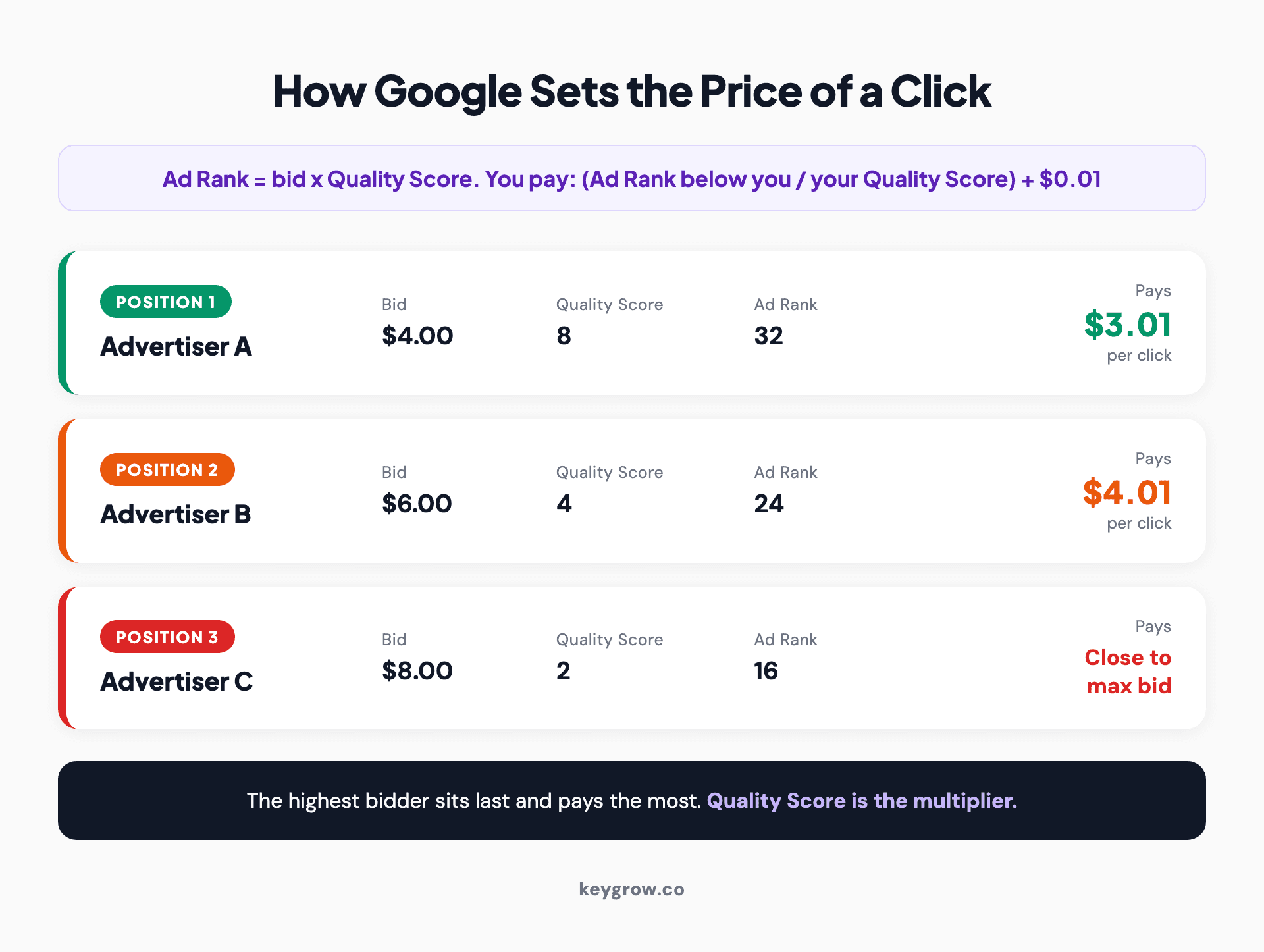
Worked three-advertiser Google Ads auction showing how bid times Quality Score sets Ad Rank and why the highest bidder can pay the most for the lowest position.
So when people ask why Google Ads is so expensive, the first honest answer is: because your competitors are willing to pay that much, and possibly because your Quality Score is making you subsidize theirs.
The forces that pushed prices up for everyone
Even a well-run account pays more today than the same account would have paid a decade ago. Four forces did that.
More advertisers chasing the same searches. Every year more businesses move budget into search, and the number of commercially valuable searches doesn't grow to match. More bidders in the same auction means higher clearing prices. This is the boring, structural answer, and it's the biggest single factor.
Customer economics set the ceiling. A keyword's price climbs toward the value of the customer behind it. An attorney whose average case is worth $8,000 can rationally pay $150 per click. A pizza shop cannot. That's why legal runs $9.87 average CPC, home services $8.33, and dental $8.00 in LocaliQ's benchmarks, while retail sits far lower. High CPCs in your industry usually mean the customers are worth real money. You're not being punished, you're in a valuable market.
Privacy changes made targeting blunter. Tracking restrictions took away signal. Advertisers respond by bidding on broader intent and letting automated bidding sort it out, which pushes more budget into the same auctions and raises the floor.
Automation optimizes for spend as much as performance. Smart Bidding, broad match defaults, and Performance Max are genuinely useful tools, and they are also very good at finding ways to spend your budget. Left unattended, automation expands into queries you never intended to buy.
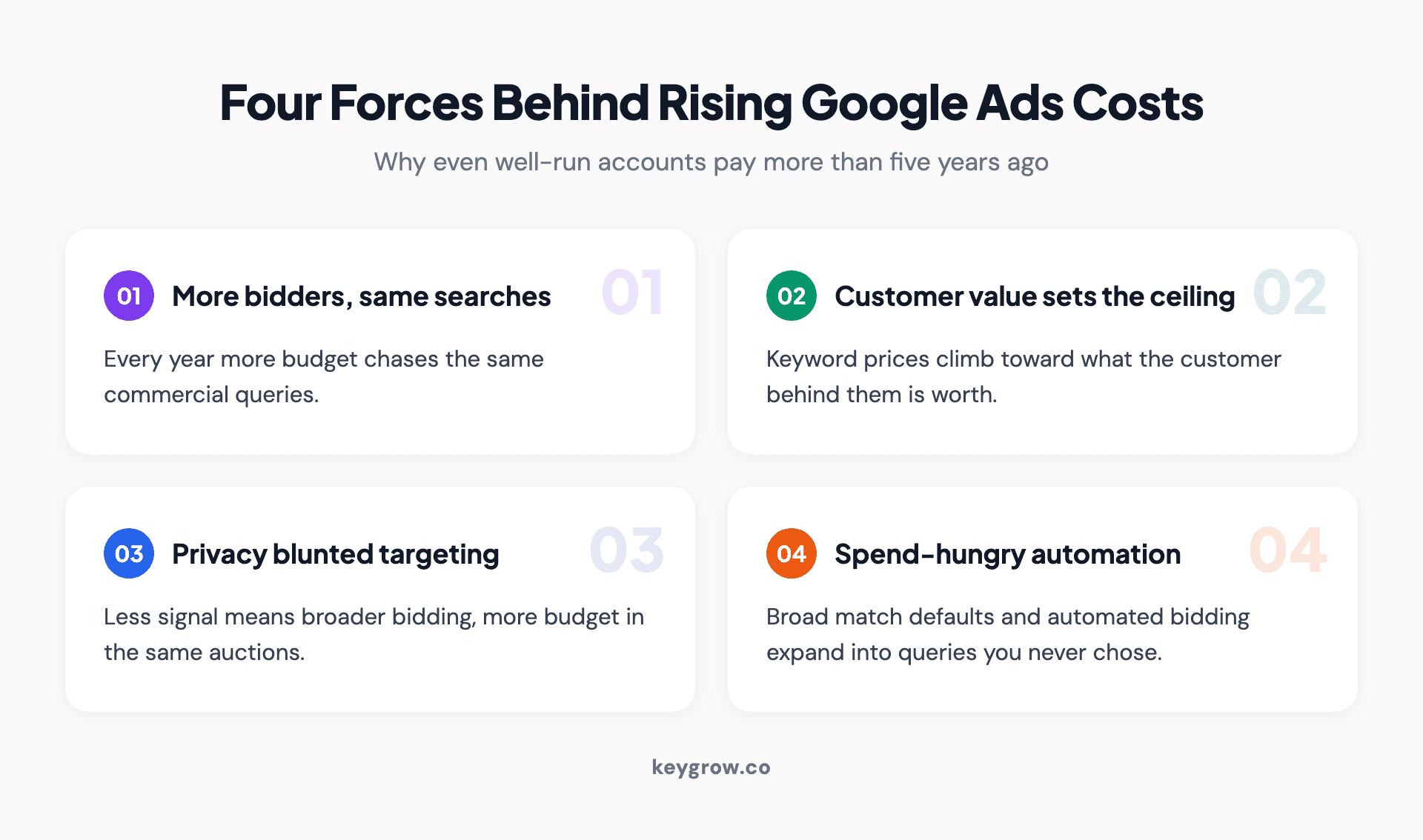
Four stacked forces that raised Google Ads costs for every advertiser: more bidders, customer value ceilings, privacy-blunted targeting, and spend-hungry automation.
The part nobody's ranking pages mention: Google turned the dials
Here's something you won't find in most posts on this topic. During the Department of Justice antitrust trial, internal documents and testimony showed that Google made deliberate auction adjustments that raised advertiser prices, without announcing them.
The trial evidence, summarized by Search Engine Land, included a few specifics worth knowing. Google's own ads executive described internal "tunings" that could raise prices 5 to 15 percent, invisible to advertisers. A 2017 project artificially inflated the runner-up's bid, which by the auction math above directly raises what the winner pays, producing a 15 percent price increase for winning advertisers. A 2019 change to how ties are broken produced roughly a 10 percent revenue increase without any quality improvement behind it. And search ad CPCs more than doubled between 2013 and 2020.
None of this means the platform stopped working. It means the marketplace has one seller, and that seller has revenue targets. When your costs creep up quarter after quarter with no change in your account, part of that is competition, and part of it, on the record, has been Google adjusting the machine.
We tell clients this not to scare them off search ads but because pricing power is exactly why the fundamentals matter more now. In an auction where the house can nudge prices, Quality Score, tight targeting, and honest break-even math are the only levers you own.
Is it actually getting worse every year?
Costs climbed for years, but the newest data is more mixed than the complaints suggest. Cost per lead fell in 2026 for the first time in five years across LocaliQ's dataset.
There's a more interesting counterexample. A dataset tracking $214.27 million in contractor ad spend, published by Data-Driven Trades, found cost per unique lead went from $122.84 in 2023 to $129.22 in 2024 and back down to $118.84 in 2025, a 3 percent net decrease. Cost per conversion fell from $90.17 to $85.83 over the same window.
Two things can be true at once. Clicks cost more than they did five years ago, and well-managed accounts are holding their cost per customer flat or better, because conversion tracking, bidding, and landing pages improved faster than CPCs rose. The advertisers actually drowning are mostly the ones paying rising prices with a 2019 account setup.
Timing and geography quietly move your price
Two cost factors get almost no coverage because they don't fit a listicle: when you bid and where you bid.
Auction prices track demand hour by hour and season by season. Retail CPCs spike from November through December when every ecommerce budget floods the same auctions. Insurance keywords surge during enrollment windows. Home services climb with the weather, an HVAC click in a July heat wave costs more than the identical click in October, because five competitors just raised bids on "emergency AC repair." If your account bids the same amount at 2 PM on Black Friday as it does on a quiet Tuesday in February, you're overpaying in one of those auctions.
Geography works the same way. The same keyword clears at different prices in different cities, because the bidders differ. A dense metro with forty law firms bidding will always out-price a suburb with six. If you serve multiple areas, split them into their own campaigns and check the numbers separately. We regularly find accounts profitably buying leads in one city while quietly torching budget in the next one over, and the blended average hides it.
Neither of these is a reason to pause the channel. They're a reason to look at your costs with time and location breakdowns before concluding the platform got expensive. Sometimes it's not the year that got pricier, it's the hour.
The expensive part is usually your account, not the platform
Here's the reality most "why so expensive" articles skip because it's harder to hear: in the accounts we audit, the platform's prices are rarely the biggest problem. The account's own settings are.

Marketing team reviewing Google Ads campaign structure and search terms on a whiteboard during an account audit.
The usual leaks:
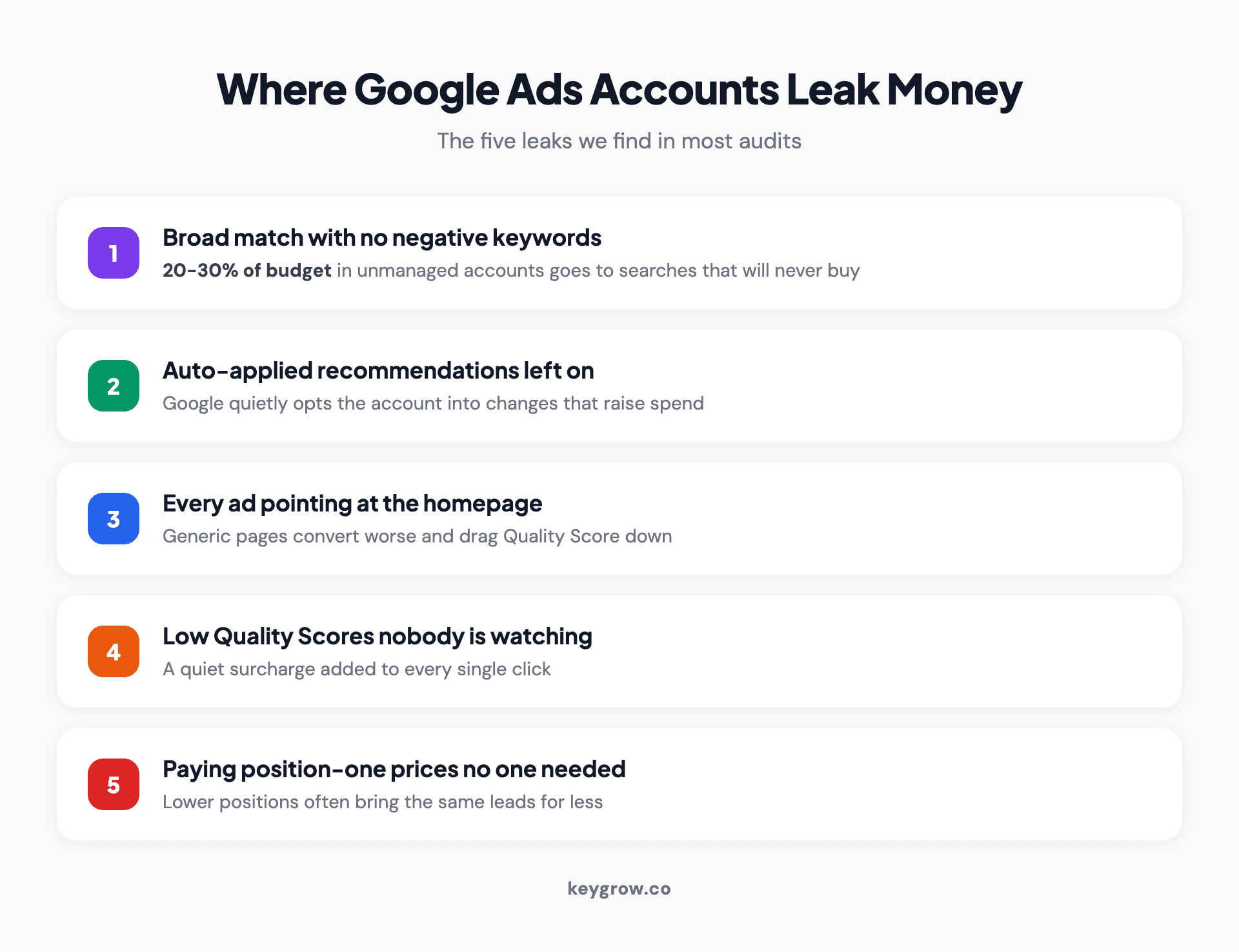
Checklist of the five places Google Ads accounts leak money: broad match with no negatives, auto-applied recommendations, homepage landing pages, ignored Quality Scores, and overbid positions.
A mobile detailing client came to us paying about $100 per booking, sending every click to their homepage. Same platform, same prices, same market. We restructured the campaigns and pointed traffic at a dedicated booking page. Cost per conversion fell to $22, bookings grew 650 percent, and monthly revenue went from $1.2K to $5.1K between August and December. Google didn't get cheaper. The account stopped leaking.
Quality Score is the discount lever you actually control
Quality Score isn't a vanity grade, it's a price multiplier. Divide by it in the CPC formula and the point is obvious: doubling your score roughly halves what you pay for the same position.
Three inputs drive it: expected clickthrough rate, ad relevance, and landing page experience. In practice that means tight ad groups where the keyword, the ad copy, and the page all say the same thing. A locksmith bidding on "car key replacement" should have an ad about car key replacement pointing at a page about car key replacement, not a general locksmith homepage. That's most of the work. We've written a full walkthrough on improving Quality Score if yours is sitting at 5 or below.
The reason to care is compounding: a better score lowers your CPC, which lowers your cost per lead, which means the same budget buys more customers, which gives the bidding algorithm more conversion data to work with. Cheap clicks feed the machine that finds you more cheap clicks.
What should a click cost you? Do the break-even math
"Expensive" is meaningless without a denominator. A $40 click can be a bargain and a $2 click can be a ripoff. The only question that matters is what a click is worth to your business, and you can work it out on the back of an envelope.
Max affordable CPC = customer value x lead-to-customer close rate x landing page conversion rate.

Calculator, banknotes, and printed charts on a desk, working out the break-even cost per click for an ad budget.
Worked through for three very different businesses:
| Business | Customer value | Close rate | Page conversion | Max affordable CPC |
|---|---|---|---|---|
| Junk removal | $350 job | 60% | 15% | $31.50 |
| Family law firm | $8,000 case | 25% | 10% | $200.00 |
| Pizza shop | $25 order | 90% | 20% | $4.50 |
This is why the lawyer shrugs at $100 clicks the pizza shop couldn't survive. It's also the fastest sanity check we know: if your market's going CPC is above your max affordable number, no optimization trick closes that gap. You either raise a variable (better close rate, better landing page, higher customer value) or you buy a different kind of traffic.
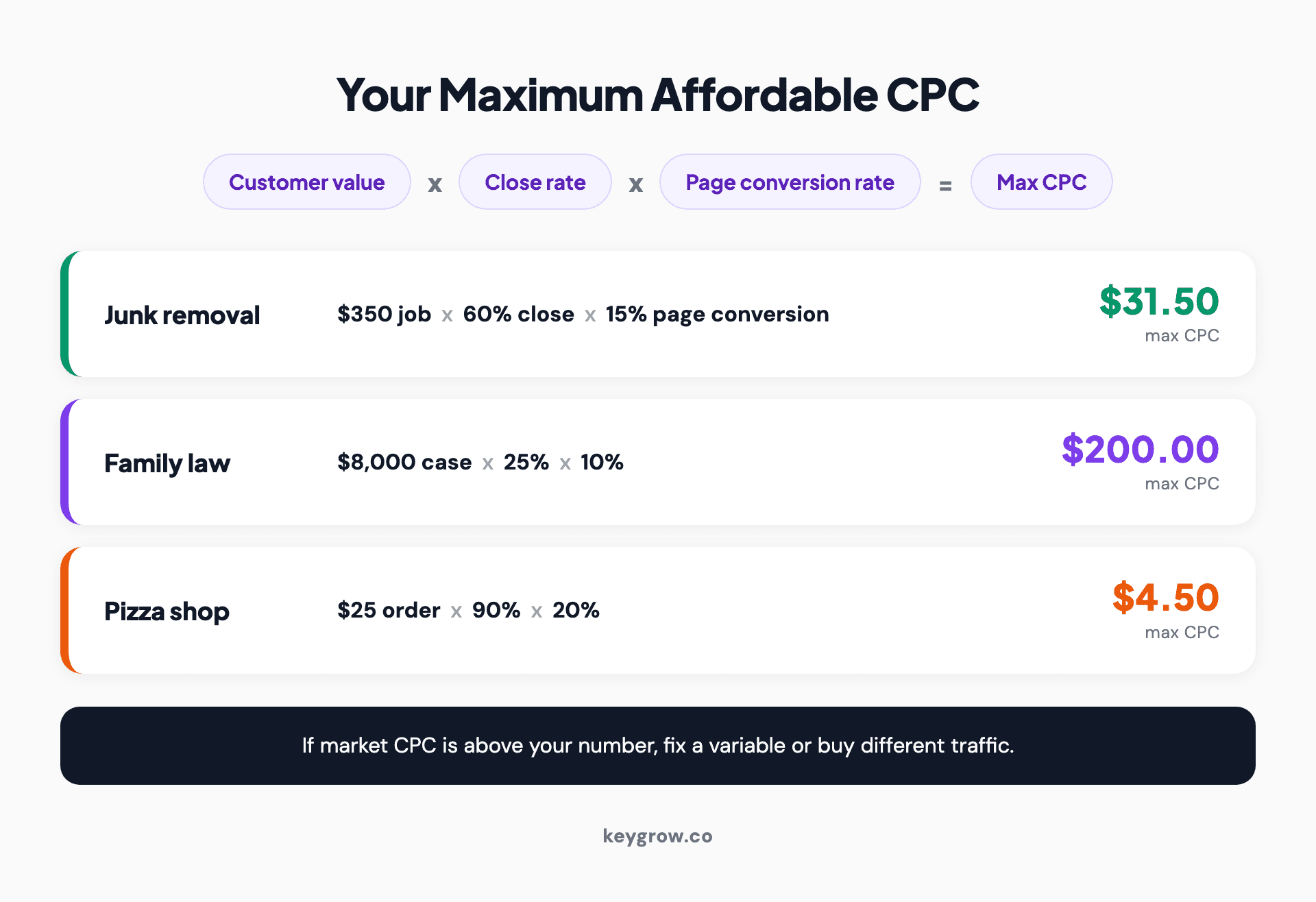
Break-even formula for Google Ads showing max affordable CPC as customer value times close rate times page conversion rate, worked for three example businesses.
Run your own numbers before you touch a bid. Everything else in this post is downstream of this arithmetic.
How to pay less without losing volume
Once the leaks are plugged and the math says the channel can work, lowering your real costs is a sequence, not a trick. In rough priority order:
1. Fix conversion tracking first. Every bidding decision downstream depends on it.
2. Mine the search terms report weekly and grow your negative list.
3. Rebuild ad groups tight enough that ad and keyword always match.
4. Point every ad at a purpose-built landing page, not the homepage.
5. Bid to conversions with a target, not to clicks or positions.
6. Test down from position one and watch cost per lead, not rank.
7. Prune non-converting keywords ruthlessly, even the ones with good CTR.
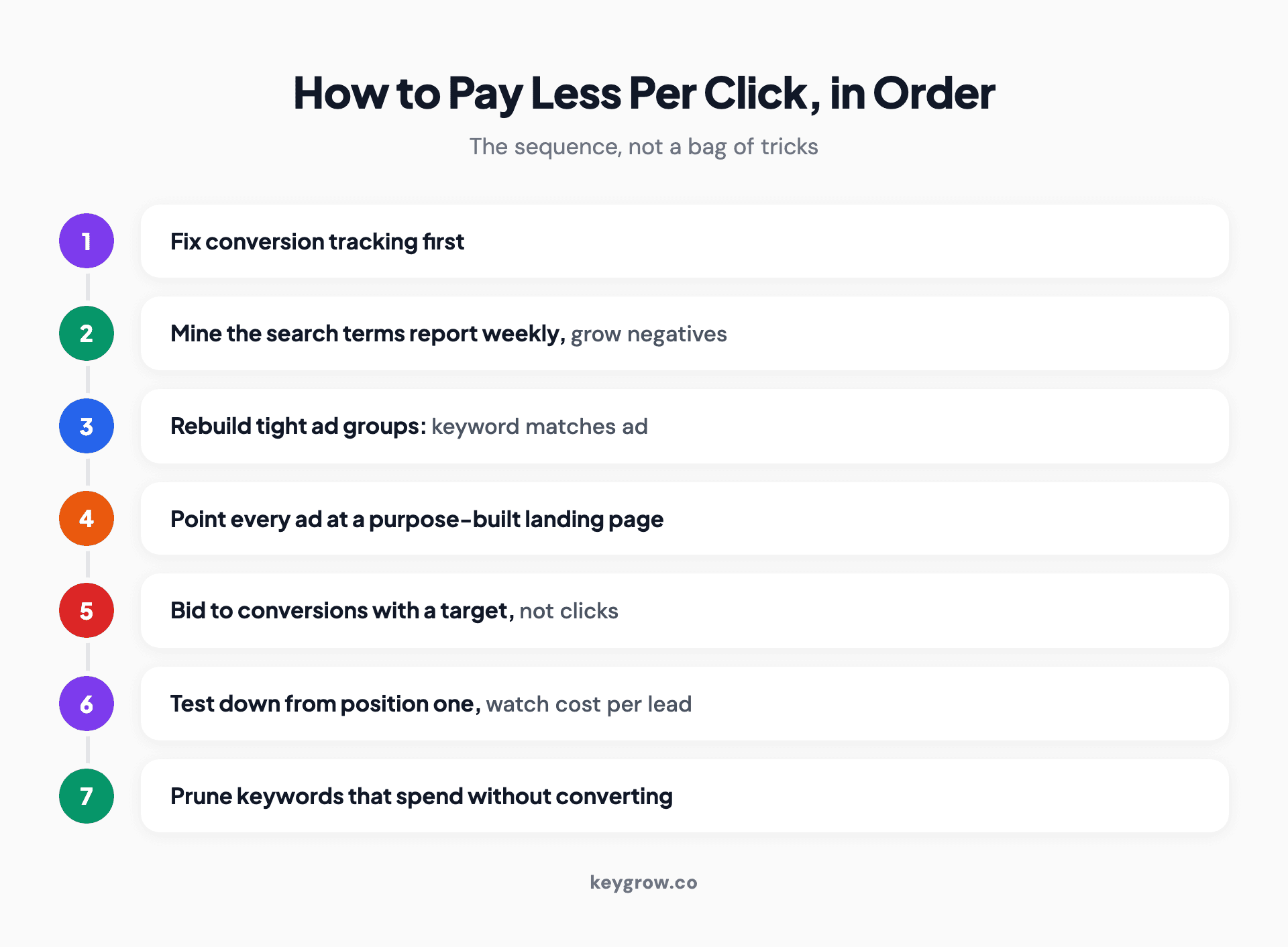
Seven-step sequence for lowering Google Ads costs without losing lead volume, from conversion tracking through keyword pruning.
We've covered the tactical detail in a separate guide to lowering cost per click, and the flip side, what unspent visibility costs you, in our post on PPC opportunity cost.
When Google Ads is honestly the wrong tool
Sometimes the answer to "why is this so expensive" is "because it's not for you," and an agency that won't say so is selling, not consulting.
Skip Google Ads, at least for now, if your margins can't clear the break-even math above even with a good account. Skip it if you can't answer the phone or respond to leads within a few hours, because paid leads decay fast. And skip it if your customer value is low and local: claim your Google Business Profile, collect reviews, and fix your website basics first. That work is free, and for a single-location business it often moves the needle more than the first thousand dollars of ad spend would.
One more escape valve for local service businesses: Local Services Ads price per lead instead of per click, which caps the downside of expensive auctions entirely. They have their own trade-offs, and we've broken down whether LSAs are worth it separately, but if your trade qualifies, they're often the cheaper first dollar into Google.
If the math works but the management overhead doesn't, that's the point where paying for PPC management beats DIY, and not before.
FAQs
Why did my Google Ads costs suddenly go up?
Sudden jumps usually come from a new competitor entering your auctions, a seasonal demand spike, or a change inside your account like a broadened keyword, an auto-applied recommendation, or a drop in Quality Score. Check the Auction Insights report and your change history for the two weeks before the jump. Structural platform-wide increases are gradual, so a sharp spike almost always has a findable local cause.
Does Quality Score directly set my cost per click?
Roughly, yes. In Google's simplified auction model, your actual CPC is the Ad Rank of the advertiser below you divided by your Quality Score, plus one cent, and today's auction keeps that divide-by-quality logic even with extra variables layered on. A higher score means you pay less for the same position, and a low score is a surcharge on every click. It is the one pricing input you fully control.
Is a high CPC always bad?
No. CPC is meaningless without your customer value behind it. A $150 click that closes into an $8,000 case is a great trade, and a $2 click that never converts is wasted money. Judge your account on cost per lead and cost per customer, never on click price alone.
What is an average cost per click for a small business?
Across all industries the 2026 average is $5.42 per click, with an average cost per lead of $66.69. Service industries run higher: legal averages $9.87, home services $8.33, and dental $8.00. Your specific keywords can sit well above or below your industry's average, so treat benchmarks as context, not targets.
Why are some keywords over $100 per click?
Because the customer behind them is worth thousands. Keywords like personal injury or emergency legal searches price toward the case value they represent, and advertisers with strong intake operations can profitably pay triple digits. The auction doesn't care what you can afford, it clears at what the most efficient bidder can afford.
Can I lower my costs without losing leads?
Usually, yes. In the accounts we audit, 20 to 30 percent of spend commonly goes to search terms that never produce leads, and cutting it via negatives and pruning is pure savings. Pair that with tighter ad groups and a dedicated landing page and cost per lead typically falls while lead volume holds or improves.
Is it cheaper to run Google Ads myself or hire an agency?
For small budgets and simple offers, running it yourself is genuinely cheaper if you'll put in a few hours a week learning the search terms report and the settings that leak money. An agency earns its fee when the waste it removes and the conversions it adds outweigh what it charges, which usually requires enough spend for those improvements to matter. Below roughly a thousand dollars a month in ad spend, management fees eat too much of the budget for most businesses.
How much does Google Ads cost per month?
There's no minimum spend for search campaigns, you set the budget. What matters is buying enough clicks to learn anything: at a $5 average CPC, a $500 monthly budget is about 100 clicks, which is enough to test one or two keywords properly. Budget backwards from your break-even math and your target number of leads rather than picking a round number.
Where this leaves you
Google Ads is expensive because the auction prices clicks at what your best-run competitor can afford, because demand kept rising for a decade, and because the house has, on the record, adjusted prices in its own favor. You can't change any of that.
What you can change is everything on your side of the auction: the score that sets your multiplier, the settings that leak budget, the page that turns clicks into customers, and the math that tells you what a click is worth. In our experience that side of the ledger is where most of the "expensive" actually lives.
If you'd rather have someone find the leaks for you, our team does exactly that. Get in touch and we'll tell you honestly whether your costs are a market problem or an account problem.


