


Do you need your own site if your brokerage already gives you one? Not on day one. The profile page on your firm's site will carry a new agent through the first few deals. Once past clients start passing your name to friends, though, a real estate agent website of your own does something that profile page can't. It gives the person holding your name a reason to call you instead of the next agent they look up.
A real estate agent website is a site you control, on your own domain, that shows who you are, where you work, what you have closed and how to reach you. Listings can live on it. They are not the point of it.
What is a real estate agent website actually for?
Mostly for people who already have your name. Most buyers and sellers pick an agent through a referral or a past deal, then look that agent up before they call.
The split is lopsided. In a Virginia REALTORS summary of NAR's 2025 Profile of Home Buyers and Sellers, 43 percent of buyers used an agent they found through a referral, and another 18 percent used an agent they had worked with before. Among sellers, 66 percent found their agent through a referral or a past relationship.
So about six in ten buyers arrive already knowing who you are. They are not browsing homes on your site. They want to know whether the person their coworker mentioned is any good.
That is why we think the platform debate gets too much airtime. When 61 percent of buyers come in through a name, the site that answers "should I call this person?" beats the one with the slicker search bar. A plain site with a real bio, closed deals and reviews will out-earn an expensive one built around a listings feed nobody uses.
The requirements checklist
Seven things go on the site at launch. Three more get added as you close deals, and two can wait. Here is the list in the order we would build it.
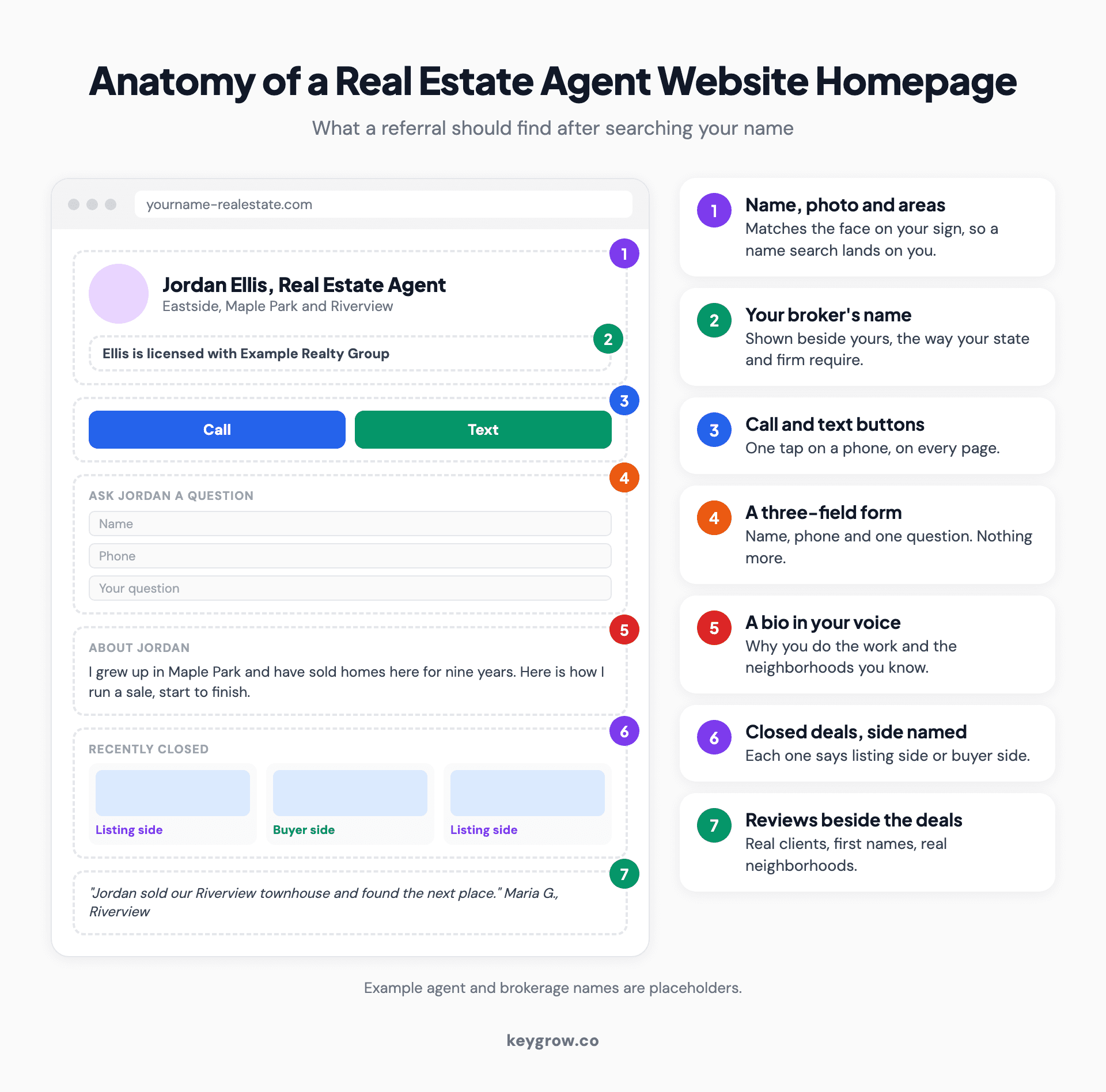
Annotated mockup of a real estate agent website homepage. Callouts mark the agent's name, photo and service areas in the header, the broker's name shown next to them, tap to call and text buttons, a three-field contact form, a short bio teaser, three closed-deal cards labeled with the side the agent worked, and client reviews placed beside the deals they mention.
Launch with these:
- Your name, photo and areas at the top of every page, so a name search lands on something that matches the face on your sign.
- Your broker's name and your license details, placed where your state and your firm require them.
- Tap to call, a text link and a short form (name, phone, one question) on every page. Most visitors are on a phone.
- An about page in your own words: why you do the work, which neighborhoods you know, and how you run a deal from first call to closing.
- A buyer page and a seller page that explain what working with you looks like.
- Reviews from real clients, with a first name and the area where you can.
- Fast pages on mobile data. If the homepage drags, fix that before you add anything.
Add as deals close:
- Closed-deal pages, one per home, each saying whether you represented the buyer or the seller.
- Area pages for the neighborhoods you actually sell in, with facts a buyer can use, like schools, commutes and what sold recently.
- Listings, either a simple page per active listing or an IDX search feed.
Add later, or skip:
- A home value request form, once you want seller leads from strangers as well as referrals.
- A blog or market update, only if you will keep it current every month.
Which rules limit what you can publish?
Your site is advertising, so the rules for a yard sign apply to it too. If you are a REALTOR, the NAR Code of Ethics covers websites directly, and your state commission and MLS add their own rules.
Six Standards of Practice in the NAR Code of Ethics touch an agent site:
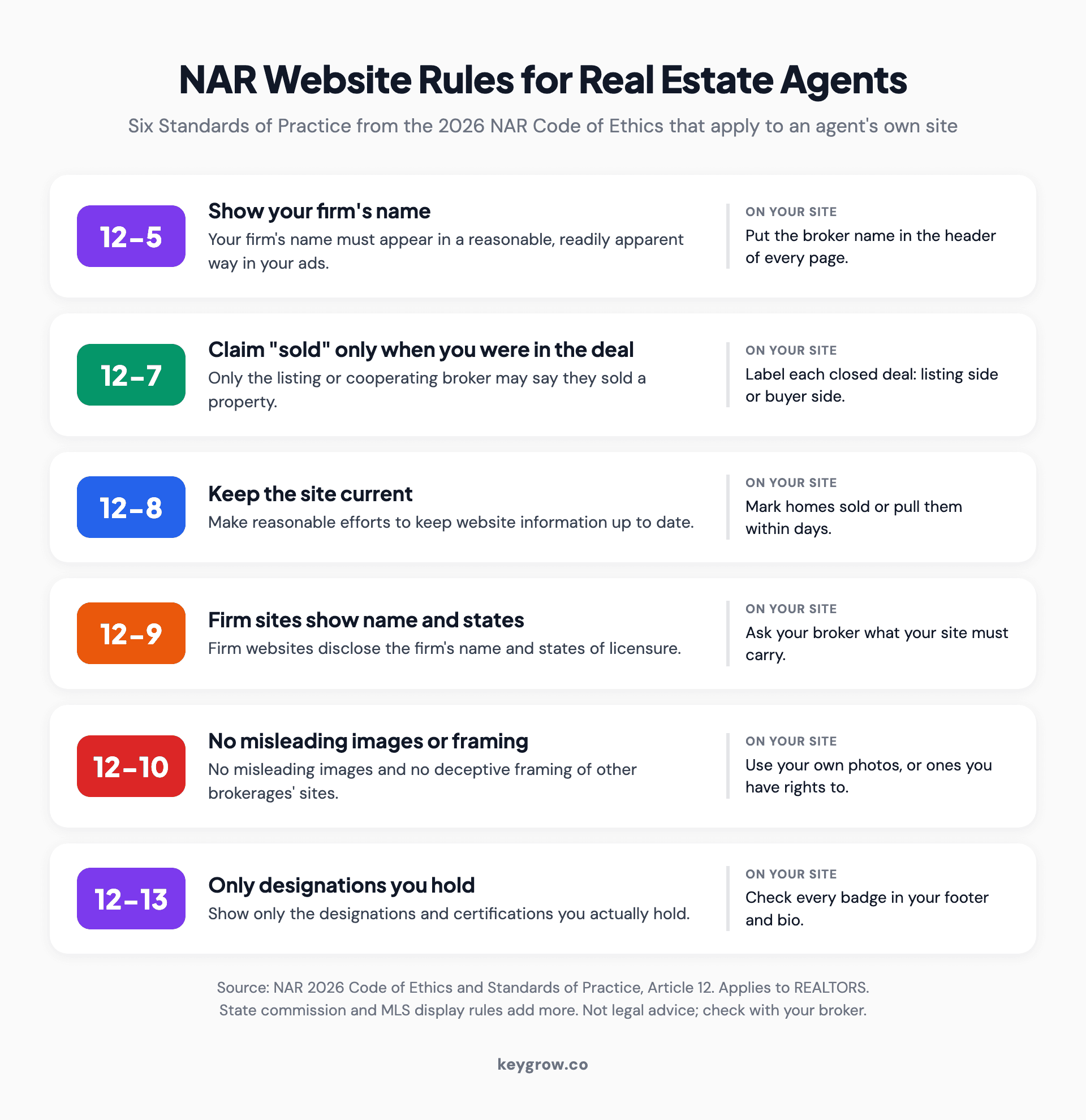
Numbered list of six NAR Code of Ethics Standards of Practice that shape a real estate agent website: 12-5 show your firm's name, 12-7 only claim sold if you were the listing or cooperating broker, 12-8 keep the site current, 12-9 firm sites show the firm name and states of licensure, 12-10 no misleading images or framing, and 12-13 show only designations you hold.
- 12-5 says your firm's name has to appear in a reasonable and readily apparent way in your advertising.
- 12-7 lets only the listing or cooperating broker in a deal claim to have sold the property. That is why each closed-deal page should name your side.
- 12-8 asks for reasonable efforts to keep the site's information current. A home that sold eight months ago and still shows as active breaks it.
- 12-9 requires firm websites to show the firm's name and the states where it is licensed.
- 12-10 rules out misleading images and deceptive framing of another brokerage's site.
- 12-13 limits you to designations and certifications you actually hold.
Two more layers sit on top. Many state commissions set how a broker's name must appear in agent ads, and some regulate its size against your own name and phone number. Your MLS also has rules for showing listings through IDX. We are not lawyers and this is not legal advice, so send your broker's compliance contact the draft before launch. After launch, keeping it current is ordinary upkeep, and our website maintenance checklist covers the monthly routine.
Four ways to build one, compared
You can stay on the brokerage page, build it yourself on a general website builder, rent a real estate website platform, or pay a developer for a site you own. A fully custom build is a fifth option, mostly for teams.

A man and a woman sitting at a table with a laptop and papers, talking through a plan.
The price ranges below come from one 2026 cost breakdown of agent website options. Treat them as market ranges, not quotes.
| Option | Upfront | Monthly | Listings search | If you change firms | Best fit |
|---|---|---|---|---|---|
| Brokerage profile page | $0 | Usually $0 | The firm's own | Usually comes down | New agents with no closed deals yet |
| General website builder (DIY) | $0 | $16 to $65 | Not built in | Stays up | Agents with few listings and time to write |
| Real estate website platform | $0 to $750 setup | $79 to $1,500+ | Included | Stays while you keep paying | Agents who want listings search and a CRM on one bill |
| WordPress, developer-built | $2,500 to $8,000 plus a theme | $10 to $30 hosting, $39 to $150 for IDX | Plugin | Stays, and you own the files | Agents with deals to show who want the site to outlast any one firm |
| Custom build | $20,000 to $45,000+ | $50 to $200 | Built to spec | Stays | Teams and brokerages with unusual needs |
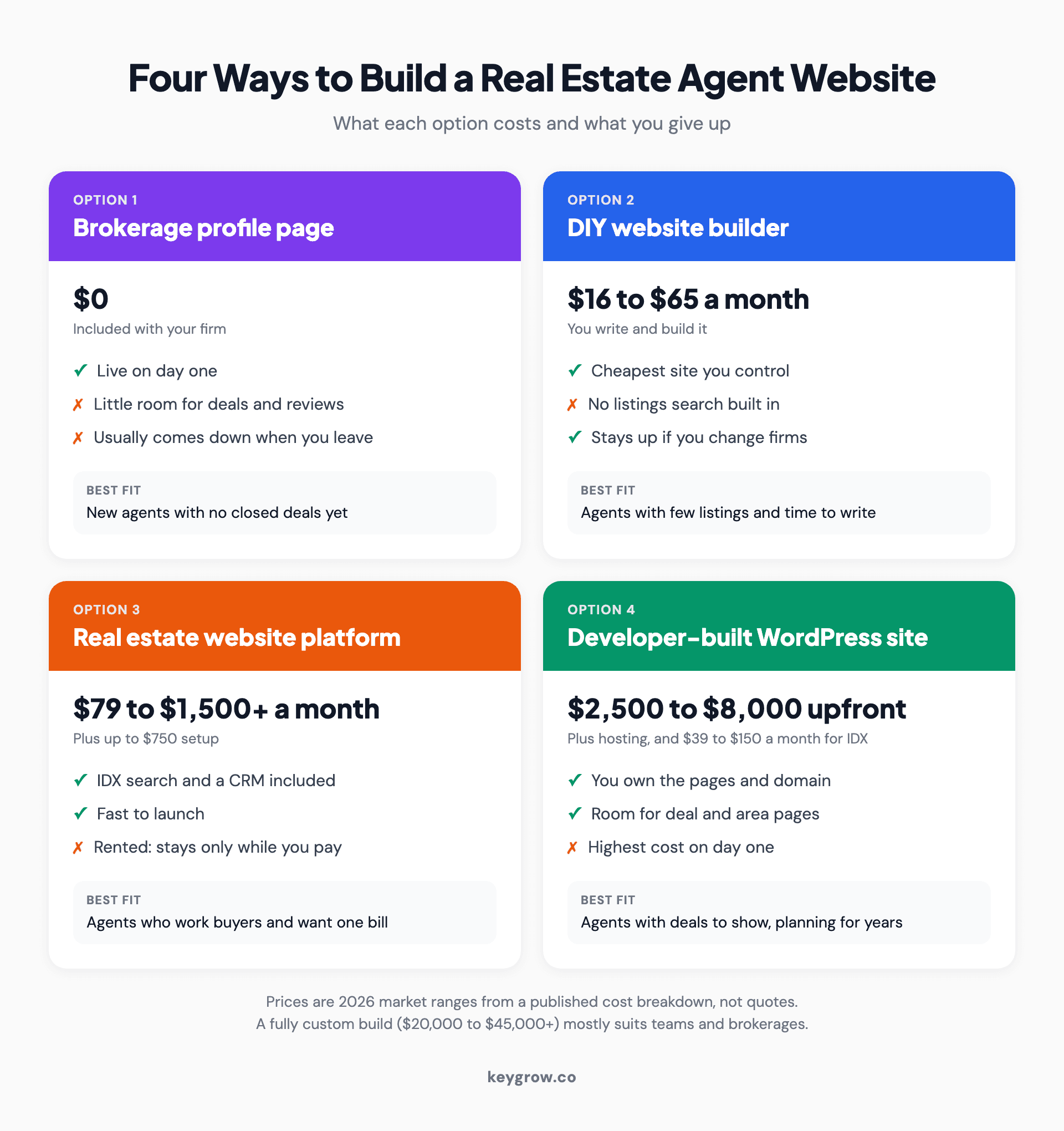
Four cards comparing ways to build a real estate agent website: a brokerage profile page that is free but usually disappears when you leave, a DIY website builder at 16 to 65 dollars a month with no listings search, a real estate website platform at 79 to 1,500 dollars a month that includes IDX and a CRM, and a developer-built WordPress site at 2,500 to 8,000 dollars upfront that you own.
Ownership is the trade-off that matters most. A platform is the fastest route to listings search and a lead inbox, and you rent both. A developer-built site costs more on day one, but the pages and the domain stay yours if you switch firms or drop a vendor.
If you would rather hand off the writing and the build, our real estate agent web design plans start at $1,400, one time, for up to six pages with the copy written for you. For how pricing works on small business sites in general, see our website cost breakdown.
What it costs over three years
Year one flatters the monthly options. By year three, a mid-tier platform has often cost more than a developer-built site with an IDX plugin.
This worked example uses the market ranges above. Assumptions: a domain at $12 to $20 a year, a $69 theme and an IDX plugin on the WordPress build, and no price increases.
| Option | Year one | Three years |
|---|---|---|
| DIY builder, no IDX | $204 to $800 | $612 to $2,400 |
| Real estate platform | $948 to $18,750 | $2,844 to $54,750 |
| WordPress, developer-built, with IDX | $3,169 to $10,249 | $4,369 to $14,609 |
| Custom build | $20,600 to $47,400 | $21,800 to $52,200 |
Take one realistic pair. A platform at $299 a month comes to $10,764 over three years. A $5,000 developer-built site with a $69 theme, $20 a month hosting, a $79 a month IDX plugin and a $15 domain comes to $8,678 over the same stretch, and it is still yours in year four.
The cheap end of the platform range is the least expensive way to get listings search for a few years. Somewhere above $250 a month, a $5,000 site you own wins by year three.
Do you need IDX on your site?
Only if buyers are a big share of your business and you want them searching on your site. For a solo agent with a handful of listings, a page per listing does the job.
A buyer who wants to browse every home in town already has a listing portal app on their phone, and your search box will not beat it. IDX earns its keep when a buyer you already know stays on your site, saves searches and registers. That matters if you work buyers heavily.
The fee never stops. The same breakdown puts IDX plugins at $39 to $150 a month for as long as you use them, which is a lot to pay for a search box if you list three homes a year. Build good listing pages first and add IDX the year your buyer business justifies it.
How does an agent website get found?
By your name first, then by area. Name searches mostly take care of themselves once your name, photo and areas match everywhere. Area searches take pages and time.
Start with consistency. Your website, your Google Business Profile and your social profiles should show the same name, phone number and service areas. Our guide to Google Business Profile optimization covers the profile side. If people find you on Instagram, the steps in Instagram marketing for real estate agents point your bio link at the right page.

A two-story white house with a front porch and a brick chimney, set among tall trees with autumn leaves.
Area pages are slower and pay off for longer. We saw this with HomeLink Properties, a cash home buyer in southwest Missouri. We built city pages for the five towns they buy in, plus pages for real seller situations like inherited and storm-damaged homes. They reached 90+ monthly seller calls in 7 months. They buy houses rather than list them, but a seller typing "sell my house in Republic" behaves the same whoever answers.
Expect months before area pages bring calls. If you want that work run for you, our SEO for real estate agents builds and maintains the area pages and the profile that sits beside them.
When a brokerage page is enough
Plenty of agents should not build a site yet. With no closed deals, you have nothing to put on the pages that would make a stranger pick you, and the brokerage page does the basic job for free.
The same goes if you work on a team that hands you leads, or if you are not sure you will be in the business in two years. Spend the first year on what moves faster: a claimed Google Business Profile, a review request after every closing and a tidy sphere list. Our scorecard of real estate lead sources ranks those options by cost and speed.
Build your own site the year people start searching your name. You will notice, because they will tell you.
FAQs
Do real estate agents need their own website?
Not at the start. A brokerage profile page works for a new agent with few deals. Once referrals and past clients look you up by name, your own site gives them your story, closed deals and reviews, which a profile page has little room for.
What should a real estate agent website include?
At launch, your name, photo and areas, your broker's name and license details, tap to call and a short form, an about page, buyer and seller pages, real reviews and fast mobile pages. Add closed-deal pages, area pages and listings as deals close.
How much does a real estate agent website cost?
Market ranges in 2026 run from $16 a month for a DIY builder, to $79 to $1,500+ a month for a real estate platform, to $2,500 to $8,000 upfront for a developer-built site. Over three years, a developer-built site with IDX often costs less than a mid-tier platform.
Do I need IDX on my real estate website?
Not always. With a handful of listings a year, simple listing pages are enough. IDX makes sense when buyers are a large share of your business, since it runs $39 to $150 a month for as long as you keep it.
What happens to my website if I change brokerages?
A brokerage profile page usually comes down when you leave. A site on your own domain stays up. You update the broker name, logo and required notices, then connect the IDX feed from your new firm.
Can I build a real estate agent website myself?
Yes. A general website builder can get a simple site live in a weekend if you write the pages yourself. You give up built-in listings search, and you should check the result against your state's advertising rules and your broker's policy before launch.
Build the page your referrals land on
Picture the next person who gets your name from a past client. They search it tonight, on a phone, probably while doing something else. Give that person an about page that sounds like you and three closed deals with your side named. Put reviews that mention real neighborhoods next to them. Listings search, blogs and calculators can come later.
If you want a second opinion on the site you have now, tell us about your business and we will say honestly whether a new one is worth it yet.