
SEO for gyms is local SEO wearing a membership problem. The searches worth having are small, tightly geographic, and mostly settled inside the map pack before anyone scrolls. Your website's job is narrower than most gym marketing advice suggests: convince someone who has already found you to walk in for a trial.
That framing changes what you build. You do not need forty blog posts about ab exercises. You need one profile Google trusts, a short set of pages that answer what a local searcher actually asks, and enough reviews to survive the comparison that happens in the four seconds before someone taps a phone number.
Here is the part nobody plans for. Gyms lose about a third of their members every year, so organic search is not a growth channel you switch on once. It is the thing that quietly replaces the people who leave.

Modern gym interior with rows of treadmills and large windows.
Where gym searches actually get decided
Three surfaces decide a local gym search, and they behave differently. Knowing which one you are losing on tells you what to fix.
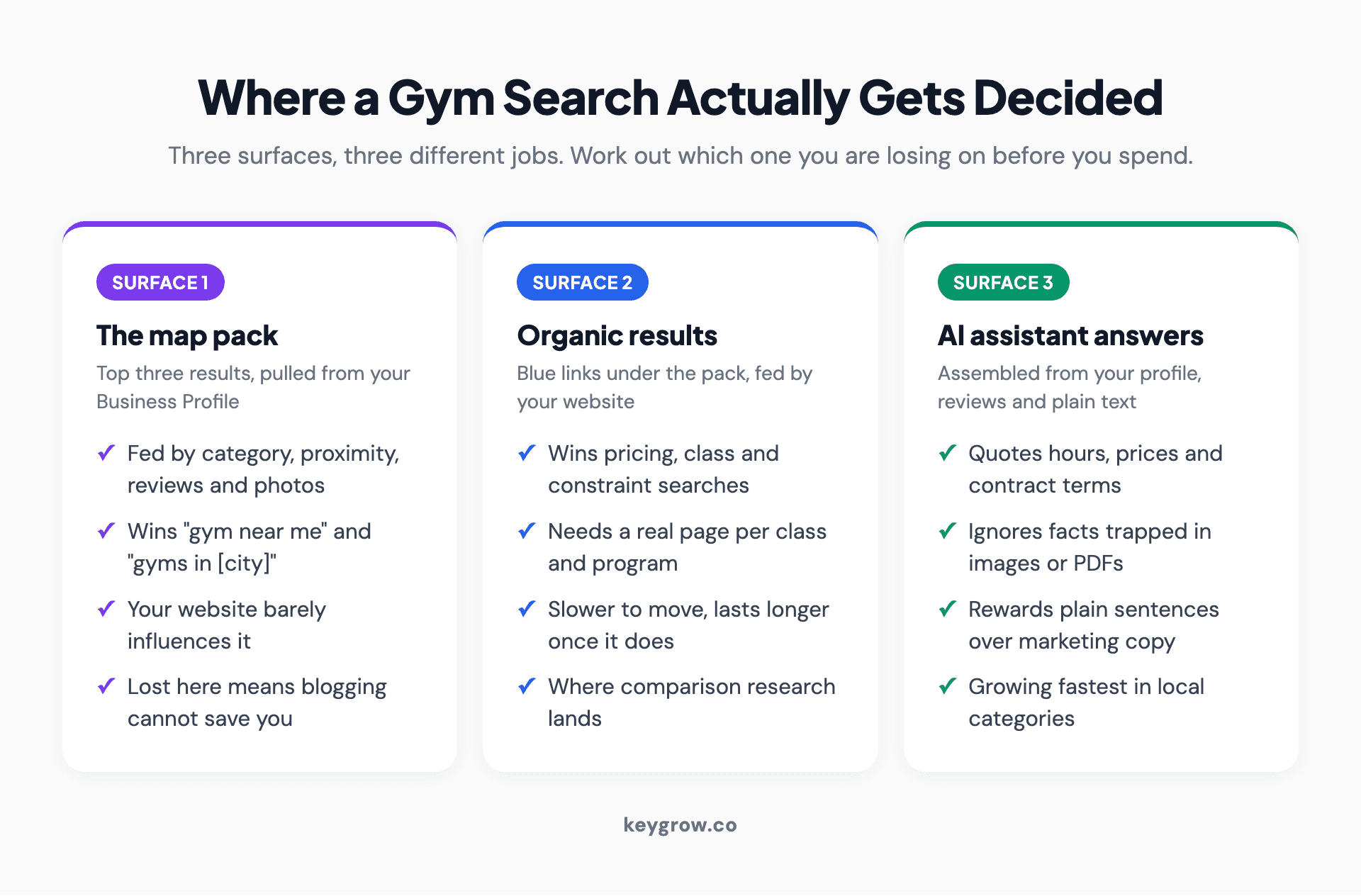
Three-column comparison of where gym searches get decided: the Google map pack, organic blue links, and AI assistant answers, with what each one rewards.
The map pack takes the top of the page for anything with local intent, which is nearly every gym query. It pulls from your Google Business Profile, not your website. Organic results sit underneath and are where comparison and research queries land: "gym with childcare", "24 hour gym vs boutique studio", pricing questions. AI assistants are the newest surface and increasingly the one people use to shortlist before they ever open a map.
If you are invisible in the map pack, no amount of blogging fixes it. If you are in the map pack but nobody clicks, the problem is your photos and your review count. Diagnose before you spend.
The diagnostic takes ten minutes. Search your three main terms from a phone, on mobile data rather than the gym's wifi, standing somewhere other than the building. If you do not appear in the three-result pack, that is a profile problem. If you appear but sit third with 11 reviews against two competitors on 300, that is a review problem. If you rank well and still get no calls, open your profile photos and look at them the way a stranger would.
Work out what a member is worth before you spend a dollar
A member's lifetime value sets your entire SEO budget, and most gym owners have never calculated it. The math takes five minutes.
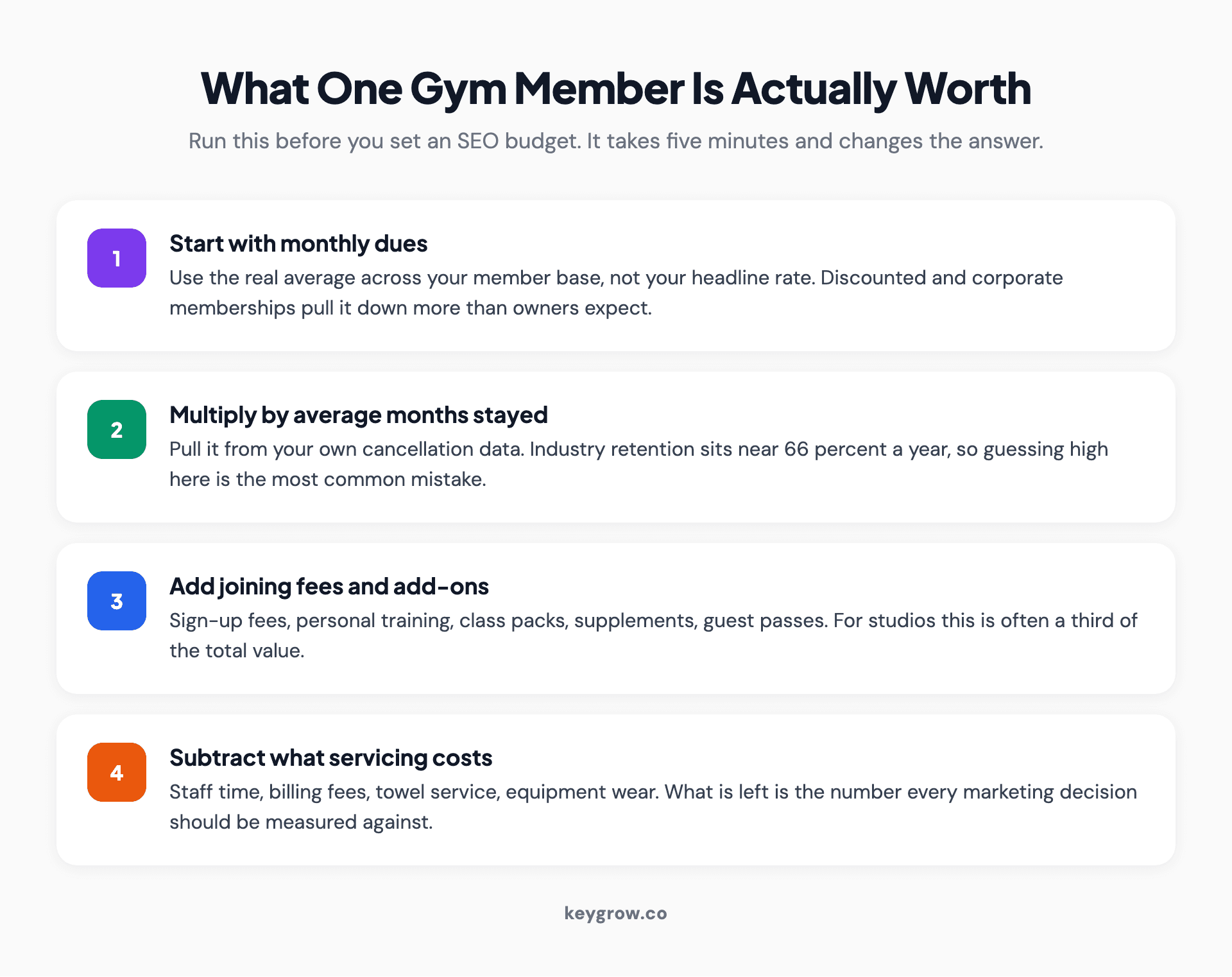
Four-step calculation of gym member lifetime value: monthly dues, average membership length in months, joining fees and add-ons, minus servicing cost.
Take your monthly dues, multiply by how long an average member stays, add joining fees and any add-ons like personal training or supplements, then subtract what it costs to service them. A $49 gym where people stay fourteen months is looking at roughly $686 of dues per member before add-ons. A $180 boutique studio where people stay nine months is at $1,620.
Those two businesses should not spend the same amount on search, and they should not chase the same keywords.
Membership length is the number people get wrong, usually because they guess high. Industry data is blunt about it. The HFA's benchmarking report, covering 175 companies and more than 17,000 facilities, puts average annual member retention at 66.4 percent. One in three members is gone inside a year. Use your own cancellation data if you have it, and the industry figure if you do not.
| Gym type | Monthly dues | Typical stay | Rough value per member |
|---|---|---|---|
| Budget / high volume | $15 to $30 | 10 to 16 months | $150 to $480 |
| Mid market full service | $40 to $70 | 12 to 18 months | $480 to $1,260 |
| Boutique studio or class pack | $120 to $200 | 7 to 12 months | $840 to $2,400 |
| Personal training led | $300 to $600 | 6 to 10 months | $1,800 to $6,000 |
Run your own numbers rather than borrowing this table. The point is the spread. A gym at the top of it can justify SEO, paid search and a full content program. A gym at the bottom needs volume, which means local SEO done cheaply and well, and not much else.
The four kinds of search that fill a gym
Gym keywords split into four buckets by how close the searcher is to signing. Most gyms optimize for the wrong two.
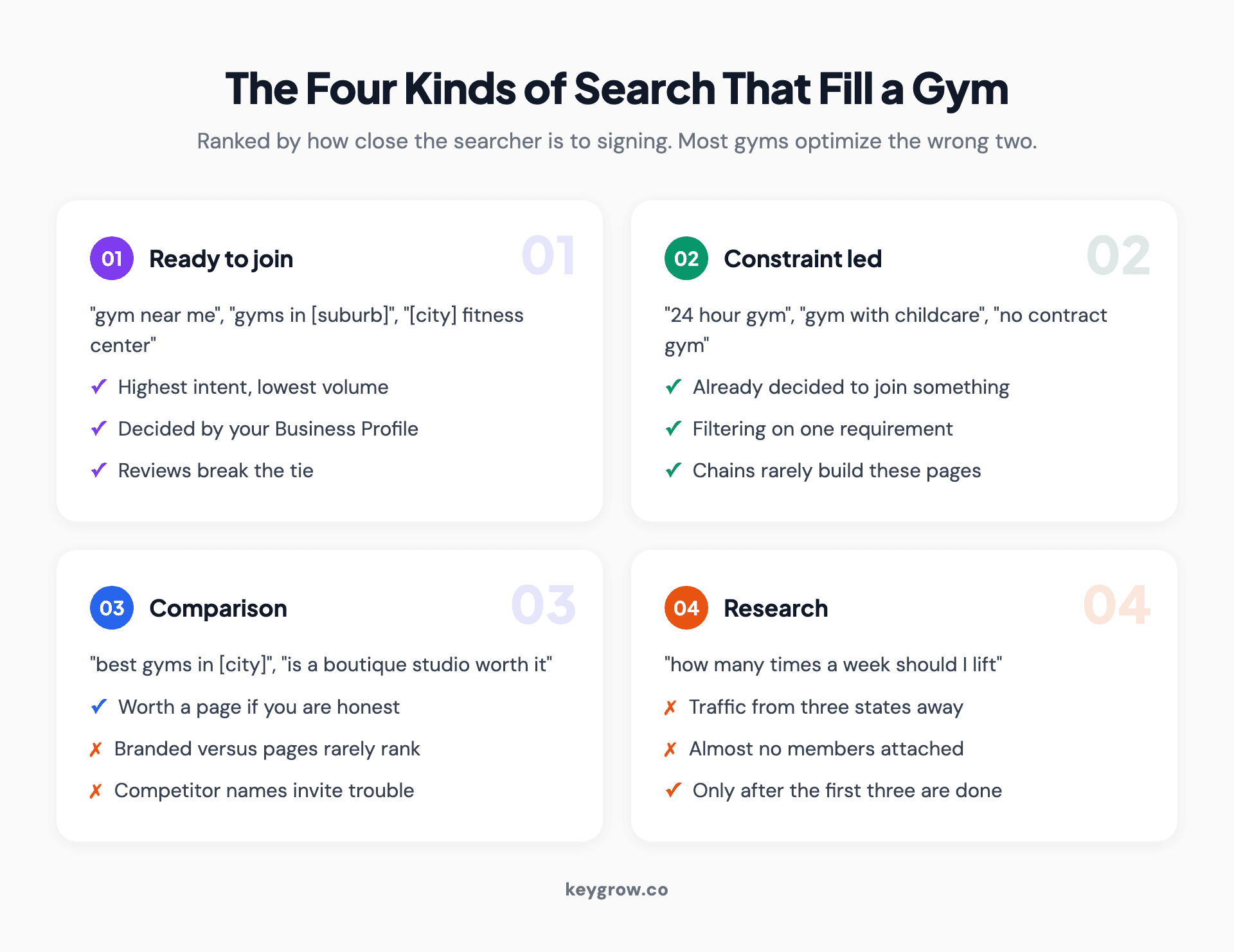
Four-card grid of gym search types: ready-to-join, constraint-led, comparison, and research searches, each with example queries and the page that should answer them.
Ready to join looks like "gym near me", "gyms in [suburb]", "[city] fitness center". Highest intent, lowest volume, decided almost entirely by your Business Profile and reviews.
Constraint led is where the money hides. "24 hour gym [city]", "gym with childcare", "women only gym near me", "gym with a pool", "cheap gym no contract". These people have already decided to join something. They are filtering. If you match the constraint and say so on a page, you win them cheaply because the big chains rarely bother.
Comparison searches are "[your gym] vs [other gym]", "best gyms in [city]", "is a boutique studio worth it". You mostly cannot rank for branded comparisons of competitors, and trying is a bad use of a week.
Research queries like "how many times a week should I lift" bring traffic from three states away and almost no members. Write them only if you already own the first three buckets.
Constraint-led terms are the single biggest missed opportunity in gym SEO. Look at your own front desk: whatever question new members ask most on the tour is probably a search someone typed last night.
A quick way to build the list is to write down every objection your sales staff handle in a week. Contract length, peak-hour crowding, parking, whether the equipment suits beginners, whether there is a women's-only area, whether the classes are included or extra. Each of those is a page, and each page can honestly answer a question a competitor is dodging.
Your Business Profile is doing more work than your website
For a gym, the Business Profile is the storefront and the website is the sales office. Get the profile wrong and the website never gets a visitor.

Modern reception desk with a staff member using a tablet to check someone in.
There is no mystery about what Google weighs here, because it publishes the list. Google's local ranking guidance lists three inputs: relevance, meaning how well the profile matches the query, distance from the searcher, and prominence, meaning how well known the business is. Distance is fixed unless you move the building. Relevance comes from your category and what your profile says you do. Prominence comes from reviews and links. Two of those three are yours to change, which is a better hand than most channels deal you.
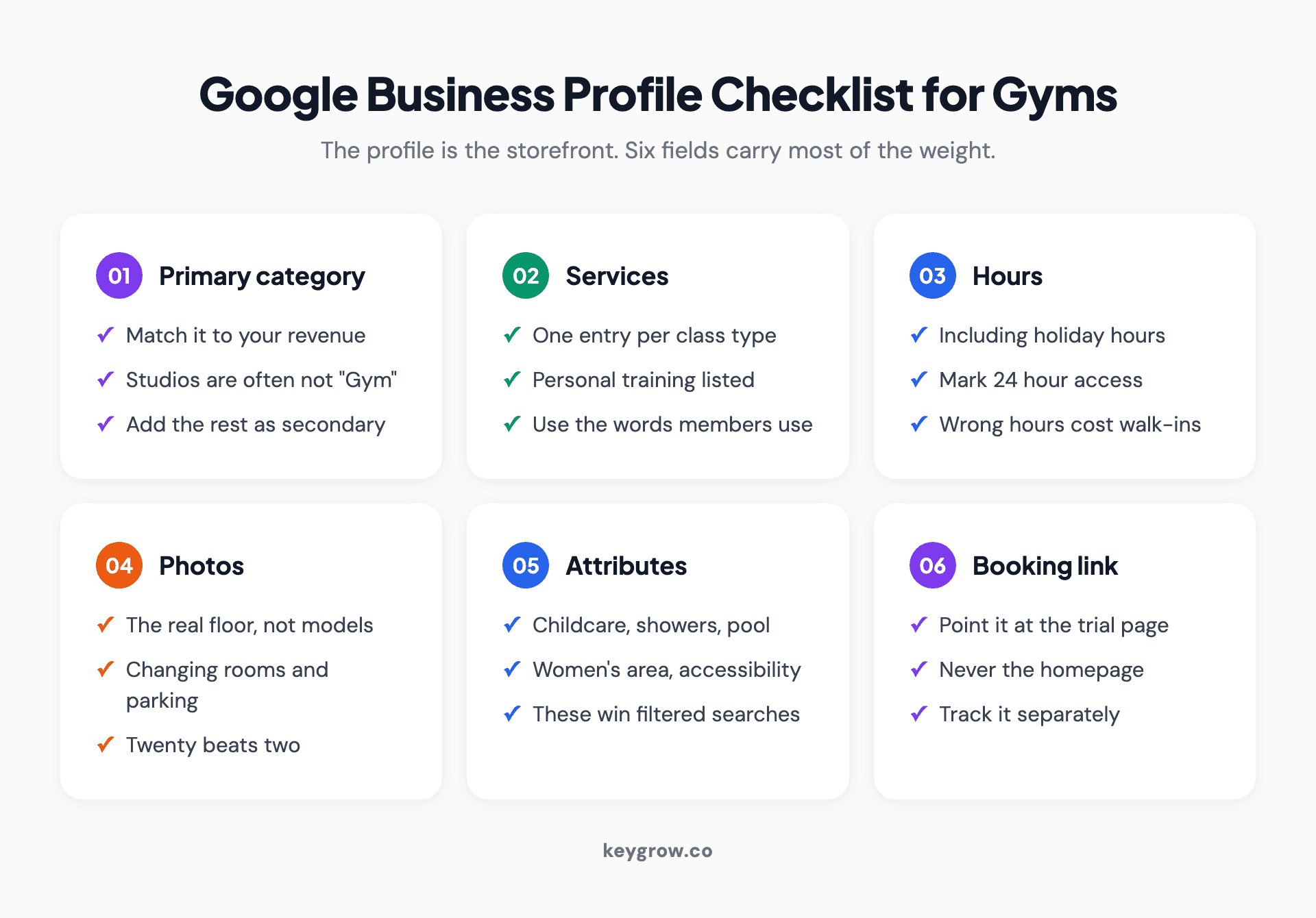
Six-card Google Business Profile checklist for gyms covering primary category, services, opening hours, photos, attributes and the booking link.
Primary category matters more than anything else you can edit. "Gym" and "Physical fitness program" and "Personal trainer" pull different result sets. Pick the one that matches what most of your revenue comes from, then add the others as secondary categories. A studio that makes its money from classes but sits under "Gym" is competing with every big-box facility in town for no reason.
Then fill everything. Hours including holiday hours, the attributes list (24 hour access, showers, parking, childcare), your class types as services, and photos that show the actual floor rather than stock fitness models. Add a booking link that goes to your trial page, not your homepage. Our deeper walkthrough of how the map pack is scored covers the ranking mechanics in more detail.
Reviews are the part gym owners avoid, and the part that decides it
Reviews are prominence, and prominence is the only local ranking lever you can actually pull. They also carry the decision after the ranking.
Gyms have a specific review problem: the people with the strongest feelings are the ones who quit. Cancellations generate one-star reviews at a rate that regular attendance never matches, so a gym that never asks ends up with a review profile written entirely by leavers.
The fix is mechanical. Ask at the moment of highest satisfaction, which for a gym is not month one. It is the week someone hits a goal they told you about at sign-up, or the day they renew. Train the front desk to ask in person and follow with a text containing the link. Do not offer a free month for a review; that violates Google's policies and can get the whole profile filtered.
Volume and recency both matter now. Our post on getting more Google reviews has the full process, including the exact ask that works better than a QR code on the counter.
The pages a gym website needs, and the ones it does not
Most gym sites have too many pages about fitness and too few about the gym. Here is the set that earns its keep.
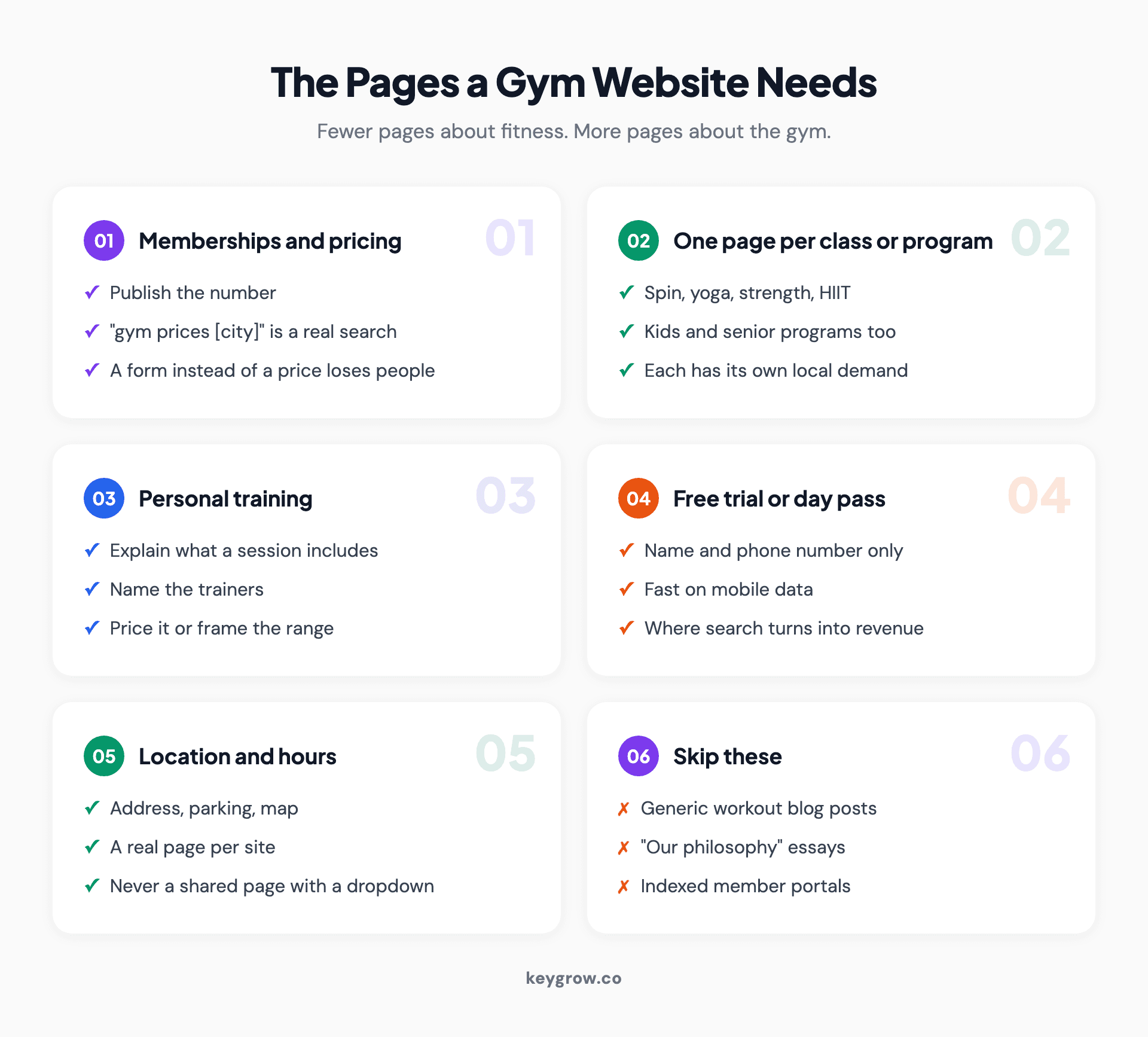
Card layout of the pages a gym website needs: memberships and pricing, one page per class or program, personal training, free trial, location and hours, and a second location page where relevant.
A memberships and pricing page is non negotiable. Hiding prices behind a form loses more people than it qualifies, and "gym prices [city]" is a real search with buying intent behind it.
One page per class or program. Spin, yoga, strength, HIIT, kids programs, senior programs. Each is a separate search with its own local demand, and each gives you something to rank with that the chains handle badly.
A personal training page if you sell it, priced or at least explained.
A free trial or day pass page that is short, loads fast, and asks for a name, a phone number and nothing else. This is where search traffic turns into revenue, so it deserves more attention than the homepage gets.
That page-per-service pattern is not gym-specific. A junk removal client of ours had six service pages built and ranking inside six weeks, each one catching a different job type that had previously all funnelled through a single vague services page. A gym has the same structure hiding in its timetable.
A location page with hours, parking, and a map for each physical site.
What you do not need: a blog full of generic workout advice, a "our philosophy" essay, or a members-only portal indexed by Google. If you run more than one location, give each one a real page with its own address and its own photos, not a shared page with a dropdown.
January is decided in September
Gym search demand is seasonal in a way that punishes late starters. New year traffic spikes hard, and the pages that catch it need to have been indexed and earning trust for months beforehand.
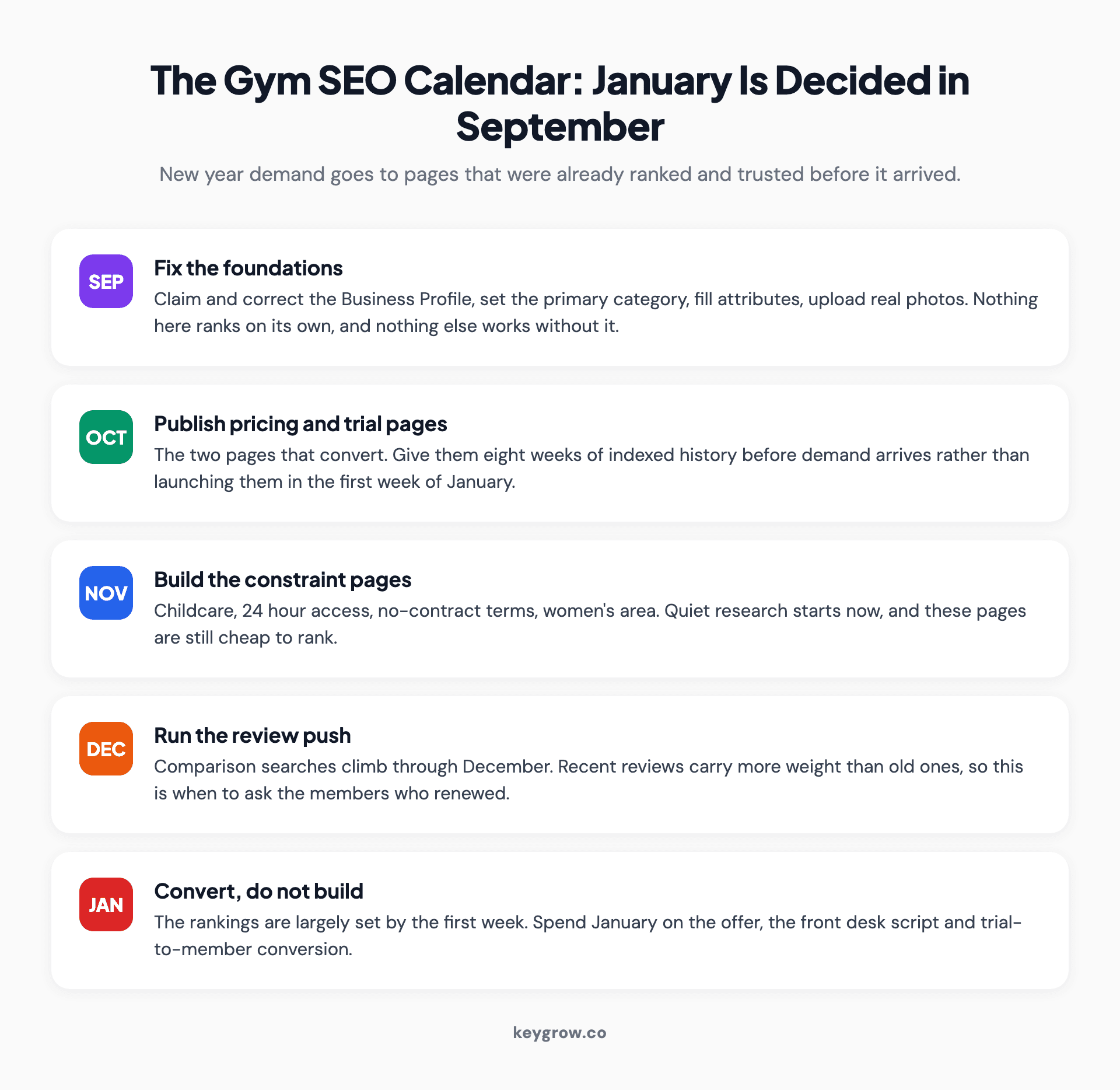
Five-step seasonal calendar for gym SEO showing what to do from September through January, from fixing the profile to running the new year offer.
September and October are for infrastructure: profile, categories, review process, the pricing and trial pages. November is for the constraint-led pages, because that is when people start researching quietly. December is when the comparison searches climb. By the first week of January the auction is already running and the rankings are mostly set.
If you are reading this in spring, that is genuinely better news than it sounds. You have the whole slow season to build something that is ranked and trusted before the demand arrives, which is exactly when this work is cheapest to do.
The same logic runs in reverse for summer. Beach-season demand climbs from March, so the March pages need to exist in January.
Getting links in a town that does not link to gyms
Link building for a local gym is unglamorous and mostly offline. Nobody is naturally linking to a fitness center, so you create the reasons.
Sponsor a local run, a school team, a charity event. Most of them list sponsors on a page with a link. Offer free classes to the staff of a big local employer and ask for a mention in their internal wellness page or newsletter. Host a community event and get the local paper's listings page. Partner with a physiotherapist, a nutritionist, or a running store and cross-link on genuinely relevant pages.
Directory consistency matters too, and it is the cheapest win on this list. Your name, address and phone number need to match everywhere they appear, because mismatches suppress the prominence signal Google is measuring. Our guide to building local citations covers which directories are worth the time and which are noise.
What does not work: buying fitness-blog guest posts from a marketplace, or link exchanges with gyms in other countries. Those get you a spammy profile and nothing else.
What AI assistants say when someone asks for a gym nearby
This is the newest surface and the one gyms have not adapted to yet. When someone asks an assistant for a good gym near them, the answer gets assembled from your profile, your reviews, and any page that states facts plainly.

Group fitness class training together on a gym floor.
Assistants pull specifics: opening hours, whether there is childcare, whether contracts are required, class timetables, price. If those facts live only inside a PDF timetable or an image of your pricing board, you are invisible to the question being asked. Put them in text, on a page, in plain sentences.
This is also why the constraint-led pages pay twice. A page that says "open 24 hours, no lock-in contract, childcare weekday mornings" in readable text is the exact thing an assistant can quote back to someone.
Two practical moves. Publish your class timetable as HTML rather than a weekly image post, and keep a plain-language facts block on the location page covering hours, contract terms, joining fee, parking and what is included. Neither is glamorous. Both are the difference between being summarized and being skipped. Our answer engine optimization service exists because this shift is arriving faster in local categories than most owners expect.
Measure trials booked, not rankings
Rankings are a means. For a gym the only numbers worth reporting are how many people got in touch and how many of them walked in.
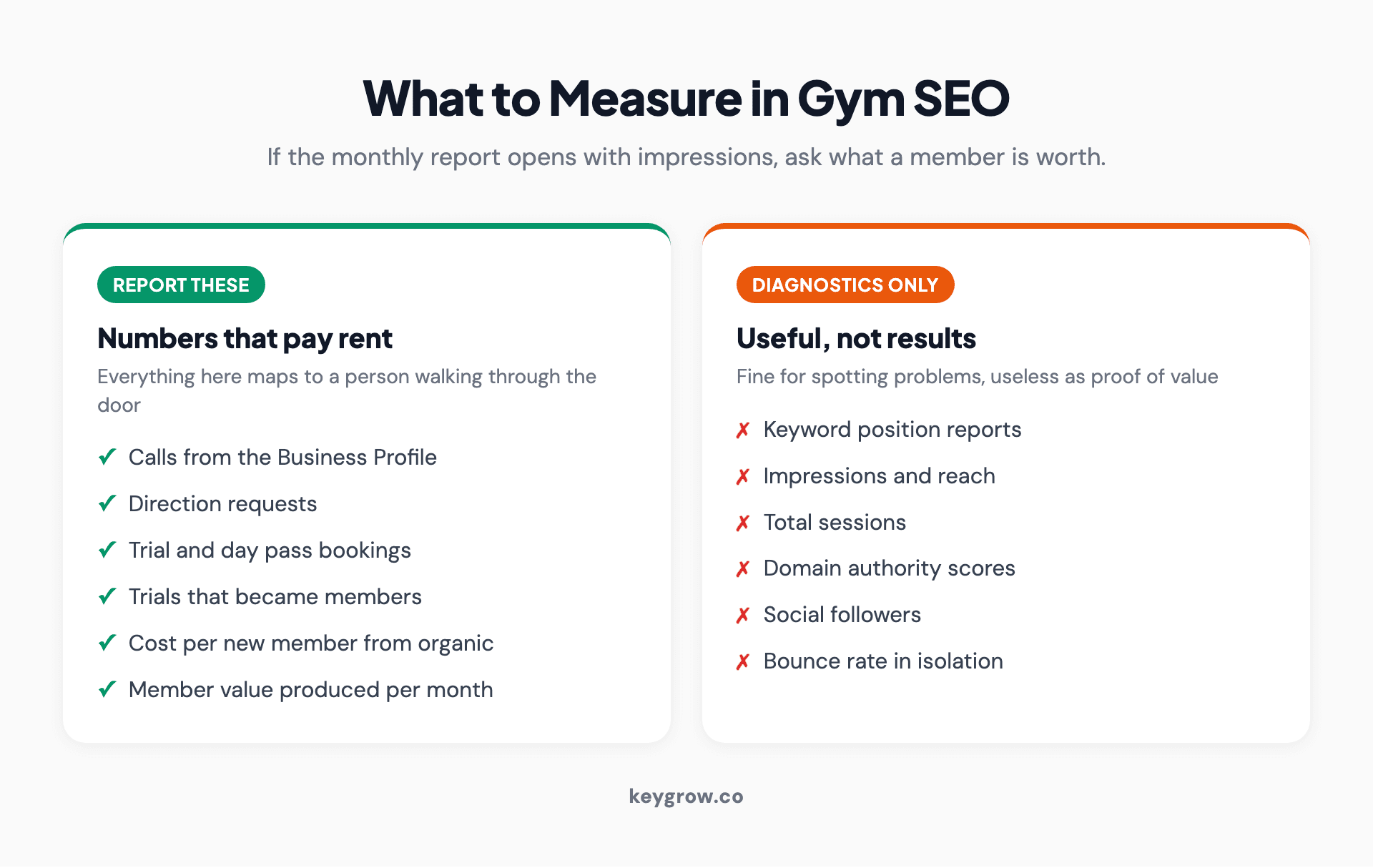
Two-column layout contrasting the gym SEO metrics worth tracking, such as trial bookings and calls, against vanity metrics like keyword rankings and impressions.
Track calls from the Business Profile, direction requests, trial form submissions, and the number of trials that convert to memberships. Direction requests are underrated as a gym metric because people who ask for directions to a gym are usually going.
Then divide. If SEO produced 40 trial bookings last month and 12 became members, and a member is worth $686, that is $8,232 of member value. Compare that with what you spent. This is the only version of SEO reporting that survives a conversation with an accountant.
Keyword position reports are fine as a diagnostic and useless as a result. When a monthly report leads with impressions, the useful question back is what one member is worth to the gym. The pause before the answer tells you a lot.
When a gym should not hire an SEO agency
A single-location gym with an unclaimed profile, fourteen reviews and no pricing page does not need an agency. It needs a Saturday morning.
Claim the profile, set the right primary category, fill the attributes, upload twenty real photos, publish a pricing page, and build a review request into the front desk routine. That is most of the available gain for a small gym, and it costs nothing but attention. Agencies rarely say this because the first ninety days of any engagement is largely that work at a markup.
Hire help when the opportunity cost of your time genuinely exceeds the fee, when you are running multiple locations with overlapping service areas, or when a competitor with a real budget has moved into your catchment and you are losing a map pack you used to own. Until then, do it yourself and put the money into converting the trials you already get. The SEO work we sell is aimed at that second situation.
FAQs
How long does SEO take to work for a gym?
Expect movement in the map pack within 4 to 8 weeks if the profile was genuinely neglected before, because category fixes and a jump in review velocity register fast. Ranking a pricing or class page organically takes longer, usually 3 to 6 months. Treat a promise of instant top placement as a reason to keep interviewing agencies.
How much should a gym spend on SEO?
Work backwards from member value rather than copying a benchmark. If a member is worth $686 and you want 15 new members a month from organic, you are trying to produce roughly $10,000 in member value, and spending a small fraction of that is rational. Budget gyms usually justify a light local SEO engagement only; boutique studios and personal training businesses can justify considerably more.
Do gyms need a blog to rank?
Not for the searches that fill a gym. Class pages, a pricing page and a well-built Business Profile do more than a blog for local intent. A blog earns its place only once those are done, and then only if it answers questions local prospects actually ask, such as what to expect on a first visit or how your contract terms work.
What is the best Google Business Profile category for a gym?
Choose the category that matches where your revenue comes from, not the one that sounds biggest. "Gym" suits full-service facilities, "Physical fitness program" often fits class-based studios better, and "Personal trainer" fits a training-led business. Add the rest as secondary categories and review the choice if your mix changes.
Should a gym publish its prices online?
Yes, in almost every case. Price searches carry strong intent, and hiding the number sends people to a competitor who shows it rather than to your contact form. If your pricing is genuinely complex, publish a starting price and a short explanation of what changes it.
Can a small independent gym outrank a national chain locally?
Often, yes. Chains usually run weak individual location profiles, thin location pages and slow review response, which leaves the prominence signals underfed. A single well-run independent with 200 recent reviews, complete attributes and real photos regularly beats a chain branch two streets closer to the searcher.
Does the gym's website speed affect local rankings?
It affects conversions more than rankings. Slow pages lose mobile visitors who found you in the map pack, and that is the expensive loss. Fix the obvious offenders, usually oversized hero images and booking widgets, before worrying about technical scores.
Sixty days, one page at a time
The gym version of this work is short. Fix the profile and categories in week one, start the review routine in week two, publish pricing and trial pages in weeks three and four, then add one constraint-led page a week until you run out of honest constraints to claim.
That is a sixty day plan a gym owner can run without help. If you would rather it ran itself, or you are fighting for a map pack across several locations, tell us about your gym and we will tell you honestly whether it is worth outsourcing yet.


