


Most small business SEO guides give you twenty-odd tactics and a tool to buy. A one-location business with two spare hours a week needs about five, done in the right order.
For a local service business, those five are a complete Google Business Profile, a steady flow of reviews, one website page per service, matching listings everywhere you appear, and a way to count calls and form fills. Do all five yourself. Hire out technical repairs and link building once they're done, and skip daily blogging, rank trackers and AI add-ons for now.
That isn't false modesty from an agency. Google's own hiring guide says that if you run a small local business, "you can probably do much of the work yourself."
Do it yourself, hire it out, or skip it for now
Do the jobs that need your knowledge of the business, hire out the ones that need technical skill, and skip whatever can't produce a call.
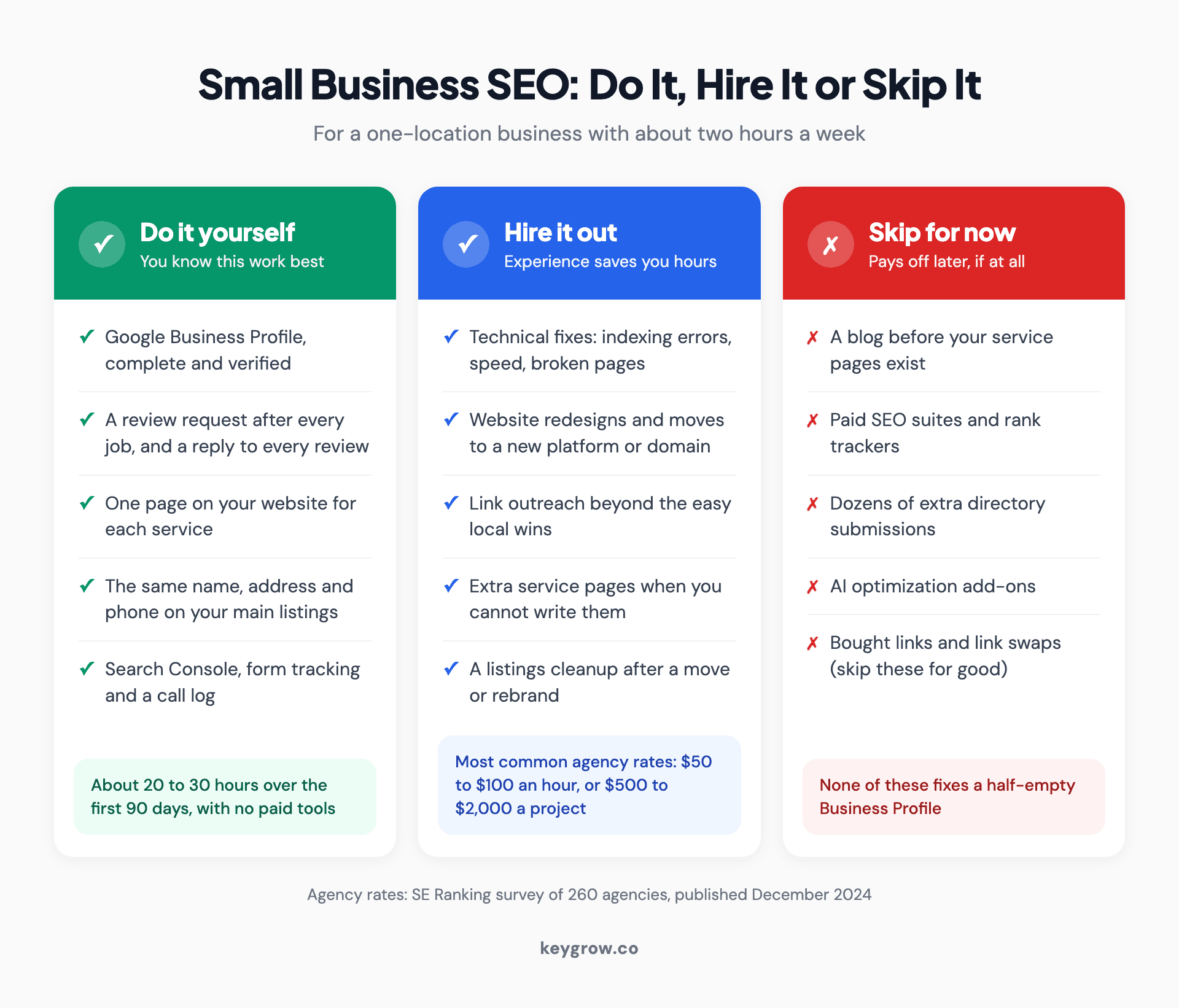
Three cards sorting small business SEO tasks. Do it yourself: Business Profile, reviews, service pages, listings and tracking. Hire it out: technical fixes, site moves, link outreach, extra pages and a listings cleanup. Skip for now: early blogging, rank trackers, extra directories, AI add-ons and bought links.
The split follows who does each job best. Nobody knows your services, customers and town better than you, and that knowledge is most of what a profile, a review request and a service page need. A specialist earns the fee where experience saves hours, like working out why Google won't index a page or moving a site without losing its rankings.
Everything else waits. With two hours a week, you can't spend them on work that pays off in year two while your profile is still half empty.
Every task, ranked by what an hour returns
Profile and reviews come first, then service pages, listings and tracking. Technical work and links come after the basics, usually with paid help.
Here's the whole list for a single-location service business, in the order we'd do it. The times are our working estimates for a typical small website, not measured averages, and "when it pays off" assumes you keep going.
| Task | Time it takes | Do it yourself or hire | When it pays off |
|---|---|---|---|
| Complete and verify your Google Business Profile | 2 to 3 hours once, then 15 minutes a month | Yourself | Weeks to a few months |
| Ask every customer for a review, reply to each one | A minute per customer, 15 minutes a week | Yourself | Builds month by month |
| One page per service | 2 to 4 hours per page | Yourself, or a hired writer | 4 to 12 months |
| Same name, address and phone on your main listings | 3 to 5 hours once | Yourself; hire if you've moved | 1 to 3 months |
| Search Console, form tracking and a call log | 2 to 3 hours once | Yourself, or one paid hour | Right away, as your baseline |
| Page titles and homepage basics | 1 to 2 hours | Yourself | 1 to 3 months |
| Technical fixes: speed, indexing errors, broken pages | Usually a one-off project | Hire | 1 to 3 months after the fix |
| Local links from sponsors, suppliers and associations | 1 to 2 hours a month | Yourself for the easy ones, hire for outreach | 6 to 12 months |
| Blog posts that answer customer questions | 3 to 5 hours per post | Skip for now, hire a writer later | 6 to 12 months |
For a business with four or five services, the first six rows come to roughly 20 to 30 hours. At two hours a week that's about three months, and none of it needs a paid tool.
Start with the five jobs you can do yourself
A single-location business with more time than money can handle all five itself, with what it knows about its customers and a few free accounts.
- Finish your Google Business Profile before anything else. It's the listing in the map results, and Google's help pages say businesses with complete and accurate info are more likely to show up in local search. Pick the primary category that matches your main service, fill in every field, add real photos and verify the profile. If you drive to customers, hide your address and set a service area. Our Google Business Profile optimization guide goes field by field.
- Make the review request part of finishing a job. More reviews and better ratings can help your local ranking, by Google's own account, and strangers read them before calling. Ask every customer while the job is fresh, with a direct link (here's how to find your Google review link), and reply to every review. Don't offer a discount in return: Google treats incentivized reviews as fake content.
- Give every service its own page. A single "Services" page listing eight jobs gives Google one weak match for each. A page per service, titled with the job and your town ("Water Heater Repair in Tulsa | Smith Plumbing"), with what the work involves, a price range, photos and the areas you cover, gives it something specific. Write it the way you'd explain the job on the phone.
- Make your name, address and phone match everywhere. Start with the listings people use: Google, Bing Places, Apple Business Connect, Facebook, Yelp and the one directory that matters in your trade.
- Set up a way to count results. Verify your site in Google Search Console, have Google Analytics count form submissions and start a call log. Six months from now, you'll want to know where you started.

A boutique owner working on a laptop among racks of clothes and shoes in her shop.
Here's the part agencies leave off their sales pages. If you run one location, have more time than money and compete with a handful of businesses in your town, you can stop here for months. You don't need an agency yet, ours included. Keep asking for reviews, add a service page when you can, and don't pay anyone until the calls stop growing.
What to hire out, and what SEO for small businesses costs
Hire out technical repairs, site moves and link outreach. The most common agency prices are $500 to $1,000 a month, or $50 to $100 an hour.
Three kinds of work earn an outside fee. Technical problems come first: a page Google won't index, a mobile site that crawls, a website move that could cost you your rankings. Then link outreach past the easy local wins, and volume, when you want more pages than your evenings allow.
For prices, SE Ranking's agency survey (published December 2024) covered 260 agencies, 94 percent of them serving small or local businesses.
| How you buy it | What agencies most often charge | Good for |
|---|---|---|
| By the hour | $50 to $100 an hour, though 40% of US and Canadian agencies charge more than $125 | A setup session or a second opinion |
| By the project | $500 to $2,000, the range for 65% of US and Canadian agencies | Technical fixes, an audit, a listings cleanup |
| Monthly retainer | $500 to $1,000 a month, though 22% of US and Canadian agencies charge more than $2,000 | Ongoing pages, links and reporting |
Run your own task list through those rates. Paying for two or three hours of Business Profile setup comes to roughly $100 to $400, for an evening's work. A technical cleanup fits the project range, and only ongoing pages and links need a retainer. Our breakdown of how much SEO costs shows what each price band buys.
Hire help when any of these is true
- You've done the five, kept asking for reviews for four to six months, and calls haven't moved.
- Search Console says pages aren't indexed, and the explanation means nothing to you.
- You've moved, rebranded or changed phone numbers, and old listings are everywhere.
- You're redesigning your website or moving it to a new platform or domain.
- You compete in a crowded market, like personal injury law in a big city.
- An hour of your time earns more than an hour of SEO help costs. If you bill $150 an hour, a $100-an-hour specialist is a bargain.
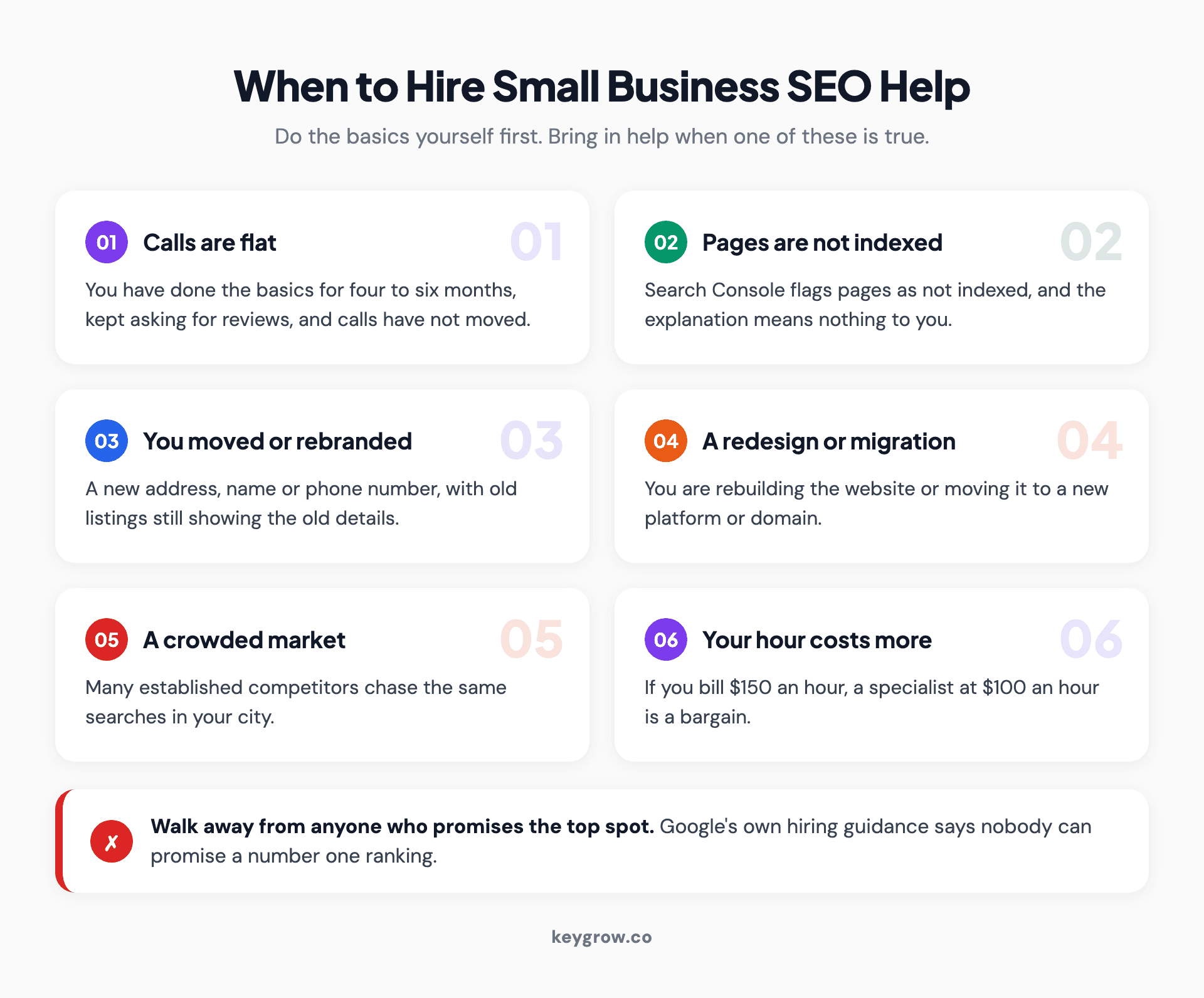
Six signs a small business should hire SEO help: flat calls after four to six months of basics, pages not indexed, a move or rebrand, a redesign or migration, a crowded market, and an owner's hour worth more than the fee.
Before you sign, ask the questions Google's hiring guide suggests, such as examples of past work and what results to expect by when. Walk away from anyone who promises the top spot, because Google says nobody can. Still unsure whether paid help pays? Run the break-even math in our guide to whether SEO services are worth it.
Skip these until the basics are done
Skip daily blogging, paid rank trackers, mass directory listings and AI add-ons for now. None of them fixes a half-empty profile.
Plenty of popular SEO tips for small business owners belong on this list. Most of them work eventually. They just don't work first.
- A blog before your service pages exist. Posts that answer customer questions help in year two. A missing page for your main service hurts this month.
- Paid SEO suites and rank trackers. Search Console is free and shows the searches your site appears for. A rank tracker tells you where you placed. It doesn't answer the phone.
- Dozens of directory submissions. The core listings matter. Listing number forty adds nothing you'll notice.
- Chasing one big keyword. "Plumber" across a whole metro is a long fight. "Water heater repair in [your town]" is winnable, and closer to a booking.
- Bought links and link swaps. Google's spam policies name both buying links for ranking purposes and excessive link exchanges. Skip this one for good.
- AI optimization packages. More on these below.
Selling online? Your first moves are different
A local service business wins in the map results. An online store's first wins come from product pages and free Merchant Center listings.
Everything above assumes customers within driving distance. If you ship nationwide, the map results barely matter, and a Business Profile only earns its keep if people visit your shop.
| Local service business | Online store | |
|---|---|---|
| Where customers find you | Map results and local searches | Product results, the Shopping tab and regular search |
| First free move | A complete Google Business Profile | A Merchant Center feed for free product listings |
| Pages that matter most | One per service | Category and product pages |
| What to count | Calls, form fills and booked jobs | Orders and revenue from organic search |
| First thing worth hiring | A listings cleanup after a move | A technical audit of site structure |
Your first free move is Google Merchant Center. According to Google's help page, free listings let your products appear at no cost on Google Search, Google Maps, Gemini, YouTube, the Shopping tab, Google Images and Google Lens.

A cardboard shipping box with a blank address label, ready to go out as an online order.
Stores also hit technical trouble sooner, because filters, variants and sold-out items pile up near-duplicate URLs. For a store, the technical row moves up the table.
Do AI answers change the plan?
Barely. Google says AI Overviews and AI Mode need no special optimization beyond normal SEO. What changes is how you should measure results.
The wording in Google's documentation for site owners is unusually direct: there are "no additional requirements" to appear in AI Overviews or AI Mode, "nor other special optimizations necessary." A page has to be indexed and eligible to show with a snippet, which is ordinary SEO. ChatGPT search has one condition: OpenAI says sites that opt out of its OAI-SearchBot crawler won't appear in ChatGPT search answers, so have whoever runs your website check that robots.txt doesn't block it.
Agencies are packaging AI work anyway. In the same SE Ranking survey, 61 percent of agencies planned to add optimization for AI engines, and those with a set price averaged about $937 a month. For a small business, the five basics above are the AI optimization.
The real change is in your numbers. When Pew Research Center tracked the browsing of 900 US adults in March 2025, people clicked a regular search result on 8 percent of visits when an AI summary appeared, against 15 percent when there wasn't one. Traffic can fall while calls hold steady. Count the calls.
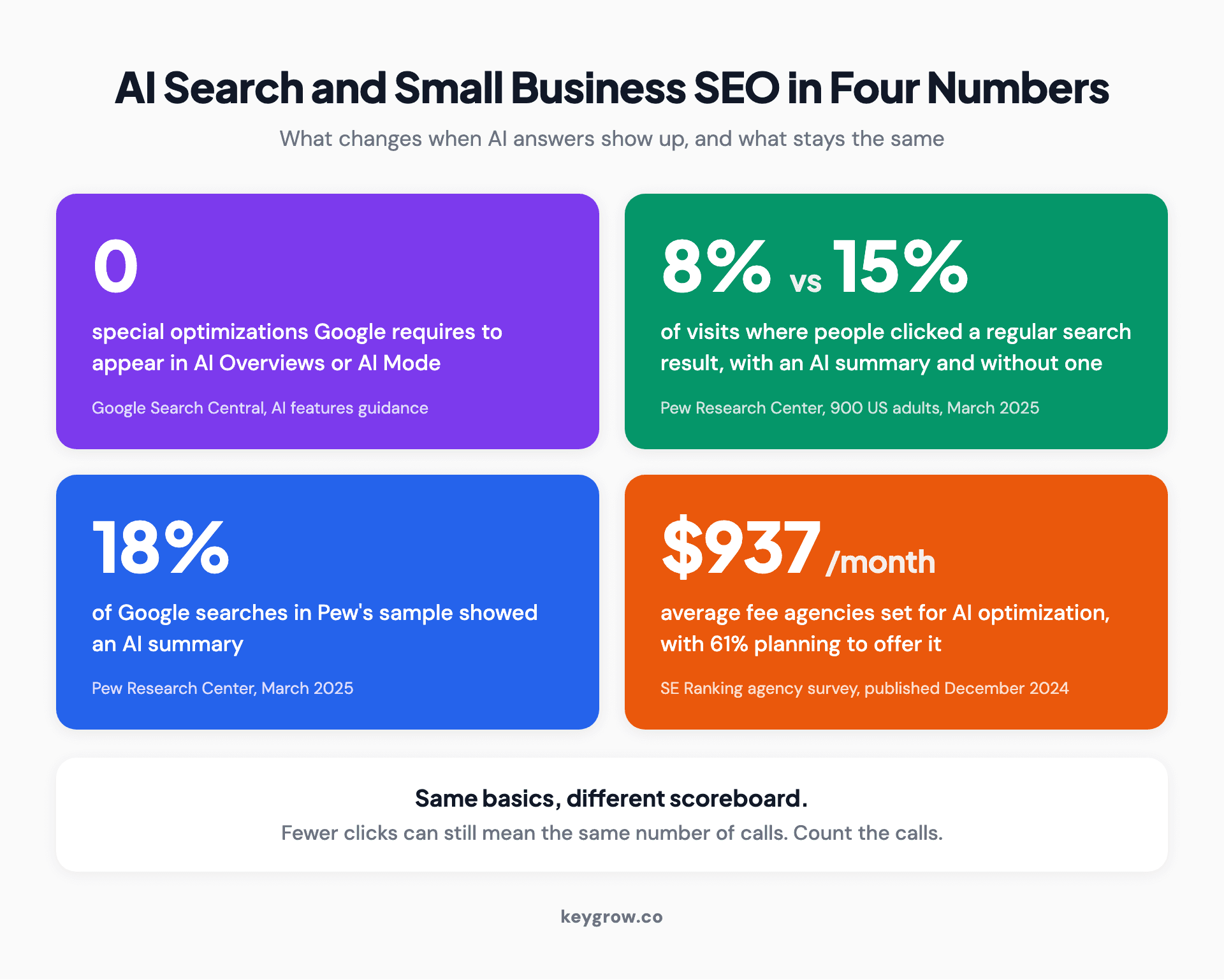
Stat strip on AI search: Google requires no special optimization for AI Overviews or AI Mode, people clicked a regular result on 8 percent of visits with an AI summary versus 15 percent without, and agencies price AI optimization at about $937 a month.
Count calls and booked jobs, not rankings
Judge small business SEO by calls, form fills and booked jobs from search, checked monthly against the month you started. Rankings are a symptom.
Four free sources cover it. Your Business Profile's performance report shows calls, messages, bookings, direction requests, website clicks and the searches people used, as long as the profile is verified. Search Console shows the searches your site appeared for and the clicks it got, AI Overview traffic included. Google Analytics counts form submissions once you set it up. The fourth is a call log: end every new call with "How did you find us?" and write the answer down.

A business owner smiling as she takes a customer's call at her desk, with her laptop open in front of her.
On the first of each month, put five numbers in a spreadsheet: profile calls, form fills, booked jobs from search, new reviews and organic clicks. That takes ten minutes, and it's a better report than plenty of agencies send.
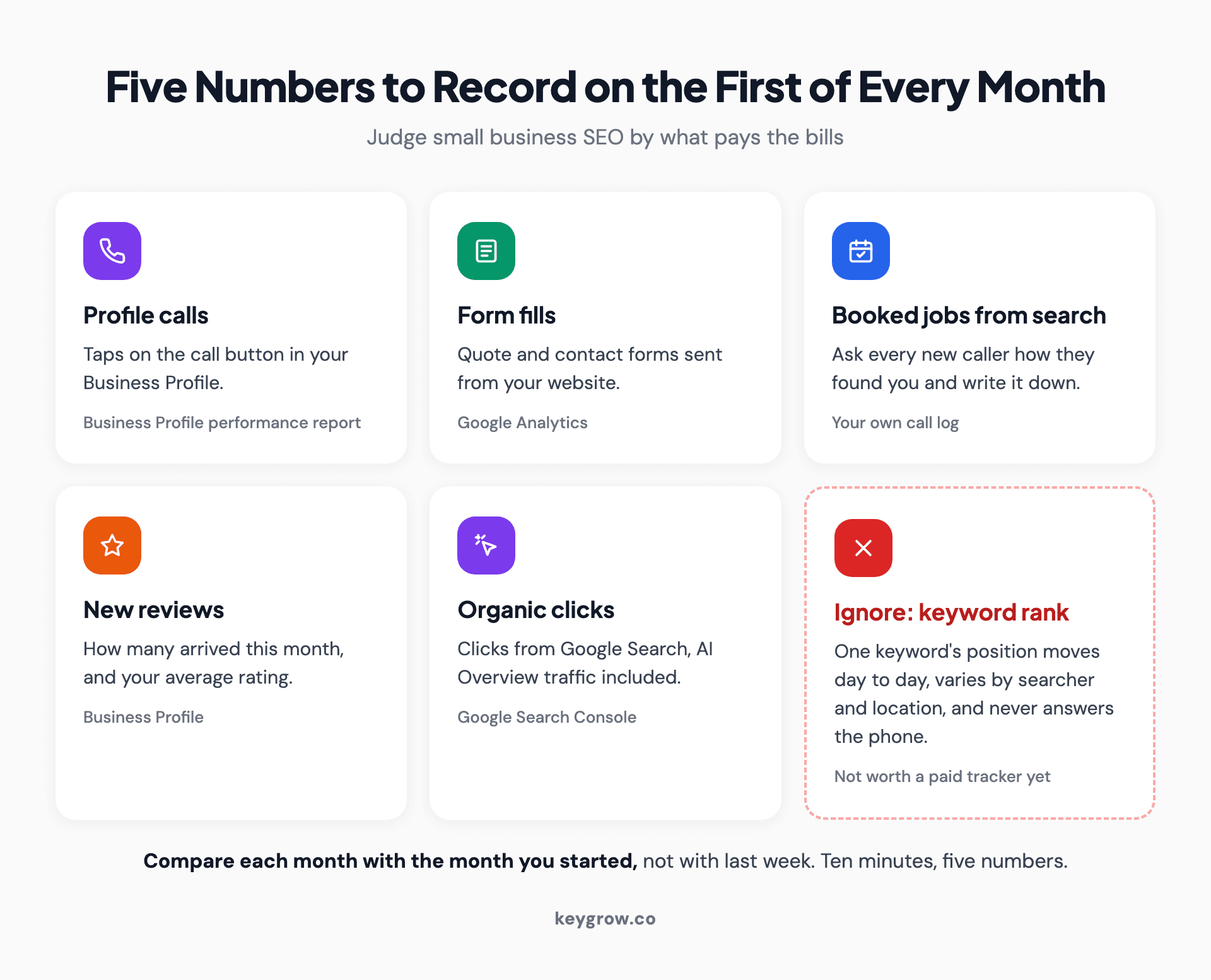
Five numbers a small business should record every month: Business Profile calls, form fills, booked jobs from search, new reviews and organic clicks, plus one to ignore, the rank of a single keyword.
Expect the first quarter to look like nothing. SEO is a compounding asset, not a campaign: it looks unimpressive for three months and embarrassingly good after a year. A doctor's practice in Dubai committed to SEO with us for a full year, and months one through three looked flat on the surface. By month twelve, organic traffic had grown 1,519 percent and the practice was taking 130+ patient calls a month. Owners who quit at month three pay for the hard part and leave before the payout.
FAQs
Can I do SEO for my small business myself?
Yes, for most single-location businesses. Google's own guidance says a small local business can probably do much of the work itself. Do the profile, reviews, service pages, listings and call tracking yourself, then pay for technical help and links.
How much does SEO cost for a small business?
Doing it yourself costs 20 to 30 hours over the first three months and no paid tools. If you hire, a survey of 260 agencies published in December 2024 found the most common prices were $500 to $1,000 a month, $50 to $100 an hour, or $500 to $2,000 per project. US and Canadian agencies charge more than European ones.
How long does SEO take for a small business?
Profile and review improvements can show up in the map results within weeks to a few months. Ranking your website takes longer, usually several months and sometimes a year. Judge the work at six to twelve months, not at month three.
What should a small business do first for SEO?
A local service business should finish and verify its Google Business Profile, starting with the right primary category. An online store should start with its category and product pages and a Merchant Center feed for Google's free product listings.
Does a small business need a blog for SEO?
Not at first. A page for each service does more for a local business, because it matches what customers search when they're ready to book. Blog posts that answer real customer questions help later.
Is SEO still worth it for small businesses now that AI answers searches?
Yes, if your customers search for what you sell. Google says AI Overviews and AI Mode need no special optimization beyond normal SEO, so the same basics do both jobs. Fewer people click through when an AI summary appears, so measure calls rather than traffic.
Two hours a week, spent in this order
The first 90 days, at about two hours a week:
- Weeks 1 and 2: finish and verify your Business Profile, and set up your review link.
- Weeks 3 and 4: fix your main listings, then set up Search Console, form tracking and a call log.
- Weeks 5 to 10: write a service page every week or so, starting with the job that pays best.
- Weeks 11 and 12: tidy your page titles, record your five numbers and check the hire list above.
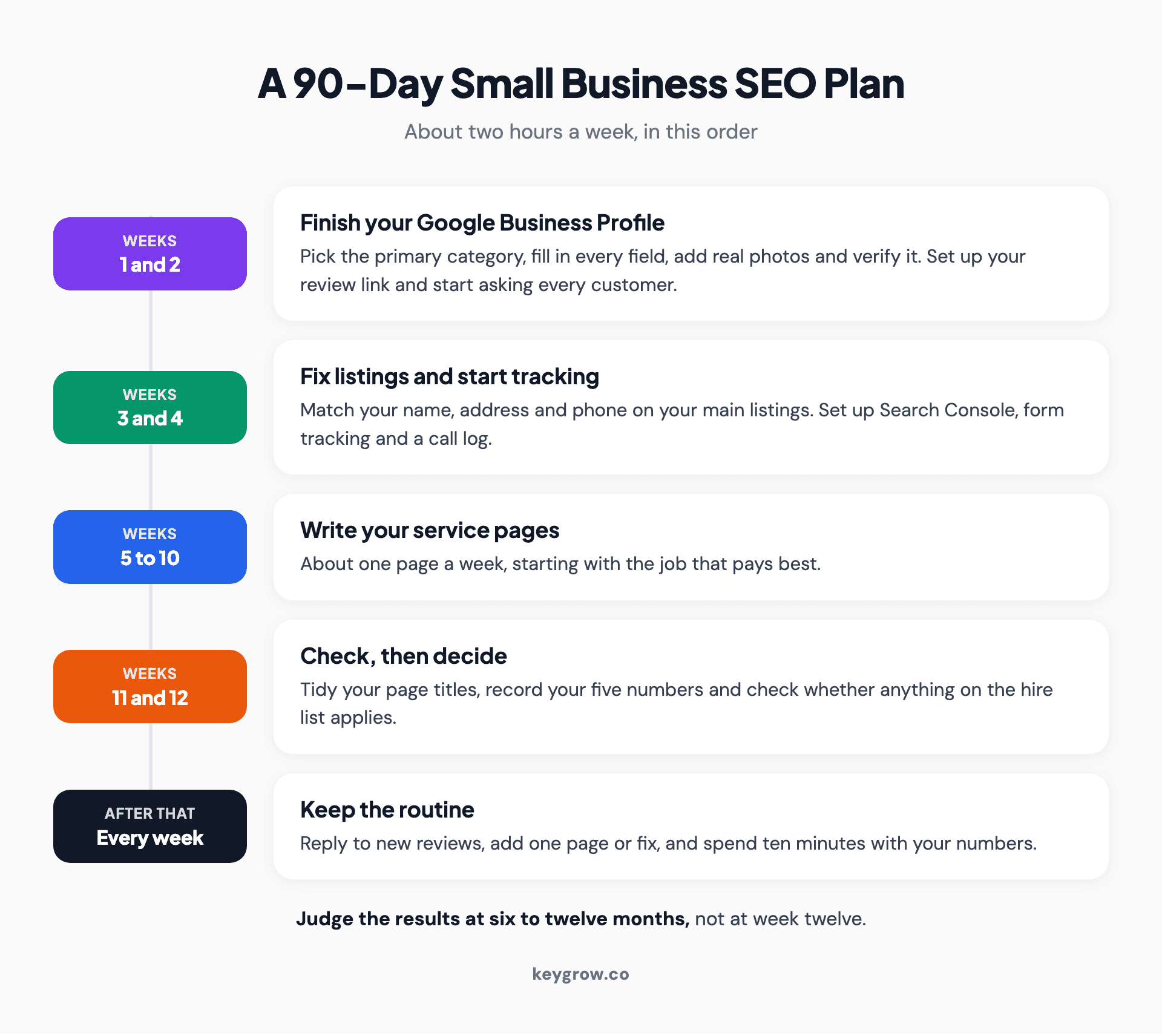
A 90-day small business SEO plan at two hours a week: the Business Profile first, then listings and tracking, then a service page a week, then a check of the numbers and the hire list, followed by a weekly routine.
After that, the two hours settle into a routine: replies to new reviews, one new page or fix, and ten minutes with your numbers. Judge the results at six to twelve months, not at week twelve.
If you reach week twelve and want a second opinion on what's worth hiring out, our SEO team will go through it with you, and sometimes the honest answer is to keep doing it yourself. We work month-to-month.