

Most articles that answer "what do you need to balance when doing SEO" hand you a list of tensions and walk off. Content vs. technical. Short term vs. long term. User experience vs. optimization. True, all of it, and useless, because knowing the tensions exist tells you nothing about what to do on a Tuesday morning with four hours and a backlog.
So here is the honest answer to what you need to balance when doing SEO: you balance five recurring tradeoffs, but balance is the wrong word for it. You are not giving each side equal weight. You are deciding which side to favor right now based on your site's biggest current weakness and what stage it is at. The five are content vs. technical SEO, short-term wins vs. long-term compounding, user experience vs. optimization, breadth vs. depth, and effort vs. ROI. There is a sixth almost nobody talks about yet, and it is the one reshaping the others: ranking in the classic results vs. getting cited inside AI answers.
This post gives a plain decision rule for each one. Not "it depends," but what tips the scale, and which way.
Why balance is the wrong word for what SEO demands
Balance implies a steady midpoint, like a scale you set once and leave. SEO does not work that way. The right allocation shifts as your site changes, and chasing a permanent 50/50 split between every priority is how you make slow progress on everything and visible progress on nothing.
A better mental model is triage. At any moment, one constraint is holding your traffic back more than the rest. Your job is to find it, fix it, and then re-check which constraint is now on top. The tradeoffs below are not five things to keep level forever. They are five questions to re-ask every quarter.

Person at a desk reviewing website analytics on a laptop in a daylight office setting
The reason this matters is that the cost of guessing wrong is real. According to a study by Ahrefs of around 2 million pages, only 1.74% of newly published pages rank in Google's top 10 within a year. You do not get many swings. Spending six months perfecting one tradeoff while a different one quietly caps your ceiling is the most common way good work produces no results.
Content vs. technical SEO: which one is your bottleneck right now?
The rule: fix whichever one is broken first, and "broken" beats "better" every time. If your site cannot be crawled and rendered cleanly, no amount of content saves you. If it crawls fine but the pages are thin or off-topic, no amount of technical polish saves you.
Here is the diagnostic. Run a crawl and check three things: are your important pages indexable, do your Core Web Vitals pass, and is your site architecture flat enough that key pages are a few clicks from the homepage. If any of those fail, technical wins this quarter. Core Web Vitals are confirmed ranking signals, and per Google Search Central, Largest Contentful Paint should stay under 2.5 seconds, Interaction to Next Paint under 200ms, and Cumulative Layout Shift under 0.1.
If the technical foundation is sound and you are still not ranking, the bottleneck is almost always content: too thin, too broad, or written for a keyword instead of a question. At that point, more redirect audits are procrastination dressed up as work.
A useful tie-breaker: technical SEO has a ceiling, content does not. Once your site passes the crawl-and-speed bar, additional technical work gives diminishing returns, while every strong page you publish keeps compounding. So fix technical until it passes, then pour the hours into content. If you want the full crawl-and-fix sequence, our walkthrough on how to run a technical SEO site audit lays it out step by step.
When technical is NOT worth obsessing over: a five-page local service site with a clean modern theme rarely has a technical problem worth a specialist. The crawl passes, the speed is fine, and the real gap is that there is no content answering what customers ask. Paying for a deep technical audit there is spending money to confirm nothing is wrong.
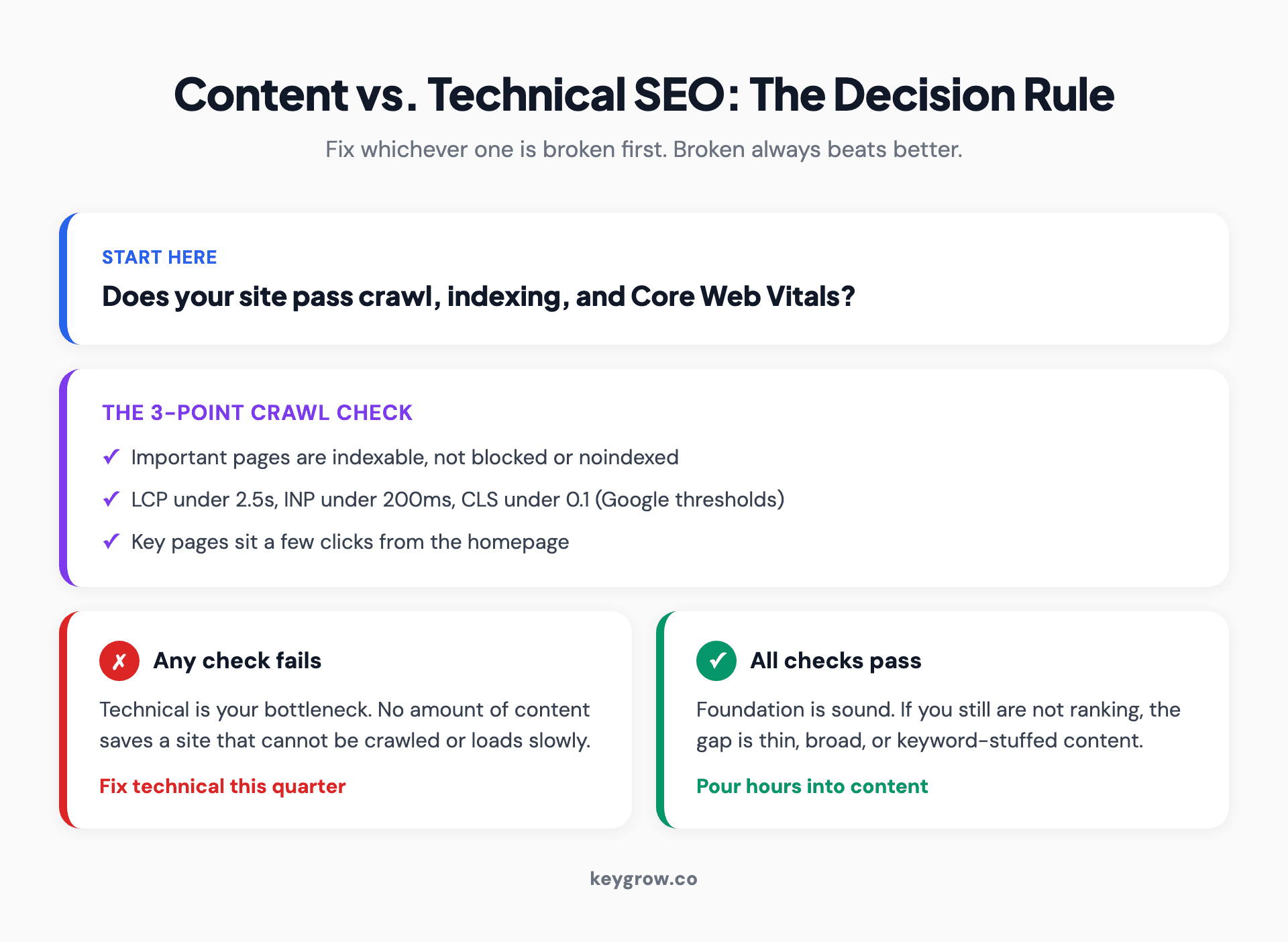
Decision flowchart for choosing between content and technical SEO based on whether your site passes crawl, Core Web Vitals, and indexing checks
Short-term wins vs. long-term compounding: how long this actually takes
The rule: take the cheap short-term wins early to fund patience for the long ones, but never let quick wins become the whole strategy. SEO pays out on a curve, and the front of that curve is flat enough to make people quit.
The numbers are sobering. That same Ahrefs study found the average page ranking at position one is roughly five years old, and 72.9% of top-10 pages are more than three years old. Pages do not age into rankings by sitting there; they age because the ones that survive keep earning links and updates. About 40.82% of pages that reach the top 10 do it within a month, but those are overwhelmingly low-competition terms. For anything worth real traffic, the timeline is measured in quarters, not weeks.
This is where short-term wins earn their keep. Updating existing pages that already rank on page two, fixing internal links to your money pages, and capturing low-competition long-tail terms all show movement in weeks. Use those to keep stakeholders calm while the compounding work matures underneath.
We watched this play out with a doctor's practice in Dubai that committed to a full year of SEO. Months one through three looked unimpressive on the surface. By month twelve, organic traffic had grown 1,519% and the practice was fielding 130+ patient calls a month. Same site, same client, no shortcuts. The businesses that quit at month three pay for the hard part and leave right before the payout. If the slow front of the curve is your worry, we go deeper on why SEO takes so long.
The strong opinion here, backed by that 1.74% figure: "page one in 30 days" is a red flag, not a real promise. Anyone selling it is either targeting keywords nobody searches or about to do something to your domain you will regret.
User experience vs. optimization: where they fight and where the fight is fake
The rule: when UX and SEO appear to conflict, UX almost always wins, because most of the conflict is imaginary and the part that is real points the same direction.
The fake conflicts are everywhere. "We need more keywords on the page" vs. "it reads badly" is a false choice; a page that reads badly converts badly and gets abandoned, which Google notices. "We need this above the fold for SEO" is usually someone defending clutter. Modern ranking and good UX want the same things: fast load, clear structure, content that answers the question without making people dig.
Where it is real: speed. Heavy hero videos, autoplaying carousels, and tracking scripts can make a page feel rich while wrecking load time. Per Think with Google, 53% of mobile visits are abandoned if a page takes longer than three seconds to load, and the probability of a bounce climbs 32% as load time goes from one second to three. That is the one genuine tradeoff, and it resolves toward speed every time.

Hand holding a smartphone showing a web page, conveying mobile page speed
The honest exception: there are cases where a heavier interactive element earns its weight, like a mortgage calculator or a booking widget that drives the actual conversion. Strip the decorative weight first. Keep the functional weight that makes you money.
Breadth vs. depth: how many topics can you actually win?
The rule: go deep before you go wide, and let your domain's authority set how wide you are allowed to go. A new site that publishes one thin post each across twenty topics will rank for none of them. The same effort spent making three pages genuinely the best answer on the internet for their query has a real chance.
The math behind this is brutal. Ahrefs' study of around 14 billion pages found that 96.55% of pages get zero organic traffic from Google, and only 3.45% get any at all. Breadth without depth manufactures pages that join the 96.55%. Depth is what gets a page into the 3.45%.
The practical version: pick one topic cluster, build a strong pillar page and a handful of supporting pages that link to each other, and make them clearly better than what currently ranks. Once that cluster earns rankings and links, your domain has more authority to spend, and you can open a second cluster. Breadth is a reward you earn with depth, not a starting strategy. Keywords still set the targets here, and we cover how to use them without writing for the robot in do keywords matter in SEO.
Effort vs. ROI: the tradeoff that decides the rest
The rule: prioritize by impact divided by effort, and protect your highest-impact work from being crowded out by easy busywork. This is the tradeoff that governs all the others, because every choice above is really a question of where the next hour goes.
A simple way to apply it is an effort-impact pass. List your candidate tasks, score each one on likely impact and required effort, and do the high-impact, low-effort items first. Most teams already know what these are: the page on position six that one good rewrite could push to position three, the product category with no content, the title tags nobody has touched since launch. The trap is that low-impact, low-effort tasks feel productive and quietly eat the calendar.
| Task | Impact | Effort | When to do it |
|---|---|---|---|
| Rewrite a page stuck on page two | High | Low | First |
| Build content for a high-value topic gap | High | High | Second, scheduled |
| Fix Core Web Vitals failures | High | Medium | First, if failing |
| Add internal links to money pages | Medium | Low | Quick win, anytime |
| Cosmetic meta tweaks site-wide | Low | Medium | Last, or never |
The constraint nobody admits to: most local and small businesses are not balancing a team, they are balancing the finite hours of one part-time person. If that is you, the answer is not to do a little of everything. It is to do one high-impact thing per month, finished, rather than five things half-done. SEO is an ongoing discipline, not a one-time project, which is why we treat ongoing SEO as the realistic frame for small operators.
When this is NOT worth it: if the math says your best keyword brings in a handful of searches a month and your margins are thin, SEO may simply lose to paid ads or referrals for now. An honest effort-vs-ROI pass sometimes tells you the next hour belongs in a different channel entirely. That is a valid answer.
The new tradeoff: ranking vs. getting cited in AI answers
The rule: keep doing the fundamentals, because they feed both, but start writing so a machine can quote you, not just rank you. AI Overviews and answer engines are pulling answers directly into the results, and the skills that win a citation are not identical to the ones that win a blue link.
What shifts: classic SEO rewarded depth and dwell time, so people wrote long. AI answers reward a clean, extractable answer near the top of the page, stated plainly. Burying the answer under 600 words of warm-up, which used to pad ranking signals, now actively keeps you out of the quoted box. Our own published work on AEO found that AI engines tend to cite only a small fraction of the pages they retrieve, which means the answer-first page wins the citation and the rambling one loses it even if both rank.
The good news is that the foundation is shared. A fast, crawlable site with deep, accurate, well-structured content does well in both worlds. The new layer is format: lead with the direct answer, use clear headings phrased as questions, and keep the facts specific and sourced so a model can lift them with confidence. You do not abandon ranking to chase citations. You write once, in a way that earns both.
For more on how these results are changing the game, Search Engine Land has steady coverage; their guide to AI Overviews tracks how the feature keeps reshaping click behavior.
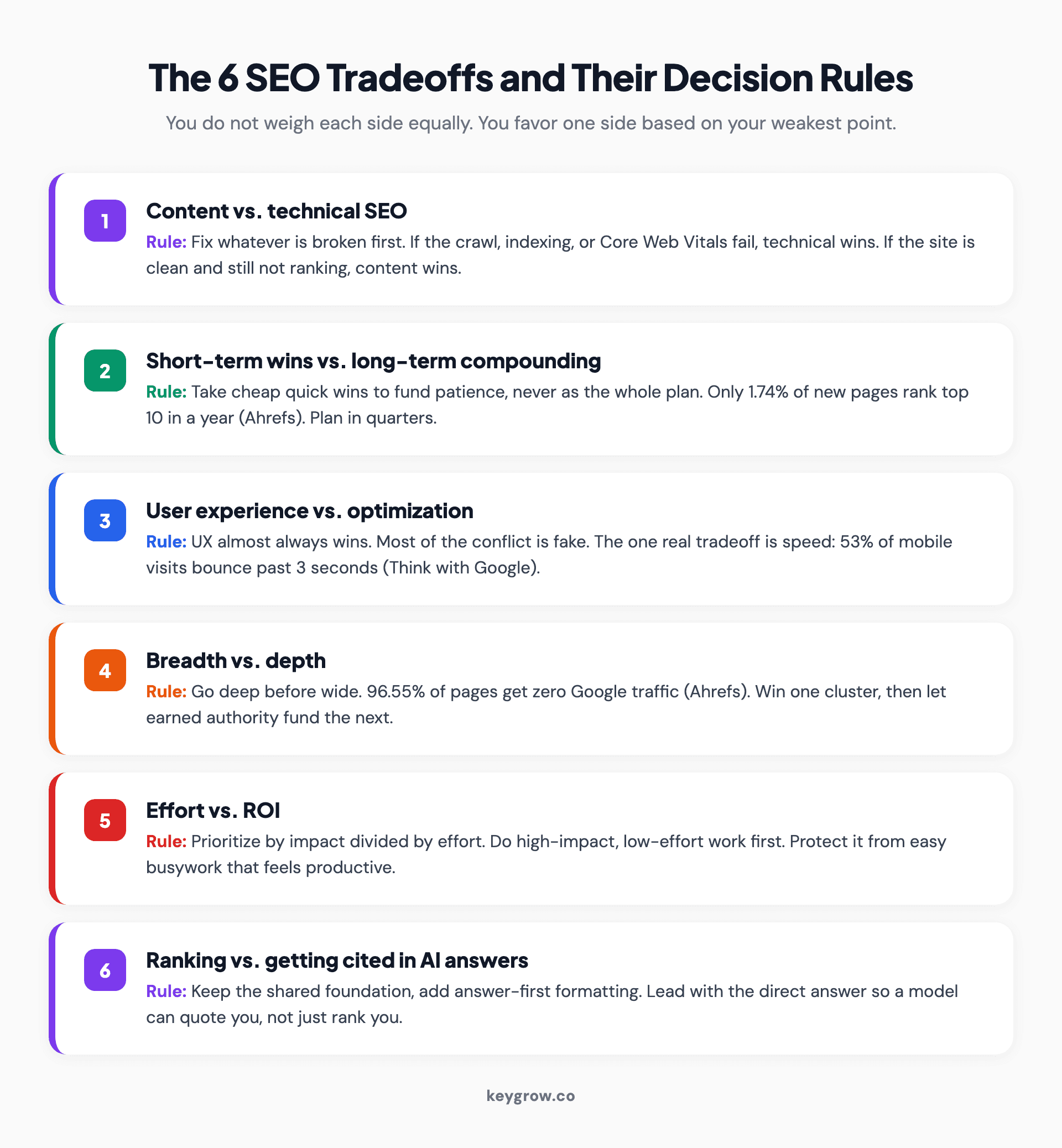
Six SEO tradeoffs each paired with a one-line decision rule for which side to favor and when
How to decide when two priorities both feel urgent
When two of these feel equally urgent, break the tie in this order. First, anything broken beats anything merely improvable; a crawl failure or a Core Web Vitals fail jumps the queue. Second, the higher impact-to-effort score wins. Third, if they are still tied, favor the work that compounds (content, links, authority) over the work that plateaus (one-off technical fixes), because compounding work keeps paying after you stop.
That order resolves almost every real standoff. Thin content on a fast site? Content. Great content on a slow, half-indexed site? Technical, until it passes. New domain torn between ten topics? Depth on one. Established site with authority to spend? Now breadth earns its turn.
FAQs
What is the most important thing to balance in SEO?
Effort vs. ROI, because it governs every other choice. Once you accept that your hours are finite, every other tradeoff (content vs. technical, breadth vs. depth) becomes a question of where the next high-impact hour goes. Score tasks by impact divided by effort and the rest of the balancing gets much simpler.
Should you focus on content or technical SEO first?
Fix whatever is broken first. If your site fails a crawl, has indexing problems, or fails Core Web Vitals, technical wins until it passes. If the technical foundation is sound and you still are not ranking, the bottleneck is content, and more technical work becomes procrastination.
How long does SEO take to show results?
Plan in quarters, not weeks. Per Ahrefs, only 1.74% of new pages rank in the top 10 within a year, and the average number-one page is around five years old. Low-competition terms can move in a month, but anything competitive compounds slowly, with real inflection often around the six-to-twelve-month mark.
Can good SEO hurt user experience?
Rarely, and when it seems to, the SEO advice was usually wrong. Modern ranking wants the same things users want: fast load, clear structure, and a direct answer. The one genuine tension is page speed, since heavy media slows pages, and Think with Google reports 53% of mobile visits are abandoned past three seconds, so speed wins.
Is it better to publish more content or fewer in-depth pages?
Fewer, deeper pages, especially on a newer site. Ahrefs found 96.55% of pages get zero Google traffic, and thin breadth manufactures pages that join that group. Win one topic cluster with genuinely best-in-class depth, then let the authority you earn fund expanding into new topics.
How do you balance SEO with optimizing for AI Overviews?
Keep the shared foundation (fast, crawlable, deep, accurate content) and add answer-first formatting on top. Lead with the direct answer, use question-style headings, and keep facts specific and sourced so a model can quote you. You write once in a way that earns both a ranking and a citation rather than choosing between them.
How to pick your next move
Stop trying to keep all six tradeoffs level. Pick the one that is currently capping your results, apply its rule, finish the work, then re-check. Broken beats better, impact-to-effort breaks the tie, and compounding work wins the last standoff.
If you would rather have someone run that triage with you and tell you honestly which lever to pull first (including when the answer is "not SEO yet"), that is the conversation we have on every call. We work month-to-month, cancel anytime, so the results have to keep earning the engagement. Get started here when you want a second set of eyes on where your next hour should go.


