


Which of these will fill a chair next month, not next year?
Usually the boring one. The patients already sitting in your practice software, overdue for a cleaning or still thinking about the crown you quoted in March, are closer to a booking than anyone an ad can reach.
Most lists of dentist marketing ideas skip that question. They give you twenty or thirty channels in no particular order, with a podcast near the top and the recall list somewhere around number twenty-six, and you are left to guess which idea pays this quarter and which needs a year of steady work.
So this list is sorted by the goal you have right now: more new patients, more implant and cosmetic cases, lapsed patients back on the schedule, or more Google reviews. Each idea comes with one thing to try this week, a rough cost, and how long it usually takes to produce a booked patient. After the four goals there is a short list of ideas that mostly waste money, and a note on when you can skip hiring anyone.
Every idea on one page
Fourteen ideas across four goals. Free and fast ones sit at the top of each group, because a practice should run those before it pays for anything slower.
The costs and timings are our working estimates for a single-location general practice, not industry data. Your market and your front desk will move them. The order is the useful part.
| # | Idea | Goal | Rough cost | Time to first booked patient |
|---|---|---|---|---|
| 1 | Fix the Google Business Profile | New patients | Free | 1 to 4 weeks |
| 2 | Call your own practice and fix what you hear | New patients | Free | Days |
| 3 | Publish an insurance and pricing page | New patients | Free to low | 2 to 8 weeks |
| 4 | Search ads for emergency and "dentist near me" | New patients | Ad spend | Days |
| 5 | Work the unscheduled treatment list | Implant and cosmetic | Staff time | 1 to 3 weeks |
| 6 | One page per high-value treatment | Implant and cosmetic | Low to medium | 1 to 3 months |
| 7 | A separate search campaign per treatment | Implant and cosmetic | Ad spend | 2 to 4 weeks |
| 8 | One elective offer on Facebook and Instagram | Implant and cosmetic | Ad spend | 2 to 6 weeks |
| 9 | Call and text the overdue recall list | Lapsed patients | Staff time | Days |
| 10 | Book the next visit before the patient stands up | Lapsed patients | Free | Next recall cycle |
| 11 | Send a benefits reset reminder | Lapsed patients | Free | 1 to 4 weeks |
| 12 | Ask every patient, by text, after they leave | Reviews | Free | Days |
| 13 | Reply to every review without confirming they are a patient | Reviews | Free | Compounds |
| 14 | Track who asked, not how many each person got | Reviews | Free | Compounds |
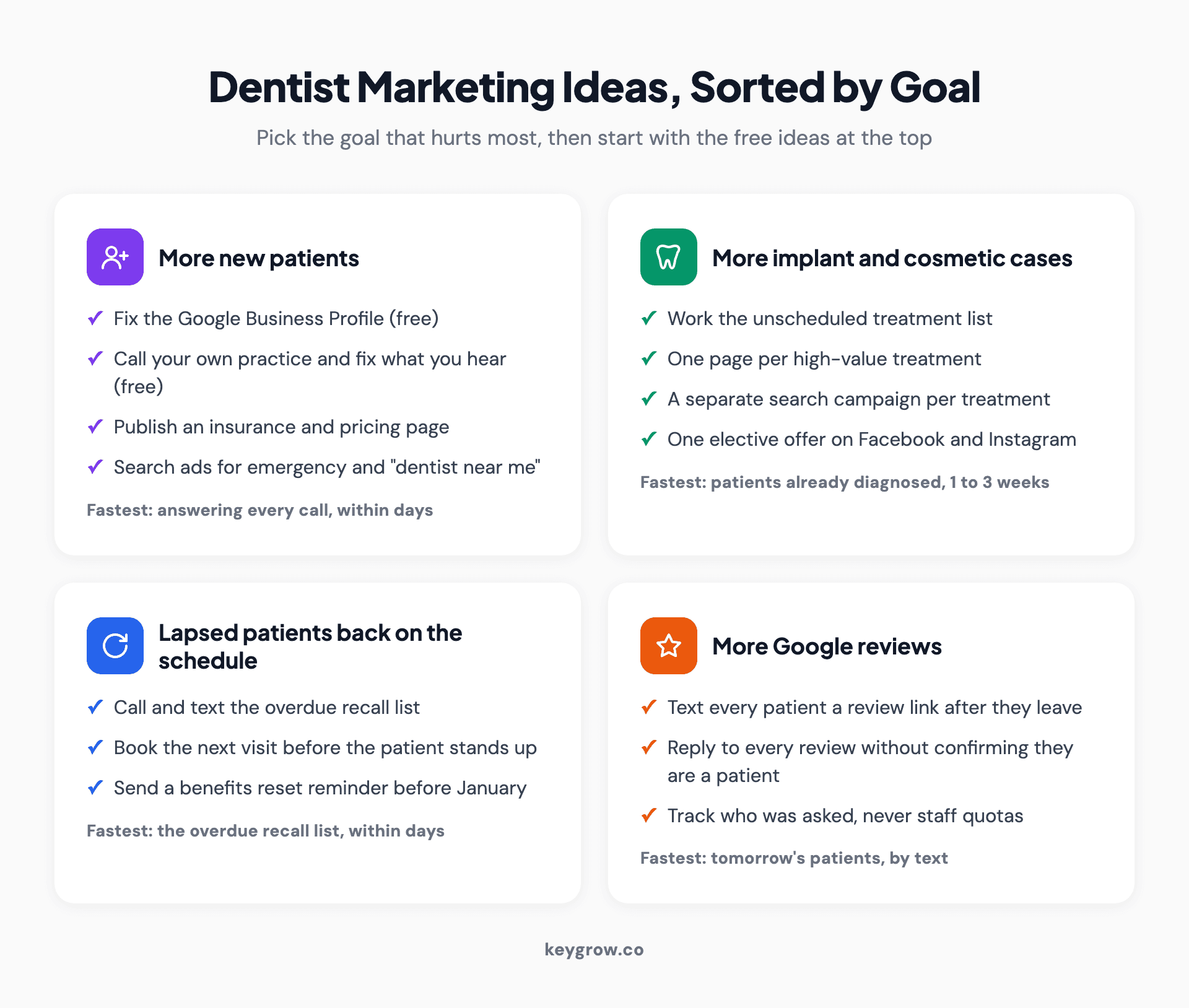
Four-card icon grid of dentist marketing ideas sorted by goal: more new patients, more implant and cosmetic cases, lapsed patients back on the schedule, and more Google reviews, each with its fastest ideas listed.
Goal 1: more new patients this month
New patients come from people already searching. The fastest wins make the practice easier to choose and easier to reach, which costs time rather than money.
1. Fix the Google Business Profile
For a local search like "dentist near me", the map results and your profile are often the first thing a patient sees, before your website. Check that the hours, phone number and appointment link are correct, list every service you offer, and add a few real photos of the office and team.
The primary category matters more than most fields. "Dentist" is right for a general practice, while a practice that mostly places implants or does cosmetic work may fit a more specific primary category with "Dentist" as a secondary. Our guide to choosing Google Business Profile categories shows how to test that.
Try this week: open your profile on a phone while logged out and read it as a stranger would. Fix anything wrong today, holiday hours included.
Rough cost: free.
2. Call your own practice and fix what you hear
Every marketing idea on this page ends in a phone call or an online booking. If the call goes to voicemail at lunch, or a new patient is told to "call back tomorrow", the ad or the profile did its job and the practice lost the patient anyway.
It is the cheapest leak on this page to fix.
Try this week: have someone you trust call as a new patient at 12:30, at 5:15 and on a Saturday morning. Note how long it rang, what they were asked and whether they were offered a time. Then pull last month's missed-call log from your phone system.
Rough cost: free. Call tracking software, if you add it later, is a modest monthly fee.

A clinician in a white coat on the phone while working at a laptop, the call that every dental marketing idea eventually depends on.
3. Publish an insurance and pricing page
The first questions most new patients ask are whether you take their insurance and roughly what a visit costs. A plain page listing the plans you accept, your new-patient exam price for people without insurance, and any membership plan answers both before the phone rings.
It also gives search engines and AI assistants a clear page to quote when someone asks which dentists nearby take their plan.
Try this week: ask the front desk for the five insurance questions they hear most, and put the answers on one page.
Rough cost: free if you can edit your own site.
4. Search ads for emergency and "dentist near me"
Paid search is the one fast channel that reaches people with a toothache today. In LocaliQ's healthcare benchmarks, built from 3,542 US search campaigns between October 2024 and September 2025, the median cost per lead was $84.77 for general dentistry and $75.19 for emergency dentistry.
Run emergency terms only during the hours someone answers the phone, and send them to a page with the number at the top. Our guide to Google Ads for dentists explains why emergency, routine and elective searches belong in separate campaigns.
Try this week: read the last 30 days of search terms if you already run ads. Add the obvious waste, such as job seekers and dental school queries, as negative keywords.
Rough cost: ad spend, plus management time.
If you would rather have someone build and watch that account, our dental PPC services cover the campaign split, call tracking and the weekly search terms review, month-to-month.
Goal 2: more implant and cosmetic cases
The cheapest high-value case is one you have already diagnosed. Start with the patients who said "let me think about it", then build pages and campaigns for the people who have not met you yet.
5. Work the unscheduled treatment list
Most practice management software can produce a report of treatment that was diagnosed and presented but never booked. Those patients have met you and heard the price, and most of them still need the work.
Start there.
Try this week: run the unscheduled treatment report for the last 12 months, sort it by value, and have one person call the top 20. Ask what got in the way. Cost and fear come up more than you would expect, which tells you what your treatment pages need to answer.
For the ones you cannot reach, keep it to three touches: a personal call within two weeks of the consult, a text with the financing option at four weeks, and a mention at their next hygiene visit. After that, stop. A fourth message starts to feel like pressure, and the patient will remember it.
Rough cost: staff time.
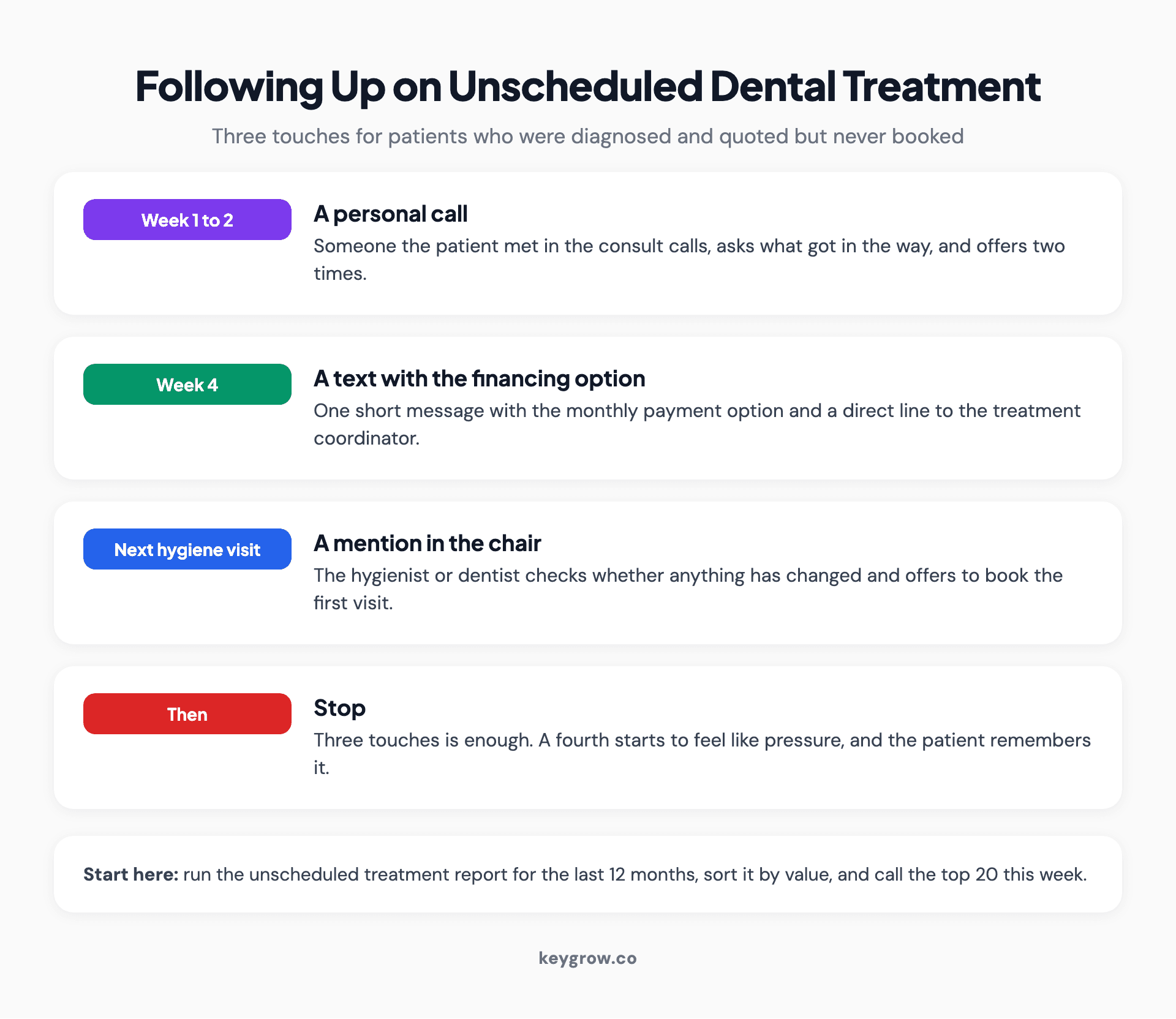
Three-step follow-up for unscheduled dental treatment: a personal call within two weeks of the consult, a text with the financing option at four weeks, and a check-in at the next hygiene visit, with a note to stop after three touches.
6. One page per high-value treatment
A single "Services" page with a paragraph on implants cannot rank for implant searches or answer an implant patient's questions. Give each high-value treatment its own page: who it suits, how many visits it takes, a price range or financing example, what recovery looks like, and photos of real cases.
Before you post any patient's photo or story, get their written authorization. A smile photo on your website is still that patient's health information, and HIPAA requires a signed authorization before you share it publicly. Have your compliance lead approve the consent form.

A dentist's gloved hands holding a model of an implant-supported denture and pointing to one of the implants with a probe, the kind of case a dedicated implant page should explain.
Try this week: write the implant page from the questions your treatment coordinator answers in every consult.
Rough cost: low if you write it, more if you hire a writer and photographer.
7. A separate search campaign per treatment
An implant search and a cleaning search should never share a budget. The implant case is worth many times more, so it can afford a higher cost per lead, and it needs its own ads that point to the implant page.
When both sit in one campaign, the cheap routine clicks usually win the budget.
Try this week: check whether implant, cosmetic and routine keywords share a campaign in your account. If they do, that split is the first structural fix.
Rough cost: ad spend.
8. One elective offer on Facebook and Instagram
Social ads work for elective treatment because they reach people who were not searching yet. You cannot target people by a dental condition, though. Meta removed detailed targeting options tied to health topics in January 2022, so location and the offer itself do the targeting.
Lead prices are lower than search but not low. LocaliQ's Facebook benchmarks, updated in September 2026, put the dental cost per lead at $61.56 against $27.39 across all industries. Pick one offer with a real case value behind it, such as an implant consult, and judge it on booked consults, not leads. Our guide to Facebook ads for dentists works through the break-even math.
Organic posts help the ads land. A before-and-after case (with that written authorization) or a two-minute video of your treatment coordinator explaining financing gives a stranger a reason to trust you before the consult. If nobody on the team has the hours, our dental social media marketing service plans and posts that content for you.
Try this week: write down the net value of one implant case and how many consults it takes to close one. That number tells you what a lead is worth before you spend anything.
Rough cost: ad spend, plus creative.
Goal 3: bring back patients who drifted
Lapsed patients are the fastest patients to win back, because they already have a chart, a history and usually a reason they stopped coming.
According to the CDC's FastStats, 66.7 percent of US adults had a dental exam or cleaning in the past year, from early 2025 National Health Interview Survey estimates.
Put the other way, about a third did not. Some of those people are on your books, and nobody has called them since their last cleaning.
9. Call and text the overdue recall list
Pull every active patient who is six months or more past their last hygiene visit and has no appointment booked. Send a short personal text first, then call the ones who do not reply. Name the hygienist they saw last if you can, so it sounds like someone at the front desk wrote it, because someone did.
On HIPAA: the rule's marketing definition excludes communications that describe a health-related service the practice itself provides, unless a third party pays you to send them. A recall reminder about your own cleanings generally falls outside it. Texting consent and the wording are still worth a check with your compliance lead.
Here is the math on a worked example. Every number below is an assumption, so swap in your own.
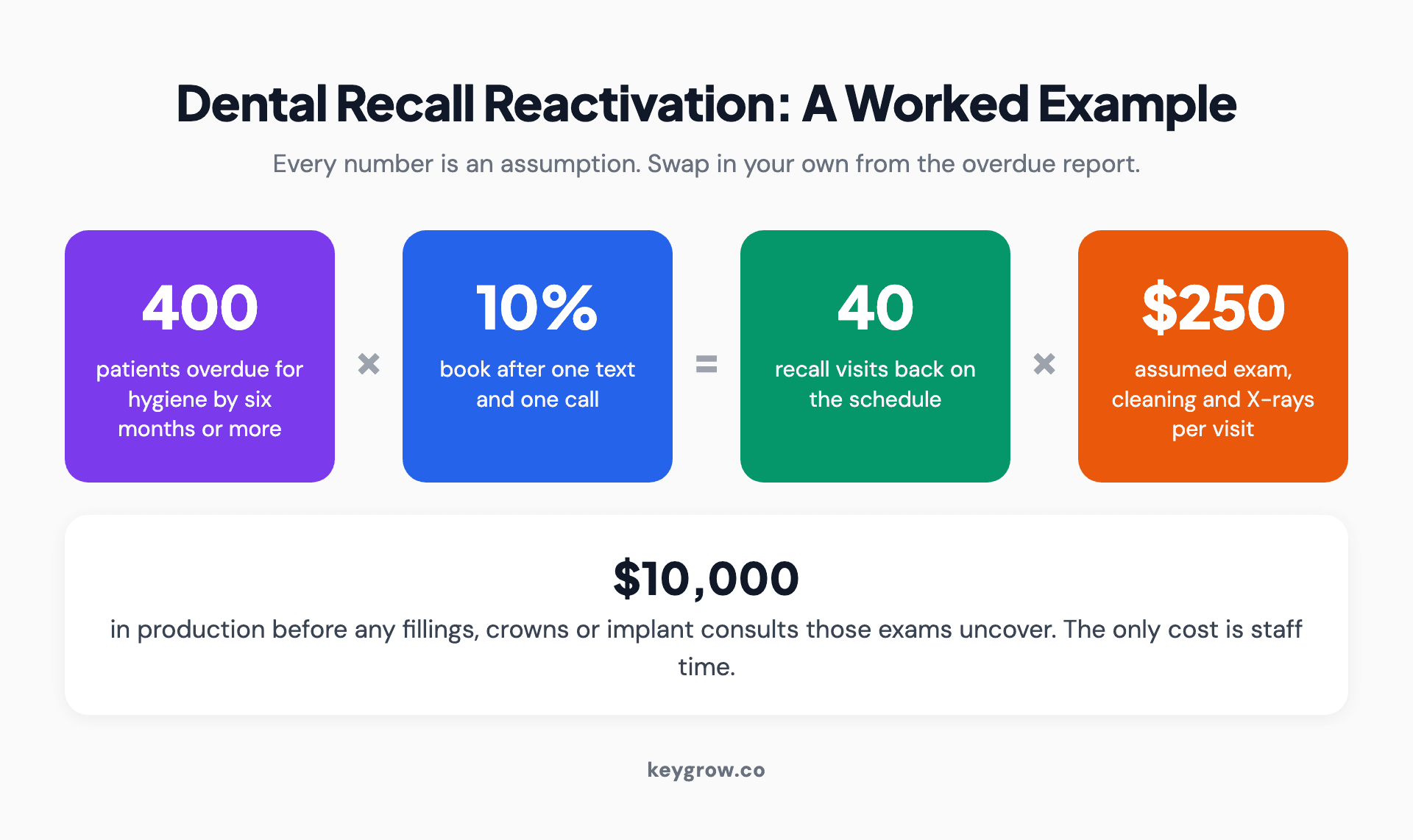
Worked example of dental recall reactivation: 400 overdue patients, 10 percent book after a text and a call, 40 recall visits, at an assumed 250 dollars each equals 10,000 dollars in production before any treatment those visits uncover.
Say the report shows 400 overdue patients and 10 percent book after a text and a call. That is 40 recall visits. At an assumed $250 for an exam, cleaning and X-rays, that is 40 × $250 = $10,000 in production, before any fillings, crowns or implant consults those exams uncover.
The only cost is staff time.
Try this week: run the overdue report and send the first 50 texts.
Rough cost: staff time.
10. Book the next visit before the patient stands up
The recall list stays short when the next hygiene visit is booked in the chair, before the patient reaches the front desk or hears "we'll send you a card".
People say yes to a date while the cleaning is still fresh.
Try this week: for five days, have the hygienist offer the next appointment before the patient leaves the chair, and count how many accept.
Rough cost: free.
11. Send a benefits reset reminder
For a patient whose dental plan has an annual maximum that resets in January, unused benefits this year are a reason to book now. A short note in November or early December, sent to patients with unfinished treatment, gives them a deadline they already care about.

A dentist and a patient sitting at a desk, reviewing an image of a smile on a monitor, the kind of treatment conversation a benefits reset reminder can bring back to the schedule.
Try this week: list patients with open treatment plans and remaining benefits, and send each one a personal reminder with two available times.
Rough cost: free.
Goal 4: more Google reviews, inside the rules
Reviews help a new patient pick between two practices on the same map, and the rules on how you ask for them are stricter than most dental marketing lists admit.
Google's review policy bans offering anything in exchange for a review, including discounts or free services. It bans asking only happy patients for reviews, and it says businesses should not pressure people to leave reviews while they are on the premises. It also bans asking staff to collect a set number of reviews.
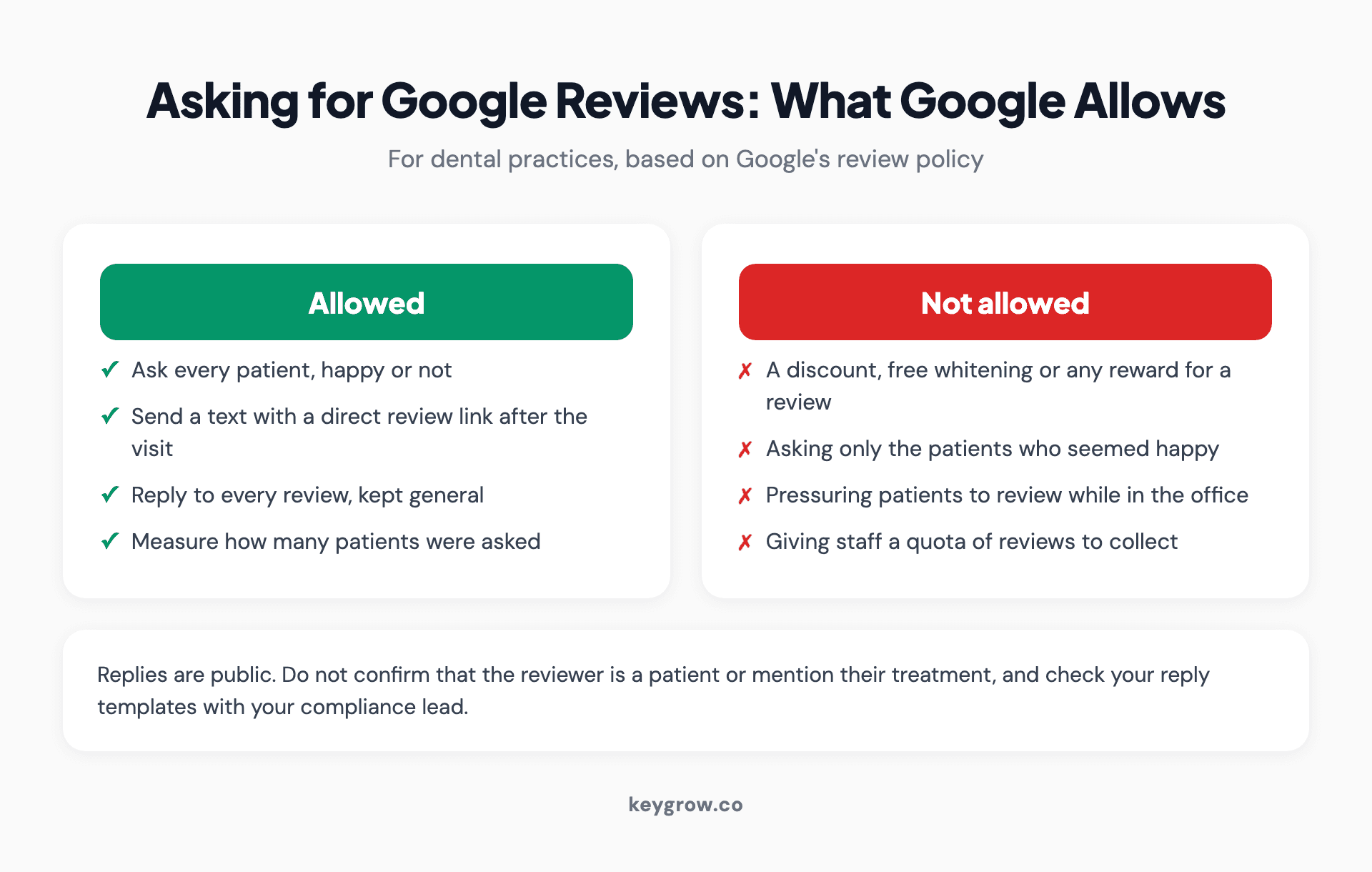
Comparison cards of Google review requests for a dental practice: allowed is asking every patient by text after the visit with a direct link and replying to every review, while not allowed is offering a discount or free whitening, asking only happy patients, pressuring patients in the office, and giving staff review quotas.
12. Ask every patient, by text, after they leave
Send one text a few hours after each visit with a direct link to your review form. Ask everyone, not only the patients who seemed pleased. Our walkthrough on how to create a Google review link takes about five minutes.

A dentist leaning over a patient in a bright treatment room with a garden view, the kind of visit a review request text should follow a few hours later.
Try this week: set up the link and have the front desk send it to every patient seen tomorrow.
Rough cost: free, or a small fee if your patient messaging software automates it.
13. Reply to every review without confirming they are a patient
A reply shows the next reader how you handle problems. But a public reply that mentions someone's treatment, or even confirms they are a patient, can disclose health information. Keep replies general: thank them, and invite anyone with a concern to call the office. Our guide to responding to Google reviews has templates you can adapt with your compliance lead.
Try this week: reply to every review from the last 90 days that has no response.
Rough cost: free.
14. Track who asked, not how many each person got
Because Google bars review quotas for staff, measure the process instead. Count how many patients received the text, not how many reviews each team member produced.
Try this week: add "review text sent" to the end-of-day checklist.
Rough cost: free.
Ideas that waste money
These turn up on most lists. For a single-location practice, each one usually costs more than it returns.
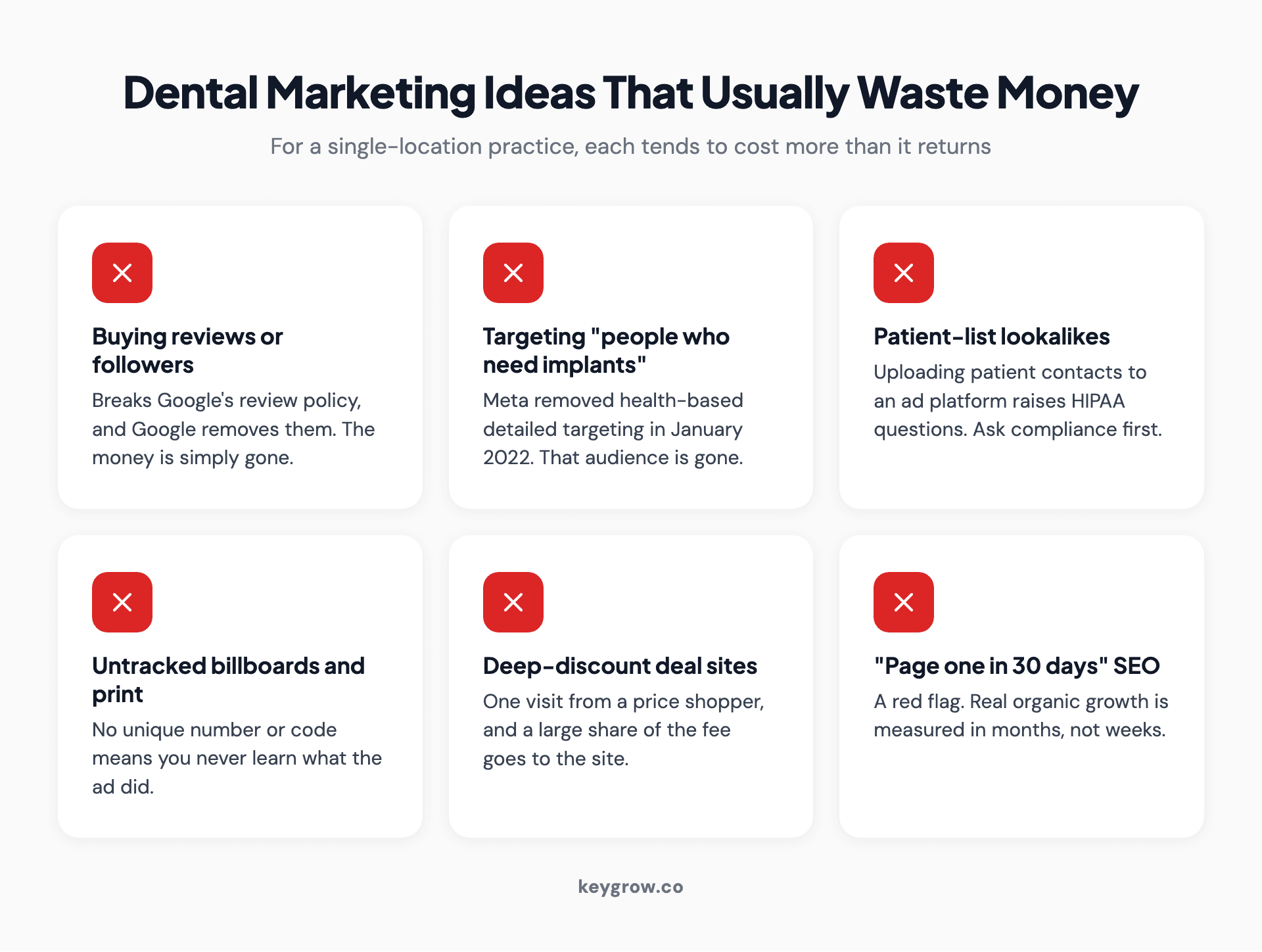
Icon grid of six dental marketing ideas that usually waste money: buying reviews or followers, targeting people who need implants on Facebook, uploading the patient list for lookalike audiences, untracked billboards and print, deep-discount deal sites, and SEO packages that promise page one in 30 days.
Bought reviews or followers. They break Google's review policy, Google removes them, and the money goes with them.
Targeting "people who need implants". That audience no longer exists on Meta. Any vendor still selling it is working from guides written before 2022.
Uploading your patient list for lookalike audiences. Sending patient contact details to an ad platform raises HIPAA questions most practices cannot answer cleanly. Talk to your compliance lead first, and expect the answer to be no.
Billboards and broad print with no tracking. If the ad carries no unique number or code, you will never know what it did.
Deep-discount deal sites. They fill the chair once with people shopping on price, and a large share of the fee goes to the site.
SEO packages promising page one in 30 days. That promise is a red flag, full stop. Anyone making it is either targeting phrases nobody searches or about to take shortcuts with your domain.
Where SEO and content fit
SEO is a next-year idea, and a good one.
It belongs on the list, just not in the column for filling chairs next month. Treat it as the thing you start now so that next November looks different.
Our clearest example is not a dental practice. A doctor's practice in Dubai committed to SEO for a full year. Months one to three looked unimpressive. By month twelve, organic traffic had grown 1,519 percent and the practice was taking 130+ patient calls a month. The 12-month SEO case study shows the work behind it: technical fixes, content and authority building, done consistently.
The treatment pages from idea 6 and the insurance page from idea 3 are the start of that work. If you want someone to carry it on month after month, our dental SEO services build on those pages with local rankings and the profile work. Our comparison of SEO vs Google Ads for dentists helps if you can only fund one channel this year.
When you do not need an agency
Nine of the fourteen ideas cost nothing but time: 1, 2, 3, 5, 9, 10, 11, 12 and 13. A single-location practice with a capable office manager can run all of them without us.
Most of it is a report, a phone and a free afternoon.
Hire help when the paid ideas start to matter, meaning search ads, social ads and SEO, or when the time you spend on marketing costs more than the fee. Until then, the overdue recall list and the unscheduled treatment report are worth more than any campaign you could buy. To see which channel sent which patient once you add paid ideas, tag every link with our free UTM builder.
FAQs
What is the best marketing for a dental practice?
For most practices, the best return comes from the patients you already have: the overdue recall list and diagnosed treatment that was never booked. After that, a complete Google Business Profile and a steady flow of reviews bring new patients for little or no cost. Paid search comes next for practices that need new patients quickly.
How do dentists get more new patients fast?
Fix the Google Business Profile, make sure every new-patient call is answered, and run search ads for emergency and "dentist near me" terms during staffed hours. Those three can produce bookings within days or weeks. SEO and content take months and should run alongside them, not instead of them.
How much should a dental practice spend on marketing?
There is no single right percentage. Work out what a new patient is worth to you over a few years, then decide what you can pay to acquire one. Start with the free ideas, and add paid channels once you can track which patients each one produced.
Can dentists offer incentives for Google reviews?
No. Google's review policy bans offering discounts, free services or anything else in exchange for a review. It also bans asking only satisfied patients and pressuring people to review while they are in the office.
Is it legal to text patients recall reminders?
Under HIPAA, a reminder about a service your own practice provides generally does not count as marketing, as long as no third party pays you to send it. Texting rules and patient consent still apply, so check your consent forms and message wording with your compliance lead.
What dental marketing ideas work for implants and cosmetic cases?
Start with patients who were already diagnosed and did not book. Then give each high-value treatment its own page, run a separate search campaign for it, and test one elective offer on social media. Judge every channel on booked consults rather than leads.
Pick the idea that fills next month's chairs
Look at the table again and pick one idea from the goal that hurts most right now. For most practices that is the overdue recall list or the unscheduled treatment report, because both are free and both produce patients within days.
Run it for a month, count the bookings, then add the next one. When you are ready to add paid channels, get in touch and we will tell you honestly whether you need help yet.