


Most restaurants do not have a marketing problem. They have a Tuesday problem.
The weekend mostly fills itself. The money leaks out on the two or three quiet nights when the kitchen is staffed, the lights are on and half the tables sit empty. So the restaurant marketing strategies worth your time are the ones that put people in those seats soonest for the least cash, and most of them are free. The paid channels everyone reaches for first belong near the bottom.
That is the reverse of the usual "30 ideas" article, where influencers and ads sit near the top and the Google profile turns up around number nineteen. Below are eleven strategies ranked by cost, weekly hours and how fast they bring in a cover, the ones to skip, and a 30-day calendar that puts them in order.
Why the order matters more this year
Traffic is the scarce thing. In February 2026 the National Restaurant Association reported that 60 percent of operators saw softer customer traffic last year, and 42 percent said their restaurant was not profitable.
Guests are pickier as well. A YouGov survey of 1,500 U.S. adults, run in August and September 2025 and summarized by Restaurant Dive, found 37 percent of diners eating out less often than a year earlier.
With margins like that, a strategy that needs three months to produce its first booking is a luxury. One that produces a booking next Tuesday is not.
How we scored each strategy
Each strategy gets three scores: cash cost, weekly effort, and the time it usually takes to produce the first extra cover. Then a verdict.
These are our working estimates for one independent location, not industry data, and your street and staff will move them. What matters is the relative order. Free, fast and easy beats expensive, slow and needing a dedicated person, however good the expensive option sounds in a meeting.
The ranked list
Read it top to bottom. Most restaurants should not touch row nine until rows one to five are running.
| # | Strategy | Cash cost | Weekly effort | Time to first covers | Verdict |
|---|---|---|---|---|---|
| 1 | Clean up your Google Business Profile | None | 1 hour once, then 15 minutes | Days | Do first |
| 2 | Put the menu on a real web page | None to low | One afternoon | 2 to 8 weeks | Do first |
| 3 | Run a review request after every meal | None | 10 minutes | Weeks, then compounds | Do first |
| 4 | Build an email and text list | Low | 30 minutes | The first send | Do this month |
| 5 | Give one slow night a standing offer | Cost of the offer | 1 hour to set up | 1 to 2 weeks | Do this month |
| 6 | Move repeat takeout to direct ordering | Ordering software | Setup, then low | The next repeat order | If you do takeout |
| 7 | Start a simple loyalty reward | Value of the rewards | Low | 1 to 3 months | If you have regulars |
| 8 | Partner with neighbors and offices | Low | 1 to 2 hours | 2 to 6 weeks | Good for lunch trade |
| 9 | Post on two social platforms | None | About 3 hours | 2 to 6 weeks | Only if someone owns it |
| 10 | Invite local creators for a comped meal | The meal | Low | Days after the post | Test once |
| 11 | Paid search and social ads | Ongoing ad spend | 1 hour or more | Days | Only after rows 1 to 5 |
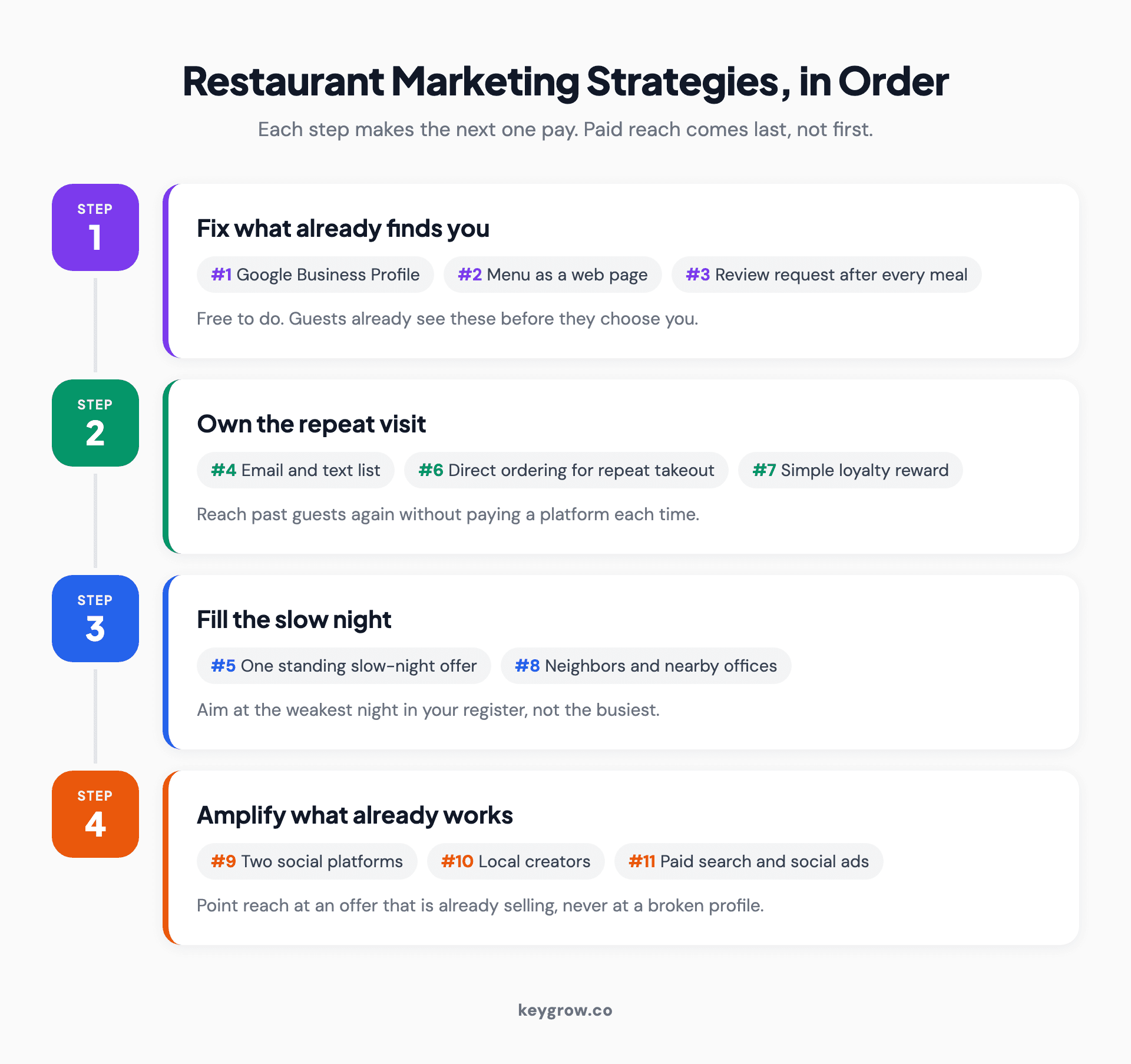
Four-step ladder of restaurant marketing strategies in the order to run them: fix what already finds you, own the repeat visit, fill the slow night, then amplify what works with social and paid ads.
The rows fall into four jobs, run in that order. Ads sent to a profile with the wrong hours and a PDF menu buy clicks that turn around at the door.
Fix what already finds you (1 to 3)
People searching for you, or for your kind of food nearby, already see your profile and your menu. Make both accurate before you pay to reach anyone new.
1. The Google Business Profile. For a restaurant this is the front door, and plenty of guests decide from it without opening your website. Check the hours on a phone while logged out, holiday hours included. Choose the most specific primary category available, link the menu, fill in the attributes people filter by (outdoor seating, reservations, good for groups) and add a few real photos each month. Our Google Business Profile optimization guide covers every field.
2. The menu as a web page. Search engines and AI assistants read a PDF menu badly, and on a phone it is miserable. Put every dish in plain text with its real name and a short description, so someone looking for birria tacos or gluten free pizza nearby can find you by the dish. That idea runs through our guide to SEO for restaurants.
3. A review request that runs itself. Recency counts for more here than in most local trades, because the kitchen two years ago is not the kitchen today. Print a QR code on the receipt, or let the booking system send a short note the next morning.
Check the rules first. Google's review policy bars discounts or free items in exchange for a review, bars asking only the happy guests, and says businesses should not pressure customers to review while they are still on the premises. So no free dessert for five stars, and no tablet passed across the table.
If you would rather hand the profile, the menu page and the review flow to someone, our local SEO services cover all three. With one location and a few spare weekends, though, you can do this tier yourself.
Own the repeat visit (4, 6 and 7)
A guest who has eaten with you once is the cheapest cover you will ever win back. These three give you a way to reach them again without paying a platform each time.

A cafe worker in an apron checking orders on a tablet at the counter, the point-of-sale screen where a restaurant can capture guest emails and phone numbers for its list.
4. Email and text. In the same YouGov survey, emails and newsletters were the top way diners heard about restaurant promotions, at 33 percent, with social media just behind at 32 percent. Your booking system and register are probably collecting addresses already. Switch on the opt-in and send one useful message a week. Save texts for things with a deadline.
6. Direct ordering for the second order. Let the delivery marketplaces find you new customers, then move the repeat order onto your own channel. Run the sum yourself: your commission rate times your monthly marketplace orders is what a direct ordering link is worth each month before you sell one extra meal. A card in every marketplace bag with that link does most of the work.
7. Loyalty. In that survey 37 percent of diners had used a restaurant loyalty program in the past year, and 77 percent said loyalty offers would make them visit more. The second figure is what people say rather than what they do, so keep it small. A stamp card beats a points app nobody downloads. If you have no regulars yet, skip it, because a reward scheme will not create them.
Fill the slow night (5 and 8)
Pick your weakest night from the register, not from memory, and give it one standing reason to come in. Then go after the people nearby who buy lunch every weekday.

Three wooden chalkboard menus standing outside a cafe's glass doors, the kind of standing board that can carry one slow-night offer for a month.
5. One slow-night offer. Pull eight weeks of covers by night and circle the lowest. Give it one offer, a two-course set price, an industry night or a family deal, and leave it alone for at least four weeks so people hear about it twice. Deals do move diners: in the YouGov data, two-for-one offers (58 percent) and discounts (56 percent) were the strongest reasons people gave for eating out more.
Price it so it still pays. The numbers in this worked example are assumptions, so swap in your own.
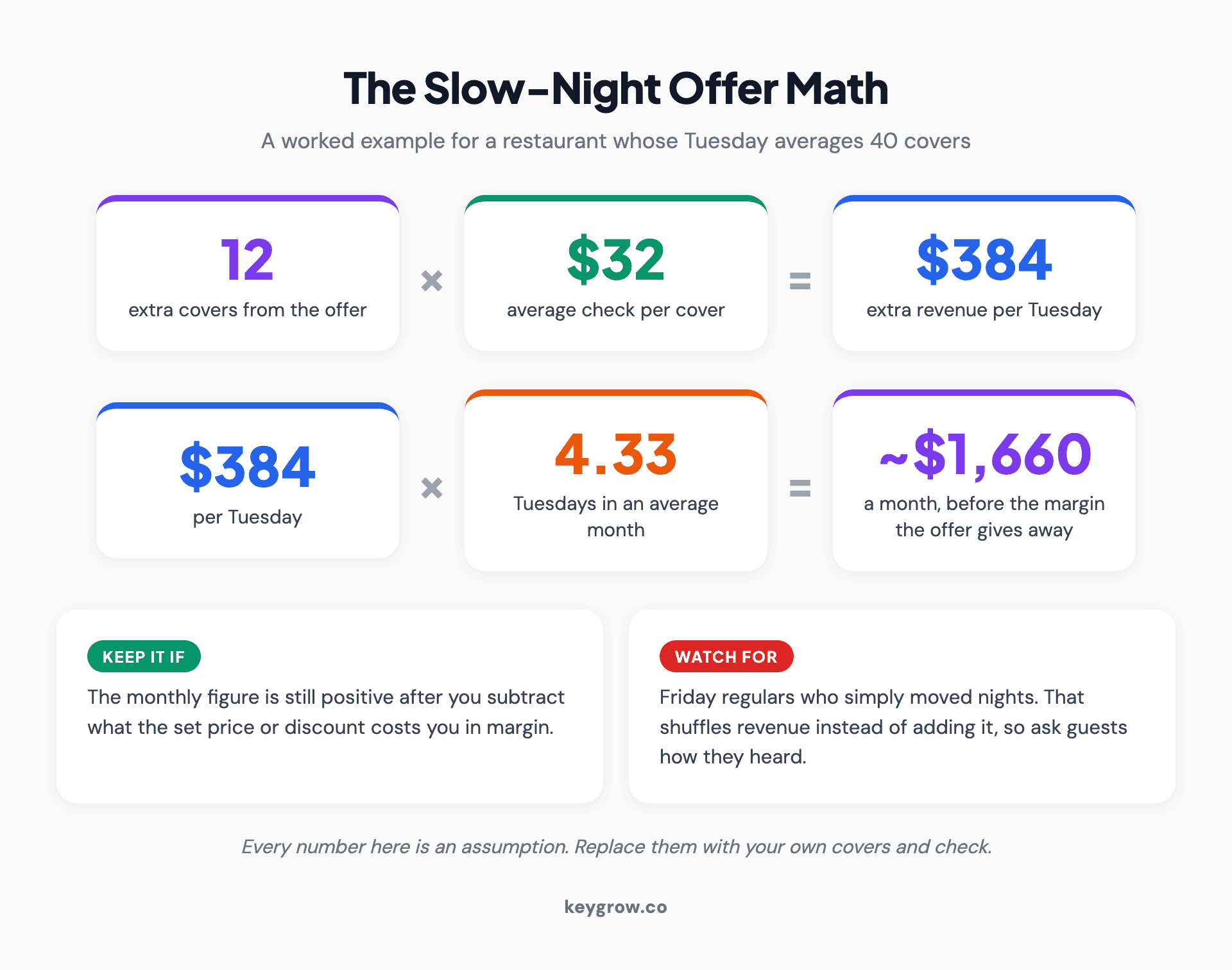
Worked example of the slow-night math for a restaurant offer: 12 extra covers times a 32 dollar average check equals 384 dollars a night, about 1,660 dollars a month, before the cost of the offer.
Say Tuesday averages 40 covers at a $32 check, and a set menu adds 12 covers. That is 12 × $32 = $384 a Tuesday, or about $1,660 over the 4.33 Tuesdays in an average month, before the margin the offer gives away. If the extra covers turn out to be Friday regulars who simply moved nights, you have shuffled revenue rather than added it. Ask guests how they heard.
8. Neighbors and offices. Lunch trade lives within a few blocks. Drop menus with a group order line at the offices nearby, swap counter space with the gym or bookshop next door, and ask the hotel concierge what guests keep asking for. An office that orders lunch for twelve every Thursday is worth more than a month of posts.
Amplify what already works (9 to 11)
Social, creators and ads multiply whatever is already happening. Point them at an offer or a dish that is selling, never at a restaurant that has not fixed the first tier.
9. Two social platforms, not five. Instagram plus Facebook covers most independents. Add TikTok only if someone on staff enjoys filming. Our restaurant social media plan sets out a sample week that takes under three hours, with each post tied to a dish ordered or a table booked. If nobody has those hours, our social media marketing services can run the same week for you, month-to-month.
10. Local creators. Offer a meal rather than a fee to people whose followers live near you, give each one their own dish or code word, and judge the post on covers. Try it once, on your slow night.
11. Paid ads. Ads are fast, which is why they come last. They pour people into whatever is already there. Sending ad clicks to your homepage is the most expensive default in paid advertising: a mobile detailing client of ours paid $100 per booking with clicks landing on the homepage, and a dedicated booking page took that to $22 between August and December 2022. Different trade, same mechanics. Send restaurant ads to the offer page or the reservation page.
What to skip, for now
A few popular restaurant marketing ideas cost an independent more than they return. Leave them until the cheaper tiers are running.
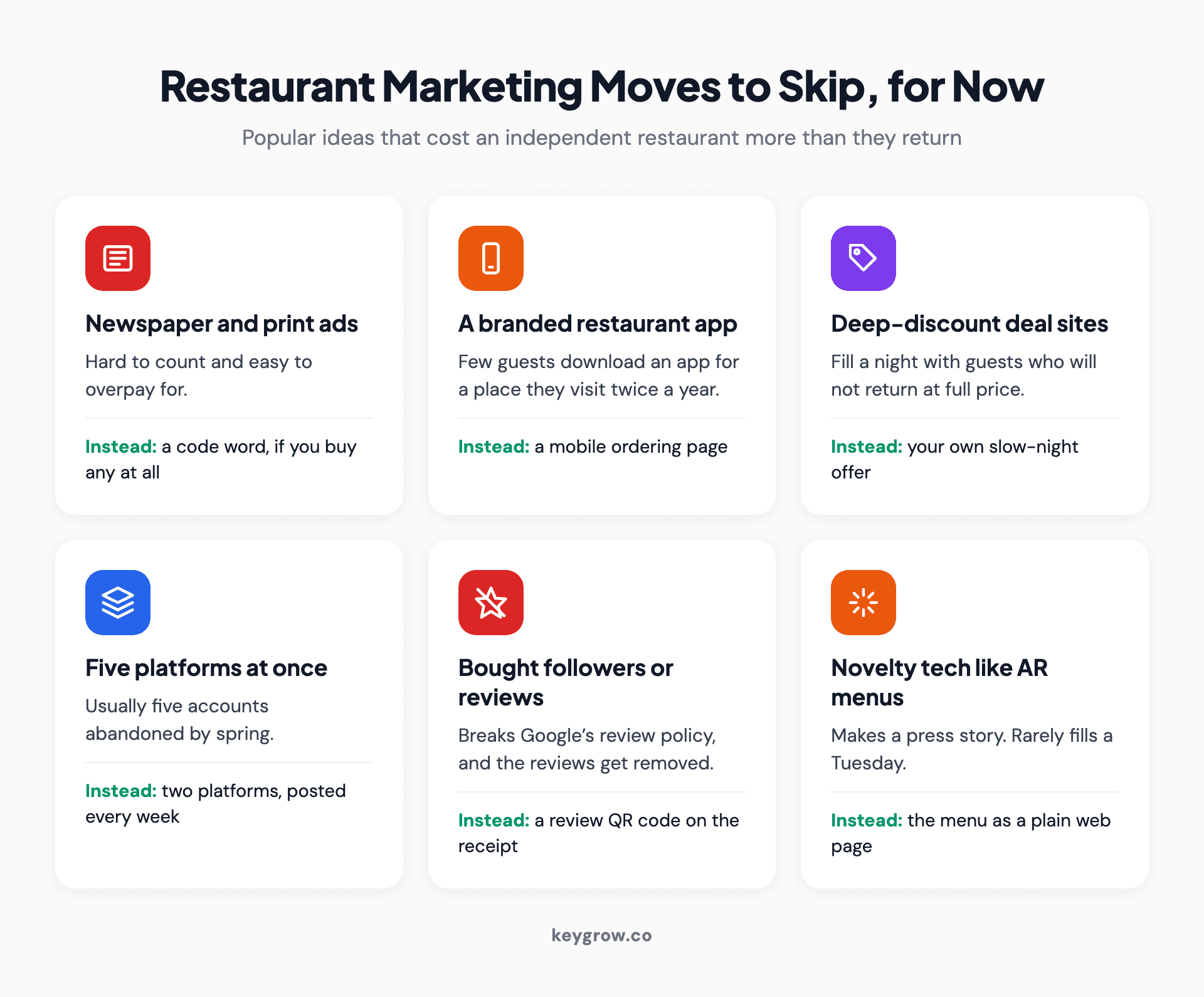
Icon grid of six restaurant marketing moves to skip for now: newspaper and print ads, a branded restaurant app, deep-discount deal sites, posting on five platforms, buying followers or reviews, and novelty tech such as AR menus.
Print ads are hard to count and easy to overpay for, unless the paper's readers are exactly your lunch crowd and the ad carries a code word. A branded app asks guests to download something for a place they visit twice a year; a mobile ordering page does the job. Deep-discount deal sites fill a quiet night with people who came for the price and will not come back at full price, and they take a large slice of the bill on the way.
Posting on five platforms usually means five accounts abandoned by spring. Bought followers or reviews break Google's policy and get removed. And augmented reality menus make a nice press story without filling a single Tuesday.
A 30-day calendar to run it
Week one fixes what finds you, week two builds the list, week three launches the offer, and week four counts.
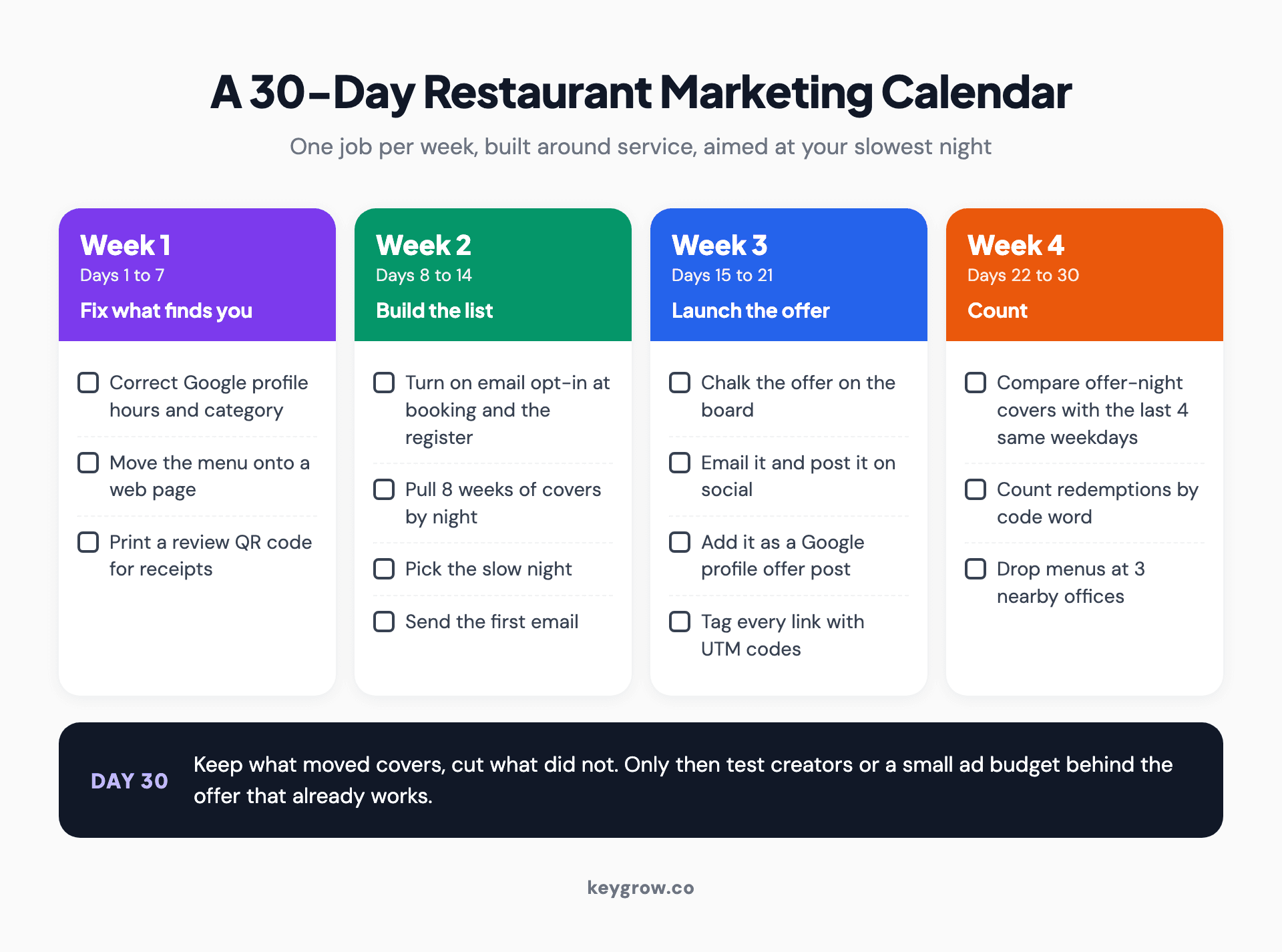
Four-week restaurant marketing calendar: week one fixes the Google profile, menu page and review QR code, week two turns on email capture and picks the slow night, week three launches and promotes the offer, and week four counts covers and decides what to keep.
Week 1. Correct the Google profile, move the menu onto a web page, and print the review QR code for receipts.
Week 2. Turn on email opt-in at booking and at the register. Pull covers by night, pick the slow one, and send the first email.
Week 3. Launch the offer. Chalk it on the board, email it, post it, and add it to the profile as an offer post, the format our guide to Google Business Profile posts explains. Tag each link with our free UTM builder so you can see which channel sent the booking.
Week 4. Compare covers on the offer night with the same weekday over the previous four weeks, and count redemptions by code word. Drop menus at three nearby offices.
Then keep what moved a number and drop what did not. Creators and a small ad budget come after that, behind the offer that already works.
When you do not need an agency for any of this
If the owner or a manager can find three or four hours a week, a single location can run everything above alone. The first three tiers are mostly setup, and the calendar fits around service.
Bring in help when you open a second site, when you want ads with proper tracking, or when nobody has the hours and the slow night keeps slipping.
FAQs
What is the most effective marketing strategy for a restaurant?
For most independents, an accurate Google Business Profile with correct hours, a linked menu and recent reviews. It costs nothing and it is where many guests make up their minds. After that, an email list and one standing offer on your slowest night usually bring covers back faster than any paid channel.
How much should a restaurant spend on marketing?
Do the free work before setting a cash budget, because the first tier costs time rather than money. Once the profile, menu, reviews and list are running, put a small fixed test budget behind the one offer already producing covers. Judge each dollar by covers and bookings, not reach.
How do you bring customers in on slow nights?
Find the slowest night in your sales data and give it one standing offer, such as a set menu, an industry night or a family deal. Run it for at least four weeks and promote it by email, on your Google profile and on a board outside. Compare covers with the same weekday in earlier weeks.
How can a new restaurant get its first customers?
Have the Google profile verified and complete before opening, with real photos and the menu as a web page. Invite neighbors and nearby offices to a soft opening and collect emails from the first week of bookings. Ask early guests for honest reviews through a receipt QR code, with no incentive attached.
Do restaurants really need social media?
Most benefit from it, but only when one person owns it. Two platforms posted every week, usually Instagram and Facebook, do more than five accounts left to go quiet. If nobody has about three hours a week, fix the profile and the email list first.
Is it worth paying a restaurant marketing agency?
Sometimes. One location with an owner who has a few hours a week can handle the first three tiers alone. Paid help makes sense across several locations, for ad campaigns that need tracking, or when the hours are not there.
Fill the slow Tuesday
Pull your covers by night this week and circle the weakest one. Fix the profile and the menu, start the list, and give that night one reason to come in. Then count for four weeks before adding anything else.
If you want a second opinion on which of these is your real bottleneck, tell us about your restaurant. If the answer is that you can run it yourself, we will say so.