


An architecture portfolio is the best SEO asset a firm owns and the worst one most firms publish.
SEO for architecture firms is the work of turning that portfolio, plus a handful of service pages, into something Google and AI assistants can read: project pages with words on them, images a search engine can understand, a licensed architect's name on the work, and plain answers to the questions clients ask before they call. Most firm sites have the raw material already. It just sits in a full-screen gallery with a project name and no text, which is a beautiful way to rank for nothing.
This guide is the order we would fix it in, with a worked example and an honest section on when you should leave SEO alone.
Why does SEO work differently for an architecture practice?
An architecture firm needs a few qualified inquiries a year, not traffic. SEO has to win the referral check and a narrow set of specific searches.
Plenty of commissions start with a name passed along by a builder, a past client or another consultant. The prospect then searches that name, opens your site, and decides whether you look like the firm for their project. If the portfolio shows twelve photos of houses and nothing about budget, site or process, a developer with an adaptive reuse brief has no way to tell you have done one.
The second job is cold search, and it is narrow. Nobody useful types "architect". They type "architect for steep lot", "adaptive reuse architect [city]" or "how much does an architect cost for an addition". Each of those has a page that should answer it, and on most firm sites that page does not exist.
Accounting firms have the same split between referral verification and cold search, which we unpacked in our guide to SEO for accountants. The difference is that an architect's proof is visual, so the fix starts with the portfolio.
The project page is the unit of architecture SEO
Give every featured project its own page with a written brief, the site and its constraints, the design response, the outcome, and captioned images.
A gallery tells a visitor the work is good. A project page tells them, and Google, what problem the firm solved, where, and for whom. That second thing is what ranks and what convinces a prospect that their own messy site is in safe hands.
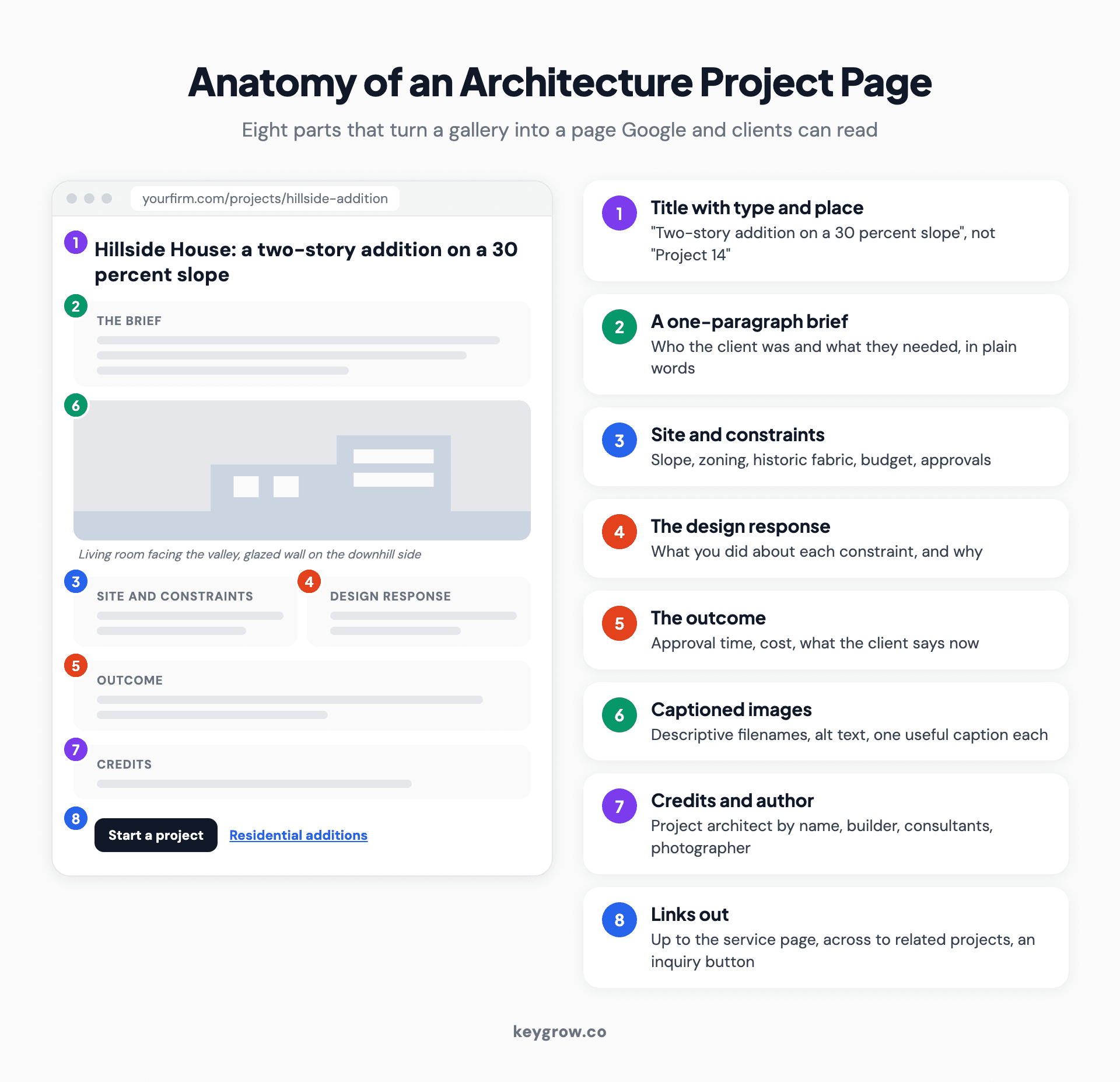
Annotated mockup of an architecture project page showing eight parts: a descriptive title with project type and place, a one-paragraph brief, site and constraints, the design response, the outcome, captioned images, project credits, and links to the related service page and an inquiry.
Here is a worked example, invented for this guide but typical of the pages we see.
Before: the page title is "Hillside House". The body is fourteen photos and one line: "A family home overlooking the valley."
After: the title becomes "Hillside House: a two-story addition on a 30 percent slope". The first paragraph says the owners needed a second bedroom wing without losing the view, the lot was steep enough that the city required an engineered retaining wall, and the budget ruled out a full rebuild. The next sections cover the design response, the materials and why, how long permitting took, and what the owners say now. The photos keep their place, each with a caption.
Nothing about the design changed. The second page can now answer "addition on a sloped lot", "hillside home architect" and a dozen variations, and a prospect with a sloped lot reads it and recognizes their own problem.
Aim for 300 to 600 words per project. If you have no idea what to write, answer the questions a client asked in the first meeting. Custom home builders run into the same gap between a gallery and a page, which is why our post on SEO for home builders argues for project portfolios deep enough to read.
Which projects should get a page first?
Start with built projects you have permission to publish, that you own the photo rights for, and that match the work you want more of.
A firm with eighty projects does not need eighty pages next month. Pick the first ten with four filters:
- Permission. Check your owner agreement for a publicity clause, then ask the client anyway. Private residential clients often want the house shown without the street name, and that is easy to honor.
- Photo rights. Architectural photographers usually license images for set uses. Confirm the license covers your website, and ideally the builder and any publication that picks the project up.
- Direction. Publish the work you want more of. If you want commercial interiors and your portfolio leads with kitchens, you will get kitchen calls.
- Story. Projects with a hard constraint (a slope, a historic facade, a tight budget, a tricky approval) write themselves. Pretty but uneventful ones can wait.
Unbuilt work and competition entries can have pages too. Label them clearly as concept or competition work, because a rendering presented as a finished building is the fastest way to lose a careful client's trust.
Build the service and project-type pages the projects feed
Project pages prove the work. Service and project-type pages collect the broader searches, so link each project up to its type and each type back down.
A searcher looking for a commercial architect lands best on a page about commercial work, with three or four projects linked from it. A searcher looking for one specific kind of project lands on the project. You need both layers, and they need to point at each other.
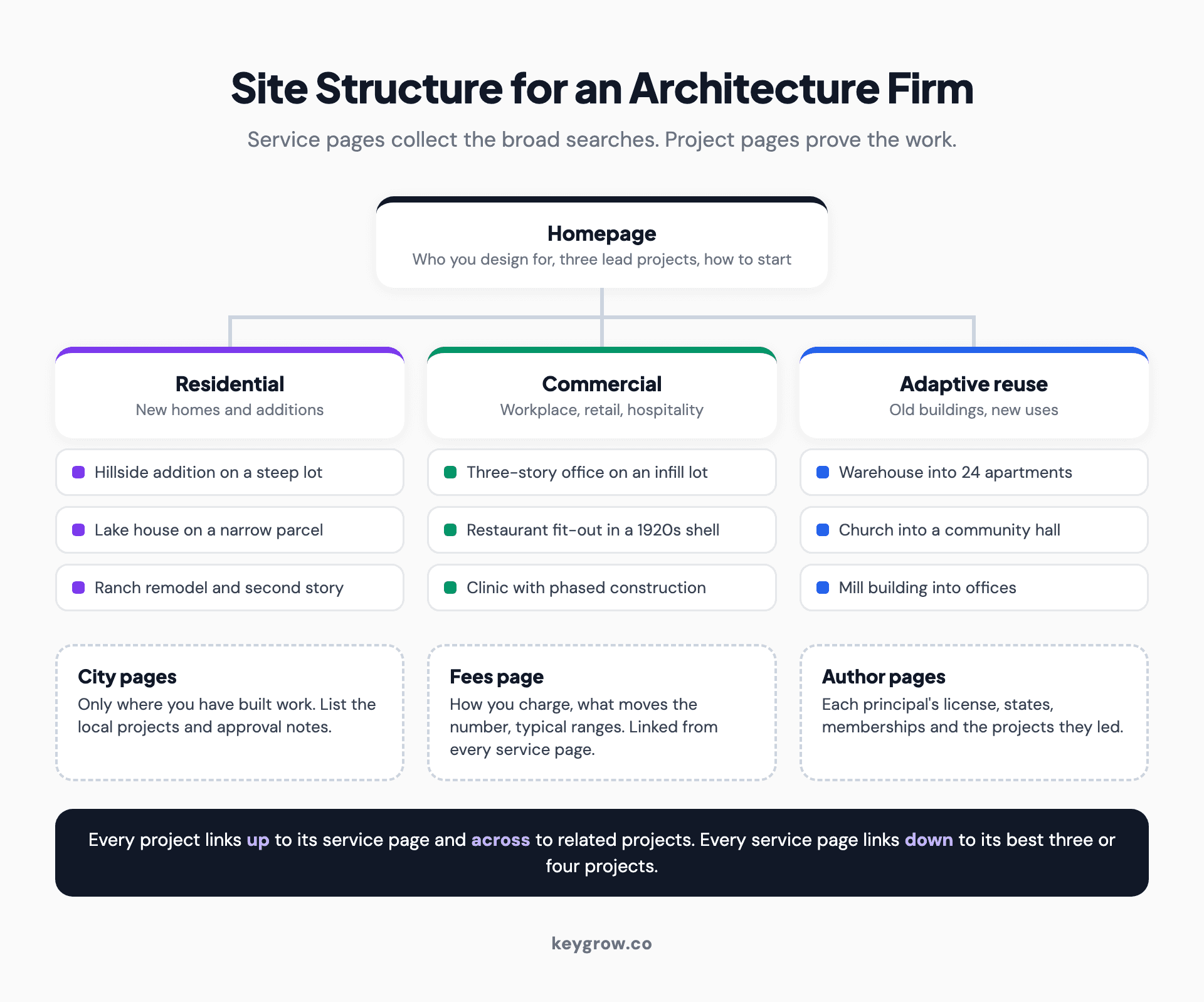
Site structure diagram for an architecture firm: the homepage links to service pages for residential, commercial and adaptive reuse work, each service page links down to its project pages, and city pages and a fees page sit alongside, linked from the relevant services and projects.
| Page type | Who searches it | What the page has to show |
|---|---|---|
| Residential (new homes, additions) | Homeowners with a lot or a house | Process, rough fee approach, three relevant projects |
| Commercial and workplace | Owners, developers, facility managers | Building types, delivery method, project scale |
| Adaptive reuse and historic | Developers and institutions | Code and approval experience, before and after |
| Interiors | Owners and tenants | Scope you take on and what you hand to others |
| City or region pages | Searchers adding a place name | Projects actually built there, local approval notes |
Only build the city pages where you have built work. A page for a town you have never worked in, with the town name swapped into generic copy, is the kind of thin page that drags a whole site down. Structured data helps here too. Our free schema markup generator produces the organization and local business markup that belongs on the site, and a developer can extend it to project pages.
Make the photography readable to a search engine
Google reads the words around a photo far more than the photo itself. Give each image a descriptive filename, real alt text, a caption and a sensible file size.

A bright, finished residential interior with tall windows, indoor trees and a city view, the kind of photography an architecture portfolio leads with.
Google's image guidelines call alt text the most important attribute for image metadata, ask for short but descriptive filenames, and recommend placing images near relevant text. They also note that captions feed what Google understands about the image. Supported formats include WebP and AVIF, which is good news for anyone exporting 8 MB photos straight from the photographer's folder.
In practice, per image:
- Filename: hillside-addition-living-room-valley-view.webp, not DSC_0412_final_v3.jpg
- Alt text: describe what is in the frame, plainly. "Living room of a hillside addition with a glazed wall facing the valley." No keyword lists.
- Caption: one line that adds something, such as the material, the constraint, or the photographer's credit
- Size: export at the size the layout shows, compress, and serve WebP or AVIF
Size is where portfolio sites quietly lose. A gallery of full-resolution images can push a project page past the point where a phone user waits. When we build sites, we target load times under 2 seconds and a 90+ score in Google PageSpeed Insights, and portfolio sites are the hardest category to hold there. If yours scores in the 30s on mobile, start with the images before anything else.
Get found for "architect near me" without faking a location
Local results come from your Google Business Profile, client reviews and pages about work in that area. A real staffed office is the anchor.
"Architect near me" and "architect [city]" searches show the map pack first. You get into it with a complete profile: Architect as the primary category, secondary categories that match what you actually do, the office address, hours, project photos, and reviews. Our walkthrough on ranking for near me searches covers the mechanics, including why proximity is the one factor you cannot fix.
Reviews are the slow part. Architecture clients are few and the relationship ends months after the design work, so ask at the moment the client is happiest: move-in, opening day, or the week the certificate of occupancy arrives. Ten detailed reviews that mention the project type do more than forty one-liners.
If you serve a region beyond your office, your city pages and project pages carry that work. Do not open virtual offices to win map rankings in towns you do not staff. Profiles at addresses that do not check out get suspended.
Put the licensed architect's name on the work
Sign project pages and articles with a named, licensed architect, link to an author page with the license and states, and keep it accurate.
Google's helpful content guidance asks whether pages carry a byline where readers would expect one, and whether that byline leads to more about the author. It also says that of the E-E-A-T qualities, trust is the most important, and it warns against invented author profiles.
Architecture has an advantage here that most industries would envy: a public, checkable credential. Use it.
- An author page for each principal: license number, the states they hold licenses in, professional memberships, education, and the projects they led
- A byline on each project page naming the project architect, not "Admin"
- Credits for the consultants, builder and photographer, which also tend to earn links back
Your state licensing board regulates who can use the title "architect" and sometimes how firms advertise. Check your board's rules before you label designers or unlicensed staff on the site.
Earn links the way architects already earn attention
Awards, design publications, local press, consultants and universities link to architecture firms naturally. Make sure each mention points at a project page.
Firms already enter award programs, give talks and get featured. The SEO problem is that the coverage links to the homepage, or to nothing. When a project is published or shortlisted, send the editor the project page URL, not the homepage.
Good sources, roughly in order of how easily they come:
- Consultants, builders and photographers who credit you on their own project pages
- Chapter and regional design awards, which usually publish winners with links
- Local business journals and city news on civic and commercial projects
- University and alumni features about principals or studio work
- Design publications, which are hard to get and worth a lot
Our guide to digital PR for SEO covers pitching in more depth. For a firm, the shortcut is simple: every project that gets a photographer also gets a one-paragraph press note and a list of five people to send it to.
Answer "how much does an architect cost" before someone else does
Publish a fees page that explains how you charge, what moves the number and typical ranges, with a direct answer in the first two sentences.

Architectural floor plans spread on a desk with drafting pencils, a ruler and a drawing tube, the planning stage where fee questions come up.
Cost is one of the first things a prospective client wants to know, and most firm sites refuse to touch it. That leaves the answer to directories and forums, and increasingly to AI assistants summarizing whatever they can find.
You do not need a rate card. Explain the methods and the variables. AIA Minnesota's guide describes hourly, fixed fee and percentage of construction cost arrangements, and puts typical percentage fees at 8 to 15 percent for new construction and 15 to 20 percent for remodels. Say which you use, for which kind of project, and what pushes a fee up or down: scope of services, construction administration, approvals, consultants.
Write the page so an assistant can lift it. A question as the heading, the answer in the first two sentences, a table of fee methods, a named author and a date. ChatGPT cites only about 15 percent of the pages it retrieves, and roughly 44 percent of its citations come from the first third of a page, so bury the answer under three paragraphs about design philosophy and it goes to a page that did not. Our guide on how to structure a page for AEO shows the pattern, and our answer engine optimization services apply it across a whole site.
The same treatment works for "do I need an architect for an addition", "how long do permits take in [city]" and "design-build or design-bid-build". Each is a question your principals answer every month in meetings.
How do you measure SEO when a project takes a year to sign?
Track inquiries by project type and source, branded search, and which project pages prospects read. Judge the channel over two to four quarters.
A residential client may read your hillside page in March, get your name from their builder in August, and sign in November. Monthly ranking reports will miss all of that.
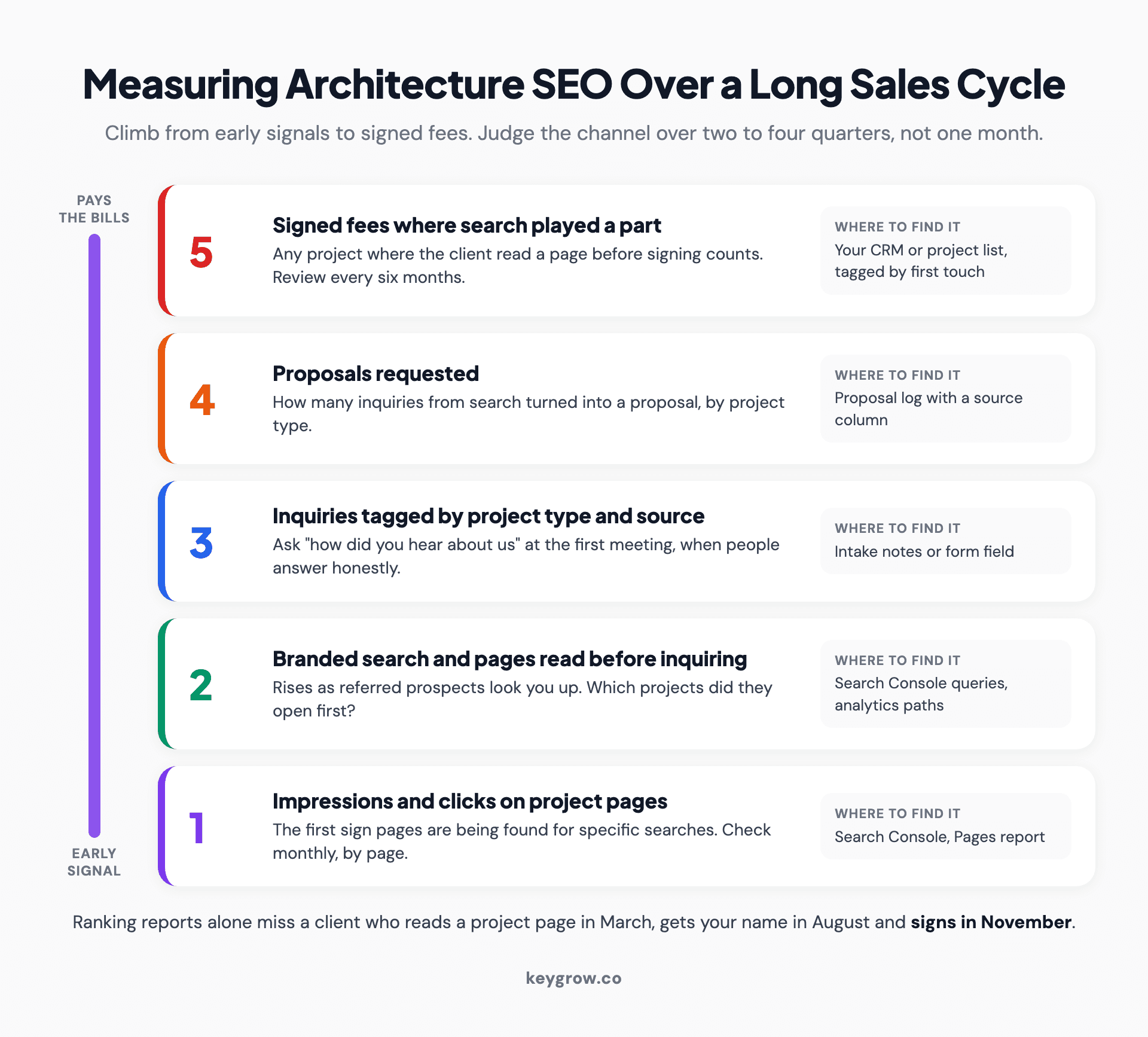
Ladder of measures for architecture firm SEO across a long sales cycle, from early signals like impressions on project pages, to inquiries tagged by project type and source, to proposals and signed fees attributed to search.
What we would track:
- Search Console impressions and clicks on project and service pages, by page, monthly
- Branded search volume, which rises as referrals check you out
- Inquiries tagged by project type and by "how did you hear about us", asked at the first meeting
- Which project pages a prospect viewed before inquiring, if your form or CRM can capture it
- Proposals and signed fees where search played any part, reviewed every six months
Expect it to look slow. Our strongest organic result was a doctor's practice in Dubai: months one to three looked unimpressive, and by month twelve organic traffic had grown 1,519 percent with 130+ patient calls a month. Nothing clever happened in between, just the same site worked on steadily. SEO compounds, and the firms that quit at month three have paid for the hard part and left before it pays back. Do the arithmetic with your own average fee. If one signed project is worth more than a year of SEO work, the bar for success is one extra project.
When you do not need an agency for this
If you are fully booked through referrals, or you can write ten project pages yourself, start without us.
A two-principal practice with a three-year backlog does not need demand. It needs a current site that closes referrals: project pages with real text, a principal bio with the license on it, and a profile with reviews. A principal can write a project page in an afternoon. Do ten and you are ahead of most firms in your city.
Bring in help when the site itself is the bottleneck (a slow gallery theme, no way to add text to projects), when you want to grow into a new project type or region, or when nobody at the firm will ever find the afternoon. That is the point where our SEO services or a rebuild through our website design and development team pays for itself, and we will tell you which one you need, if either.
FAQs
Does SEO work for architecture firms?
Yes, when it targets the right job. For most firms SEO wins in two places: closing referrals who search your name before calling, and specific searches for a project type, a place or a constraint. It rarely wins on the bare word "architect", and it does not need to.
How long does SEO take for an architecture firm?
Expect three to six months before project and service pages rank for specific searches, and nine to twelve months before search reliably shows up in signed work. The long sales cycle means the lag between a page ranking and a contract can be another six months on top.
Should every architecture project have its own page?
Every project you want to be hired for again should. Start with ten that you have permission and photo rights to publish, and that represent the work you want more of. Older or minor projects can stay in a gallery.
What should an architecture project page include?
A descriptive title with the project type and place, a short brief, the site and its constraints, the design response, the outcome, captioned images and credits. Link it to the related service page and give the reader a way to start a conversation.
Do architects need to publish their fees online?
Not a rate card, but you should explain how you charge. Describe the fee methods you use, which projects each applies to, and what moves the number. Firms that answer the cost question get the searches and the assistant answers that firms who stay silent give away.
Is local SEO important for architects?
For residential and small commercial work, yes. Those clients search with a place name or "near me" and see the map pack first. Large institutional and national work is driven more by RFPs, relationships and published projects, so local SEO matters less there.
Turn the portfolio into pages
Sequence is most of the strategy here. Write the ten project pages first, connect them to service pages, fix the image weight, then add a fees page and a principal's author page. Links and PR work better once there is a page worth linking to.
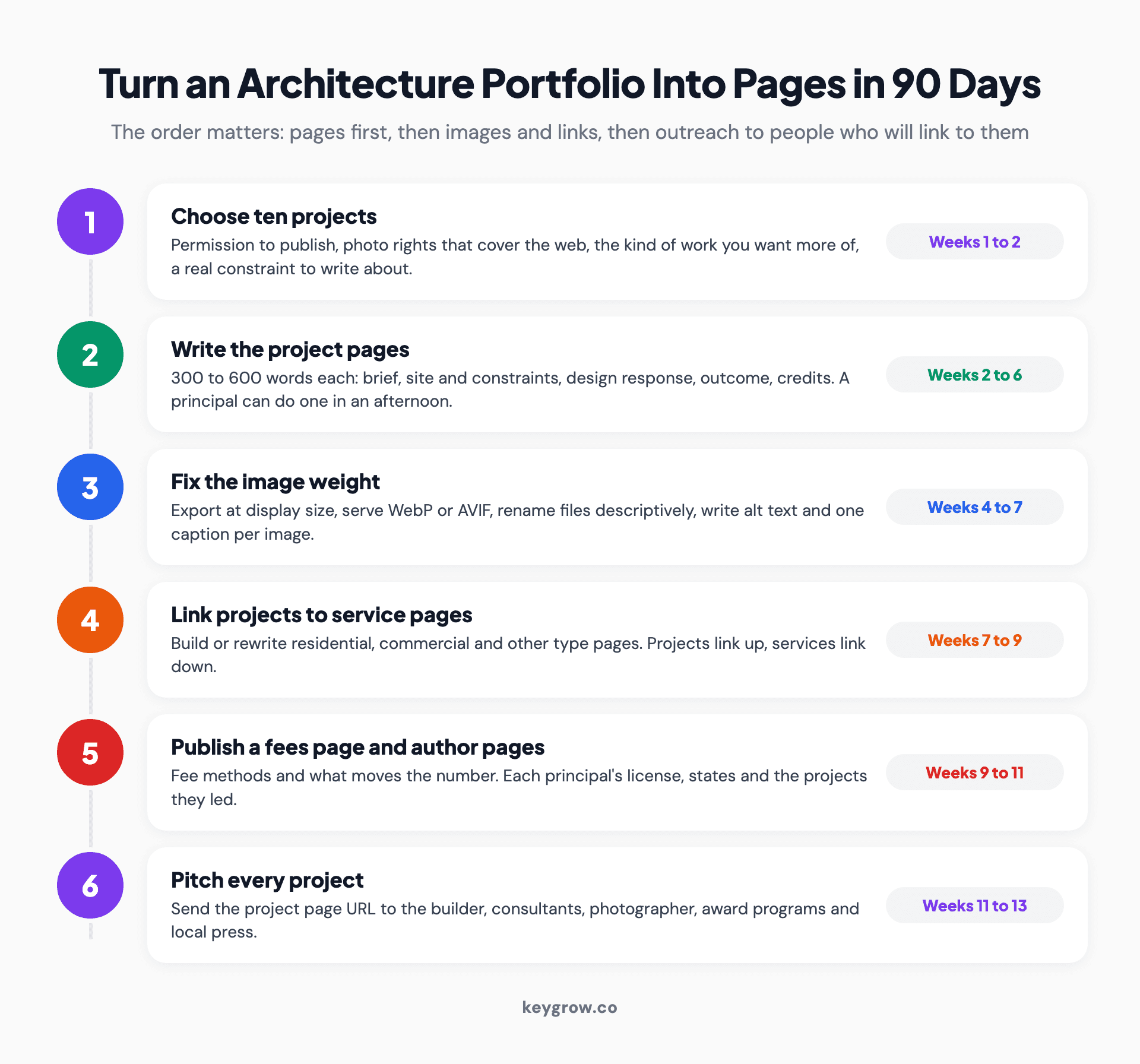
Numbered process for turning an architecture portfolio into search-ready pages over 90 days: choose ten projects, write the project pages, fix image file sizes, link projects to service pages, publish a fees page and author pages, then pitch each project to the people who should link to it.
If you want a second opinion on which projects to start with, tell us about your firm. We will say what we would build first, and if the honest answer is a few weekends of writing rather than an agency, we will say that too.