


Fifty-one percent. That is the share of dealerships that answered a website inquiry by phone, email and text within 15 minutes when Pied Piper's 2026 study mystery-shopped 3,290 dealership websites. Everyone else was slower, picked one channel, or never replied.
That number matters more than which ad platform you pick. Lead generation for car sales is getting in-market buyers to raise a hand (a form, a call, a chat, a walk-in) and then reaching them before another store does. The second half decides what the first half was worth.
So this list ranks lead sources by what each one costs per sold car, not per lead. A cheap lead nobody calls back is the most expensive lead you can buy.
Rank every lead source by cost per sold car
Cost per sold car is cost per lead divided by the close rate for that lead type. It is the only number that puts a $36 search lead, a walk-in and a referral on the same scale.
Two public data sets give you the inputs. LocalIQ's automotive benchmarks, drawn from 1,983 US search campaigns that ran between April 2025 and June 2026, put the average cost per lead at $35.87 for general new car dealers and $59.74 for general used car dealers. And Foureyes data covering more than 8 million sales opportunities found walk-ins closing at 41 percent, phone leads at 24.8 percent and form leads at 7 percent.
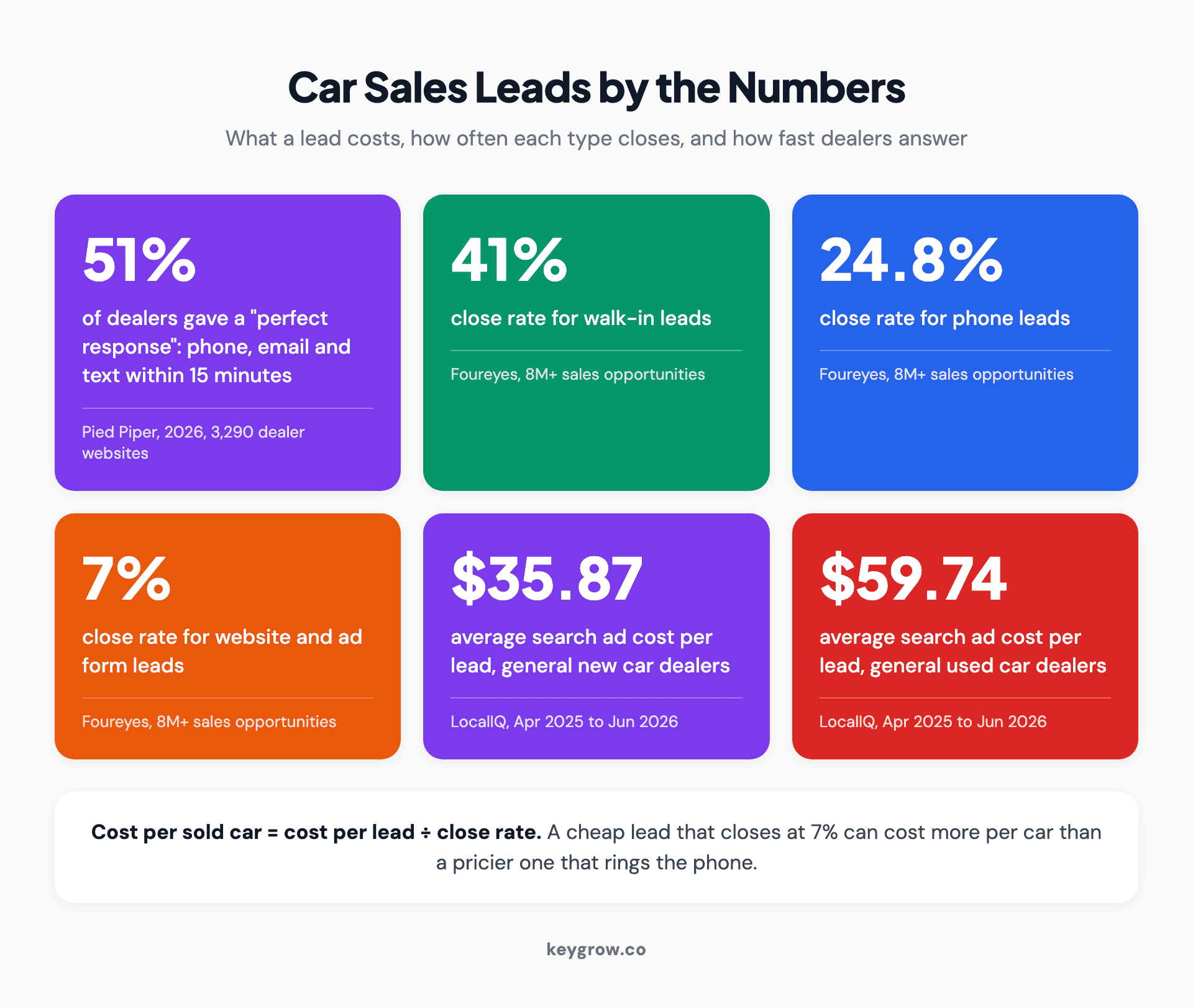
Stat strip of car sales lead benchmarks: 51 percent of dealers give a perfect 15-minute response, walk-ins close at 41 percent, phone leads at 24.8 percent, form leads at 7 percent, and search leads cost $35.87 new and $59.74 used.
| Lead type | What it costs | Close rate | What to do with it |
|---|---|---|---|
| Walk-in | No direct ad cost | 41% (Foureyes) | Highest intent, but you cannot buy more of it directly |
| Phone call | Whatever the channel that made it ring costs | 24.8% (Foureyes) | Track it separately from forms |
| Website or ad form | $35.87 new, $59.74 used per search lead (LocalIQ) | 7% (Foureyes) | Cheapest to generate, slowest to close |
| Past customer or referral | Staff time and a CRM | Not measured in either study | Usually your best source, and rarely tracked |
Now the arithmetic. A new car search lead at $35.87 that arrives as a form and closes at 7 percent costs about $512 per sold car. Had the same click rung the phone and closed at the phone rate of 24.8 percent, it would cost about $145 per car.
Treat that second figure as an illustration, since call leads from ads do not cost exactly what form leads cost. It still shows why a store that pushes shoppers toward a call, and picks up, can pay less than a third as much per car.
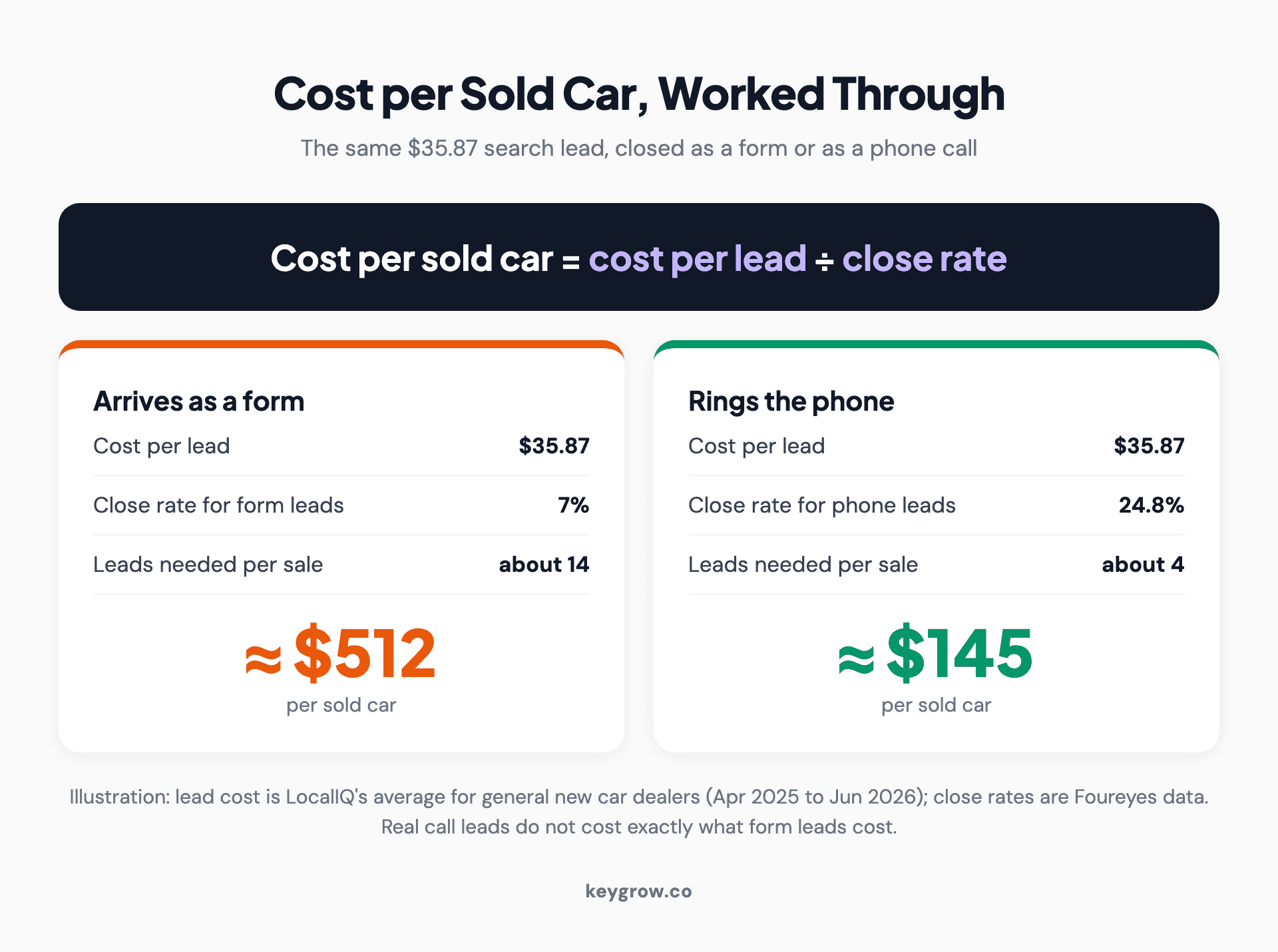
Worked example of cost per sold car: a $35.87 search lead closing at 7 percent as a form costs about $512 per car, and the same lead closing at 24.8 percent as a phone call costs about $145.
Seven car sales lead sources, ranked
This is the order for a typical franchised or independent store, cheapest cost per sold car first. Your own CRM will reshuffle the middle, and it should.
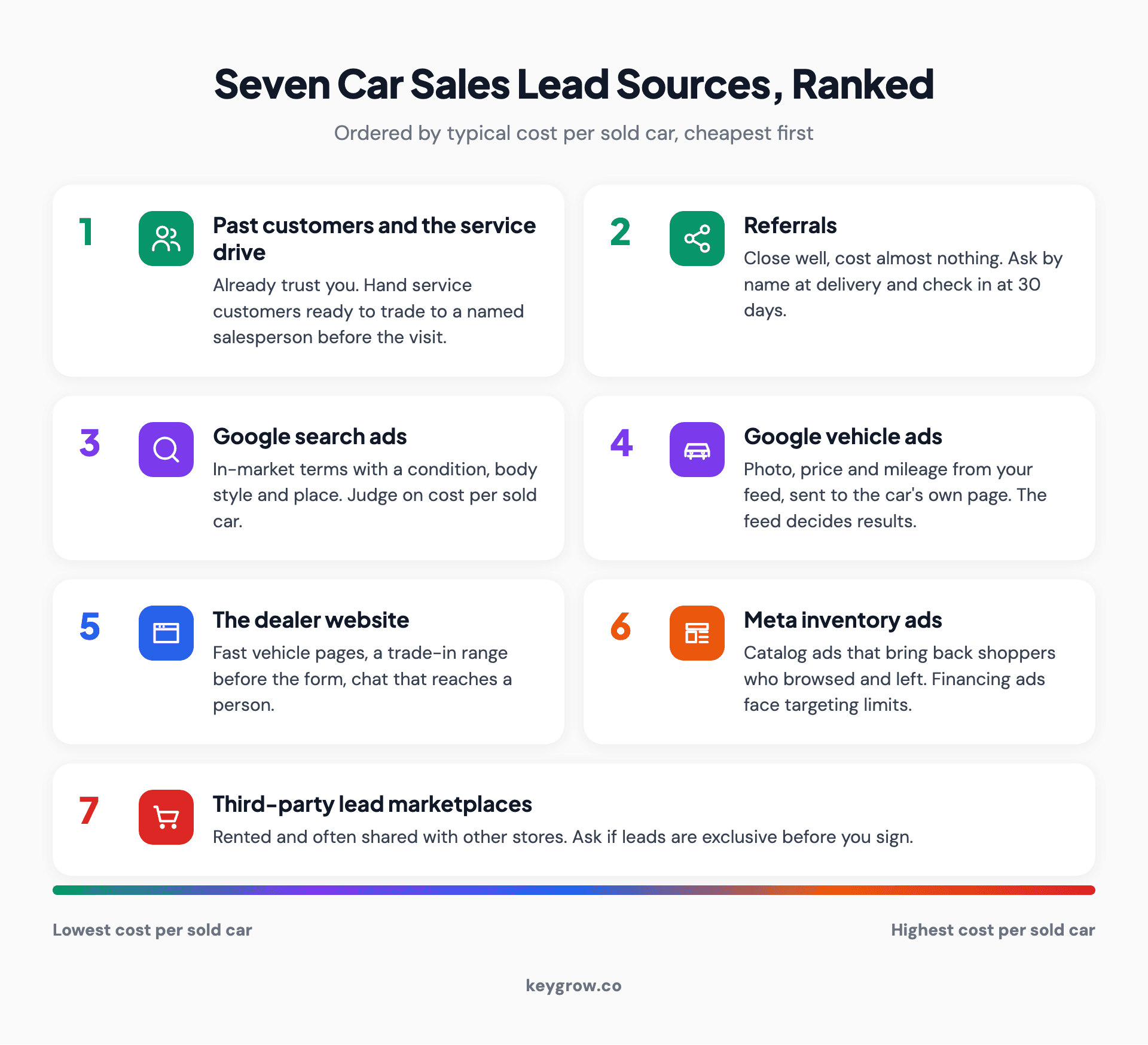
Ranked icon grid of seven lead sources for car sales, from past customers and referrals at the top through search ads, vehicle ads, the dealer website and social inventory ads, down to third-party lead marketplaces.
1. Past customers and the service drive
Your cheapest lead already bought from you. They are in the DMS, they have a service history, and some of them are sitting in your service lounge this week.
Pull a monthly list of service customers whose vehicle has reached the age or mileage where trading makes sense, note the likely equity, and give each name to a salesperson before the appointment. That beats a mass email every time, because the customer hears from someone they can picture, with an actual number.
2. Referrals
Referrals close well and cost almost nothing. They also happen by accident unless someone owns them.
Ask at delivery, by name ("who else at work is shopping?"). Pay any referral reward quickly, after checking your state's dealer rules. Then check in at 30 days, while the buyer still likes the car.
3. Google search ads on in-market terms
Search ads catch people who have decided to buy and are choosing where. The terms that convert usually name a condition, a body style and a place, like "used trucks near me". Research terms from someone two months out burn budget.
LocalIQ's averages show how much the inventory type moves the cost. Used car dealers paid $59.74 per lead at a 3.53 percent conversion rate, against $35.87 and 6.73 percent for new car dealers. Budget for that gap, and judge each campaign on cost per sold car from your CRM, not on the lead count the platform reports.
If you would rather hand the account over, our Google Ads for car dealerships service runs search and vehicle ads from your inventory feed and reports back to sold units.
4. Google vehicle ads
Vehicle ads show a car's photo, price and mileage from your inventory and send the click to that car's own page. Google's Merchant Center documentation says they run from a vehicle feed through Performance Max or Standard Shopping campaigns, cover new and used inventory, and are fully released in the US, Canada, Australia and Japan. Private sellers and brokers are not eligible.
The feed is the whole game. Wrong prices, sold units and missing photos get disapproved, or worse, approved.
Performance Max also decides where your budget goes, so feed it appointments or sold cars rather than raw form fills. Our guide to how Performance Max campaigns work covers which signals it optimizes on.
5. The dealer website: inventory pages, chat and trade-in tool
Most paid and organic leads convert on the website, so it is less a source than the place every other source lands.
Vehicle detail pages should load fast, show the real price and offer one obvious next step, such as checking availability or booking a test drive. The trade-in tool should show a value range before it asks for contact details. Chat has to reach a person quickly, because Pied Piper's 2026 study named the handoff from AI tools to dealership staff as the riskiest point in the process.
This is also where ad budgets leak. One of our automotive clients, a mobile detailing business, was paying around $100 per booking with every click landing on the homepage. A page built for one action took cost per conversion to $22, and conversions rose 650 percent between August and December 2022. Not a dealership, same mechanics. Sending ad traffic to a homepage is the most expensive default in paid search, and the dealer version is sending a click for one specific truck to the general inventory search.
If the site itself is the bottleneck, car dealership website design is where we would spend before adding ad budget. Indexed inventory pages also bring in organic leads, which is the job of car dealership SEO: getting each vehicle page found for the "near me" searches in your market.
6. Meta automotive inventory ads
Meta's automotive inventory ads pull from a vehicle catalog and show people the cars that match what they looked at on your site. Their strength is bringing back shoppers who browsed a car and left.
Meta's developer documentation lists the setup as an automotive catalog, a Facebook Page and an ad account, with the pixel connected to the catalog. One rule catches dealers out: an ad that promotes financing (a monthly payment, a rate, a loan offer) falls under Meta's financial products and services special ad category for US audiences, which limits targeting. Check with your compliance lead before you run payment-led creative.
7. Third-party lead marketplaces
These sell inquiries per lead, and some sell the same shopper to several stores at once. Before you sign, ask whether each lead is exclusive and what the contract says about leads with bad contact details.
They rank last because you are renting them. A shared lead rings your competitors' phones at the same moment it rings yours.
The first fifteen minutes decide the close rate
Close rates in the table above are not fixed. The same Foureyes data shows close rates falling from 12.4 percent in a lead's first three days to 2.3 percent in days four through seven.
A sale that does not start early mostly does not start.

A salesperson on a phone call at her desk, following up on a new inquiry.
This is the order we set it up in:
- Every lead lands in the CRM tagged with its source and assigned to a named person, never a shared inbox.
- The shopper gets a text, an email and a call. That combination inside 15 minutes is what Pied Piper calls a perfect response.
- The first reply answers the question they asked. If they asked whether the car is still there, line one says yes or no, with the price.
- An auto-reply works as a receipt, but a person should be on the thread within minutes.
- Calls get counted. Phone leads closed at 24.8 percent in the Foureyes data, so set up call tracking for PPC and give the ad platforms credit for the calls they produce.
- Days one to three get worked hard, since that window holds most of the close rate.
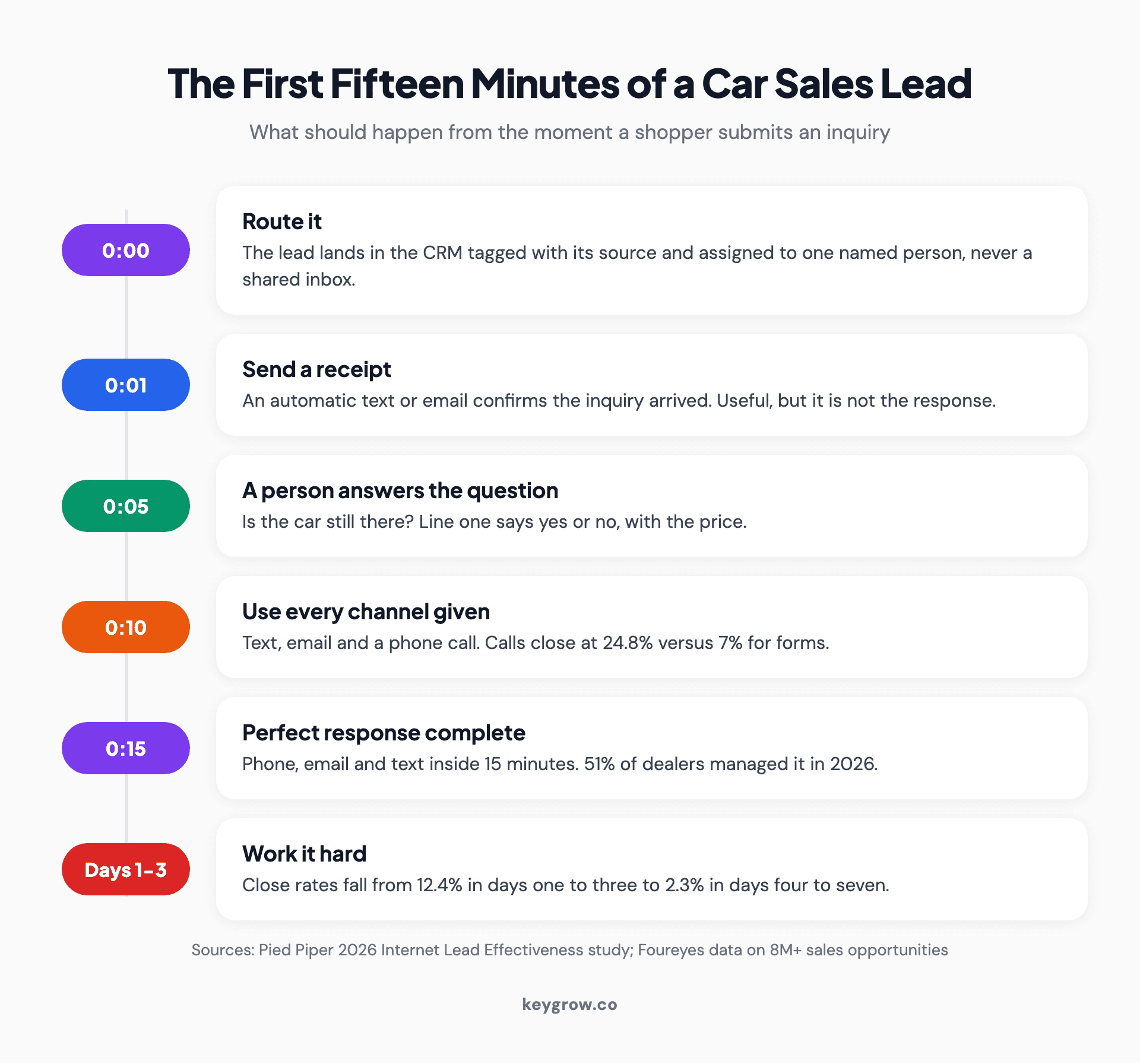
Timeline of the first fifteen minutes of a car sales lead, from routing in the CRM through a reply by text, email and phone to a person taking over from the bot.
Stores are getting faster. Pied Piper found dealers answered by text 54 percent of the time in 2026, up from 38 percent in 2025, and phoned web shoppers 75 percent of the time, up from 66 percent.
If you sell cars rather than run the store
You do not control the ad budget, so your list starts with your own sold customers. Text them on the anniversary of the purchase, and again when their loan or lease is nearing its end. Catch past buyers in the service lane, ask for referrals by name at delivery, and post your deliveries on social if your store's policy allows it.
None of that needs an agency. It needs a phone and a spreadsheet you actually open.
When you do not need an agency for this
If your store answers fewer than half its web leads inside 15 minutes, do not buy more leads from anyone, us included. Fix routing and response first. It costs a CRM setting and a manager's attention.
A small independent lot (say 40 cars and an owner who knows search) can run local search ads and the Google Business Profile in-house. Bring in help when the feed, the ad accounts and the reporting to sold units take more hours than you have, or when nobody can say which source sold last month's cars.
FAQs
What is the best lead source for car sales?
Past customers and referrals usually cost the least per sold car, because the trust is already there. Among paid sources, search ads on in-market terms reach people who are already choosing a store. Rank yours by cost per sold car from your own CRM, since the order varies by store.
How much does a car sales lead cost?
LocalIQ's benchmarks for April 2025 to June 2026 put the average search ad lead at $35.87 for general new car dealers and $59.74 for general used car dealers. Cost per sold car matters more, and it is the lead cost divided by your close rate for that lead type.
How fast should a dealership respond to an internet lead?
Within 15 minutes, on every channel the shopper provided. Pied Piper's 2026 study found 51 percent of dealers replied by phone, email and text inside that window. Aim faster, because about half your competitors already clear it.
What is a good close rate for car sales leads?
Foureyes data on more than 8 million sales opportunities found walk-ins closing at 41 percent, phone leads at 24.8 percent and form leads at 7 percent. Compare your own numbers by lead type rather than as one blended rate.
Are third-party car leads worth buying?
Sometimes. Ask whether each lead is exclusive or shared, and judge the source on cost per sold car like any other. Shared leads reward whoever responds first, so they only pay off for stores with fast follow-up.
How can a car salesperson get leads without an ad budget?
Work your own sold customers on purchase anniversaries and near loan or lease end, meet past buyers in the service lane, and ask for referrals by name at every delivery. These cost time rather than money.
Answer the lead in five minutes
Pied Piper's bar is 15 minutes. Make yours five, because half the stores in the study already clear fifteen and a shared shopper tends to go to whoever calls first.
Then pull 90 days from your CRM, work out cost per sold car for each source on this list, and move budget toward the top. If you want a second pair of eyes on those numbers, request a quote and bring your follow-up times. That is the first thing we look at, before the ad spend.