


Digital marketing for small business is the set of online channels that put you in front of people already looking for what you sell, plus the tracking that tells you which of those channels paid for itself. For most local businesses that means a Google Business Profile, a website that turns visits into calls, search ads or SEO, and email for the customers you already have.
That is the whole list. The hard part is the order, and the order depends on two things: how much you can spend each month and how fast you need the phone to ring.
Most guides on this topic hand a bakery with $300 a month the same 13 tactics they hand a 20-person contractor with $8,000. Both end up doing a little of everything and learning nothing. This guide sorts the channels by cost and time to first lead, then tells you what to buy at four budget levels and what to skip.
The numbers that shape the plan
Two 2026 data sets explain most of what follows. Customers check reviews before they call, a growing share ask an AI tool, and a lead from paid search has a price you can look up.
In BrightLocal's 2026 survey of 1,002 US consumers, 97 percent said they read online reviews, and 45 percent had used ChatGPT or another AI tool for local recommendations, up from 6 percent a year earlier. On the paid side, LocaliQ's 2026 benchmarks put the average search ad click at $5.42 and the average cost per lead at $66.69 across industries.
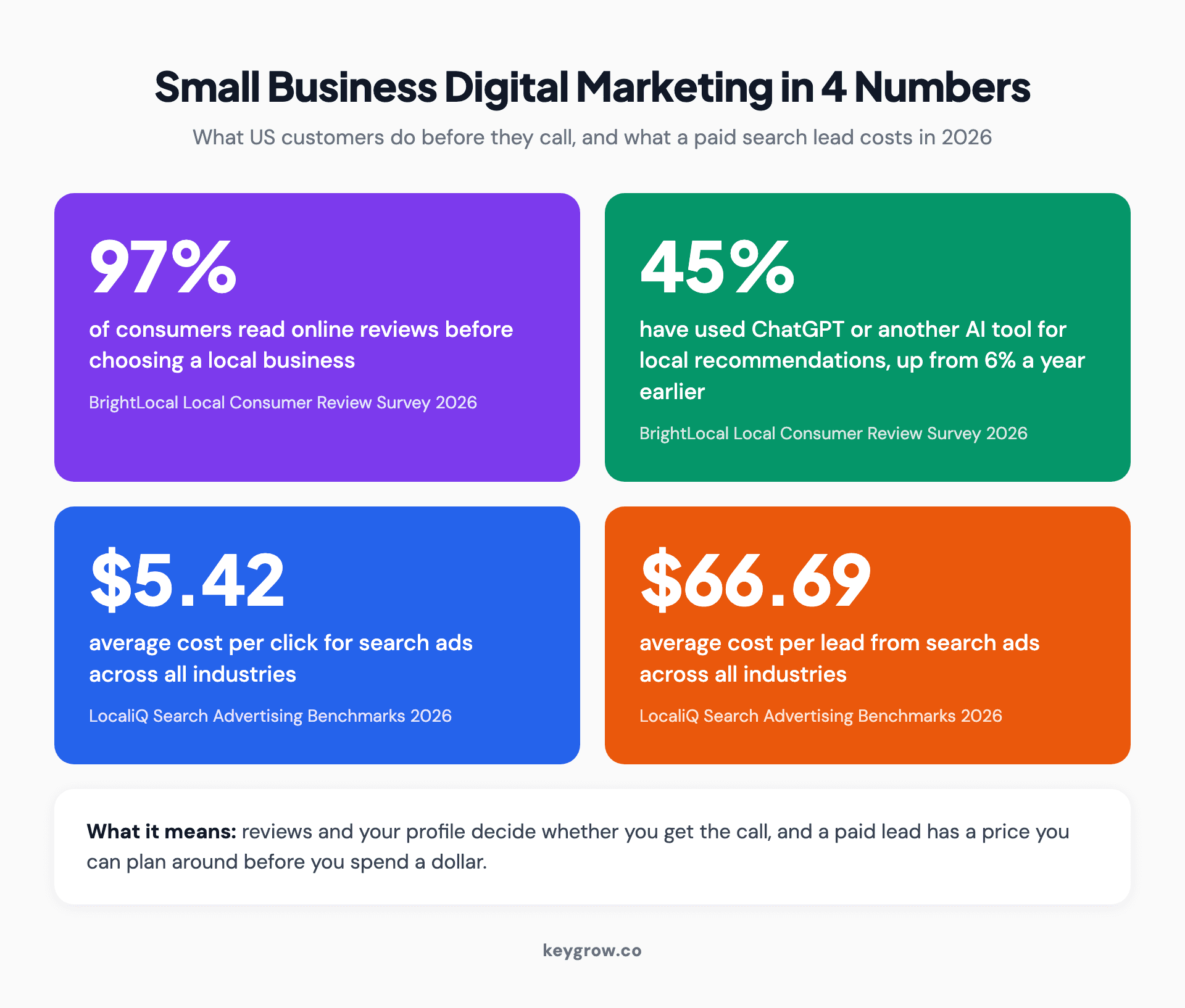
Stat strip of four 2026 numbers for small business digital marketing: 97 percent of consumers read online reviews, 45 percent have used ChatGPT or another AI tool for local recommendations, the average search ad click costs $5.42, and the average search ad lead costs $66.69.
Keep that $66.69 in your head.
It turns "should I run ads?" from a feeling into arithmetic, and it comes back in every budget tier below.
Every channel, by cost and speed
Each channel has a price and a clock. Paid search is fast and charges per click. SEO is slow and compounds. Your profile and reviews cost time, not money.
| Channel | What it costs | Time to first lead | Suits | Skip it when |
|---|---|---|---|---|
| Google Business Profile and reviews | Free to create, plus your time | Weeks, once the profile is verified and complete | Any business that serves a local area | Never, if you serve local customers |
| Website or landing page | One-time build; our sites start at $1,400 and a single landing page is $500 | It converts traffic from other channels rather than creating it | Everyone | You only need one page for one offer right now |
| Google Ads (search) | $5.42 average click, $66.69 average lead (LocaliQ, 2026) | Days after the ads are approved | Services people search for by name, with a job value well above the cost of a lead | A lead costs more than your average job earns |
| SEO | Local plans start at a median of $800 a month in our 2026 price study | Months; our strongest organic result took 12 months | Businesses that plan to be around in two years | You need cash this month and have nothing for next year |
| Organic social | Your time | Slow for most service businesses | Restaurants, salons, retail, anything visual or repeat-visit | You post only because you feel you should |
| Paid social | Ad spend plus management; freelancers charge about $400 to $2,000 a month for two platforms | Days, but mostly lower-intent leads | Products people buy on impulse or do not search for | The page the ad lands on does not convert yet |
| A starter plan from an email tool, mostly your time | The day you send, but only to people who know you | Repeat purchases and seasonal services | You have no customer list yet |
The local SEO figure comes from our 2026 SEO price study. The freelance social range comes from Upwork's hiring guide, which we broke down in our post on social media management pricing.
Notice that two rows are the foundation and do not create leads alone: the profile and the website. Everything else sends people to one of them.
A weak website taxes every other row in this table.
Start with the free layer
Your Google Business Profile and reviews cost nothing and often reach people before your website does. Finish them before you pay for any channel.
A Business Profile is free to create, per Google. The work is in filling it out properly and keeping it current. Pick the primary category that matches your main service exactly (get this one wrong and the map rarely shows you for the work you want), then add secondary ones only where you do that work.

A small flower shop with its glass door open, buckets of flowers out front and a worker in an apron standing in the doorway.
Reviews are the part owners put off longest. With 97 percent of consumers reading them, a profile with 6 reviews loses to one with 60 even when the business with 6 does better work. The habit that fixes it is boring: ask at the moment the job is finished, send a direct link, and reply to every review. Our walkthrough on how to get more Google reviews has the scripts.
This layer is also your first step into AI answers. When someone asks an AI tool for a local recommendation, it can only work from what is public: your profile, your reviews and what your service pages say. Complete, current versions of those are where AI visibility starts.
Budget backward from the jobs you need
Start with how many new customers you need each month, not with a budget. Divide by your close rate to get leads, then multiply by cost per lead.
Here is a worked example, using the LocaliQ averages and an assumed close rate. A home services business needs 10 new jobs a month and closes 1 in every 3 leads. That is 30 leads. At $66.69 per lead, paid search would need about $2,000 a month in ad spend, which buys roughly 369 clicks at $5.42 each.
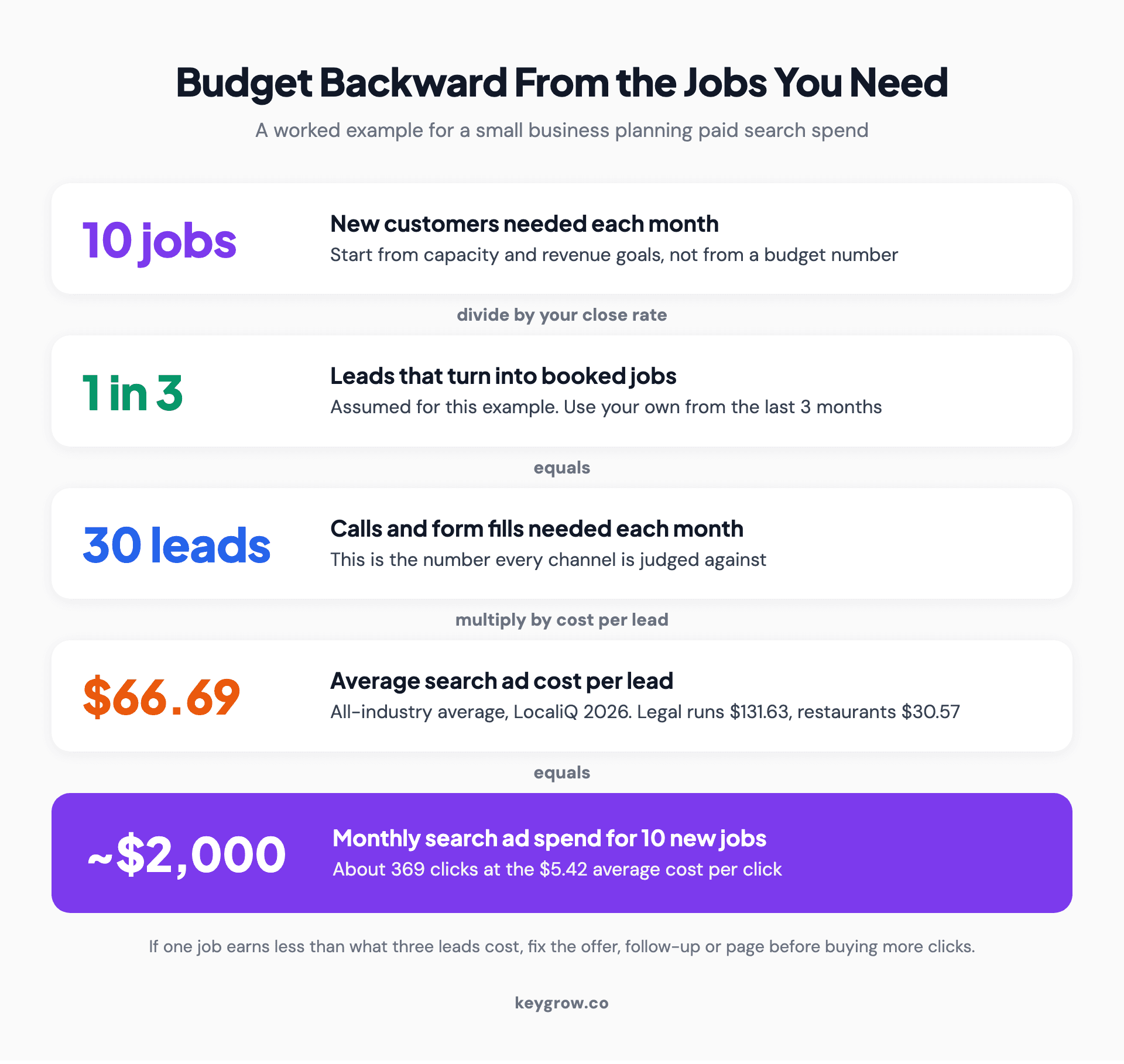
Flow diagram of budgeting digital marketing backward for a small business: 10 new jobs needed a month, a close rate of 1 in 3, so 30 leads, at a $66.69 average cost per lead, about $2,000 a month in search ad spend.
Your numbers will differ by trade, and by a lot. LocaliQ's 2026 data puts a legal lead at $131.63 and a restaurant lead at $30.57. Swap in your own close rate and average job value, or run them through our Google Ads budget calculator before you commit.
The useful part of the math is what it rules out. If your average job earns $150 and you close 1 lead in 3, a $66.69 lead costs you about $200 per job. Paid search loses money for that business until the close rate or the job value goes up, and no amount of campaign tuning changes the arithmetic. Fix the offer, the follow-up or the page first.
What to buy at each monthly budget
Pick the tier that matches what you can spend every month for six months, not what you could spend once. A budget you cut in month two teaches you nothing.
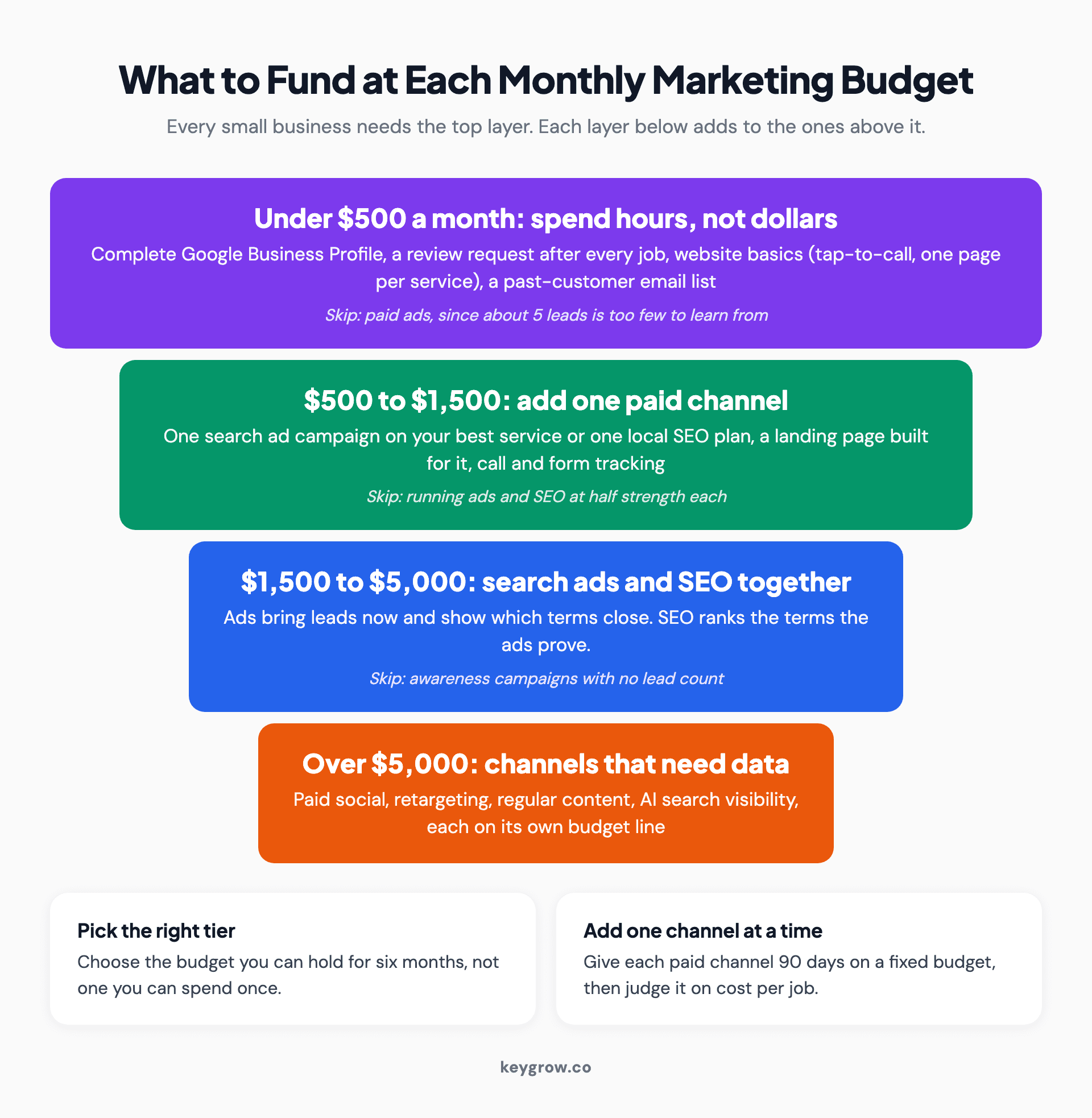
Funnel of four monthly budget tiers for small business digital marketing: under $500 a month spends hours on the Google Business Profile, reviews, website basics and an email list; $500 to $1,500 adds one paid search campaign or one local SEO plan with a landing page and tracking; $1,500 to $5,000 runs search ads and SEO together; over $5,000 adds paid social, retargeting, content and AI search visibility, each on its own budget line.
Under $500 a month: spend hours, not dollars
At this level, ads are mostly a way to learn nothing. $300 at $66.69 a lead buys four or five leads, which is too few to tell a good campaign from a bad one.
Put the money and the evenings into the free layer above instead. Fill in every field of the profile: service area, hours, photos, and each service you offer. Ask every happy customer for a review by text, the same day. Make sure your phone number is tappable on mobile, and that each main service has its own page that says the price range or how pricing works.
Then start a customer email list, even if it is a spreadsheet. It will be the cheapest channel you own a year from now.
$500 to $1,500 a month: one paid channel, done properly
Choose one: a single Google Ads search campaign on your most profitable service, or a local SEO plan. Not both. Two half-funded channels produce two sets of inconclusive data. Ads win if you need calls this quarter and your lead math works. SEO wins if your cash flow is fine and the searches in your area are not dominated by national brands. Whichever you pick, send the traffic to a page built for that one service, not your homepage.
$1,000 a month at the LocaliQ average buys about 15 leads. That is enough to see a pattern inside 90 days.
$1,500 to $5,000 a month: search ads and SEO together
This is where the two halves of search start working on each other. Ads bring in leads now and show you which search terms close. SEO turns the best of those terms into pages that rank and stop costing a click each. It is also the tier where paying for help usually makes sense, because running both well takes more hours a week than most owners have.
Over $5,000 a month: add the channels that need data
Paid social, retargeting, regular content and work on how AI tools describe your business all perform better when search is already producing leads and you know which customers are worth the most. Add them one at a time, each with its own budget line, so you can tell which one moved the number.
Your website is where every channel lands
Every ad, profile visit and email ends on a page. If that page does not make the next step obvious, every channel above it costs more per customer.
Sending ad traffic to your homepage is the most expensive default in small business marketing. A homepage has to serve everyone, so it closes no one in particular. A mobile car detailing client of ours was paying about $100 per booking from Google Ads, with every click landing on the homepage. We built a dedicated booking page and restructured the campaigns. Between August and December 2022, cost per conversion fell to $22, conversions grew 650 percent and monthly revenue went from $1.2K to $5.1K. The full numbers are in the mobile detailing case study.
Same service, same market. The page did a large share of that work. Our post on landing page vs homepage explains which traffic should go where.
You do not need a big site to start. Five pages that load fast, state your service area, show real photos and put the phone number in reach of a thumb will beat a 40-page site that does none of that.
If yours needs a rebuild rather than a fix, our web design services start at $1,400 for a site of up to six pages, copy included.
Paid search or SEO first?
Paid search buys leads this month at a known price. SEO builds an asset that keeps producing after you stop paying for clicks. Most small businesses need the first while they build the second.
The trade-off is speed against cost over time. An ad can show the day it is approved. Organic results take months. Our strongest organic result took 12 months to reach 1,519 percent traffic growth, and the first quarter of that looked like nothing was happening.
Our breakdown of local PPC vs SEO for small businesses walks through both timelines with costs. In short:
- Start with ads if you need jobs in the next 60 days and one lead is worth several times its cost.
- Start with SEO if cash is steady, you are in it for years, and your cost per click is high enough that ranking saves real money.
- Run both once the budget clears about $1,500 a month, and use the ad data to choose which pages to rank.
When you would rather hand the ad account to someone who checks it weekly, our PPC management covers setup, search terms and conversion tracking. For the organic side, our SEO services are built around the same lead numbers, not rankings for their own sake.
Where social media and email fit
Social media and email mostly keep you in front of people who already know you. They rarely produce the first lead for a service business, but they make the second and third sale cheaper.
For a plumber or an accountant, organic social is a credibility check: a prospect looks, sees recent posts and real jobs, and calls. That needs a post a week, not a daily calendar. For a restaurant, salon or shop, social is closer to a main channel, because people choose those places by what they look like. Our guide to restaurant marketing strategies shows how that changes the plan for a business that sells by the visit.
Paid social is different again. It works for offers people do not think to search for, and it works badly for urgent services, because nobody scrolling a feed has a burst pipe. If you want someone to plan and run it with the reporting tied to sales, our social media marketing services do that.
Email is the quiet winner. A list of past customers costs almost nothing to keep, and one seasonal reminder (furnace check, spring cleanup, annual service) can fill a slow week without buying a single click.
How to tell if it is working
Measure calls, form fills and booked jobs by channel. Clicks, followers and impressions tell you a channel is running, not that it is paying.

A customer paying at the counter of a small shop full of plants while the owner smiles behind a tablet register.
The minimum setup is three pieces. A tracking number or call tracking on the website, so you know which calls came from ads and which from the profile (our post on call tracking for PPC covers the options). Tagged links on every email and social post. And one monthly line per channel: money spent, leads, jobs won, cost per job.
Give each paid channel 90 days with a fixed budget before you judge it. Then cut the one with the worst cost per job and move its budget to the best. That one habit does more than any new tactic.
Should you hire help?
Do it yourself while your budget sits under about $500 a month and you have the hours. Hire when an hour of your time is worth more than what the help costs per hour.
A single-location business with more evenings than money should set up the profile, gather reviews and fix the website before paying anyone. Yes, an agency is telling you that. At that budget the fee eats the money that should go to the work itself.
Hire when you reach the paid tiers and the accounts start needing weekly attention you cannot give. Look for month-to-month terms, reports that lead with cost per lead and booked jobs, and someone willing to tell you which channel to drop.
FAQs
What is digital marketing for a small business?
It is the use of online channels to reach people who are looking for what you sell: a Google Business Profile, a website, search ads, SEO, social media and email. The goal is calls, bookings or sales you can trace back to a channel. For most local businesses, the profile and the website come first.
How much should a small business spend on digital marketing?
Work backward from the customers you need. Divide new jobs needed by your close rate to get leads, then multiply by cost per lead. At the 2026 LocaliQ average of $66.69 per search lead, 30 leads a month costs about $2,000. Under $500 a month, spend time on free channels rather than ads.
What is the best digital marketing channel for a small business?
For local service businesses, a complete Google Business Profile with steady reviews usually pays back first, because it is free and shows up where people search. After that, paid search brings the fastest leads and SEO the cheapest over time. Restaurants and retail lean more on social media.
Can I do digital marketing myself?
Yes, and below about $500 a month you probably should. Claiming your profile, asking for reviews, fixing your website basics and emailing past customers need time more than skill. Bring in help once you run paid ads or SEO that need weekly attention.
How long does digital marketing take to work?
Paid search can produce leads within days of approval. A Google Business Profile usually takes weeks to gain traction, and SEO takes months. Our strongest organic result took 12 months to reach its full growth. Email works the day you send it, but only to people already on your list.
Is social media enough to market a small business?
Rarely, unless you sell something visual or repeat-visit, like food, beauty or retail. Most people looking for a plumber, lawyer or dentist search Google rather than scroll a feed. Treat social as a credibility check and a way to stay in touch, with search doing the heavy lifting.
Start with what already finds you
Before you buy anything, look at where your last 20 customers came from. Often it is a short list: the map listing, referrals, a page or two of the website. Those sources already work.
Strengthen them first, then fund the next channel your budget tier allows.
If you would like a second opinion on which tier you are in and what to fund next, tell us about your business and we will walk through the numbers with you. Our work runs month-to-month, so you can cancel anytime.