


The Instagram ad examples worth copying in 2026 fall into seven patterns, and each one does a single job:
- Get a local lead without sending anyone to a website
- Prove the result on screen
- Borrow trust from a customer or a local creator
- Move one offer with a deadline
- Stop the Reels scroll in the first second
- Sell a product someone can hold
- Fill a date on the calendar
Below are 12 Instagram ad examples across those seven jobs. Each one is a mock-up we drew of a pattern, built to Meta's current specs, with the hook, the button, why it works and the way it usually fails.
You won't find screenshots of famous brands' ads here. Most galleries are built from them, and they have two problems for a business with a $30 daily budget: the ads were made by production crews, and nobody can tell you whether they worked. A screenshot of a sneaker launch teaches a window cleaner very little. The businesses in our mock-ups are placeholders, and no results are attached to them, because we'd have to make them up.
If you also run ads on Facebook, our Facebook ad examples cover the Feed-first versions. This post is about the four places Instagram actually shows ads (Feed, Stories, Reels and Explore), because the same idea has to be built differently for each.
Instagram ad specs that shape every example
Build for 9:16 vertical first, then 4:5 for Feed images. Keep text out of the top 14 percent and bottom 35 percent of any Reel or Story.
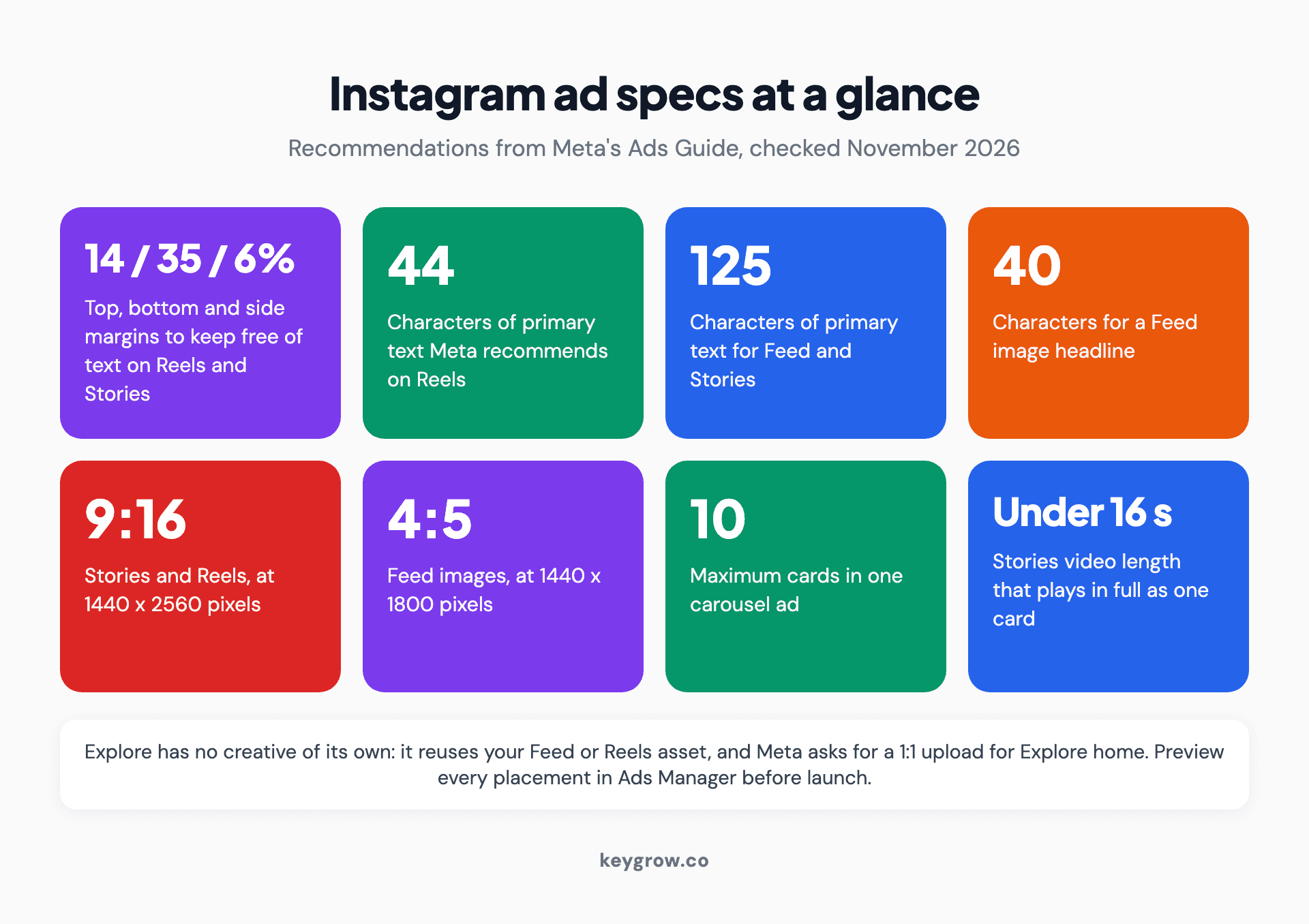
Stat strip of Instagram ad specs from Meta's Ads Guide, checked November 2026: keep 14 percent of the top, 35 percent of the bottom and 6 percent of each side of Reels and Stories free of text, 44 characters of recommended primary text on Reels, 125 characters on Feed and Stories, a 40-character Feed headline, 9:16 at 1440 x 2560 for Stories and Reels, 4:5 at 1440 x 1800 for Feed images, up to 10 carousel cards, and Stories videos under 16 seconds play in full.
These are the recommendations in Meta's Ads Guide as we checked them on November 11, 2026. Meta changes them without much ceremony, so treat the table as dated and preview every ad in Ads Manager before it goes live.
| Placement | Ratio Meta recommends | Resolution | Text Meta recommends | What it means for the ad |
|---|---|---|---|---|
| Feed image | 4:5 | 1440 x 1800 | 125-character primary text, 40-character headline | One focal point, readable at thumb size |
| Feed video | 9:16 | 1080 x 1920 | 125 characters | Captions and sound optional, both recommended |
| Feed carousel | 4:5 for image cards, 1:1 for video cards | At least 1080 x 1080 | 125 characters | 2 to 10 cards, each with its own link |
| Stories | 9:16 | 1440 x 2560 | 125 characters | Under 16 seconds plays in full; longer videos can be split into up to three cards |
| Reels | 9:16 | 1440 x 2560 | 44 characters | Keep 14% top, 35% bottom and 6% sides clear |
| Explore and Explore home | Reuses your Feed or Reels asset | Same as source | Same as source | Keep the subject centred, since the grid crops tighter |
Two numbers in that table catch people out.
The first is 44. The Meta Ads Guide recommends 44 characters of primary text for Reels, about a third of what Feed gets. On a Reel, the caption is a label. The pitch lives in the video.
The second is the safe zone. Meta's own wording is to leave at least 14 percent of the top, 35 percent of the bottom and 6 percent of each side free of text and logos, so nothing gets covered by the profile icon or the button. A third of the screen, at the bottom, belongs to Instagram. When a Reel ad looks broken, the usual cause is a headline sitting in that third.
Explore is the odd one out, because you don't make separate creative for it.
For Explore home, Meta asks for a 1:1 upload even though it recommends taller video, per Jon Loomer's breakdown of the placement conflicts. In practice that means a square crop of whatever you built, so anything important near the edge of a 9:16 frame is gone.
Which placement wants which kind of ad?
Feed rewards a single strong still, Stories reward a short sequence, Reels reward native-looking video with sound, and Explore rewards anything visual enough to win a square tile.
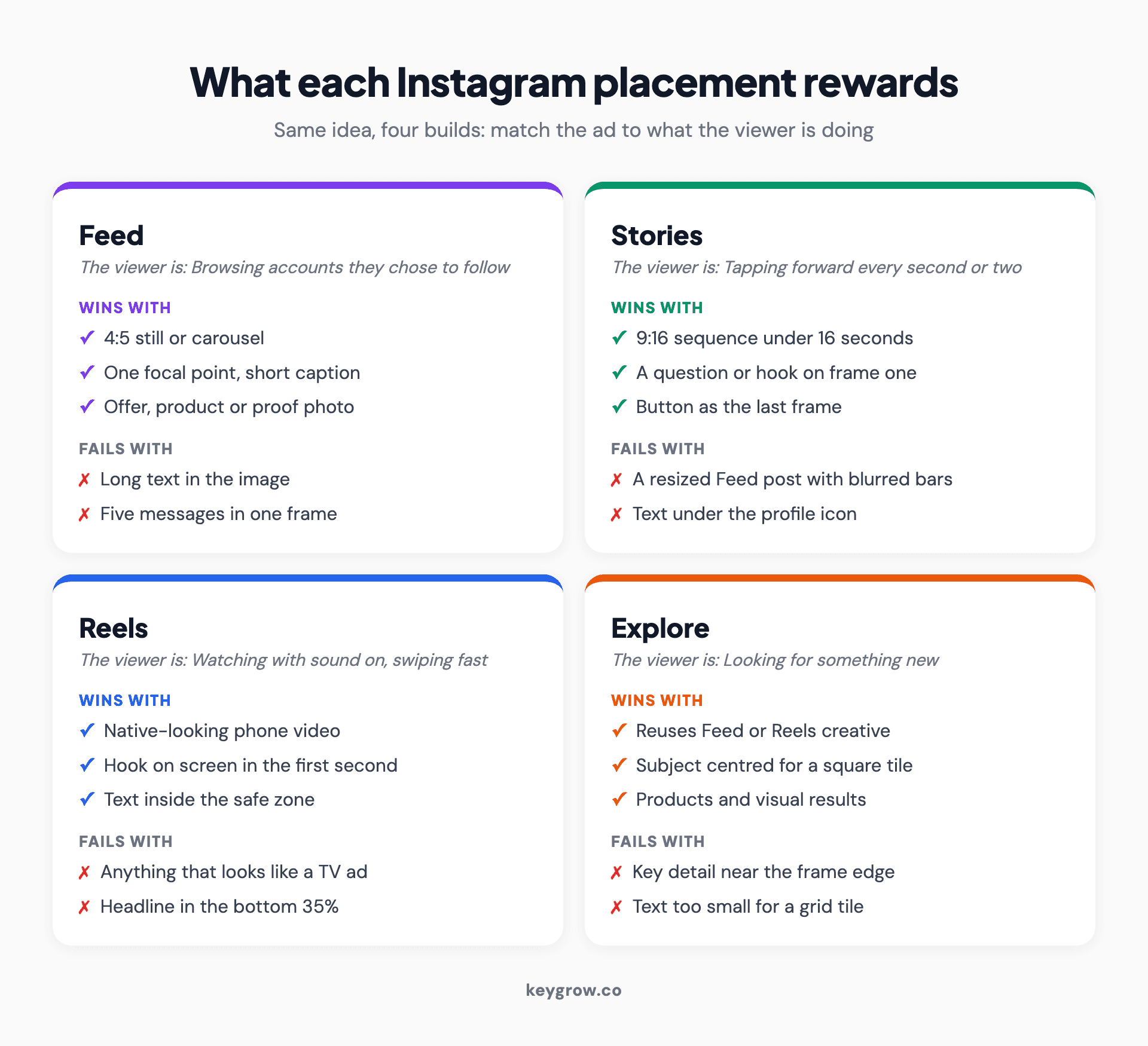
Comparison cards for the four Instagram ad placements: Feed suits a 4:5 still or carousel and fails with long text; Stories suits a 9:16 sequence under 16 seconds with the button as the last frame and fails when it looks like a resized Feed post; Reels suits sound-on native video with the hook inside the safe zone and fails when it looks like a TV ad; Explore reuses Feed or Reels creative in a square tile and fails when the subject sits near the edge.
The reason is what the person is doing at that moment. In Feed, they're browsing accounts they chose to follow and will stop for something that looks like those accounts. In Stories, they're tapping forward, so each frame gets a second or two before the thumb moves. In Reels, they're watching with sound on and swiping away from anything that feels like a commercial. In Explore, they've gone looking for something new.
You can leave placements on automatic, and for most small accounts that's the right call. Just make the ad in two shapes (9:16 and 4:5) so Meta isn't stretching a square photo into a Story. A stretched photo with blurred bars above and below looks exactly as good as it sounds.
Get the lead: two examples that never leave Instagram
For local services, the shortest path is a form or a chat that opens inside the app. A website visit is one more step where people quit.
1. The Stories quote form
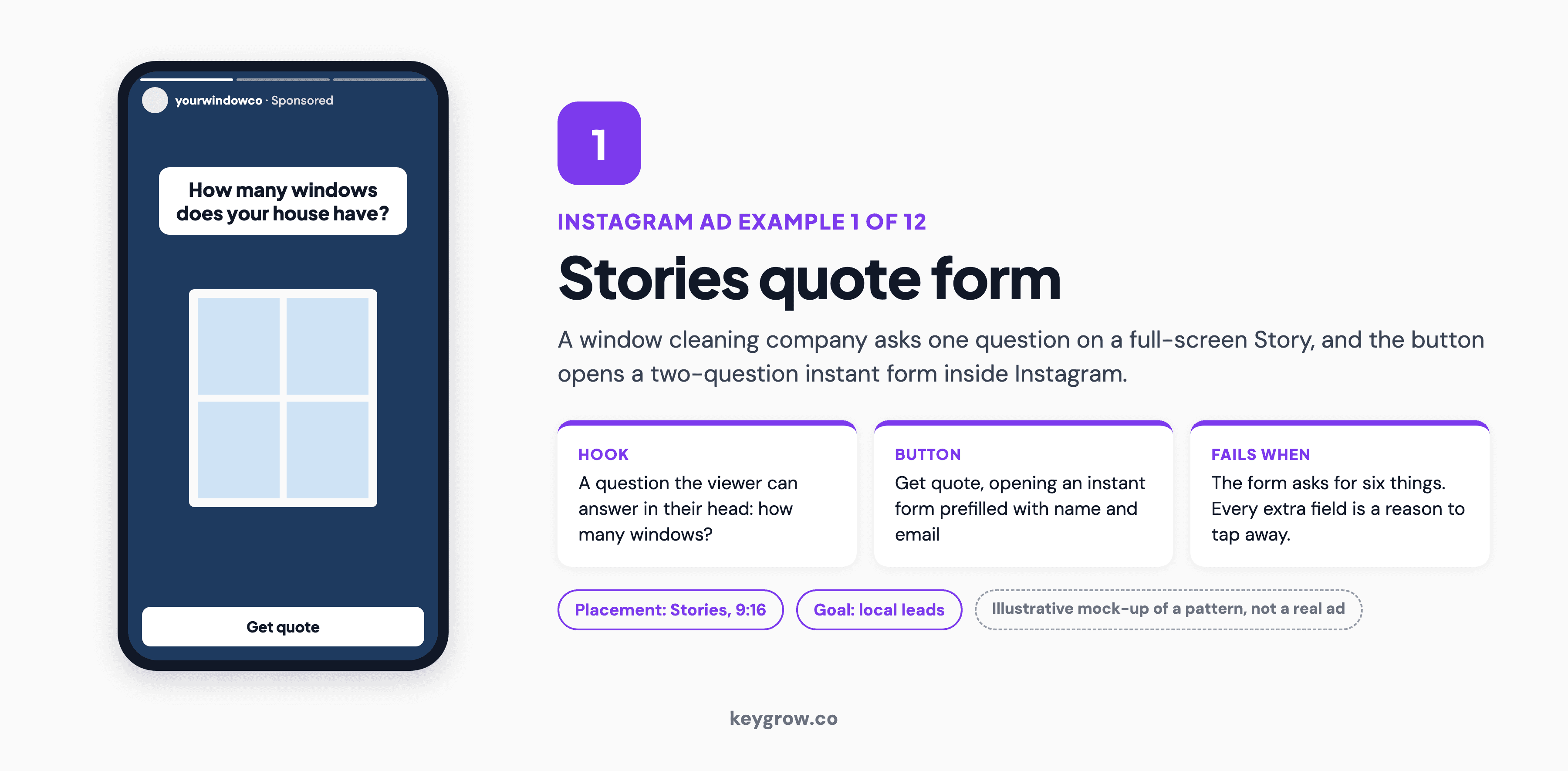
Instagram ad example 1 of 12, the Stories quote form: an illustrative mock-up of a window cleaning company's full-screen 9:16 Stories ad asking how many windows the house has, with a Get quote button that opens an instant form inside Instagram.
A window cleaning company runs a 9:16 Story with one sunlit window and one question on screen: how many windows does your house have? The button says Get quote and opens an instant form with two questions (window count and street name), prefilled with the person's name and email.
Hook: a question the viewer can answer in their head. CTA: Get quote.
It works because the Story asks the question the form asks. By the time the form opens, the person has already counted.
Six form fields will sink it. Each one is a reason to tap away, and Stories viewers are already in tap-away mode. The full form setup, including the settings that slow down junk submissions, is in our guide to running Facebook ads for leads. The same instant forms run on Instagram.
2. The photo-quote DM ad
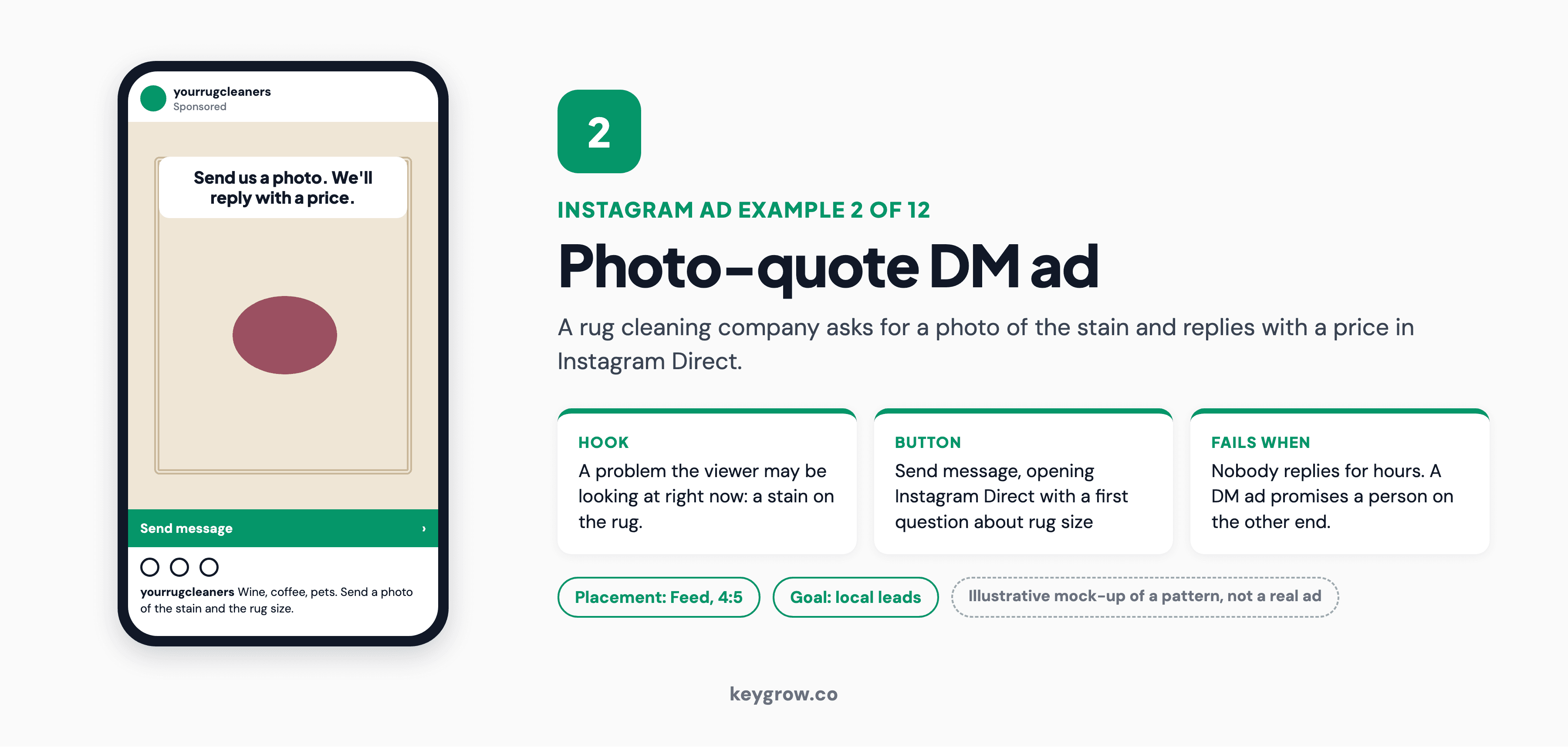
Instagram ad example 2 of 12, the photo-quote DM ad: an illustrative mock-up of a rug cleaning company's Feed ad that says send us a photo of the stain and we'll reply with a price, with a Send message button that opens Instagram Direct.
A rug cleaning company shows a wine stain on a cream rug. The text: "Send us a photo. We'll reply with a price." The button opens a chat in Instagram Direct, with a ready-made first question about rug size.
Hook: a problem the viewer may be looking at right now. CTA: Send message.
People on Instagram already send photos in DMs all day. Asking for one feels normal, and a photo tells you more than any form field could.
The weak spot is reply time. A DM ad promises a human on the other end. If messages get checked at 6 p.m., run the quote form instead. Our guide to social media for local businesses covers setting up the inbox so leads don't sit there.
Prove the result
Show the change in the first two seconds. A before-and-after is the one ad format that doesn't need the viewer to trust you yet.
3. The Reels reveal
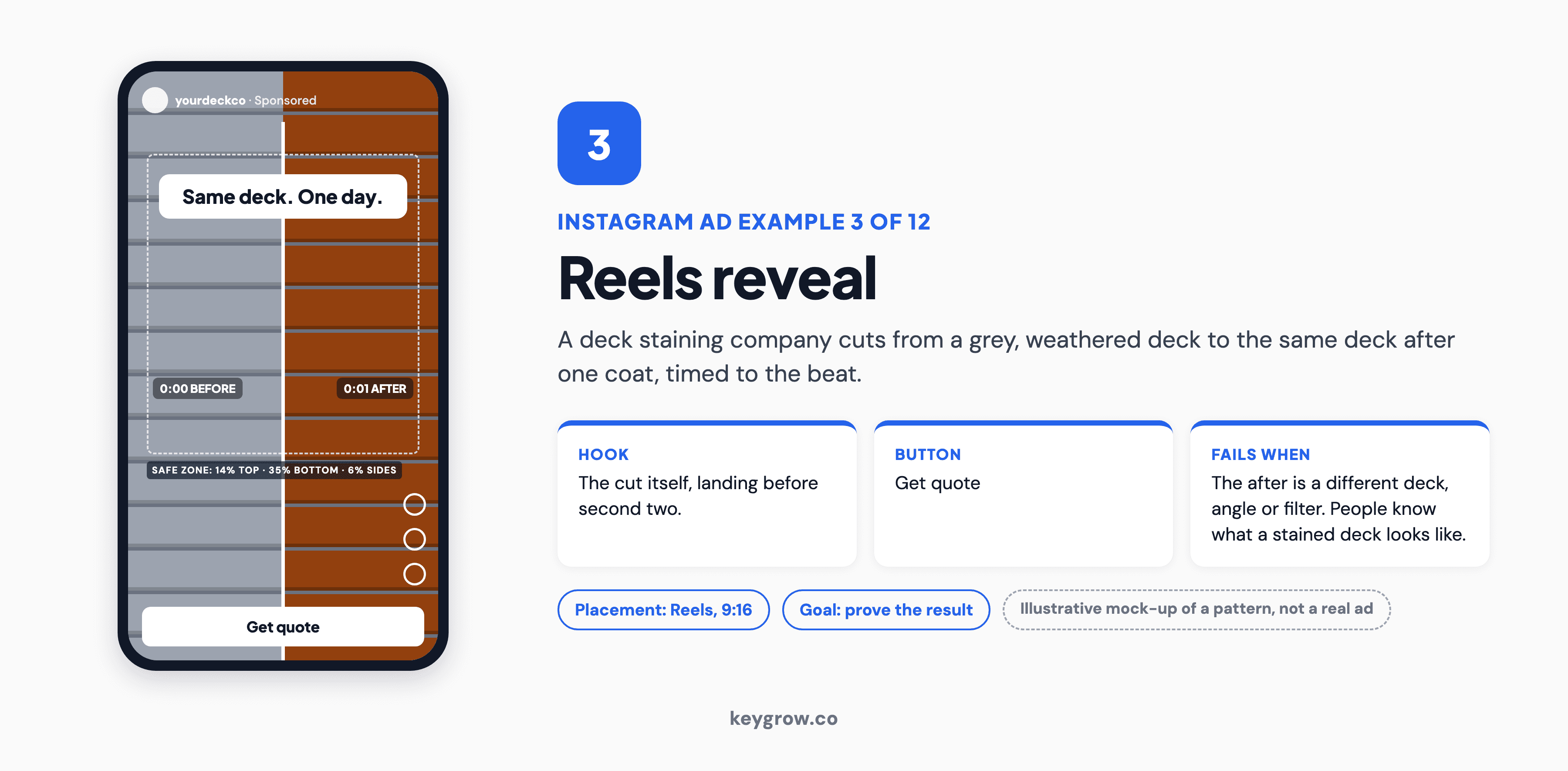
Instagram ad example 3 of 12, the Reels reveal: an illustrative mock-up of a deck staining company's 9:16 Reels ad that starts on a grey, weathered deck and cuts to the same deck freshly stained on the beat, with the caption same deck, one day and a Get quote button.
A deck staining company films a grey, weathered deck for one second, then cuts to the same deck after one coat, timed to the beat of the audio. The on-screen line: "Same deck. One day."
Hook: the cut itself. CTA: Get quote.
On Facebook, the classic version of this is a carousel. On Reels it's a single cut, and the cut has to land before second two. Film both shots from the same spot, at the same height, so the change is the only thing that moves.
Change the deck, the angle or the filter between the two shots and nobody believes it. People know what a stained deck looks like. If you sell anything to do with bodies, skin or health, read Meta's advertising standards on health and appearance before you run a before-and-after, and have your compliance lead see the ad first.
Borrow someone else's trust
A stranger believes a customer or a familiar local face faster than they believe your logo.
4. The customer-filmed testimonial
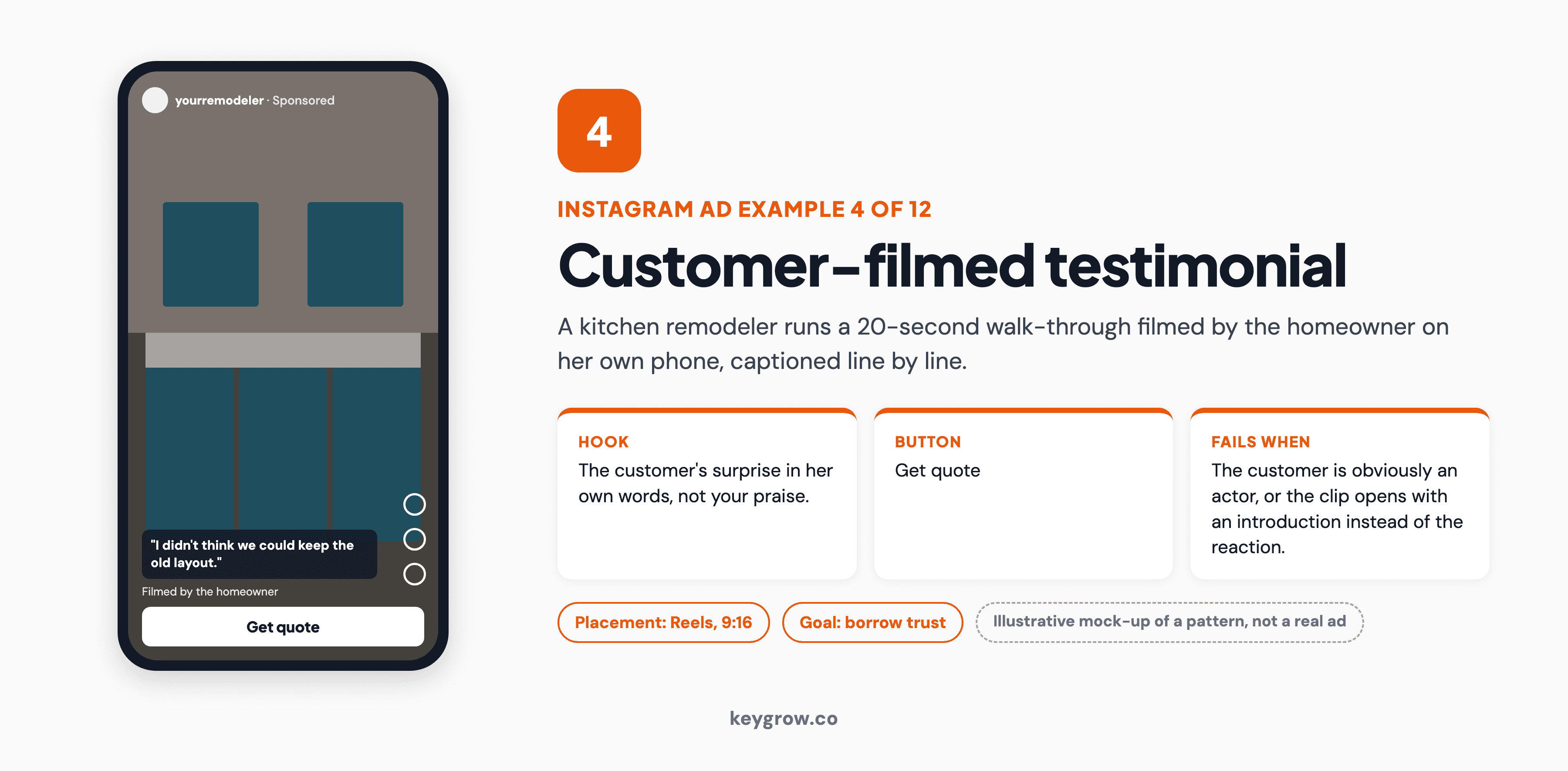
Instagram ad example 4 of 12, the customer-filmed testimonial: an illustrative mock-up of a kitchen remodeler's Reels ad where the homeowner films a 20-second walk-through of the new kitchen on her own phone, with captions on every line and a Get quote button.
A kitchen remodeler asks a happy client to film a 20-second walk-through of the new kitchen on her own phone, in her own words. The first line, captioned: "I didn't think we could keep the old layout."
Hook: the customer's surprise, not your praise. CTA: Get quote.
This is what people mean by UGC, user-generated content, and it fits Reels because it looks like everything else in Reels. Shaky footage and a real voice signal that nobody paid a crew.
Get written permission, keep the street address out of frame, and never script the customer word for word. The clip dies if the "customer" is obviously an actor, or if it opens with "Hi, I'm Sarah, and I want to tell you about my remodeler." Open on the reaction. Introductions can wait, and usually aren't needed.
5. The local creator partnership ad
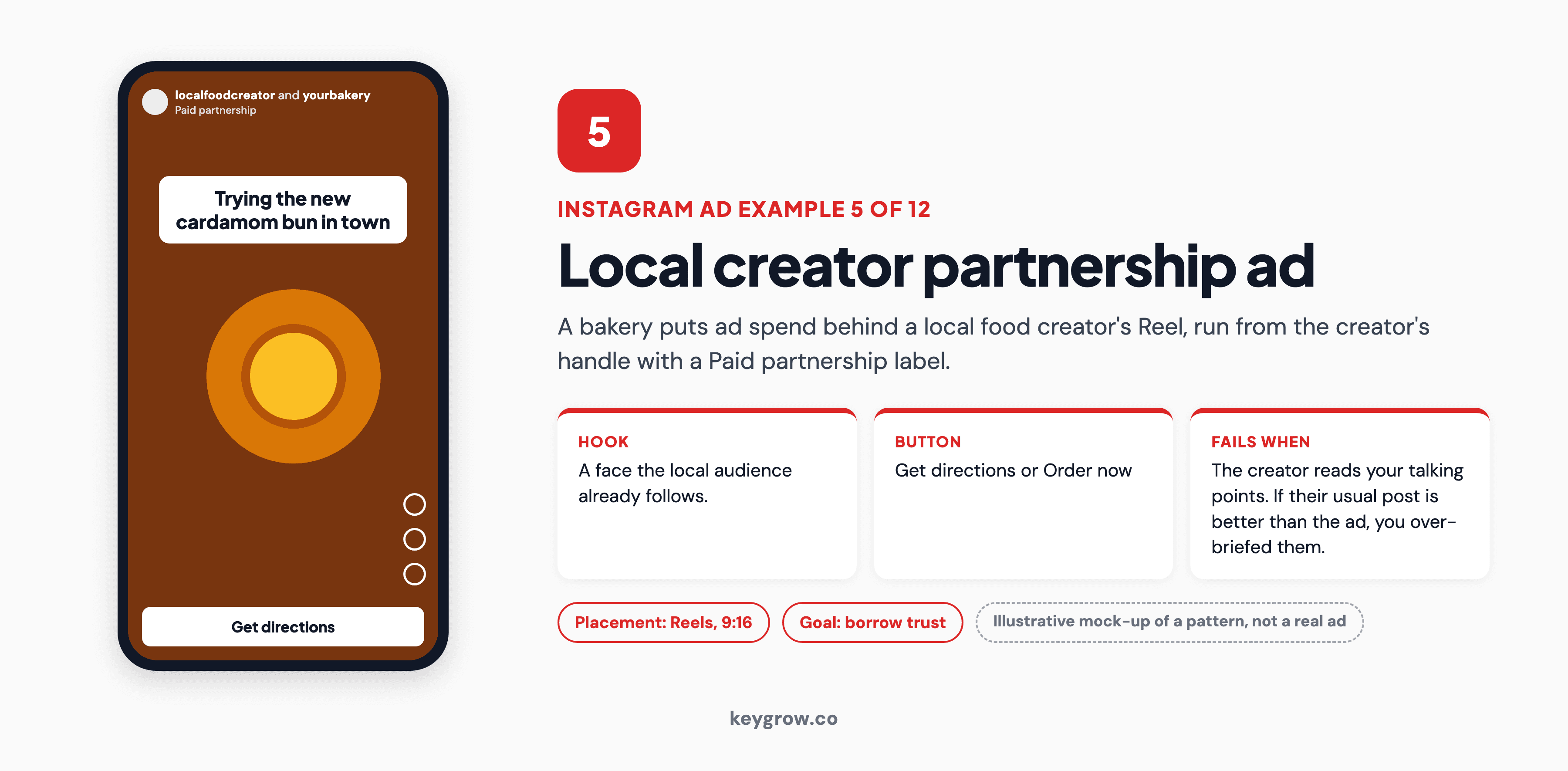
Instagram ad example 5 of 12, the local creator partnership ad: an illustrative mock-up of a bakery's Reels ad that runs from a local food creator's handle with a Paid partnership label, showing the creator trying a pastry, with a Get directions button.
A neighborhood bakery pays a local food creator to film a visit, then runs that Reel as a partnership ad. The ad shows the creator's handle at the top, with a "Paid partnership" label naming the bakery.
Hook: a face the local audience already follows. CTA: Get directions or Order now.
Partnership ads let you put spend behind a creator's post from their handle, with their permission, so the ad carries their audience's trust instead of yours. For a business with a storefront, a creator who posts about your town is worth more than one with ten times the followers in another country.
Where it breaks: a creator who reads your talking points. Give them the facts (prices, hours, what to order) and let them talk the way they normally do. If their usual post is better than the ad, you've over-briefed them.
Move one offer
One offer, one reason it exists, one deadline. A carousel gives each of those its own card.
6. The offer carousel
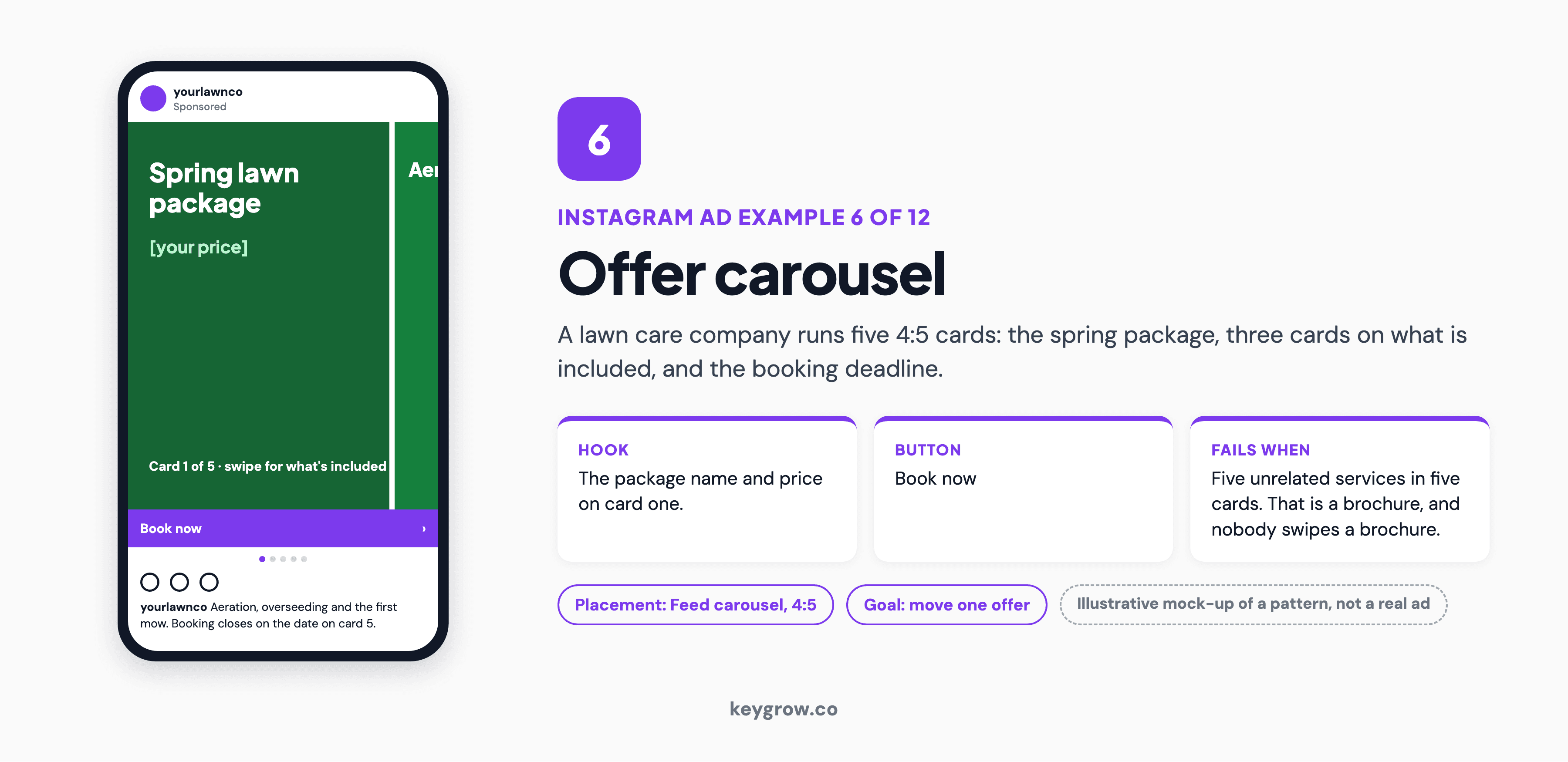
Instagram ad example 6 of 12, the offer carousel: an illustrative mock-up of a lawn care company's five-card Feed carousel with the spring package on card one, what is included on cards two to four, and the booking deadline on card five, with a Book now button.
A lawn care company runs five 4:5 cards. Card one names the spring package. Cards two to four show what's in it: aeration, overseeding, the first mow. Card five shows the date booking closes and the button.
Hook: the package name and price on card one. CTA: Book now.
The carousel works because people who swipe are telling you they're interested, and each card answers the next question. It also respects the 125-character text limit, since the cards carry the detail the caption can't.
It fails as a menu. Five unrelated services in five cards is a brochure, and nobody swipes a brochure. Also, turn off automatic card ordering if the order tells a story, or Meta may show the deadline before the offer.
Stop the Reels scroll
On Reels, the first second decides whether the other 14 get watched. Put words on screen before anyone has to listen.
7. The "three things" hook Reel
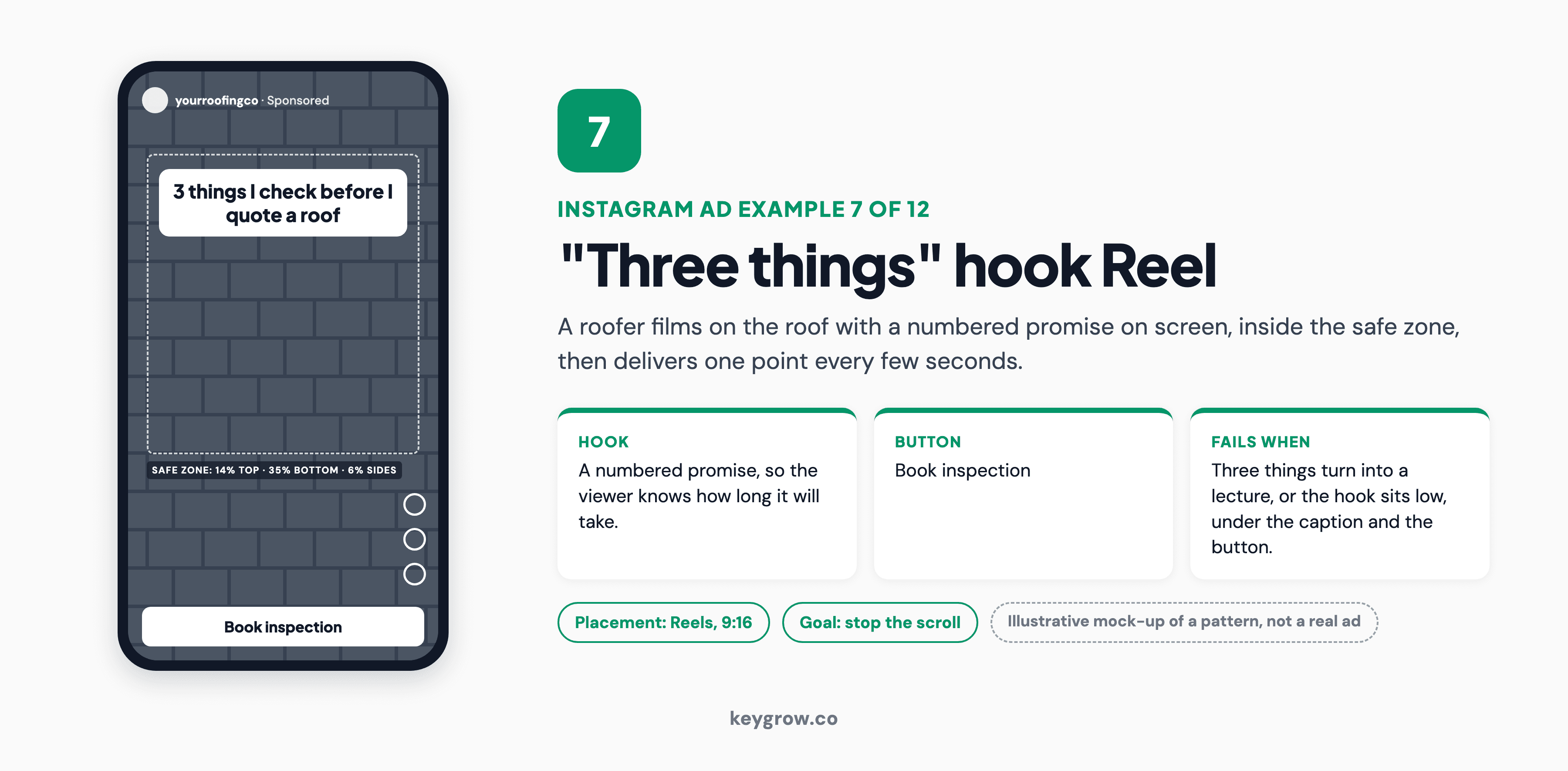
Instagram ad example 7 of 12, the three things hook Reel: an illustrative mock-up of a roofing company's 9:16 Reels ad where the owner stands on a roof and the on-screen text reads three things I check before I quote a roof, placed inside the safe zone, with a Book inspection button.
A roofer stands on a roof, phone held vertical, with on-screen text inside the safe zone: "3 things I check before I quote a roof." Then he shows them, one every few seconds.
Hook: a numbered promise, so the viewer knows how long it'll take. CTA: Book inspection.
It works because it gives the viewer something useful before asking for anything, and the number sets a finish line. The same rules apply as in compelling PPC ad copy: be specific, name the reader's problem and say what to do next.
Keep it short. A "3 things" Reel that turns into a seven-minute lecture loses people at thing two.
And count the words on screen. A hook needs five or six, placed high, not a paragraph sitting under the caption and the button.
8. The three-frame Story
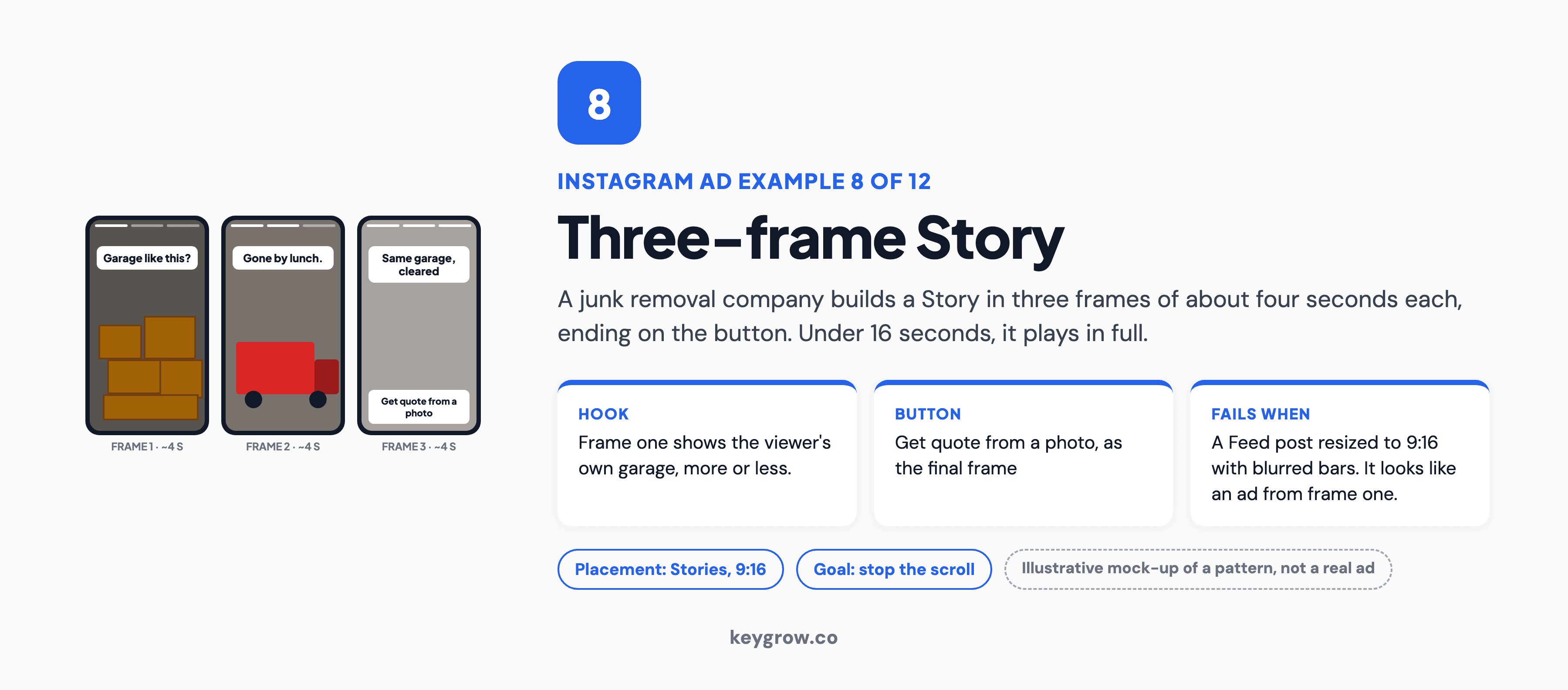
Instagram ad example 8 of 12, the three-frame Story: an illustrative mock-up of a junk removal company's Stories ad in three frames, a packed garage with the line garage like this, a loaded truck with the line gone by lunch, and an empty garage with a Get quote from a photo button.
A junk removal company builds a Story in three frames of about four seconds each. Frame one: a packed garage, "Garage like this?" Frame two: the loaded truck, "Gone by lunch." Frame three: the empty garage and the button.
Hook: the viewer's own garage, more or less. CTA: Get quote from a photo, as the final frame.
Stories are a tap-forward format, so a sequence uses that habit instead of fighting it. Keep the whole thing under 16 seconds and Meta plays it in full, per its Ads Guide, instead of splitting it into separate cards.
The version that fails is a Feed post resized to 9:16, with blurred bars above and below. It looks like an ad from the first frame, and a Story that looks like an ad gets one tap.
Sell a product
For ecommerce, show the product in a hand, in use, with the price before anyone has to ask.

A woman with a patterned headwrap sitting in front of a ring light and checking her phone, the kind of simple setup small brands use to film product demos and creator-style Instagram ads.
Online stores start with an edge here, because people browse Explore and Reels looking for things to buy. If you run a store and want help with creative, catalog setup and testing, our ecommerce social media marketing covers all three.
9. The product-in-hand demo
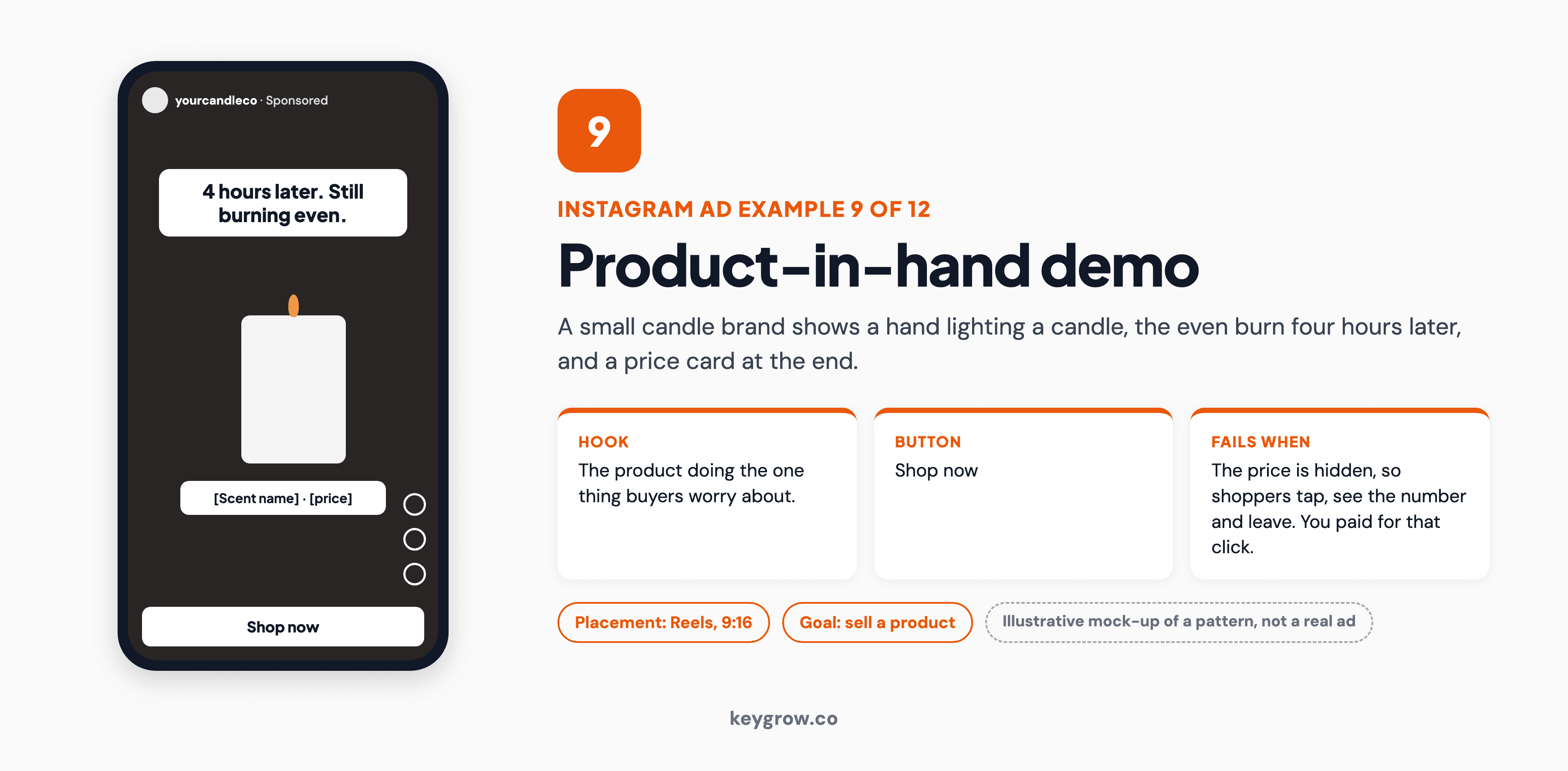
Instagram ad example 9 of 12, the product-in-hand demo: an illustrative mock-up of a small candle brand's 9:16 Reels ad showing a hand lighting a candle, the burn after four hours, and a price card at the end, with a Shop now button.
A small candle brand films a hand lighting a candle, then a cut to the same candle four hours later, burning evenly. The last two seconds show the price and the scent name on a plain card.
Hook: the product doing the one thing buyers worry about. CTA: Shop now.
The demo answers the question a photo can't. For a candle it's the burn, for a backpack it's what fits inside, and for a sauce it's someone pouring it.
Hiding the price is the classic mistake. A shopper who taps through and finds the price higher than they guessed bounces, and you've paid for the click. Show it in the ad and the people who tap have already said yes to the number.
10. The catalog retargeting carousel
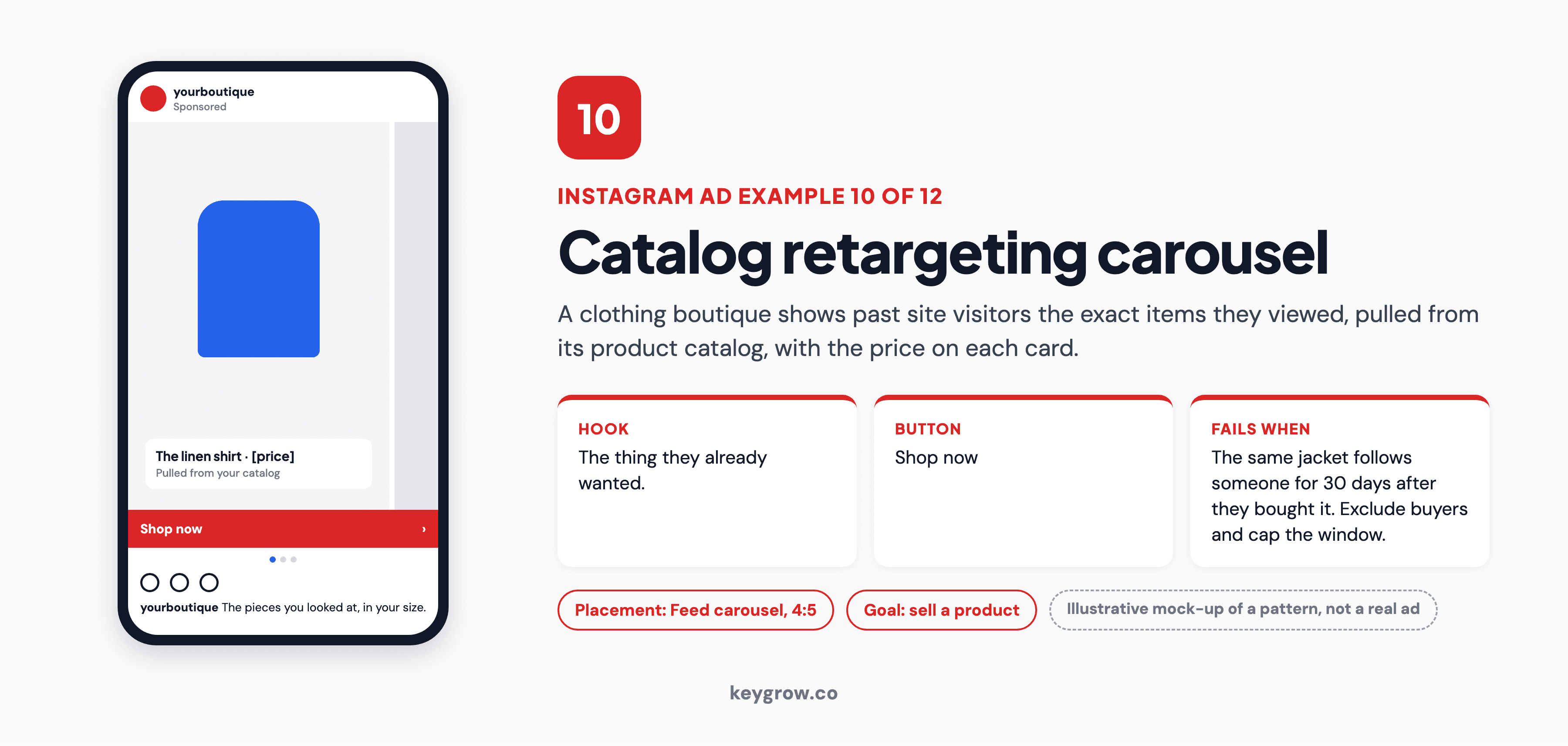
Instagram ad example 10 of 12, the catalog retargeting carousel: an illustrative mock-up of a clothing boutique's Feed carousel showing the exact three items a shopper viewed, each card with the price and a note that sizes are running low, with a Shop now button.
A clothing boutique shows past site visitors the exact items they looked at, pulled from its product catalog, with price on each card.
Hook: the thing they already wanted. CTA: Shop now.
Meta builds these automatically from a product catalog and your site's tracking pixel (it calls them Advantage+ catalog ads). The audience already picked the product. With a cold audience, that's the hardest part.
Where it goes wrong: showing the same jacket for 30 days after someone bought it, or after they decided against it. Exclude recent buyers and cap how long people stay in the audience. A week or two is plenty for most products.
Fill a date on the calendar
When the goal is a specific day, the ad should be about that day, and the button should save it or book it.
11. The event reminder ad
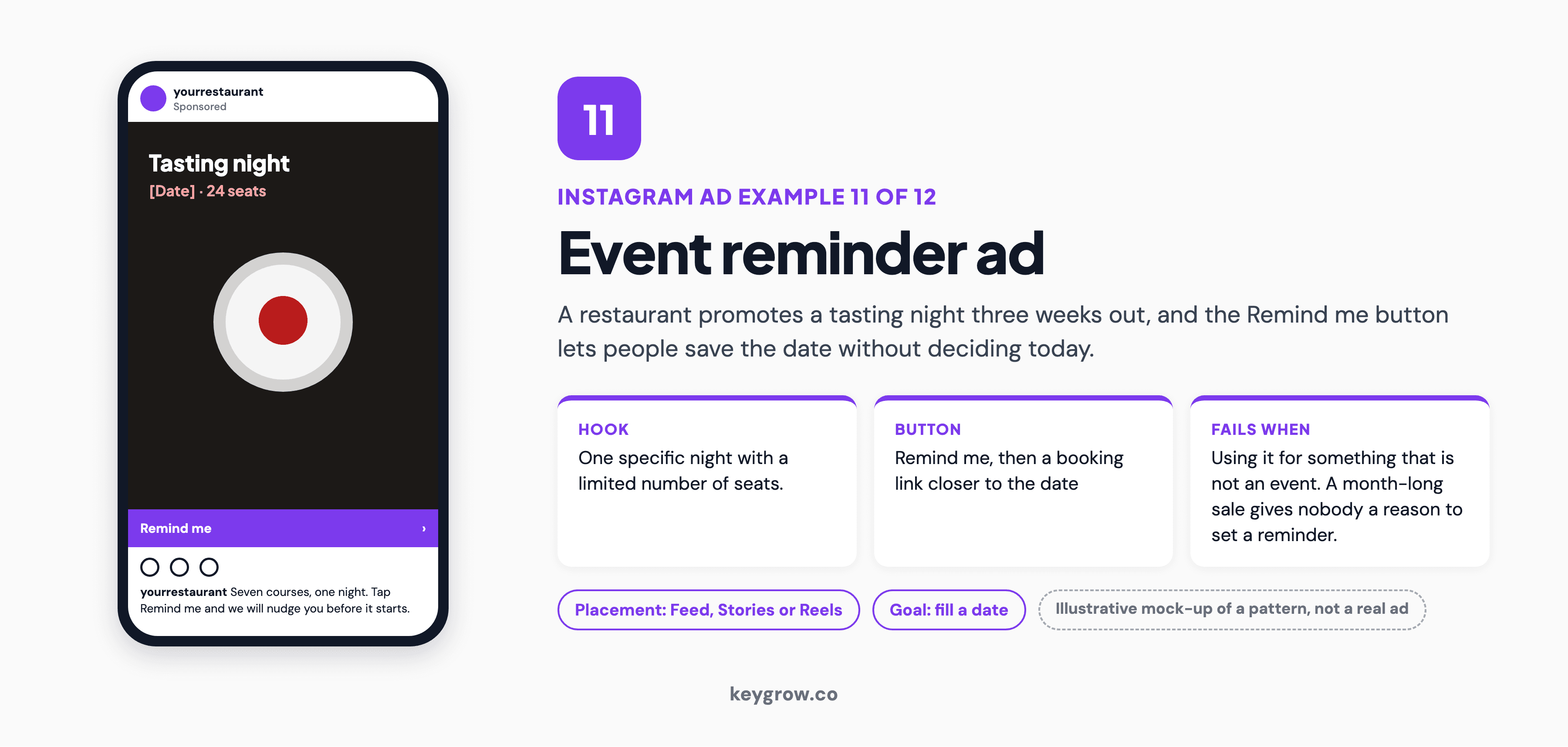
Instagram ad example 11 of 12, the event reminder ad: an illustrative mock-up of a restaurant's Feed ad for a tasting night with the date and seat count on the image and a Remind me button, which sends a notification before the event starts.
A restaurant promotes a tasting night three weeks out. The image shows the date, the menu and the number of seats. The button is Remind me, so the viewer doesn't have to decide today.
Hook: a specific night with a limited number of seats. CTA: Remind me, then a booking link closer to the date.
Reminder ads attach an Instagram upcoming event to the ad, and they run in Feed, Stories and Reels, per Meta's developer guide. Once the event is in the past, the ad stops delivering, which saves you from paying for the leftovers. More ideas for filling tables are in our guide to restaurant social media marketing.
It fails for things that aren't events. A "reminder" for a sale that runs all month gives people no reason to set one.
12. The open-slots Story
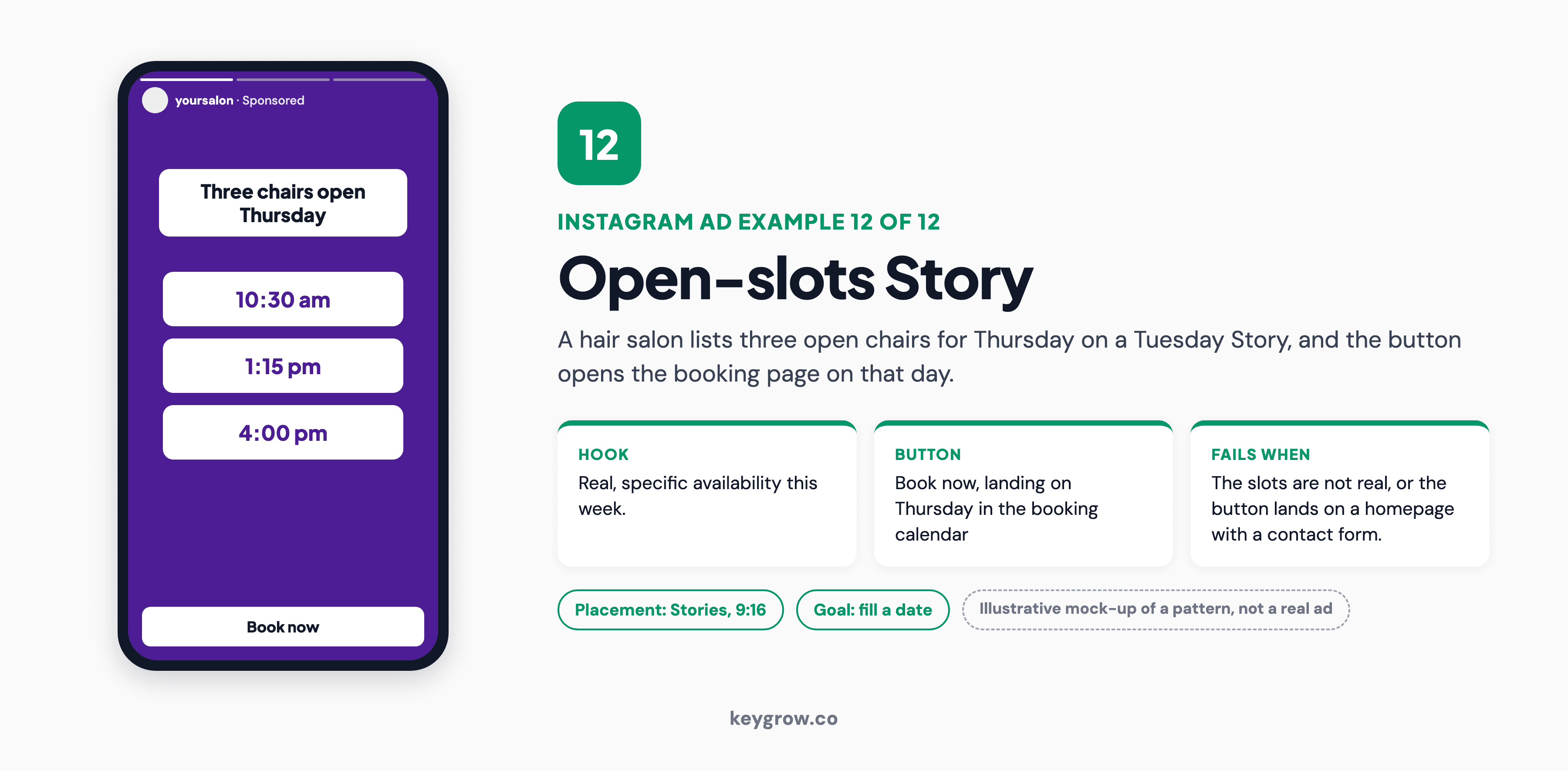
Instagram ad example 12 of 12, the open-slots Story: an illustrative mock-up of a hair salon's 9:16 Stories ad listing three open appointment times on Thursday with a Book now button that opens the online booking page.
A hair salon runs a Story on Tuesday listing three open chairs for Thursday, with the times. The button opens the booking page on the right day.
Hook: real, specific availability. CTA: Book now.
Empty appointments are the one product a service business can't store.
This pattern sells this week's gaps without discounting, because "three chairs open Thursday" is a reason to act, not a sale.
It only works if the slots are real and the booking page opens on that date. If people tap and land on a generic homepage with a "Contact us" form, the urgency is gone before they find the calendar.
Which pattern should you test first?
Start with the doubt that stops a stranger from contacting you today, then pick the job from the seven above that removes it.
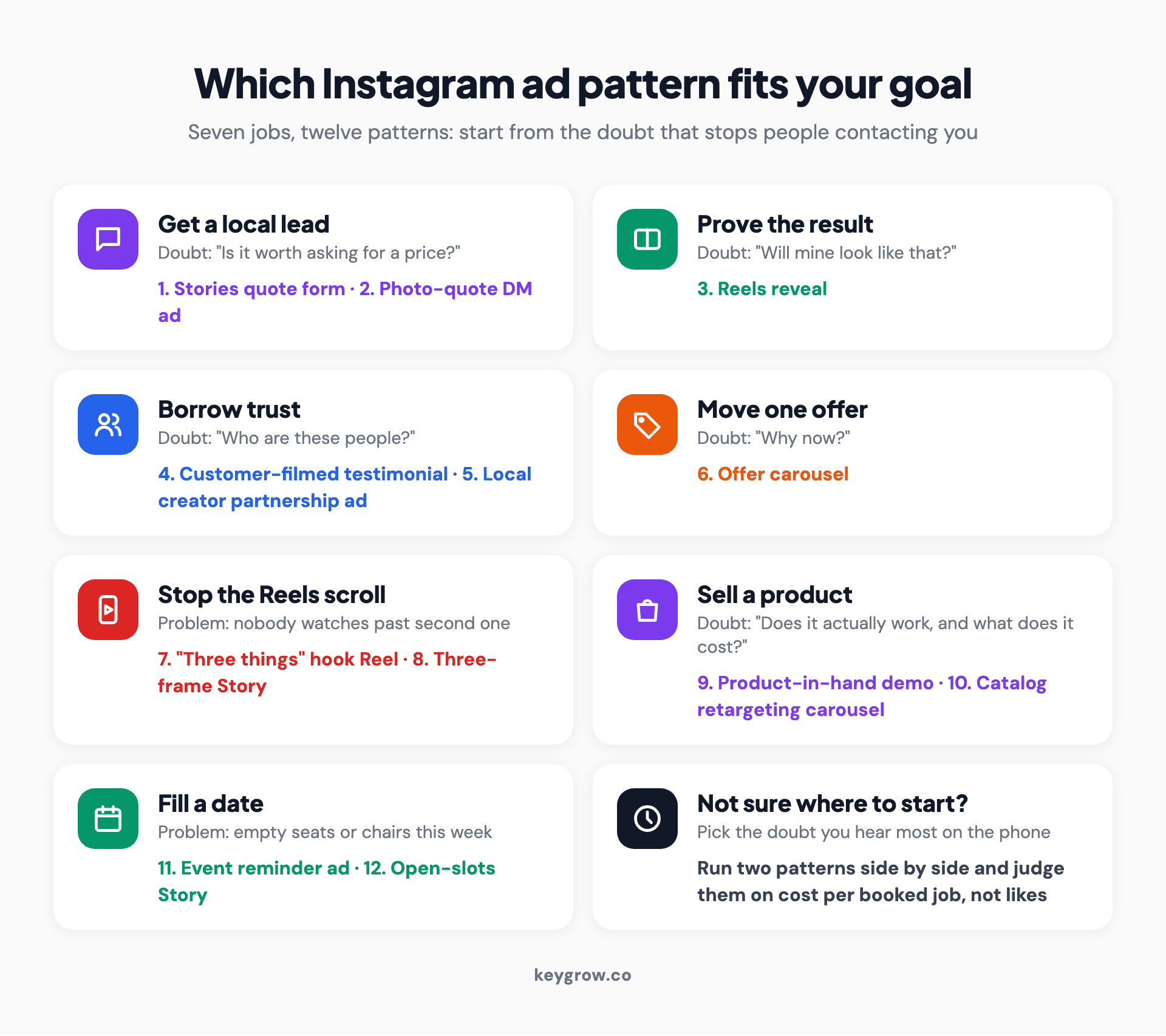
Icon grid matching seven Instagram ad goals to patterns: get a local lead with the Stories quote form or photo-quote DM ad, prove the result with the Reels reveal, borrow trust with a customer-filmed testimonial or local creator partnership ad, move one offer with an offer carousel, stop the Reels scroll with a three things hook Reel or three-frame Story, sell a product with a product-in-hand demo or catalog retargeting carousel, and fill a date with an event reminder ad or open-slots Story.
If people can't picture the result, start with job two. If they don't know who you are, job three. If the price is the question, jobs one and four. A store with traffic but few sales should set up job six before anything else, since the catalog ad works on people who already showed up.
Run two patterns side by side, not twelve. On a small budget, two ads give you a readable comparison in a few weeks.
Twelve give you twelve guesses.
Our breakdown of what Instagram ads cost shows how many leads a given daily budget buys by industry, which tells you how long the test needs to run.
Judge the winner on cost per booked job or per sale. Likes and views are nice to look at and pay nothing.
The ad gets the tap, the page gets the customer
Every example above ends with a button. What's behind it decides the cost per lead more than the ad does.
Sending ad clicks to a homepage is the most expensive default in paid social.
A Greater London security company we worked with was running Google and Facebook ads into a dated site with several pages of general information and no clear next step. We built one focused page for the ads, around their 20+ years of experience, their certified guards and a single request for a free security assessment. The conversion rate rose 95 percent in 4 weeks. The security company's landing page case study shows the before and after.
The same applies to every pattern here. The open-slots Story needs a calendar, the Reels reveal needs more before-and-afters, and the product demo needs the product page, not the shop's front door. Our guide to landing page conversion rate optimization walks through what to fix first. If you'd rather have the page built for you, our landing page design services start from the ad and work backward.
Build a swipe file from real ads
Meta's Ad Library is free and shows the active ads of any Page, including the Instagram versions. Use it to collect patterns, not to copy wording.

A woman typing on a laptop at a wooden table with a camera and phone beside her, planning ad creative and reviewing examples before a shoot.
Search for businesses like yours in other cities. Filter to Instagram, look for ads that have been running for months, and save the ones that match a pattern above. You won't see their results, but an advertiser who keeps paying for an ad for six months usually thinks it works.
Then rebuild the pattern with your own footage. Copying another business's ad word for word is lazy, and in a small town someone will notice.
When you can do this yourself
You don't need an agency to run any of these 12. A single-location business can cover them with a phone and a couple of free afternoons.
Shoot the Reels reveal and the three-frame Story yourself this week. Ask your three happiest recent customers for a 20-second clip. Set up one instant form. That's a month of testing, and it costs nothing beyond the ad spend.
Hire help when you can't keep producing new creative, since ads wear out as the same people see them again, or when you need tracking to tell which ad booked which job. If you're comparing quotes, our breakdown of social media management pricing shows what agencies and freelancers charge.
And if your customers search in a hurry (a burst pipe, a locked car, an arrest), Instagram is the wrong first dollar. They're on Google, not Reels. Our comparison of Google Ads vs Facebook ads works through which one gets the budget first.
FAQs
What are the main types of Instagram ads?
Instagram ads come as single images, videos, carousels of up to 10 cards, and collection or catalog ads for products. They run in four placements: Feed, Stories, Reels and Explore. Lead forms, message ads that open Instagram Direct and reminder ads for events are options layered on top of those formats.
What size should Instagram ads be?
Meta's Ads Guide recommends 9:16 at 1440 x 2560 pixels for Reels and Stories, 4:5 at 1440 x 1800 for Feed images, and 4:5 for image carousel cards. Keep the top 14 percent, bottom 35 percent and 6 percent of each side of vertical video free of text. Specs change, so check the guide and preview each placement before launch.
How long should an Instagram video ad be?
Meta's Ads Guide allows Reels ads from 0 seconds to 15 minutes, so the length is your call. Stories videos under 16 seconds play in full; longer ones can be split into up to three cards. Whatever the length, the hook has to land in the first second or two.
Do Instagram ads work for small businesses?
They work best for businesses whose results people can see, like remodeling, cleaning, salons, restaurants and online stores, and for any business where trust decides the sale. They work poorly for urgent services people search for in a hurry. Judge them on cost per booked job, not likes.
Can I run the same ad on Facebook and Instagram?
Yes. Both run from Meta Ads Manager, and one ad can serve on both. Build each ad in two shapes, 9:16 for Stories and Reels and 4:5 for Feed, so neither platform has to crop or stretch it. Check the Reels preview, where the recommended text is only 44 characters.
Where can I see other businesses' Instagram ads?
Meta's Ad Library shows every active ad from any Page, and you can filter it to Instagram. It is free and needs no ad account. You see the ads but not their results, so treat long-running ads as the ones their owners think are working.
Borrow the pattern, shoot your own footage
Pick the job you need done this month. Choose two patterns for it, film them on a phone in 9:16 with the hook inside the safe zone, and run them side by side to a page that matches the ad. Keep the one that books more work and make a new version before it wears out.
If you'd rather hand the whole thing off, our social media advertising services build, test and track Instagram ads for local businesses on cost per booked job, month-to-month.