


Most jewelers think SEO means ranking for "engagement rings". That keyword is not where your next customer is.
It belongs to national retailers and large marketplaces with link profiles no independent shop will match, and the person typing it is usually weeks from buying anything. Your next customer typed "ring resizing near me" this morning. Or "jewelry repair" plus your town, or "custom engagement ring" plus your town, or "jewelry appraisal for insurance". Short searches, local, from people ready to walk in.
SEO for jewelers is the work of showing up for those searches: in the map results through your Google Business Profile, and in the organic results through a page for every service you do and every piece worth finding. Win the repair, custom and appraisal searches first. They bring people to the counter, and the counter is where rings get sold.
Where your next customer is actually searching
Jewelry searches split into five intents: fix it, make it, value it, research it, buy it online. An independent shop wins the first three locally and picks its battles on the last two.
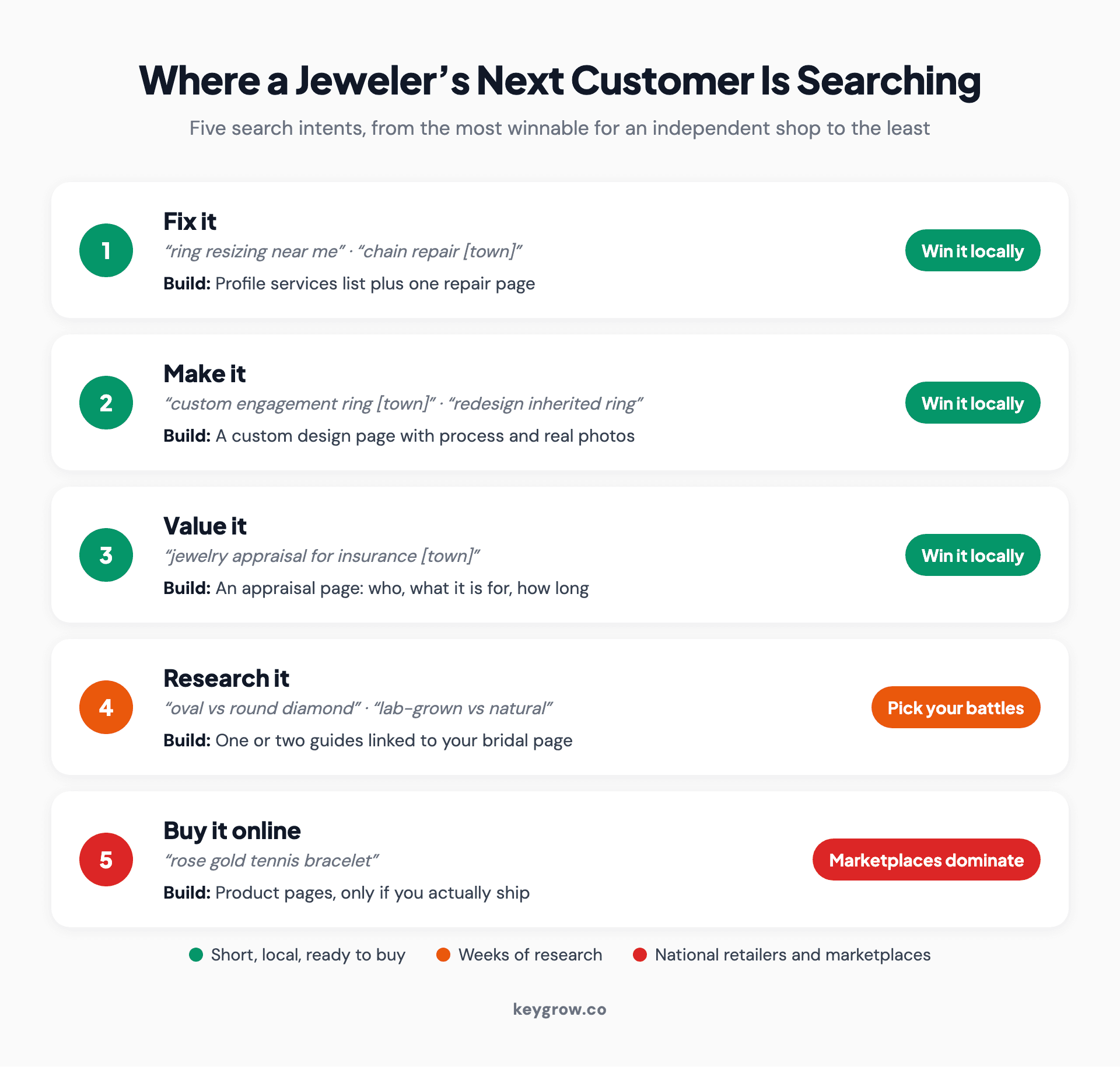
Five-step ladder of jewelry search intent, from fix it and make it searches that an independent jeweler can win locally, down to research and buy-online searches dominated by national publishers and marketplaces.
| Intent | Example search | How close to a sale | Who usually wins it | What you build |
|---|---|---|---|---|
| Fix it | "ring resizing near me", "chain repair [town]" | Days | The nearest shop with a complete profile | Profile services plus a repair page |
| Make it | "custom engagement ring [town]", "redesign inherited ring" | Weeks, high ticket | Local shops that show real work | A custom design page with process and photos |
| Value it | "jewelry appraisal for insurance [town]" | Days | Whoever bothered to write a page | An appraisal page |
| Research it | "oval vs round diamond", "lab-grown vs natural" | Weeks to months | National publishers | One or two guides linked to your bridal page |
| Buy it online | "rose gold tennis bracelet" | Varies | Marketplaces and national retailers | Product pages, only if you ship |
Read the bottom row twice. Broad product searches are the hardest place for an independent jeweler to compete and the place most jewelry SEO advice starts.
The top three rows are the opposite. They carry a town name or "near me", they are answered mostly from the map, and the competition is the four or five shops within driving distance, and often several of them have never listed their services. Our guide on ranking for near me searches covers how proximity and profile signals interact.
There is a commercial reason to start with repair, too. A resize customer stands at your counter, next to your cases, twice: once to drop off, once to collect. Nobody browsing a marketplace listing ever did.
Choose categories that say what the shop is
Pick the primary category that describes where most of your revenue comes from, then add secondaries only for work you do in-house. A short, accurate list beats a long hopeful one.
Google's own wording is blunt. Google's profile guidelines say to "choose the fewest number of categories it takes to describe your overall core business" and to pick categories that complete the statement "This business IS a". Categories are not keywords, and the guidelines say so too.
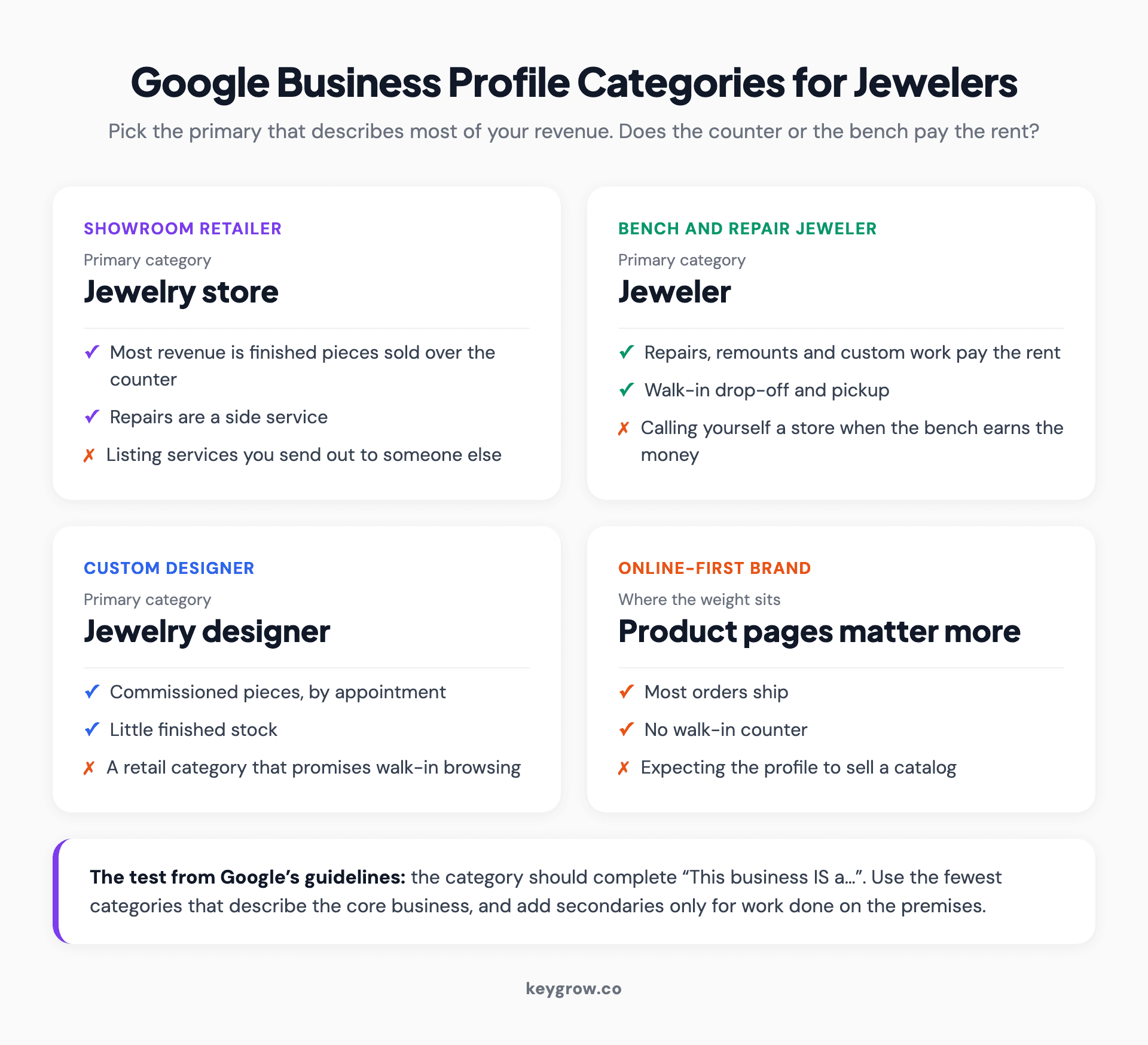
Four comparison cards for jeweler Google Business Profile categories: Jewelry store for a showroom retailer, Jeweler for a bench and repair shop, Jewelry designer for a custom studio, and product pages over categories for an online-first brand.
For most shops the choice comes down to one question: does the counter or the bench pay the rent?
- If most revenue is finished pieces sold over the counter, "Jewelry store" is the honest primary.
- If repairs, remounts and custom work carry the business, "Jeweler" usually describes you better.
- A studio that makes commissioned pieces by appointment and keeps little stock fits "Jewelry designer".
- If you ship most orders and nobody walks in, categories matter less than your product pages.
Then the secondaries. Google's list changes and varies by country, so type "jewelry", "watch", "repair" and "appraiser" into the category picker and read every option before choosing. Add one only when you do that work on the premises. A shop that sends watch repairs out to a specialist should not list itself as a watch repair business, because the first customer who arrives expecting same-day service will say so in a review.
Our guide on how Google Business Profile categories work covers primary versus secondary in more depth. After the categories, fill the services list with every repair you take in (each with a one-line description), add your signature pieces to the products section, upload photos of the bench as well as the cases, and keep holiday hours current. The remaining profile fields are in our local SEO checklist.
Build one page per service you want to be found for
Repair, custom design, engagement rings and appraisals each need their own page. Each answers a different search with a different promise, and one "Services" page cannot rank for all four.

A jeweler's hands working on a ring with a small hand tool at a workbench.
The typical independent site has a home page, an about page, a gallery and a contact form. The services sit in one paragraph on the home page. Google has no page to rank for "ring resizing", so it ranks the shop across town that wrote one.
Start with four pages:
- Jewelry repair. Resizing, chain soldering, prong retipping, stone tightening, clasp replacement. Group them on one page at first. Split resizing out once it is clearly your busiest repair.
- Custom design. The process from sketch to finished piece, how long it takes, what a deposit covers, and photos of commissions you have actually made.
- Engagement rings. Covered in the next section, because it works differently.
- Appraisals. Who does them, what the document is used for (insurance, estates, resale), how long it takes and how the fee works.
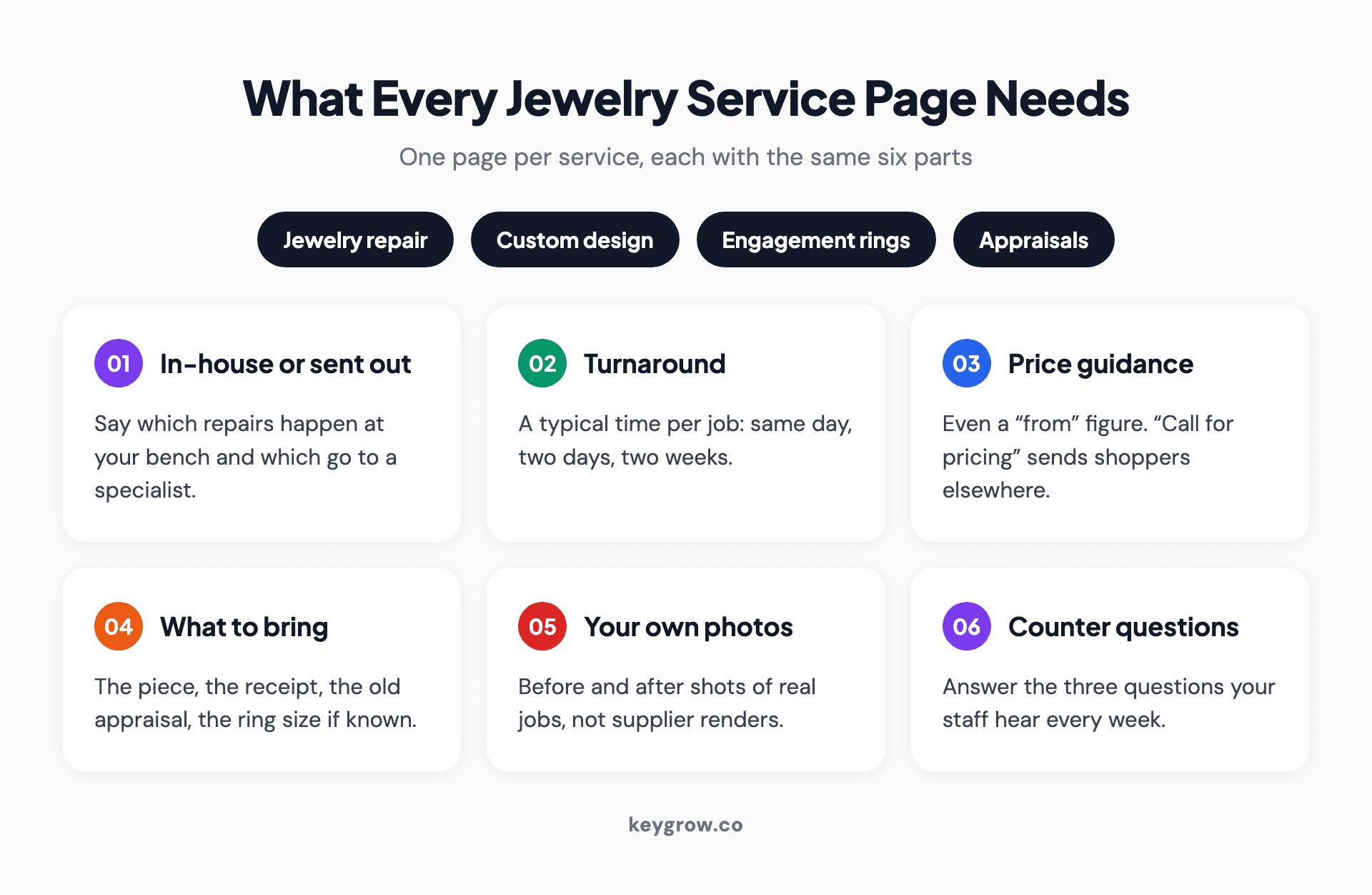
Checklist grid of what every jewelry service page needs: what you do in-house, turnaround, price guidance, what to bring, real photos, and answers to common questions.
Every one of those pages needs the same few things. Say what you do in-house and what you send out. Give a typical turnaround. Give price guidance, even a "from" figure, because "call for pricing" sends price shoppers to whoever answered. Tell people what to bring (the ring, the receipt, the old appraisal). Show your own before and after photos. Answer the three questions your staff hear every week. Our guide to writing local service pages goes through the structure line by line.
The closest thing in our own client work is a repair business with a counter. A phone repair shop came to us with almost no search presence. Over 7 months, monthly organic visitors went from 50 to 2,500, 15+ keywords reached the top three, and the shop went from no calls out of search to 115+ phone calls a month. Different trade, same shape of search: someone has a broken thing and wants the nearest shop that can fix it this week. The phone repair case study lists what was done.
How should an engagement ring page work for a local jeweler?
Aim at your town, not the national term. Target custom and lab-grown engagement ring searches with your city name, give couples a clear way to book a viewing, and answer what they ask in plain words.
Most couples research for a while before they visit anyone. The early searches are about shapes, settings, metals and the natural versus lab-grown question, and national publishers own most of them. You do not need to beat those publishers. You need one page that turns up when the search narrows to a town, and that answers enough of the early questions that the couple books with you.

An engagement ring on a white display stand in a jewelry store case, lit in blue.
What the page should carry:
- The settings and metals you make or stock, with your own photos, not supplier renders.
- How custom works with you: consultation, design, approval, making, fitting, and a realistic timeline.
- An honest comparison of natural and lab-grown stones, including how each holds value.
- Price guidance as a range, and what moves it.
- A booking link or calendar that works on a phone.
Write the lab-grown part carefully. The diamond section of the FTC's Jewelry Guides (16 CFR 23.12) expects a laboratory-created stone to be described with a clear and conspicuous qualifier such as "laboratory-grown", "laboratory-created" or "[manufacturer name]-created". That applies to your product pages and ads as much as to the label in the case. It is also a trust signal: buyers can tell when a shop is being straight with them. This is not legal advice, so have your counsel or trade association check your wording.
Then write one or two guides on the questions couples ask first, such as how to choose a stone shape or what a grading report tells you, and link them to this page. That is the whole content strategy for bridal. Fifty generic blog posts about ring trends will not move it.
Mark up what you actually sell
Write your own product descriptions, add Product structured data that matches what the page shows, and decide what happens to a one-of-a-kind piece after it sells.
Supplier descriptions are the first problem. The same paragraph appears on every stockist's site, so Google has no reason to pick yours. Rewrite it with the details a buyer checks: metal and karat, stone type and size, grading report number where there is one, dimensions, ring size and whether it can be resized, and care. Photograph each piece on a hand so the scale is obvious, and write alt text that describes the piece as a person would ("14k yellow gold oval solitaire on a hand"), not a keyword string.
Structured data is the second. Google treats product structured data in two ways: product snippets for pages where people cannot buy directly, and merchant listings for pages where they can. A product snippet needs a name plus one of review, aggregateRating or offers. A minimal JSON-LD object for a piece you sell online has these properties (the price and details here are an example):
| Property | Example value | What it tells Google |
|---|---|---|
| @type | Product | This page is about one item for sale |
| name | 14k Yellow Gold Oval Solitaire, 1.2 ct Laboratory-Grown Diamond | The piece, with metal, shape, weight and stone origin |
| image | A photo URL of the ring on a hand | The image that can appear with the result |
| description | Oval laboratory-grown diamond, 1.2 carats, set in 14k yellow gold, size 6, resizable in store | The details a buyer checks |
| sku | ER-0412 | Your own stock number |
| offers | Offer: price 2400.00, priceCurrency USD, availability InStock | Price and stock, which must match the page |
Whatever the markup says has to match what a visitor sees. If the page shows no price, leave the price out.
For the store itself, schema.org has a JewelryStore type for your location page, and our guide to local business schema markup shows how to fill it in. If you would rather not hand-write JSON-LD, our schema markup generator builds the base object.
One-off pieces need a rule before they sell. Our default: keep the page live, mark it sold, and link to similar pieces and the custom design page, because the person who loved it is a commission waiting to happen. Delete or redirect it only if nothing similar exists. For catalog structure beyond this, our guide to ecommerce product page SEO goes further.
Get reviews that name the service
Ask at pickup, when the repaired or resized piece is back on the customer's hand, and reply in a way that names the work. Never pay for reviews and never ask only the happy customers.
Google's help page on local ranking says local results are "mainly based on relevance, distance, and popularity", and that "more reviews and positive ratings can help". Distance you cannot change. A steady flow of reviews you can.
The content of the review matters as much as the count. "Resized my mother's ring in two days and it fits perfectly" tells the next customer, and Google, that you do resizing. "Great service" tells nobody anything. So ask in a way that invites detail: "Would you mind mentioning what we fixed? It helps the next person with the same problem find us." When you reply, name the job back.
Two rules to keep. Google's review policy prohibits offering incentives "such as payment, discounts, free goods and/or services" for reviews, and prohibits merchants who "selectively solicit positive reviews from customers". A free cleaning in exchange for a review breaks the first. Asking only the customers who smiled at pickup breaks the second. Our guide to getting more Google reviews has the request scripts and timing.
When ecommerce SEO matters, and when it does not
If most revenue walks through the door, local SEO is the job. Ecommerce SEO earns its cost once a shipped catalog of repeatable products drives a real share of sales.
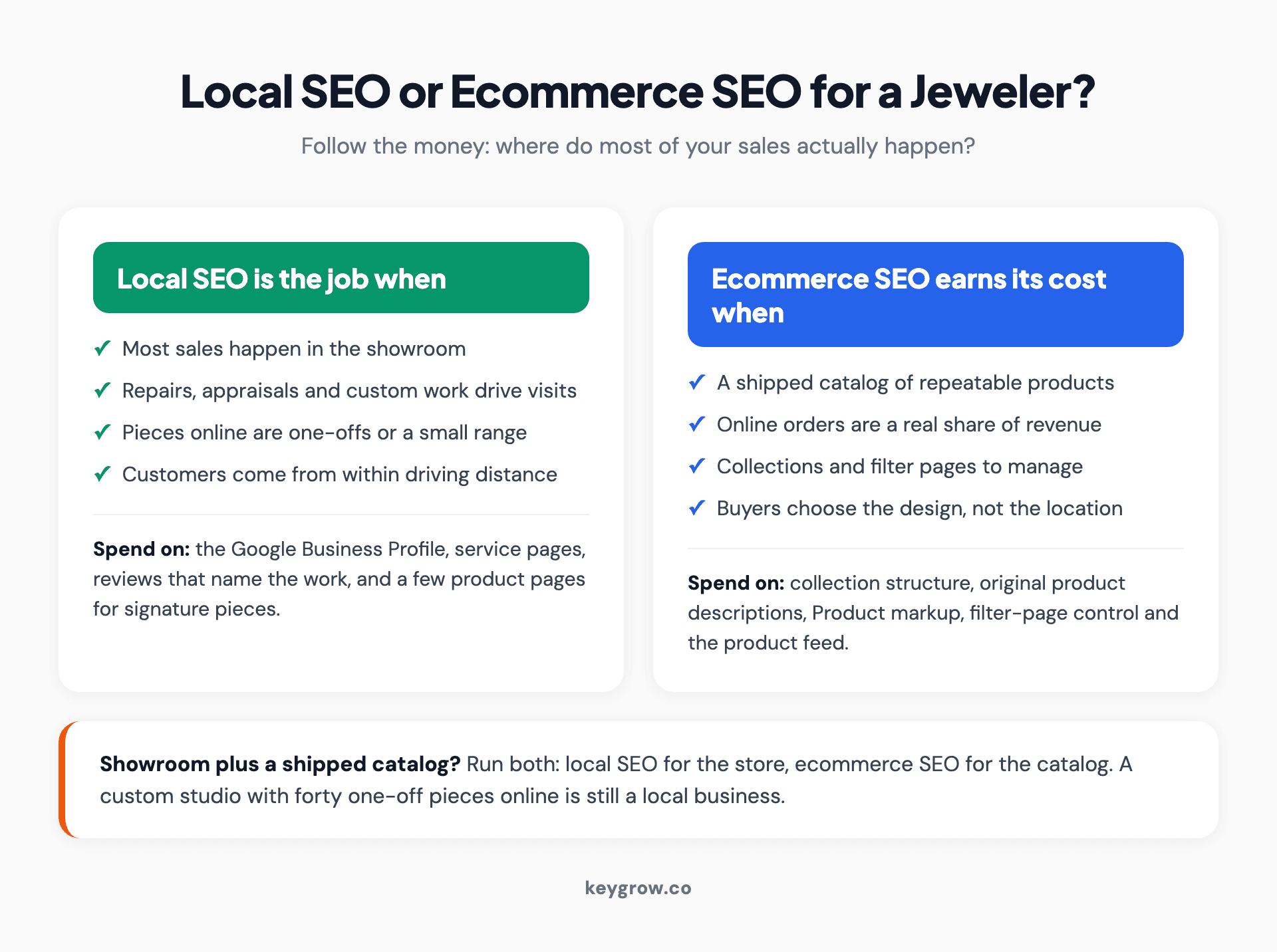
Two-column comparison cards for jewelers: when local SEO is the job, such as showroom sales, repairs and appointments, versus when ecommerce SEO earns its cost, such as a shipped catalog of repeatable products.
| Your business | Where the SEO effort goes |
|---|---|
| Showroom, mostly in-store sales, small online catalog | Profile, service pages, engagement page, a few product pages for signature pieces |
| Bench or custom studio, by appointment | Portfolio and process pages; product markup only for ready-made pieces |
| Showroom plus a shipped catalog of repeatable products | Both: local for the store, plus collection structure, product markup and a product feed |
| Online-only brand | Ecommerce first; the profile barely matters |
The trap is the second row trying to act like the fourth. A custom studio with forty one-off pieces online does not need faceted navigation, a feed strategy and a hundred collection pages. It needs its commissions photographed and written up as projects.
The fourth row is different work entirely: collection architecture, filter pages that do not multiply into thousands of near-duplicate URLs, feed quality, and competing with marketplaces on product terms where your designs, not your location, are the reason to buy. When the catalog is the business, our ecommerce SEO services cover the collection, schema and feed work a store-only plan leaves out.
A 90-day SEO plan for a jewelry store
Days 1 to 14 fix the profile, days 15 to 45 build the service pages, days 46 to 75 build the bridal and product pages, and days 76 to 90 measure and set up the next season.
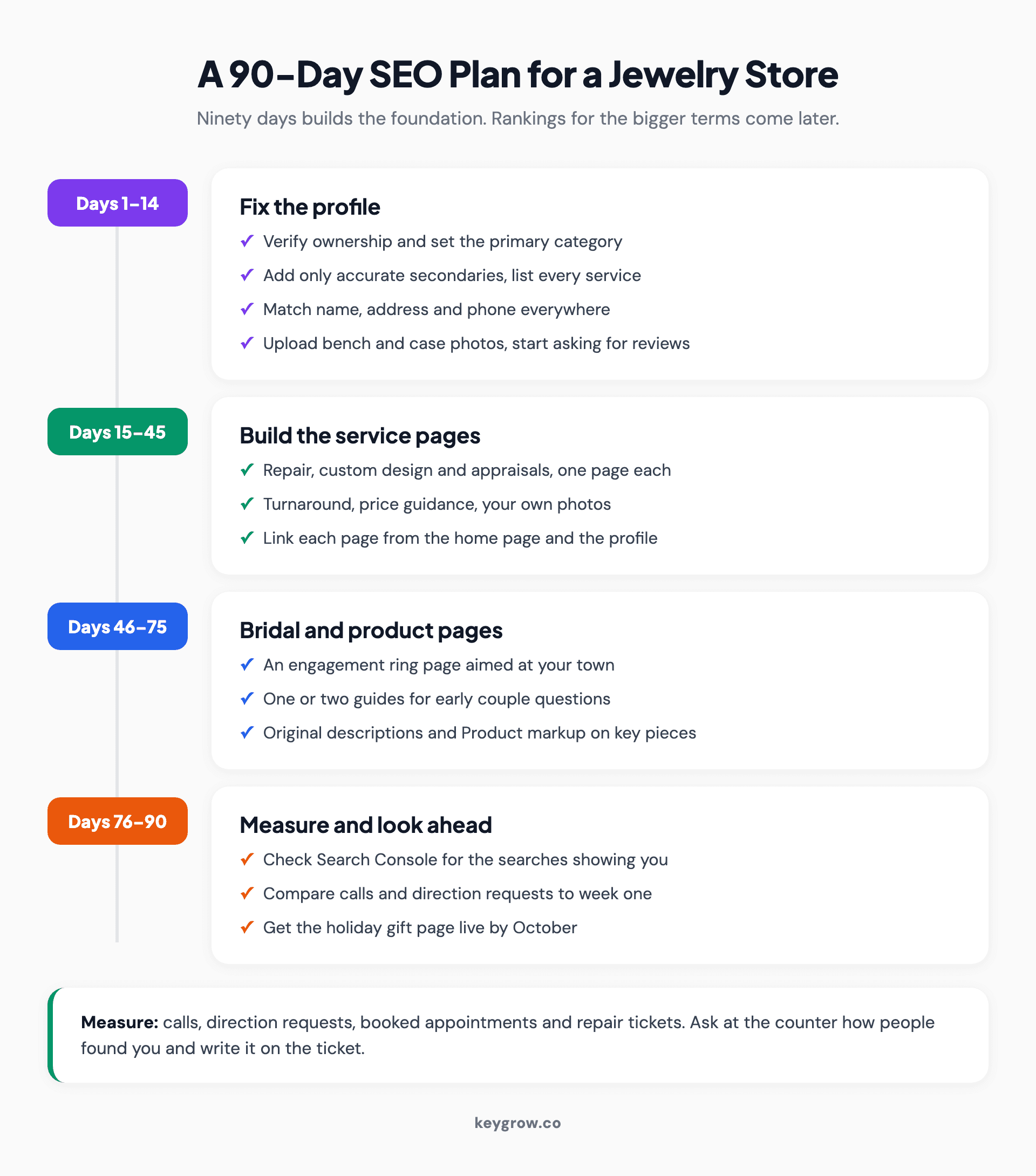
Four-phase 90-day SEO plan for a jewelry store: fix the profile in days 1 to 14, build service pages in days 15 to 45, build bridal and product pages in days 46 to 75, measure and prepare for the season in days 76 to 90.
- Days 1 to 14: the profile. Verify ownership, set the primary category, add only accurate secondaries, list every service, make your name, address and phone identical on your site and the main directories, upload bench and case photos, and start asking for reviews at pickup.
- Days 15 to 45: the service pages. Repair, custom design and appraisals, one page each, with turnaround, price guidance and your own photos. Link each from the home page and from the profile.
- Days 46 to 75: bridal and products. The engagement ring page, one or two research guides linked to it, rewritten descriptions for your best-selling and signature pieces, and Product markup on those pages.
- Days 76 to 90: measure and look ahead. Check which searches are bringing impressions in Search Console, compare calls and direction requests from the profile against the first fortnight, and get the holiday gift page live by October. A page published in mid-December has had almost no time to be crawled before the shopping is done.
Measure in calls, direction requests, booked appointments and repair tickets. Ask at the counter how people found you and write it on the ticket. Rankings for "engagement rings" are the last number worth watching.
Be realistic about what 90 days buys. It buys the foundation. The payout comes later. Our strongest organic result, a doctor's practice in Dubai, took 12 months to reach 1,519% traffic growth. Anyone promising your shop page one for "engagement rings" in 30 days is either targeting a phrase nobody searches or about to do something to your site you will regret. Our post on how long local SEO takes breaks down what usually moves first.
When you do not need an agency
A single shop in one town can do most of this alone: the profile, a review habit, and four service pages written by the person who does the work. That is most of the value for a one-location jeweler.
You will write a better repair page than an outside writer, because you know which questions customers ask at the counter and which ones they are embarrassed to ask. Give it a few evenings.
Outside help starts to pay when the work outgrows the owner. A second location. A shipped catalog with hundreds of products and filter pages to manage. A site that cannot be edited without a developer. Or simply a calendar so full of commissions that the evenings are gone. That is when the cost of your time is higher than the fee.
FAQs
How long does SEO take for a jewelry store?
Profile changes, such as a corrected category and a steady flow of reviews, can show in the map results within weeks. New service pages usually take a few months to rank for local searches. Competitive bridal and product terms take much longer, and can run to a year or more, because the pages already ranking have years of links behind them.
What Google Business Profile category should a jeweler use?
Use the category that describes most of your revenue. A shop that mostly sells finished pieces over the counter fits "Jewelry store", a bench-led shop that lives on repairs and custom work often fits "Jeweler", and a commission studio fits "Jewelry designer". Add secondary categories only for work you do on the premises.
Should a jeweler try to rank for "engagement rings"?
Not as a starting point. The national term is dominated by large retailers and marketplaces, and most people searching it are early in their research. Target engagement ring searches that include your town, build a strong local bridal page, and let the broader term come later if it comes at all.
Do jewelry stores need product schema?
If you show individual pieces on your site, yes. Product markup helps Google understand the piece, its price and availability, and can make the page eligible for richer results. The markup has to match what the page shows, so a page with no price should not claim one in the code.
Can I do SEO for my jewelry store myself?
For a single location, mostly yes. Completing the profile, asking for reviews at pickup and writing four service pages are all jobs an owner can do in a few weeks of evenings. Help is worth paying for when you sell a large catalog online, run several locations, or simply have no time left.
Does a jewelry store need a blog?
It needs a few useful guides, not a blog for its own sake. One or two pieces answering the questions couples ask early, such as stone shapes or natural versus lab-grown, linked to your engagement ring page, do more than a weekly post about trends. Write when a question keeps coming up at the counter.
Rank for the repair, sell the ring
The searches that fill an independent jeweler's week are short and local: fix this, size this, value this, make me something. Win those first with a profile that says what you are and a page for each service, and the ring buyers start arriving through the same door.
If you would rather hand the profile, the pages and the markup to someone else, our local SEO services cover that work month to month, and for a single shop with time to spare we will tell you that you can do most of it yourself.