


The call comes at 6 a.m. after a storm: an oak on a garage, a homeowner standing in the driveway in a bathrobe, phone in hand. They search "emergency tree removal," look at the three businesses on the map, and call the first one that looks real. Whoever shows first on the map gets the job. Nobody scrolls to page two at 6 a.m.
SEO for tree services is the work of making sure that first business is yours. In practice that means a Google Business Profile set up for the jobs you want, one page per service, city pages only where you have real work to show, and enough proof (reviews, job photos, a checkable ISA credential) that a stranger trusts your crew with a chainsaw above their roof. The order matters, and so does the timing, because none of it can be done the morning the storm hits.
What follows is how we approach it, including three things the guides ranking for this topic leave out: which towns deserve their own page, how to get storm pages ready before the season, and a change to the ISA arborist directory that most certified arborists have not acted on yet.
What does SEO for a tree service actually have to win?
Three different searches, won in three different places. The emergency call is won on the map, the planned removal on your website, and the trust check on your reviews and credentials.
| The search | What the homeowner wants | Where it is won | What decides it |
|---|---|---|---|
| "emergency tree removal near me" | A crew on site today | The map pack | Distance, category, reviews, a phone that gets answered |
| "tree removal cost [city]" or "stump grinding [city]" | A fair quote this month | Your service pages | A page for that exact job, price ranges, your own photos |
| "[company name] reviews" or "is [company] insured" | Reassurance before signing | Profile, reviews, website | Recent reviews, stated insurance, a credential they can verify |
Most tree company websites we look at are built for the third search by accident and the first two not at all. There is a homepage that says "full-service tree care," a gallery, and a phone number. That page can rank for the company name. It will not rank for "stump grinding" in the next town over, because nothing on it is about stump grinding.
Set the profile up for the jobs you want
Pick Tree service as the primary category, add only the secondary categories that describe work you do every month, hide your address if customers never visit, and list hours when someone really answers.
Google's local ranking page says local results are mainly based on relevance, distance and prominence, and that there is no way to pay for a better local ranking. The category carries most of the relevance. Distance you cannot fake: the map leans toward businesses close to the person searching, which is why a storm call in the next town tends to go to a crew based there.
What we set on a tree company's profile:
- Primary category: Tree service. It is the category built for the trade. Type "tree", "arborist" and "stump" into the category box to see the current secondary options, since Google renames and adds categories without notice. Add an arborist category only if a certified arborist works for you. Our guide to choosing Google Business Profile categories shows how to check what the top map results use.
- Service-area setup. Most crews run out of a yard no customer visits. Hide the address and list the towns you actually send trucks to. Our explainer on the service-area business setup covers the rules.
- Services named as jobs. Tree removal, tree trimming, stump grinding, emergency tree service, land clearing, cabling and bracing. "Arboricultural solutions" matches nothing anyone types.
- Hours that are true. If you take storm calls overnight, say so and pick up. A "24/7" claim that rings through to voicemail at 9 p.m. tends to come back as a one-star review.
The full walkthrough, including where a license number goes and what gets profiles suspended, is in our guide to Google Business Profile setup for contractors. It applies to tree crews almost line for line.

A tree service worker in a helmet and ear protection running a stump grinder against a wooden fence in a backyard.
Keep shooting photos from the truck. A profile with recent pictures of your own crew, your own grinder and a clean yard after the job reads as an operating business. Stock photos of a forest read as nobody in particular.
Build one page per service
Every service you want more calls for needs a page of its own: removal, trimming and pruning, stump grinding, emergency storm work, and any specialist work you sell, such as plant health care or land clearing.
The logic is plain matching. Someone searching "stump grinding" wants a page about stump grinding, and Google wants to show them one. A "Services" page with six short paragraphs loses to a competitor's dedicated stump grinding page almost every time, even when the rest of that competitor's site is worse.
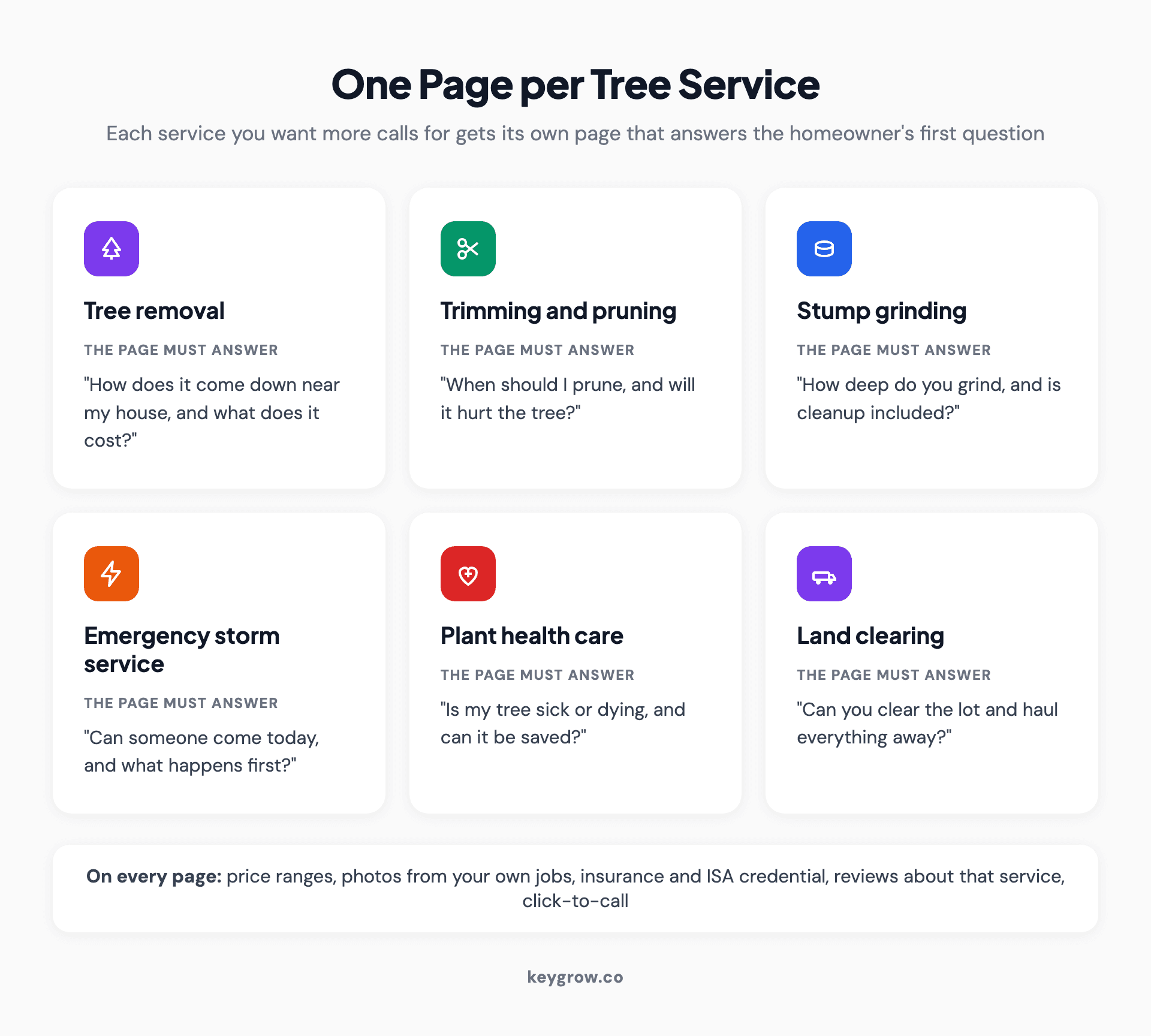
Icon grid of six service pages a tree service website needs: tree removal, trimming and pruning, stump grinding, emergency storm service, plant health care, and land clearing, each with the homeowner question the page has to answer.
Each page should answer what the homeowner would otherwise ask on the phone:
- What the job involves, in plain words. For a removal: climbing or crane, how the wood comes down near a house, what happens to the stump and the brush.
- Price ranges you are willing to stand behind, and what moves them: height, access, how close the tree is to a structure, whether the stump is included. Most competitors publish no numbers at all, which is exactly why a page that does gets read.
- Photos from your own jobs, with filenames and alt text that describe the work, such as "oak removal over garage roof, before and after".
- Proof close to the button: insurance stated plainly, the arborist's ISA certification number if you have one, and two or three reviews that mention that service.
- One way to act: a click-to-call button on mobile and a short quote form that takes a photo upload, because a homeowner can show you the tree faster than they can describe it.
Build them in the order of what pays. For most tree companies that means removals and emergency work first, stump grinding next (it often rides along with a removal), then trimming and pruning. If tree work is one line inside a bigger outdoor business, our guide to SEO for landscaping companies covers the seasonal side of that trade.
City pages: which towns earn one?
Build a page for a town when you have done real jobs there and can say something specific about tree work in that place. A page with the town name swapped into the same text is a doorway page, and Google treats those as spam.
Google says so itself. Its spam policies list "multiple domain names or pages targeted at specific regions or cities that funnel users to one page" as an example of doorway abuse. Forty near-identical "Tree Service in [Town]" pages are the textbook case.
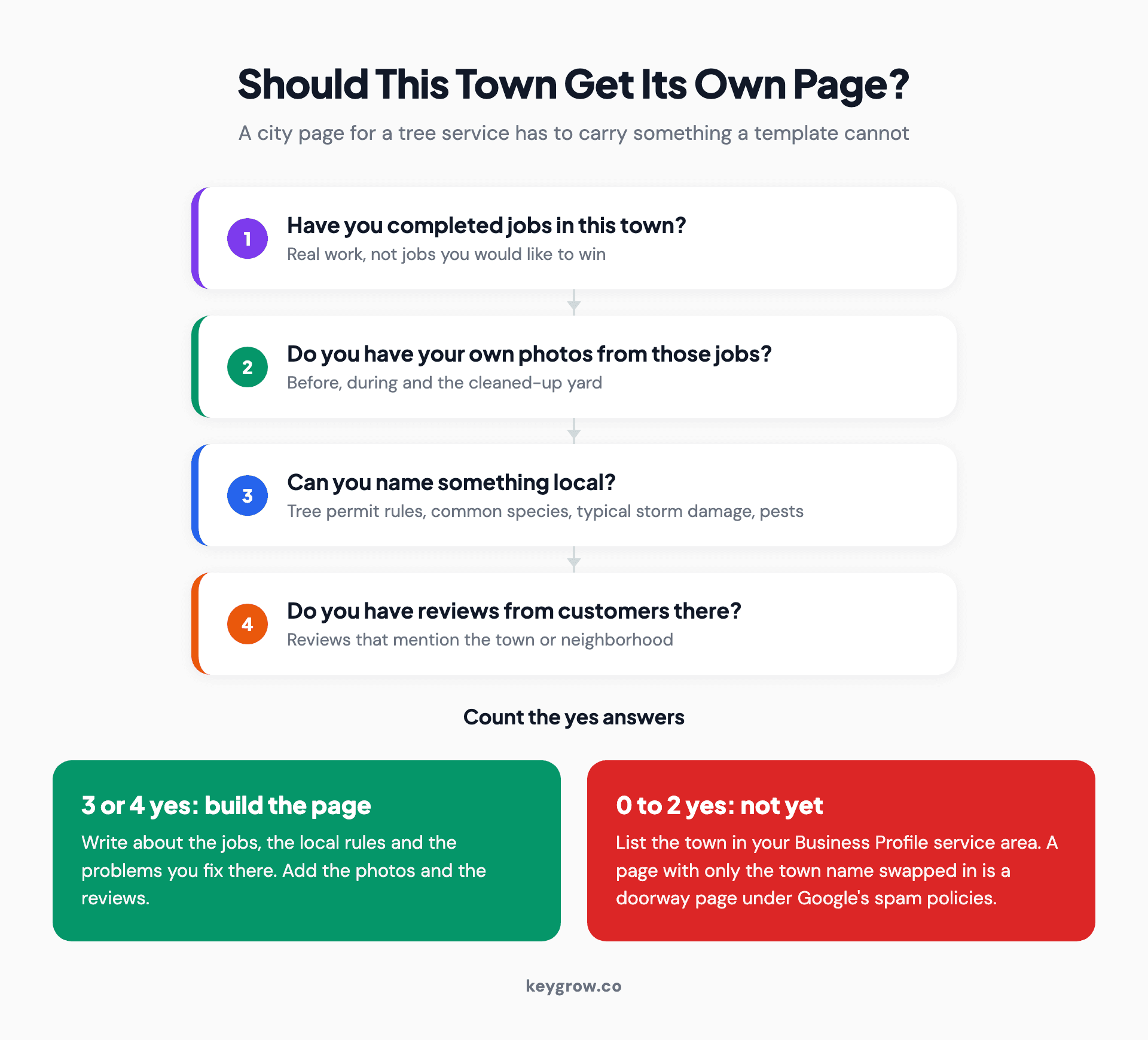
Decision flow for whether a tree service should build a city page: have you completed jobs there, do you have your own photos from those jobs, can you name local tree rules, species or storm problems, and do you have reviews from that town; three or more yes answers means build the page, otherwise list the town in the service area and wait.
A city page that earns its place carries things a template cannot produce:
- Jobs you completed there, with photos, and the neighborhood named in general terms (never a client's house number).
- The town's rules, where it has them. Plenty of municipalities require a permit to remove certain trees or regulate street trees, and a homeowner searching from that town wants to know whether they need one. Read the town's own code before you write a word about it, and link to it.
- The local problems you actually deal with: the species that fail in that area's storms, a pest that has moved through, a soil type that lets roots heave.
- Reviews from customers who live there.
A site with four of these is in better shape than one with forty templates. Each page takes longer to write, the set takes less time overall, and none of them drags the rest of the site down.
Get the storm pages live before storm season
A page published the morning after a storm will not rank for that storm. Your emergency and storm cleanup pages need to exist, be indexed and have a few months of history before the weather that brings your busiest week.
Storm demand arrives as a spike. A windstorm or an ice storm can pack a season's worth of emergency searches into two days, and those searches go to whatever was already ranking when the wind picked up. Nothing you publish during the spike will catch it.
This is also where we push back on a certain kind of agency pitch. "Page one before storm season," sold to you in spring, is a red flag. Our strongest organic result took 12 months to reach 1,519% traffic growth, and our walkthrough of how long local SEO takes explains why nobody can honestly promise a date. The work compounds, slowly.
What we put in place during the quiet months:
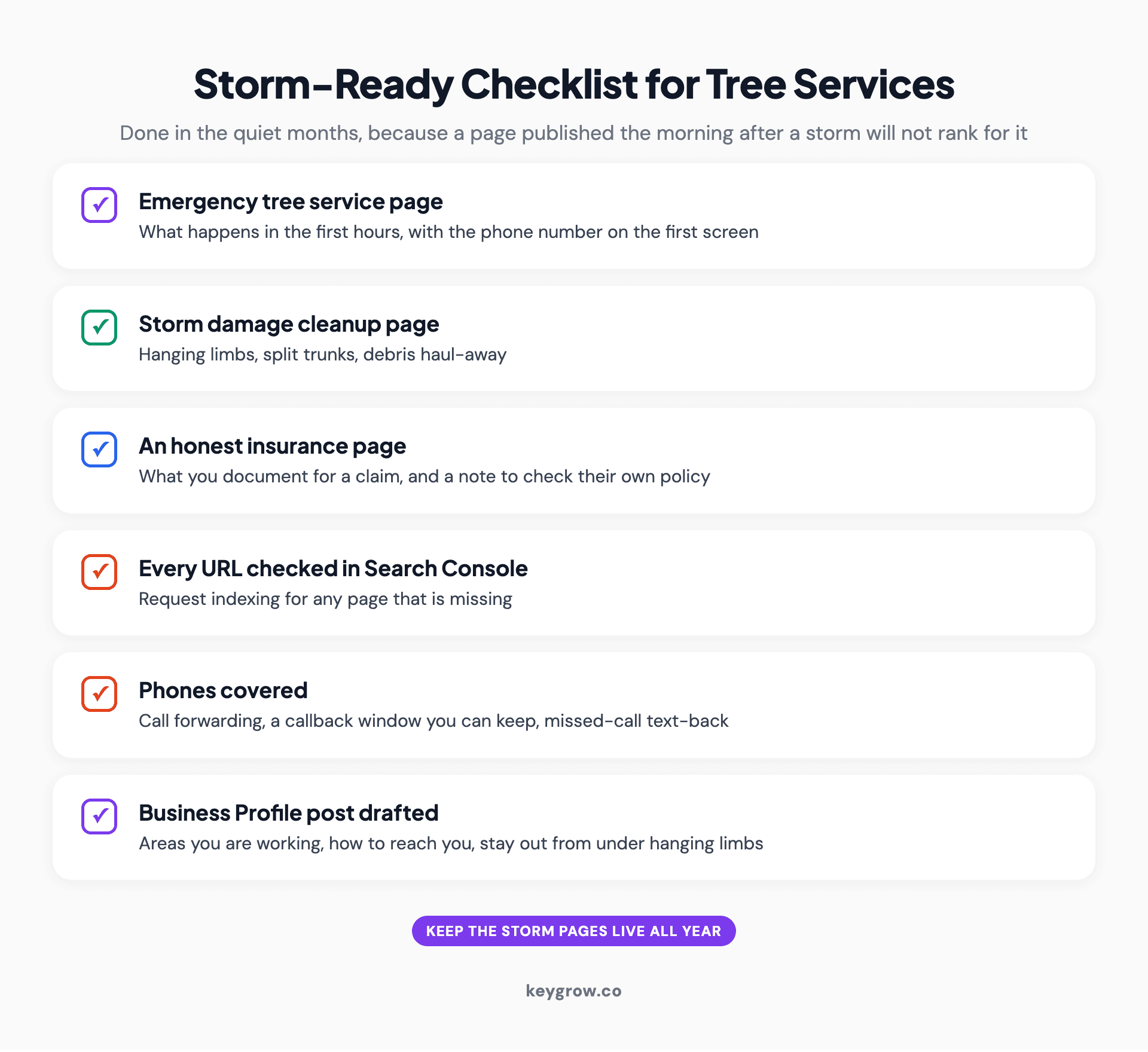
Storm-ready checklist for tree service SEO: an emergency tree service page with the phone number on the first screen, a storm damage cleanup page, an honest page about insurance claims, every URL checked in Search Console, phones covered with forwarding and missed-call text-back, and a Business Profile post drafted for the day after a storm.
- An emergency tree service page that says what happens in the first hours: making the tree safe, clearing access, coordinating with the roofer, and when the full removal follows. Phone number on the first screen.
- A storm damage cleanup page for the planned work afterwards: hanging limbs, split trunks, debris haul-away.
- An honest page about insurance. Homeowners want to know if their policy pays for tree removal. Do not answer for their insurer. Explain what you document (photos, the damage to the structure, a written estimate) and tell them to check their own policy.
- Inspect each URL in Google Search Console and request indexing for any that are missing.
- Cover the phones with call forwarding, a callback window you can keep, and an automatic text reply to missed calls. A ranking is worth nothing if the call dies in voicemail.
- A profile post drafted for the day after a storm: which areas you are working, how to reach you, and what to do about a hanging limb until a crew arrives (stay out from under it). Our breakdown of Google Business Profile posts covers where they show.
Then leave the storm pages up all year. They earn their history in the off-season.
Make your credentials checkable
Show credentials homeowners can verify: the ISA certification number of each certified arborist, insurance details on request, and any license your state requires. Then make sure the ISA directory points back to your website.
Tree work is dangerous and expensive to get wrong, so careful homeowners check. ISA's directory FAQ, revised January 2026, describes a new Find an Arborist portal where the public can find and verify ISA-credentialed professionals. It replaced the old Verify a Credential and Find an Arborist tools, and the details matter for your marketing:
- The legacy tool's data was frozen as of July 7, 2025, and none of it moved to the new portal. An arborist who set up a listing years ago is not in the new one until they rebuild it.
- Listing is voluntary. Credential holders log in and fill out their own profile, and one with no location added may not appear when a homeowner searches by area.
- A profile can carry a bio, a city and a link to the business website.
- By default the portal shows more complete profiles first.
The fix is about twenty minutes for each certified arborist on your team: log in, add the city, a short bio and the link to your site. A homeowner checking a credential then lands on a profile that sends them back to you, and your site picks up a relevant link from the body that issues the credential.
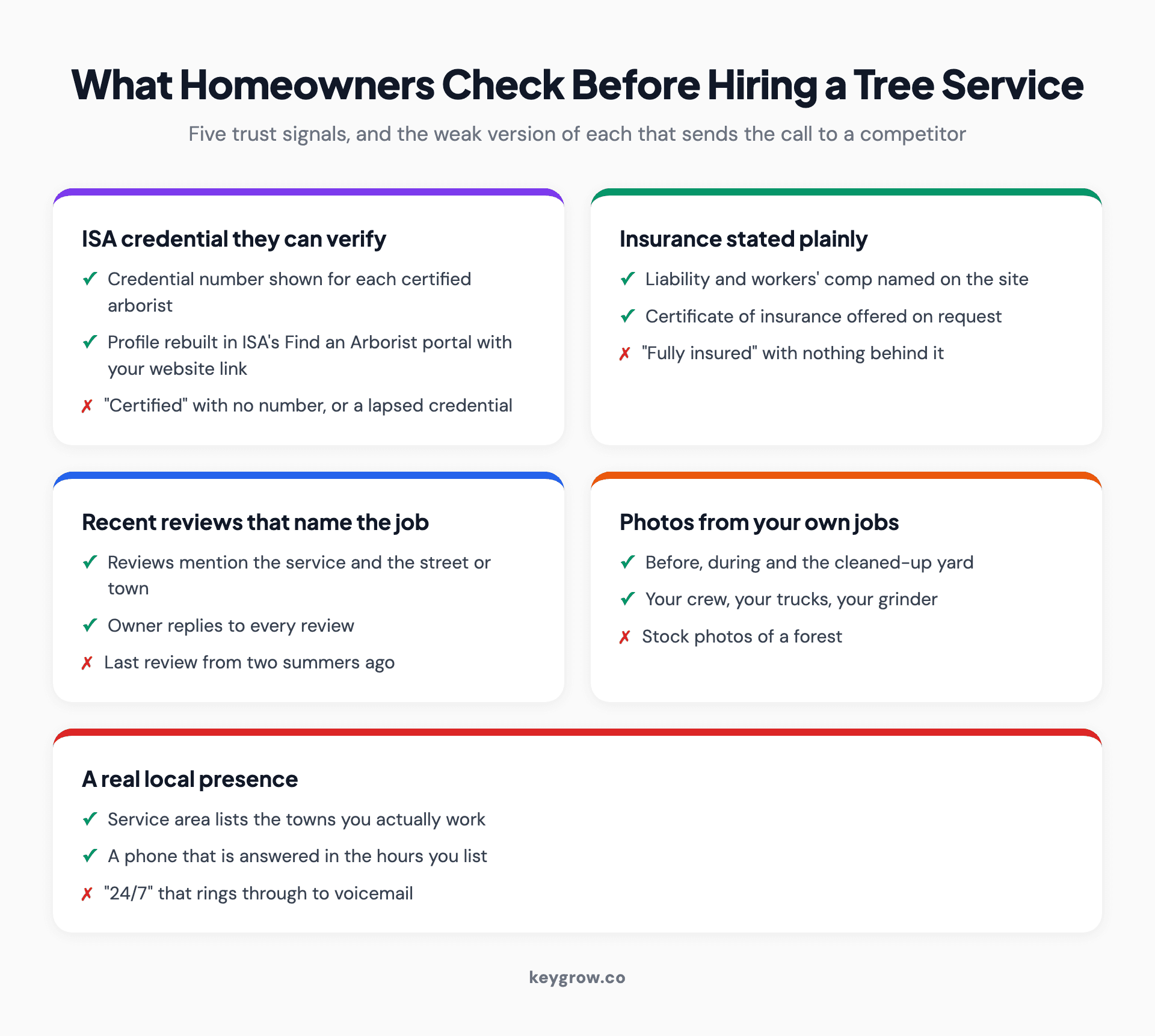
Five trust signals homeowners check before hiring a tree service, each with its weak version: an ISA credential number they can verify in the Find an Arborist portal, insurance named on the site with a certificate on request, recent reviews that name the job and town, photos from your own jobs including the cleaned-up yard, and a true service area with a phone answered in the listed hours.
Two cautions. ISA's credentialing FAQ sets the recertification period at three years, so an expired credential on your website does more harm than leaving it off. And only say "ISA Certified Arborist on staff" while that person still works for you.
Photograph the job, then ask for the review
Ask for the review before the crew leaves, photograph every job at three stages (before, during, and the clean yard after), and post the photos to your profile and the matching service page.
The cleanup shot is the one most crews skip, and it is the one homeowners care about. What people fear from a tree company is the mess: ruts in the lawn, sawdust in the flower beds, a brush pile left for the weekend. A photo of a raked yard with the stump ground below grade sells harder than the dramatic takedown video.

An arborist in a climbing harness working high in the bare crown of a large tree against a gray sky.
For reviews, the ask works best in person at the end of the job, followed the same day by a text with the direct link. Ask every customer, not only the ones who seemed pleased, because Google's review rules do not allow picking and choosing. A review that names the job and the street ("took down two dead ash trees over our driveway") helps the next homeowner and echoes the searches you want. You cannot write it for them, but you can ask them to mention what you did. Our guide to getting more Google reviews has the full routine.
Where tree service links come from
The links worth having for a tree company come from people who already refer tree work: nurseries, landscapers, HOAs, property managers and the ISA directory.
Google's ranking page counts information from across the web, such as links and articles, toward prominence. A local tree company does not need hundreds of links. It needs a handful from sources a homeowner would trust, in or near the service area:
- Local nurseries and garden centers. Their staff get asked "who can take this tree down?" every week. Ask for a spot on a recommended-contractors page, and offer a short guide on how far from the house to plant in return.
- Landscapers and lawn care companies that do not climb. Most turn removals away. A referral page on their site and one on yours is a fair trade.
- HOAs and property managers. Many keep vendor lists, some of them public, and the work recurs.
- The town's Arbor Day or tree-planting event. Volunteering or sponsoring often earns a mention on the event or town page. Communities in the Arbor Day Foundation's Tree City USA program hold an Arbor Day observance every year, so there is usually an event to show up to.
- Local news after a big storm. Reporters need someone to explain what to do about a tree on a house. Be the arborist who calls back.
Skip paid link packages and bulk directory submissions. They do not move a tree company's map position, and some of them put the site at risk.
Count booked jobs by type, not rankings
The number that shows SEO is working is booked jobs from search, split by type: storm, removal, stump, trim. Rankings and impressions are supporting detail.
Tag every inbound call. A tracking number on the profile, a different one on the website, and one question on the phone ("what's the job?") are enough. Then read the split. If calls doubled and every one of them is a small trim, the pages are pointing at the wrong work.
Compare year on year rather than month to month. One windstorm in March makes March look like a triumph and April like a collapse, and neither says anything about the search work.
The closest example from our own work is a junk removal company: a service-area business hauling debris out of yards, much like the back half of a tree job. Over six months of local SEO with a review system built in, monthly calls went from 8 to 50+ and first-page keywords from 1 to 14+, as the Easy Cleanouts case study shows. We reported it in calls, because calls were the number the owner cared about.
When you do not need an agency
A one-truck operator in a small town, booked out through referrals and repeat customers, can do most of this guide alone: set up the profile, ask for reviews, photograph jobs, and write three service pages over a winter. For that business, doing it yourself is the right call, and we would say so on a sales call.
Paying for help makes sense when your hours are worth more on the saw than at a keyboard, when you compete in a metro where every crew on the map has already done the basics, or when you want the storm pages, the city pages and the call tracking built before next season and nobody in the office will get to it. If you are already turning work away, more visibility mostly means more quotes you cannot schedule. Raise your prices first.
If you would rather have someone build the pages and run the profile, our landscaping SEO services are the closest fit for a tree company, since the two trades share most of their searches and their seasons. For a business that also takes on other home repair work, our home services SEO covers the wider mix.
FAQs
How long does SEO take for a tree service company?
A well-built Business Profile can start moving in the map results within a few months, and service pages usually take several months to rank, longer in a crowded metro. That is why storm pages belong in the off-season. Anyone who gives you a firm date for page one is guessing.
What Google Business Profile category should a tree service use?
Tree service is the right primary category for most tree companies. Add secondary categories only for work you do regularly, and add an arborist category only if a certified arborist is on your team. Check the category box for current wording, because Google changes the list.
Does a tree service need a separate page for every city it serves?
No. Build a city page only where you have completed jobs, have your own photos and can say something specific about that town, such as its tree permit rules or common storm damage. Pages that only swap the town name are treated as doorway pages under Google's spam policies.
Does ISA certification help a tree service rank on Google?
Google does not document it as a ranking factor. It helps homeowners choose you, and a complete profile in ISA's Find an Arborist portal can link to your website, which gives you a relevant link and a way for people checking your credential to reach you.
Should a tree service run ads or invest in SEO?
Ads can put you in front of storm searches this week, while SEO takes months and keeps working after you stop paying. Many tree companies run ads through storm season while their pages build. If you can only afford one, start with the free Business Profile and reviews.
What should a tree service website include?
A separate page for each service, an emergency page with the phone number on the first screen, price ranges, photos from your own jobs, insurance details, ISA credential numbers where you have them, and a click-to-call button on mobile. City pages come later, and only for towns where you have real work to show.
Be on the map before the storm
The storm decides who needs a tree crew. It does not decide who gets the call. That was settled months earlier by whoever set up the profile, built the emergency page and the service pages, and asked for the reviews.
So use the quiet months. Fix the profile category and service area, write the emergency page and your three best service pages, rebuild each arborist's profile in the ISA directory with a link to your site, and test the phones. If you want a second opinion on where your company stands, tell us about your service area and we will say plainly whether it is worth paying for help.